
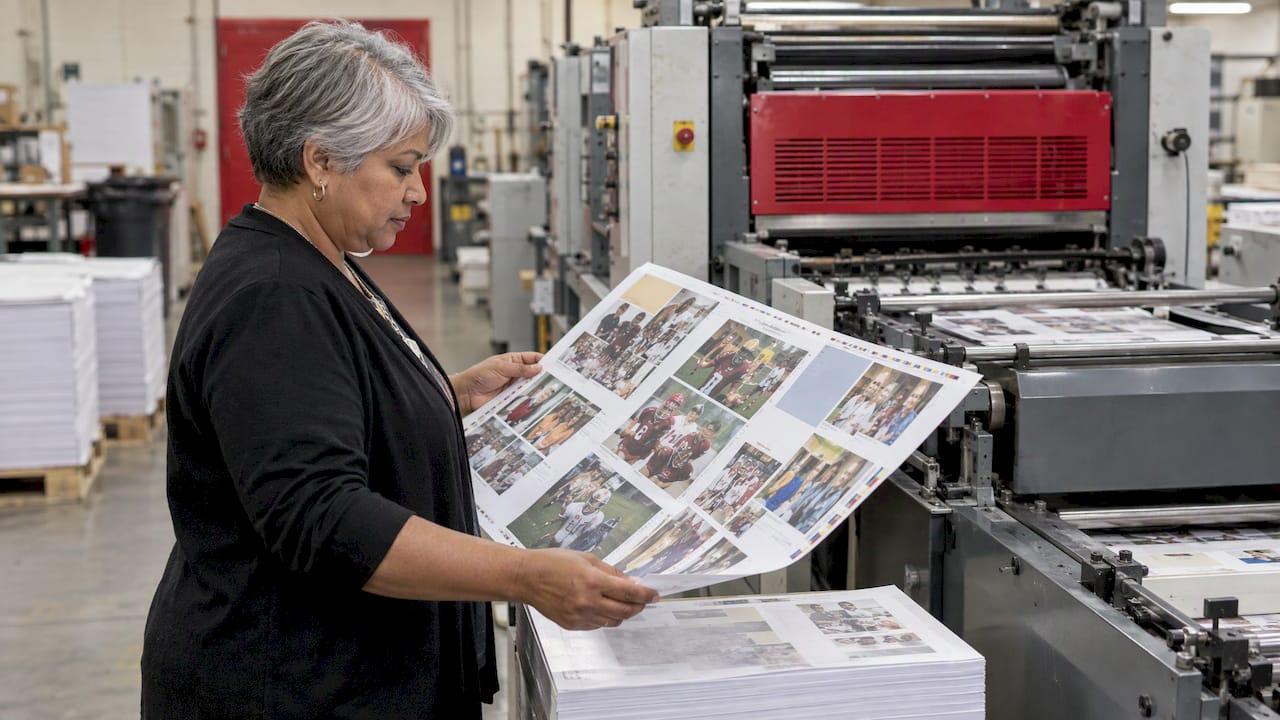
A yearbook press check is a final review of actual printed sheets, pulled once the job is running on the press and before the full production run continues. It is the one moment when you judge color, registration and paper as they really look, not as they look on a screen. This guide explains what a press check covers, who should approve it, what to bring, what to look for, and how to get the same protection when you never set foot in a pressroom.
TL;DR
- A press check happens after your final proof sign-off and before the full run. It is for color, print quality and paper, not for rewriting pages.
- Typos, caption errors and layout fixes belong in proofing. Changing them on press can mean stopping the run, and that costs money and time.
- Bring your approved proofs, your specs sheet, color references and a way to mark and sign sheets.
- Many schools cannot travel to a printer. A printed proof book gives you a physical check of the real thing before production.
- Name one approver at your school and put every correction in writing, with page number, location and the exact fix.
Table of Contents
- What a yearbook press check actually is
- When a press check happens in the yearbook timeline
- Who should attend and who should approve
- How to prepare
- What to inspect on the press sheet
- How to record and communicate corrections
- What to do if you find a significant error
- If you cannot attend a press check
- Our perspective
- Get a physical look before the full run
- A simple press check plan for advisers
- FAQ
- Sources
What a yearbook press check actually is
Printing a yearbook is a chain of approvals. You approve page layouts, then proofs, then the printer sets up the job on press. A press check sits at the end of that chain. According to a commercial printing guide, it is a review of sheets pulled during setup, under production conditions a digital proof cannot fully reproduce.
The purpose is narrow. The Washington State Department of Enterprise Services says a press check gives you the chance to approve overall color, ink coverage and other print quality issues as the job comes off the press. That is a quality gate, not an editing session.
The term trips people up online. If you search it, most results are about firearms. In printing, it has nothing to do with that: it means standing at the press, or reviewing a pulled sheet, and deciding whether the ink on paper matches what you approved.
Press check versus digital proof
A digital proof, sometimes called a soft proof, is a PDF or image of your pages. It is excellent for confirming that fonts did not change, nothing reflowed and every photo is in place. It is a poor judge of color: screens typically show colors lighter or brighter than paper does, according to D Media's proofing guide.
A physical review fills that gap. In practice the split looks like this:
| Check | Best tool | What it catches |
|---|---|---|
| Page order, captions, names, spelling | PDF proof | Content errors |
| Image placement, bleeds, fonts | PDF proof | Layout errors |
| Color, paper feel, finish | Printed proof or press sheet | Appearance errors |
| Ink consistency, registration, flaws | Press sheet | Production errors |
If you want the full workflow for the digital side, our guide to soft proofs versus hard proofs walks through it step by step.
When a press check happens in the yearbook timeline
The order matters because it decides what you can still change.
- Pages are finished and proofread by your staff and a second set of eyes.
- Proofs are approved in writing by the person your school has designated.
- The job is set up on press. This is the moment a press check, if you do one, takes place.
- The full run continues, followed by binding, packing and shipping.
One published example shows how formal the approval chain can be. A Kentucky school district's yearbook specifications state that the yearbook sponsor approves all proofs before the book is assembled. In most schools, the adviser is that person.
A press check can be short or long. One printer describes it as anywhere from about an hour to eight hours in total across several days, depending on page count and the number of press runs, according to Print Prologue. A typical school book on a normal schedule is far from a marathon, but plan for waiting, because press time is not yours to hold up.
Who should attend and who should approve
Keep the group small. A press check works when one person has authority to say yes.
- The adviser is the natural reviewer. They know the approved proofs and the color expectations.
- A second reviewer, such as a design lead or a colleague with a good eye for color, helps if you are on site. Two opinions are useful, but only one signature counts.
- The administrator is the person with purchasing authority. Decide in advance whether the adviser can sign off alone or whether the administrator must be reachable by phone.
Students are valuable at the proofing stage. At a press check, the pressroom is a loud, fast environment, and decisions have to be made quickly. Most schools keep it to adults.
Write down, before the job starts, who approves, who is the backup and how to reach them. Delays happen when a printed sheet is ready and nobody can say yes.
How to prepare
Preparation is where press checks succeed or fail. Gather these items ahead of time, drawing on checklists such as this one from Prepressure:
- The final approved proof, the latest revision, not an earlier one sitting in your email.
- Your specs sheet, with trim size, page count, binding, paper and cover finish.
- Color references, such as a swatch book if you rely on specific spot colors, and printed samples of anything that must match, like a school color on the cover.
- A loupe or magnifier for registration and small type.
- A pen, sticky flags and a way to date and sign.
- A list of what you are checking, so that you do not get distracted by what you cannot change.
Also arrive on time. A press that is waiting for you is money burning, and the printer will not have much patience for it.
Do your proofreading first
The most important preparation happens weeks earlier. Press check guidance is consistent on one point: it is too late at this stage to raise typos or layout issues, and there are limits to the major color changes a press operator can make, according to Prepressure. A typo found on press can mean canceling a run or remaking plates, as Print Prologue points out.
If you want a refresher on catching errors before they get this far, see our guides to the yearbook proofing process and handling printing proofs.
What to inspect on the press sheet
Work through the sheet in passes. Looking for everything at once is how things get missed. Based on the state print guidance, cover these areas.
Paper
Confirm the stock matches your specification: finish, color and weight. Paper changes how photos look, so a proof printed on different stock will not match exactly. Our overview of yearbook paper options explains the choices so you know what you ordered.
Color
- Compare images with your approved proof, remembering the proof is a close approximation and not a twin.
- Check solid colors, school colors especially, against your swatch or reference.
- Look at skin tones in group photos. They are the first thing parents notice.
- Check that ink density looks consistent across the sheet, not heavy on one side and light on the other.
Registration
In four-color printing, the cyan, magenta, yellow and black plates must land in the same spot. Check small text and fine lines with a loupe. Color fringes or a blurry look usually mean registration is off.
Content and flaws
- Confirm any last corrections you requested actually appear.
- Look for scratches, stray marks, broken type, specks or missing elements.
- Check page numbers and folios on the sheet you can see.
Trim, bleed and binding
If you can, fold a few pulled sheets into a dummy to check alignment and creep, the way the pages shift toward the outer edge as they fold. Confirm that photos near the edge have bleed and that nothing important sits too close to the trim. Photo problems often start earlier, so our list of common yearbook photo quality issues is worth a skim before you build pages.

How to record and communicate corrections
Press checks move fast, and verbal comments get lost. Use a simple discipline:
- Mark the sheets. Number and time each pull so you know which one you reviewed.
- Be specific. For every issue, give the page, the location on the page and what you want changed or fixed.
- Talk to one person. Raise concerns with the press supervisor, not with whoever is closest.
- Recheck. Ask to see a later sheet to confirm a flaw was cleaned up and nothing new appeared.
- Sign and date. Approve the final sheet in writing, with time and signature.
A published checklist from a print shop also suggests limiting the number of color adjustments you ask for and marking one key area to focus on, so the operator knows what to match, as described in this press check checklist.
What to do if you find a significant error
Stay calm and collect facts. Notify the press supervisor right away, mark and circle the flaw, and ask to see an earlier sheet to learn whether the problem has been present since the start.
Then weigh the choice. Stopping the run is possible, but it costs money and delays delivery. Before you insist, understand who pays and what the delay does to your delivery date, a point raised in Prepressure's press check guide.
A few practical rules:
- Decide whether the error is a content mistake or a quality issue. Content mistakes you approved in proofing are your responsibility. Quality issues versus the approved proof are a conversation with the printer.
- Keep your approved files, proof records and photos of the problem. If there is a dispute later, evidence settles it.
- Take timing seriously. If your book must arrive before an event, build in time for this scenario. Our yearbook printing turnaround guide shows how to plan a calendar with room to spare.
For a broader view of how to prevent surprises, see our risk management checklist and the print quality workflow for avoiding reprints.
If you cannot attend a press check
Most school advisers are teaching, supervising clubs and chasing deadlines. Traveling to a printing plant for a few hours is not realistic for many schools, especially when the printer is in another state.
The good news is that the goal of a press check, seeing the real thing before committing to the full run, can be met another way. A physical proof book gives you the real paper, the real binding and the real color to hold in your hands. You can check it at your desk, show it to your administrator and sign off with a clear record.
Use the same discipline you would on press:
- Compare against your approved digital proof, page by page.
- Check color on photos and school-color elements.
- Flip the pages and feel the paper and cover.
- Send corrections in writing, with page, location and the fix.
That is why we offer printed proof books, litho only, as a two-copy set for $100, shipping included. One copy can stay with you and the other can go to your administrator or a second reviewer.
Our perspective
Advisers tell us the same thing every year: the hard part of a yearbook is not the design, it is the worry at the end. Did we check enough? Will the color look right? Who signs?
We built TrailMark around taking that worry down. Our pricing is instant and all-inclusive, so there are no surprises when the invoice arrives. Our design help is free, and you can build in Canva, InDesign or our online creator, so your staff works in the tool they already know.
Our view is that a review step is only useful if you can actually do it. A printed proof you can hold, shared with the people who need to approve, is a review step a busy adviser can complete. Pair it with one named approver and written corrections, and you have a process that works without a trip to a pressroom.
We have no order deadlines, and our 2 to 3 week turnaround is designed to let you take the time to review properly, not rush a signature.
Jace
Get a physical look before the full run
If you are planning this year's book, start with your numbers. You can see all-inclusive pricing instantly online, with no signup and no sales pitch. Binding, cover and add-on prices are published on our printing and options page: perfect bound soft cover is $1.60 per book, 150 point board hard cover is $1.50 per book, and Smyth sewn binding is $2.00 per book.
We also offer free design assistance, a dedicated adviser and optional full-service design. Want to see how it all fits together? Visit TrailMark Yearbooks and get your school's price in minutes. If you are still working out how many books to order, our quantity ordering checklist helps you land on a number.
A simple press check plan for advisers
Put it all together on one page you can reuse every year.
Four weeks before files go to print
- Name your approver and a backup.
- Finish proofreading with at least two people who did not build the pages.
- Confirm specs: trim, page count, binding, paper and cover finish.
One week before
- Gather final proofs, specs sheet and color references.
- Decide whether you will review in person or with a printed proof.
- Tell your administrator when a signature will be needed.
On review day
- Check paper, color, registration, flaws and last corrections in separate passes.
- Mark every issue with page, location and fix.
- Sign and date the approval, and save a copy.
After approval
- Keep records until books are delivered and checked.
- Note what you would change next year while it is fresh.
One closing habit: when books arrive, spot-check a few before distribution. If something is wrong, you will have your records to hand.
FAQ
Is a press check required for a school yearbook?
No. It is an optional last-chance review of color and print quality, offered by printers for those who want to see sheets as they come off the press. Many schools get the same assurance from a printed proof reviewed carefully before the full run.
Can I fix typos at a press check?
It is far too late. Text errors should be caught in proofing, because changing them on press can require stopping the run or remaking plates, which adds cost and delay. Use the press check for color, registration and print flaws.
Who should sign off on the final sheet?
The person your school has designated, usually the yearbook adviser, sometimes with administrator approval. Agree on this before the job starts, and sign with the date and time so that the record is clear.
How long does a press check take?
It depends on the page count and the number of press runs. One printer says it can run from about an hour to as long as eight hours over multiple days, according to Print Prologue. Ask your printer what to expect for your book.
What is the difference between a printed proof and a press check?
A printed proof is a sample of your book produced for review. A press check is a review of sheets pulled from the actual production run as it is being set up. Both give you something physical to judge before the full run is finished.
Sources
- The Essential Press Check Guide
- How to Perform a Press Check, Washington State Department of Enterprise Services
- Print Proof and Prepress Proofing: Client Questions Answered
- School Yearbooks and Memory Books bid specifications
- Proof and Press Checks, Print Prologue
- Press check overview and checklist, Prepressure
- Checklist for Press Checking Like a Pro