
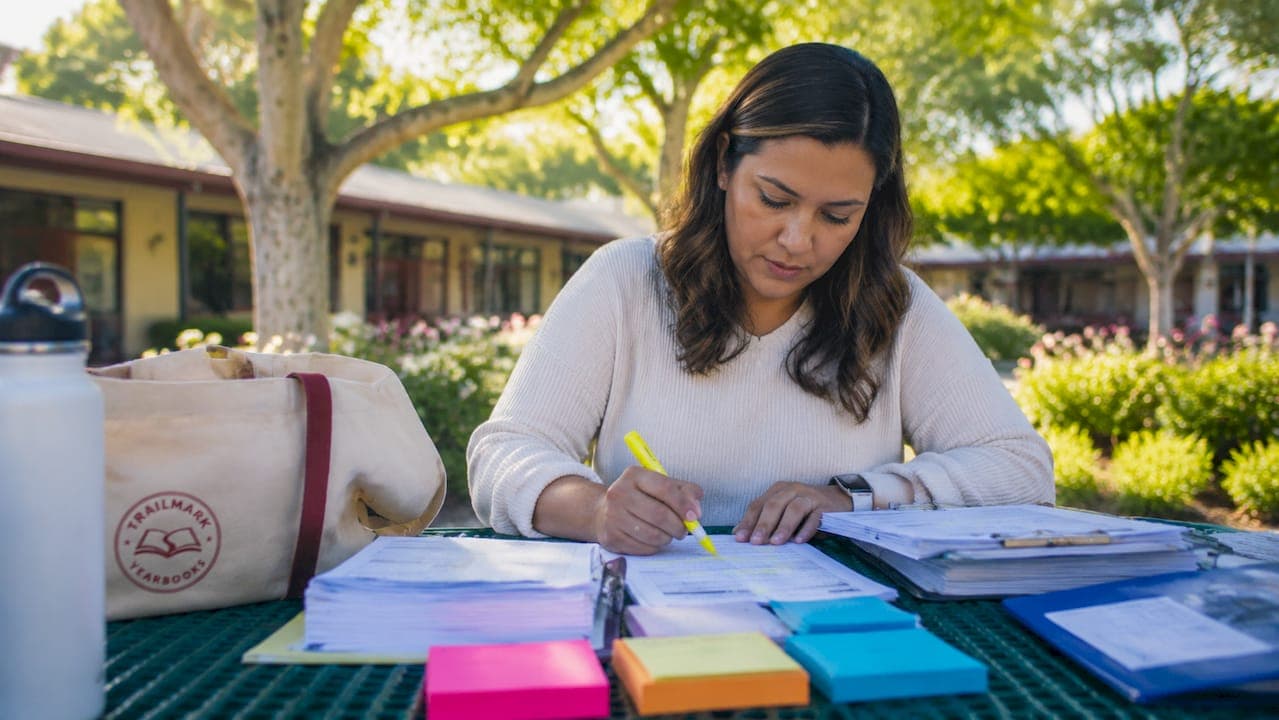
A school yearbook quantity ordering checklist is the single most reliable tool for matching your print run to actual student demand without blowing your budget. Most advisers who order too many books end up absorbing the cost themselves or leaving boxes in a storage room for years. Most who order too few face angry students and parents on distribution day. The right checklist eliminates both problems by walking you through pre-sale data, school size, printing specs, and surplus planning before you commit to a single copy.
1. Use this school yearbook quantity ordering checklist as your starting framework
A yearbook quantity ordering checklist is a structured decision guide that covers every variable affecting how many books you should print. It replaces guesswork with a repeatable process built on enrollment data, pre-sale results, and cost modeling. Advisers at Jostens, Treering, and Yearbook Avenue all recommend starting with a checklist before contacting any printer. The checklist format keeps you from skipping steps under deadline pressure.

2. Run a pre-sale campaign before setting your print quantity
Pre-sale ordering is the most effective method for quantifying demand before printing begins. It forces students and families to commit financially, which gives you a hard number to build your order around. Without pre-sale data, you are estimating based on last year's sales or gut instinct. Both are unreliable.
A well-run pre-sale campaign follows these steps:
- Set a firm pre-sale deadline at least 8–10 weeks before your print submission date.
- Announce the campaign through school email, social media, and morning announcements.
- Offer an early bird discount to drive urgency. A lower price for the first two to three weeks consistently increases sign-up rates.
- Use a platform like Treering to automate payment collection and track orders in real time. Treering automates sales data collection, reducing human error and giving you a live order count.
- Send reminder notices at the two-week and one-week marks before the deadline closes.
- After the deadline, add a small buffer for late or missed orders before finalizing your quantity.
Pro Tip: Set your pre-sale price at least $5–$10 below your post-sale price. The price gap is the single strongest motivator for early purchases.
3. Account for surplus copies beyond your pre-sale number
Schools routinely order extra yearbooks beyond pre-sale totals to cover the library, staff, alumni, and last-minute walk-up sales. Extra copies are standard practice, but the quantity needs careful thought. Ordering too many extras ties up budget. Ordering too few leaves stakeholders without books.
Common recipients of surplus copies include:
- School library: One to two archival copies per year is standard.
- Principal and administrative staff: Budget two to five copies depending on school size.
- Alumni or graduating class parents: Demand varies but is predictable if you track it year over year.
- Last-minute student sales: Add 5–10% above your pre-sale total as a reasonable buffer.
- Replacement copies: Damaged or lost books during distribution require a small reserve.
Track your unsold surplus after distribution every year. If you consistently have 20 books left over, reduce your buffer next cycle. If you sell out within a week, increase it.
Pro Tip: Keep a simple spreadsheet logging surplus copies ordered versus sold for the past three years. That trend line is more accurate than any formula.
4. Factor in school size and enrollment when setting your quantity
School size directly determines your realistic order range and your per-unit cost. Yearbook production costs vary by quantity, and larger orders consistently produce lower per-unit prices. A school ordering 1,000 copies pays far less per book than one ordering 75.
| School size | Typical order range | Estimated total cost |
|---|---|---|
| Small (under 300 students) | 50–100 copies | $500–$5,000 |
| Medium (300–800 students) | 200–500 copies | $3,000–$15,000 |
| Large (800+ students) | 1,000+ copies | $10,000–$50,000+ |
These ranges reflect real cost brackets, not theoretical estimates. A medium school ordering 200 copies pays significantly more per book than one ordering 500. That difference compounds quickly across a multi-year budget.
Pull your current enrollment figures from your school's student information system. Compare them against last year's sales rate, which is the percentage of enrolled students who actually bought a yearbook. Multiply enrollment by that rate to get your demand baseline. Adjust for any known enrollment changes, such as a new grade level or a school merger.
For a deeper look at how school size shapes your pricing, the yearbook pricing guide from Trailmarkyearbooks breaks down cost brackets by enrollment tier.
5. Understand minimum order requirements and print-on-demand options
Most yearbook providers set a minimum order near 40 copies. That threshold exists because offset printing requires setup costs that make very small runs economically unviable for the printer. Schools with very small enrollments or clubs with limited membership should know this number before planning.
Print-on-demand services remove the minimum order constraint entirely. Some providers offer print-on-demand starting as low as $3.27 per book with no minimums. The trade-off is a higher per-unit cost compared to bulk offset printing. Print-on-demand works well for supplemental orders after your main run sells out, but it is not cost-effective as your primary production method for most schools.
The right approach depends on your enrollment. Schools with fewer than 40 likely buyers should explore print-on-demand. Schools above that threshold should commit to a standard bulk order and use pre-sale data to set the quantity.
6. Optimize page count to avoid wasted printing costs
Page count optimization is one of the least discussed but most impactful cost controls in yearbook printing. Printers charge equally for certain page ranges because of how printing plates work. Jumping from 30 pages to 31 pages costs the same as jumping to 32 pages. Planning your layout to land on multiples of 4 or 16 pages avoids paying for unused plate capacity.
Advisers who ignore this end up with "orphaned" pages. An orphaned page is a single page that pushes you into the next pricing tier without filling it. The fix is simple: design your content to fill complete plate sets. If you are at 29 pages, add one more page of content rather than submitting at 30 and paying for 32 anyway.
Review your page count before submission and confirm it aligns with your printer's plate structure. Ask your printer directly what the pricing breakpoints are. That one question can save your school real money.
7. Choose printing specifications that match your budget
Printing specifications affect both your per-unit cost and the total number of copies you can afford to order. Full-color printing on every interior page increases costs substantially compared to a full-color cover with black-and-white interior pages. The cost-effective standard for most schools is a full-color cover with selective color use inside.
Softcover binding costs less than hardcover. For schools on a tight budget, softcover with a full-color cover and limited black-and-white interior is the standard formula that keeps prices competitive without sacrificing quality. Hardcover adds perceived value but reduces the number of copies you can afford at the same budget.
Pro Tip: If your budget is fixed, calculate your per-unit cost at your target quantity with softcover and black-and-white interior first. Then see how many additional copies that savings buys you. More books in students' hands often matters more than a hardcover binding.
8. Lock in your deadline and communicate it clearly
Print deadlines are fixed once your order is submitted. Missing a deadline does not just delay your yearbook. It locks your quantity at whatever number you submitted, with no ability to add or remove copies. Advisers who miss deadlines often face either a shortage or a surplus they cannot correct.
Set your internal deadline at least one week before the printer's actual cutoff. That buffer gives you time to collect final pre-sale payments, confirm your surplus quantity, and review your page count. Communicate the deadline to students, parents, and administrators in writing. A deadline management checklist helps you track every step leading up to submission.
Strict adherence to print deadlines is the difference between a smooth distribution and a crisis. Build the deadline into your school calendar at the start of the year so it never sneaks up on you.
9. Take advantage of bulk ordering discounts
Schools ordering 100 or more yearbooks benefit noticeably from tiered bulk discounts. The per-unit price drops as quantity increases, which means your ordering decision is also a pricing decision. Ordering 150 copies instead of 120 might cost less per book and only marginally more in total.
Run the math at multiple quantity points before finalizing your order. Ask your printer for a tiered price sheet showing cost per unit at 100, 150, 200, and 250 copies. Compare those numbers against your pre-sale total plus your surplus estimate. The optimal quantity is often slightly above your pre-sale number because the bulk discount offsets the cost of the extra copies.
This is where a yearbook budget planning guide becomes useful. Mapping out cost at each quantity tier before you order prevents you from leaving money on the table.
Key takeaways
Accurate yearbook quantity ordering requires pre-sale data, enrollment analysis, and printing specification decisions made together before any order is submitted.
| Point | Details |
|---|---|
| Start with pre-sale data | Base your print quantity on confirmed pre-sale orders, not enrollment estimates alone. |
| Add a calculated surplus | Budget 5–10% above pre-sale totals for library, staff, and last-minute sales. |
| Match quantity to school size | Small schools pay $500–$5,000; large schools $10,000–$50,000+, with lower per-unit costs at scale. |
| Optimize page count | Plan layouts to land on plate multiples to avoid paying for unused printing capacity. |
| Lock deadlines early | Set your internal cutoff one week before the printer's deadline to avoid quantity errors. |
Why I think most advisers overcomplicate yearbook quantity decisions
The most common mistake I see is advisers treating the quantity decision as a math problem when it is really a communication problem. The number of yearbooks you need is not hidden in a formula. It is sitting in your pre-sale data, your enrollment records, and last year's leftover box count. The advisers who get this right are the ones who run a tight pre-sale campaign, track their surplus history, and communicate deadlines relentlessly.
What surprises most people is how much the printing specification decision affects quantity. Choosing softcover over hardcover or black-and-white interior over full color does not just save money on each book. It frees up budget to order more copies, which often matters more to students than the binding type.
In 2026, print-on-demand technology has made it easier than ever to do a small supplemental run after your main order sells out. That option changes the risk calculation. You no longer have to guess high and absorb unsold inventory. Order conservatively based on pre-sale data, then use print-on-demand to fill gaps after distribution. That combination is the most financially sound approach I have seen for schools of any size.
The emotional side of this matters too. Advisers who run out of yearbooks on distribution day face real backlash from students and parents. Advisers who have 50 books left over face questions from administrators about budget management. Getting the quantity right is not just a financial win. It is a credibility win.
— Jace
Trailmarkyearbooks makes quantity decisions easier
Trailmarkyearbooks gives advisers the tools to make confident quantity decisions without a sales pitch or hidden fees. Instant all-inclusive pricing means you can model costs at different quantity tiers in minutes, not days. The 2–3 week turnaround removes the pressure of locking in your order months in advance.
If you are still working out your quantity, request a sample to evaluate print quality before committing to a full run. Trailmarkyearbooks also offers adviser resources including downloadable checklists and templates that walk you through every step of the ordering process. Schools nationwide trust Trailmarkyearbooks because the process is transparent from the first quote to the final delivery.
FAQ
What is a yearbook quantity ordering checklist?
A yearbook quantity ordering checklist is a structured guide that helps advisers determine the correct number of yearbooks to print by working through pre-sale data, enrollment figures, surplus needs, and printing specifications before submitting an order.
How many extra yearbooks should a school order beyond pre-sale?
Most schools add 5–10% above their pre-sale total to cover the library, staff, alumni, and last-minute student purchases. Track your unsold surplus each year to refine that buffer over time.
What is the minimum order quantity for school yearbooks?
Most yearbook providers require a minimum order of around 40 copies. Schools with fewer than 40 buyers can use print-on-demand services, which have no minimums but carry a higher per-unit cost.
How does school size affect yearbook order quantity and cost?
Small schools ordering 50–100 copies typically spend $500–$5,000 total, while large schools ordering 1,000 or more copies can spend $10,000–$50,000 or more. Larger orders produce lower per-unit costs through bulk pricing tiers.
What happens if you miss the yearbook print deadline?
Once a print deadline passes, your quantity is locked and cannot be adjusted. Missing the deadline removes your ability to add or remove copies, which can result in a shortage or unsellable surplus with no correction available.