
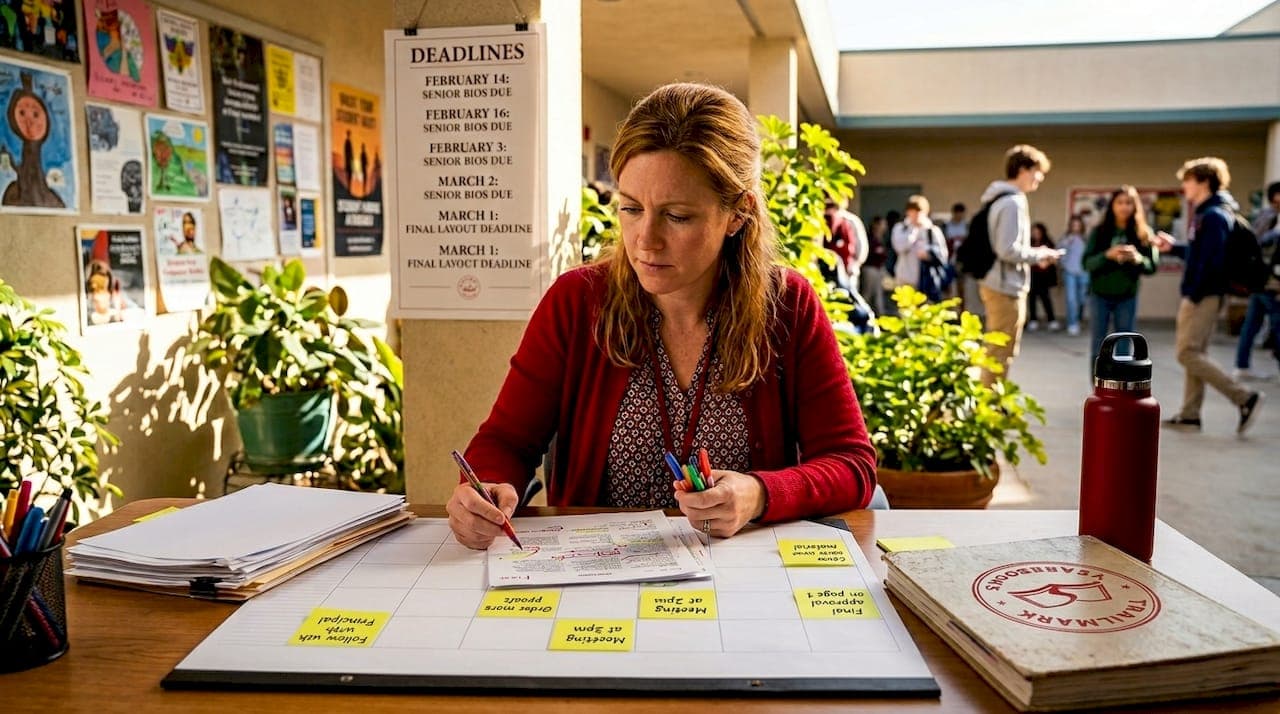
Most educators stepping into a yearbook adviser role assume the job is mostly about approving photo layouts and making sure the cover looks good. That assumption fades fast. Yearbook adviser responsibilities explained properly reveal a role that touches leadership development, financial planning, editorial governance, student training, and compliance review, all running simultaneously across an entire school year. This guide breaks down every core duty so you know exactly what the role demands and how to manage it without burning out.
Table of Contents
- Key takeaways
- Yearbook adviser responsibilities explained: the full scope
- Managing student leadership and course integration
- Budgeting, sales, and marketing responsibilities
- Daily workflow, check-ins, and quality control
- My honest take on governance vs. student freedom
- How Trailmarkyearbooks supports advisers like you
- FAQ
Key takeaways
| Point | Details |
|---|---|
| Governance before production | Advisers hold final approval authority to verify policy compliance before any page goes to print. |
| Phased deadlines prevent chaos | Structuring submissions in phases distributes student workload and prevents last-minute scrambles. |
| Budgeting is a real duty | Advisers review prior sales data, set ad revenue goals, and plan for cost gaps every year. |
| Student contracts formalize roles | Multi-year programs require signed contracts that clarify escalating responsibilities for students and parents. |
| Training pays long-term dividends | Early-year workshops on writing, photography, and design reduce adviser corrections throughout production. |
Yearbook adviser responsibilities explained: the full scope
The job does not begin when students start designing pages. It begins months earlier, when the adviser maps out the entire production calendar. Phased page submissions with detailed coverage calendars are the backbone of an organized yearbook program. Openers and ads go first, bulk editorial content follows in the middle phase, and spring sports plus index pages close out the sequence. This structure is not optional. It is what separates teams that finish on time from teams that scramble through April.
Here is how a well-functioning adviser manages the core responsibilities across the year:
- Establish the production timeline. Map every submission phase to a calendar date before the school year begins. Build buffer weeks around high-pressure academic periods like midterms.
- Coordinate student roles and training. Assign section editors, a photographer lead, and a copy editor. Host an early training workshop covering writing, photography, and design basics tied to that year's theme.
- Develop the theme and content plan. Work with the editor-in-chief to establish a visual and narrative direction before any page design begins. This prevents mid-year pivots that waste hours of student work.
- Monitor phased submissions. Review completed pages at each deadline, not just at the end. Catching design inconsistencies or caption errors in phase one costs far less time than fixing them in the final review.
- Conduct final approval. Before the yearbook goes to the printer, the adviser performs a comprehensive content review that checks for policy compliance, factual accuracy, and editorial quality. This is the last line of defense.
Pro Tip: Build your deadline calendar backward from your printer's submission date. If you need to submit by March 15, your final adviser review should be complete by March 8, with student corrections finished by March 5. This removes the anxiety of last-minute printing rushes.
The yearbook deadline management checklist developed for advisers is a practical starting point for building this kind of phased calendar without starting from scratch.
Managing student leadership and course integration
One of the most underestimated parts of the role of a yearbook adviser is managing the human side of the program. Students are not just completing assignments. They are operating a publication, and many of them are doing it for the first time.
Structuring leadership clearly from day one makes everything else easier. Most programs use a hierarchy that looks like this:
- Editor-in-chief: Sets direction, mediates creative disagreements, and communicates directly with the adviser on major decisions.
- Section editors: Own specific coverage areas (academics, clubs, sports, portraits) and are responsible for their team's deadlines.
- Staff photographers: Work from a shoot schedule and submit images through a shared system the adviser has access to.
- Copy editors: Review captions, headlines, and student-written content before it reaches the adviser.
When yearbook operates as a multi-year course, the role of the yearbook adviser expands into formal academic management. Multi-year yearbook courses require advisers to manage student contracts and set expectations for significant out-of-class responsibilities. These contracts are signed by the student, the adviser, and a parent or guardian, and they formalize expectations around attendance at events, meeting deadlines, and behavior as a representative of the publication.
"Treating student contracts as genuine professional agreements, not just classroom paperwork, changes how students perceive their role. They stop thinking like students completing an assignment and start thinking like staff members responsible for a product."
Balancing student autonomy with adviser oversight is a continuous calibration. Give students too little room, and the program stifles creativity while burning out the adviser. Give them too much, and quality suffers. The practical answer is graded independence. Early in the year, the adviser reviews everything closely. By spring, experienced returners handle most decisions independently, and the adviser shifts to a quality-control role.
Good yearbook photography checklists for student coordinators are one example of how you can delegate responsibility clearly without losing oversight.

Budgeting, sales, and marketing responsibilities
This is the part of the yearbook adviser role most schools fail to prepare new advisers for. You are not just an educator. You are managing a small publications budget, and decisions made in September affect whether the yearbook breaks even in May.
The table below shows where advisers typically spend their financial attention across the year:
| Budget area | Adviser's responsibility | Timing |
|---|---|---|
| Printing costs | Review prior year vendor pricing; negotiate with rep | August to September |
| Yearbook sales | Set per-copy price based on print volume projections | September |
| Ad sales | Recruit local businesses and families; set rate card | September to November |
| Event photography costs | Budget for contracted photographers or equipment needs | October |
| Deficit planning | Identify gap between projected income and total costs | November |
Reviewing past year sales, ad revenue, and expenses is how advisers build a realistic budget for printing and events each cycle. This is not guesswork. Advisers pull actual numbers from prior years, adjust for enrollment changes and price increases, and set income targets accordingly.
Ad sales deserve special attention because they are both a revenue source and a student learning opportunity. Students can manage outreach to local businesses, but the adviser approves pricing, reviews ad copy, and handles any disputes. Families also purchase personal ads and senior tributes, which often require an adviser-managed submission portal or deadline enforcement.
Pro Tip: If projected yearbook sales income falls short of printing costs, explore offering early-bird pricing in August. A modest discount drives front-loaded sales that improve your financial position before production costs hit.
Daily workflow, check-ins, and quality control
Once production is underway, the role of adviser feedback in yearbook quality becomes the defining factor in whether the final product reflects the school well or falls short. An adviser who waits until deadline day to review pages will spend far more time on corrections than one who builds feedback into the weekly rhythm.
Effective yearbook teams hold daily brief meetings during production periods to stay aligned. These do not need to be long. A ten-minute check-in at the start of class where each section editor reports their progress against the weekly milestone is enough. The adviser uses this time to spot bottlenecks before they become crises.
Beyond daily check-ins, periodic quality control checkpoints are non-negotiable:
- Draft review after phase one: Adviser reviews all submitted pages for consistency in fonts, margins, color usage, and caption style.
- Content accuracy pass: Every name, grade, and caption fact gets verified before any page locks for submission.
- Policy compliance review: Content is checked against school handbook policies covering image standards, language, and representation.
- Final proof read: Even after student editors have reviewed content, the adviser completes a cover-to-cover read of the final proof before approving production.
The adviser's final approval step is the governance moment where the yearbook is confirmed to meet school policy and community standards before it goes to print. This is not a formality. It is where advisers catch the caption that uses a wrong surname, the photo that violates an image policy, or the spread that accidentally omits an entire club. The role of adviser in yearbook approval is, in practice, the last and most consequential quality check in the entire process.
The role of the principal in yearbook approval varies by school. Some principals review sensitive content or thematic decisions. Others delegate the entire approval authority to the adviser. Either way, the adviser is expected to have already cleared the content before it reaches administration.
My honest take on governance vs. student freedom
I have watched advisers at both extremes, and neither works. The adviser who signs off on everything without really looking is not protecting students. They are leaving the school exposed to content problems that surface only after 500 copies are distributed. The adviser who controls every creative decision produces a technically correct yearbook that students are not proud of, and the program loses talented staff every year.
What I have found actually works is treating adviser final approval as a governance safeguard, not a creative override. Students make the editorial choices. The adviser verifies those choices meet legal, ethical, and school policy requirements. Those are different jobs, and keeping them separate changes the dynamic completely.
The multi-year progression model is genuinely powerful when the adviser treats student contracts as real professional agreements. Students who return for a second or third year arrive with skills and expectations already calibrated. That investment compounds. The first-year class struggles; the third-year class leads. The adviser's role shifts from instructor to editor-in-chief coach, which is a much more sustainable place to be.
The burnout risk is real. Most advisers who leave the role report that managing everything alone was the breaking point, not the work itself. Build a structure where students carry genuine responsibility for their domains and the adviser holds the governance and mentorship role. That distribution makes the position manageable and, honestly, more rewarding.
— Jace
How Trailmarkyearbooks supports advisers like you
Running a yearbook program is a demanding job, and the production side should not add to that pressure. Trailmarkyearbooks was built specifically to make the production process easier for school advisers, with transparent pricing, no hidden fees, and a 2 to 3 week turnaround that gives you real scheduling flexibility.

Advisers working with Trailmarkyearbooks get access to free design assistance, flexible design tools including Canva, InDesign, and an online design platform built for school workflows. The adviser resources hub brings together guides, checklists, and production tools in one place. If you want to see the quality before committing, you can request a physical sample with no sales pressure attached. Or connect directly with a TrailMark representative to talk through your school's specific needs. Trailmarkyearbooks works with elementary, middle, and high schools nationwide and backs every project with 50-plus years of combined experience.
FAQ
What does a yearbook adviser actually do?
A yearbook adviser manages the full production process including planning timelines, training students, overseeing budgets, reviewing content, and giving final approval before the yearbook goes to print. The role combines editorial supervision with administrative and financial responsibilities.
What is the adviser's role in yearbook approval?
The adviser conducts a comprehensive final review covering content accuracy, policy compliance, and editorial quality before production submission. This approval step is a governance checkpoint, not just a creative sign-off.
What is the role of the principal in yearbook approval?
The principal's involvement varies by school. Some principals review thematic or sensitive content decisions, while others delegate full approval authority to the adviser. In most cases, the adviser clears all content before it reaches administration.
How do student contracts work in multi-year yearbook programs?
In programs with Yearbook II, III, or IV courses, students sign contracts with the adviser and a parent or guardian that formalize out-of-class responsibilities, leadership expectations, and conduct standards tied to escalating roles.
How can advisers avoid burnout in the yearbook role?
Advisers reduce burnout by building a clear leadership structure where students carry genuine responsibility for their sections, using phased deadlines to distribute workload, and reserving their own focus for governance, mentorship, and final approval.