
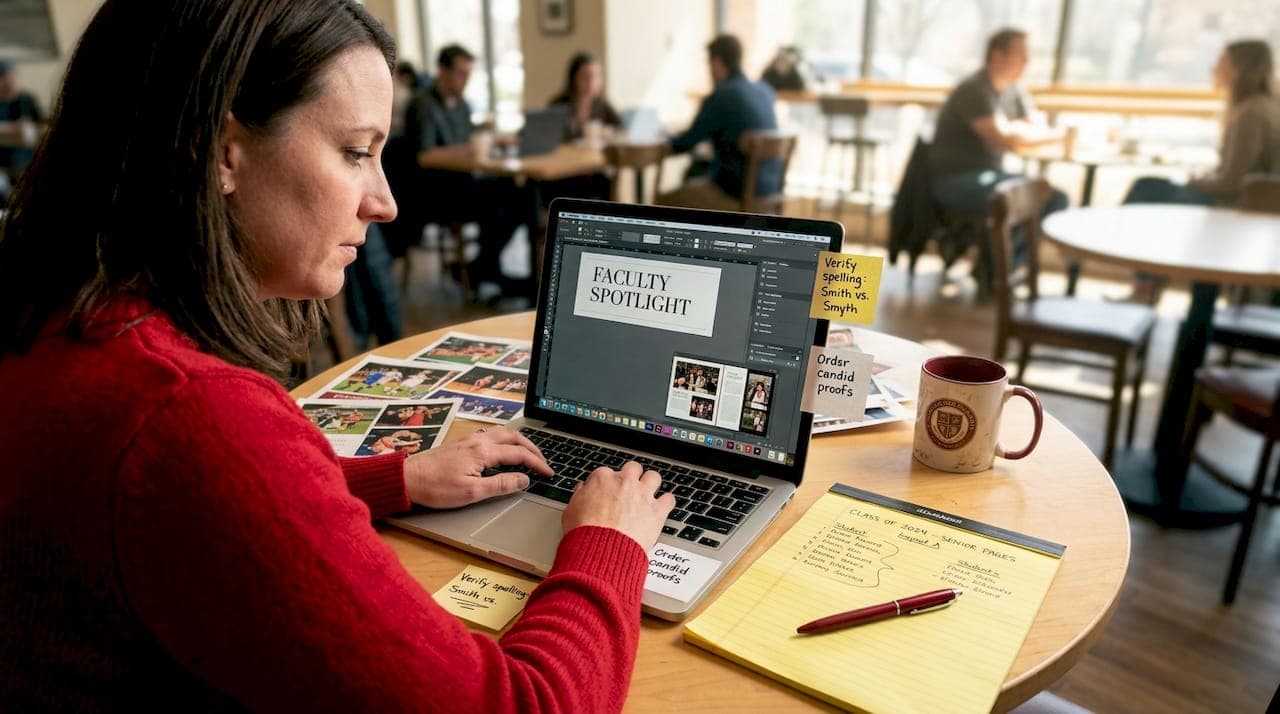
Every yearbook adviser knows the feeling: you're staring at a blank caption field, a stack of event photos, and a deadline that's closer than it should be. The copy has to be accurate, engaging, and personal enough that students will actually want to read it. Getting those three things right at the same time is where most yearbooks fall short. This guide covers proven yearbook copy writing techniques, from pre-writing organization to personalization strategies, so you can build a book that students keep for decades, not just flip through once.
Table of Contents
- Preparing to write compelling yearbook copy
- Step-by-step techniques for writing engaging captions and feature stories
- Proofreading and verifying your yearbook copy for accuracy and professionalism
- Personalizing yearbook copy to make the book truly theirs
- The overlooked power of fresh eyes in yearbook copywriting success
- How TrailMark Yearbooks supports your yearbook copywriting journey
- Frequently asked questions
Key Takeaways
| Point | Details |
|---|---|
| Organize thoroughly | Gather and sort all materials early to streamline writing and avoid mistakes. |
| Use proven writing formulas | Apply structured caption and story techniques to engage readers effectively. |
| Proofread rigorously | Multiple reviewers and physical printouts catch errors digital proofs miss. |
| Personalize by age | Tailor interactive elements to student developmental levels for meaningful connection. |
| Fresh eyes matter | Inviting new proofreaders reduces oversight and improves quality before printing. |
Preparing to write compelling yearbook copy
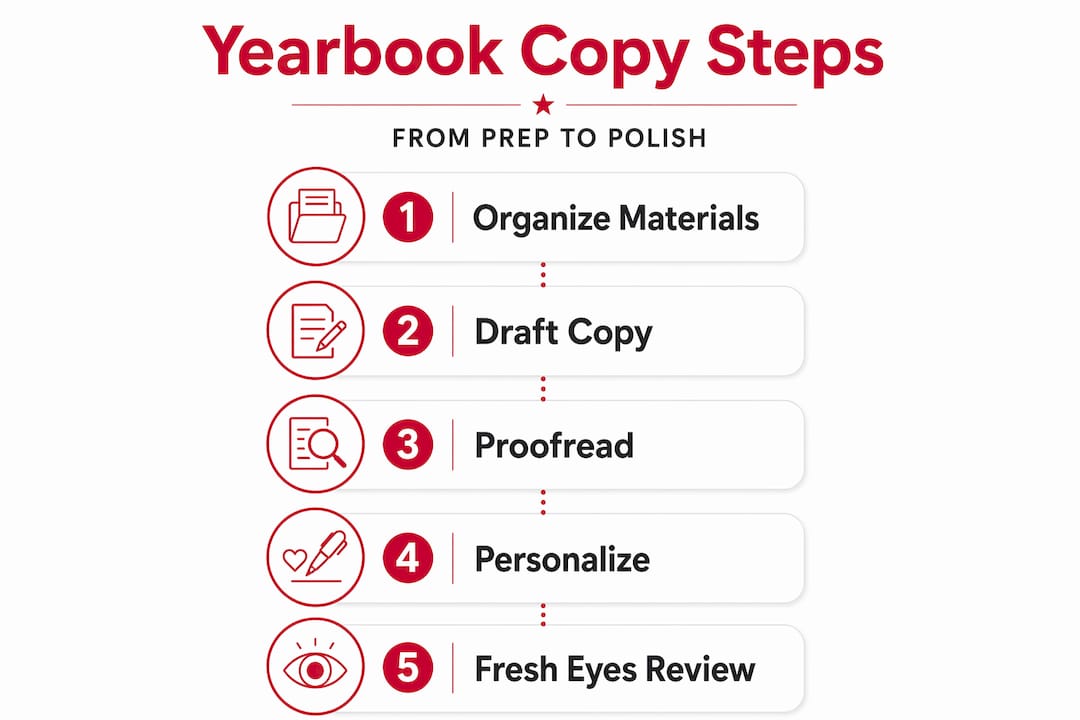
Before a single word goes on the page, the quality of your copy is already being decided. Advisers who skip the preparation phase end up chasing corrections at the worst possible time, right before print.
Start by gathering every resource you'll need in one place. That means current photo files organized by event and grade, updated class rosters, official event results (scores, dates, award recipients), club and team sponsor contacts, and at least one previous yearbook for tone and format reference. Disorganized source material is the single biggest cause of name misspellings and factual errors in finished yearbooks.
One of the best yearbook writing tips is to organize materials by grade level and event category from day one. Create clearly labeled folders, whether digital or physical, so student editors can pull information quickly without guessing. When copy writers have to hunt for a name or a date, they improvise. That's when errors happen.
Best practices for yearbook copy in 2026 require printing physical copies for review, cross-checking names against grade rosters (K-12), and fact-checking scores and dates with at least three staffers minimum. Build that expectation into your workflow from the start, not as an afterthought.
Key preparation tasks before writing begins:
- Collect updated class and activity rosters from the registrar or office
- Organize photos by event, date, and grade level
- Confirm photo permissions are on file for all students
- Identify quote sources and schedule brief interviews early
- Pull official results for sports, academic competitions, and performances
- Review previous yearbooks to establish consistent tone and style
Preparation checklist table:
| Item | Source | Who verifies |
|---|---|---|
| Student name lists | School registrar | Adviser + editor |
| Event dates and results | Coaches, sponsors | Fact-checking editor |
| Photo permissions | Office files | Adviser |
| Quote approvals | Student interviewees | Copy editor |
| Previous yearbook files | Archive | Design lead |
Pro Tip: Before your staff begins writing, consider requesting a yearbook sample to study how professional layouts integrate copy with design. Seeing real examples helps student editors understand how much space copy actually occupies on a spread, which shapes how they write it.
Age-appropriate personalization starts here too. What works for a fifth grader is not what works for a junior in high school. Review high school yearbook tips alongside your elementary and middle school planning to tailor your approach from the beginning.
With your materials and organization in place, you're ready to begin writing copy that brings your yearbook to life.
Step-by-step techniques for writing engaging captions and feature stories
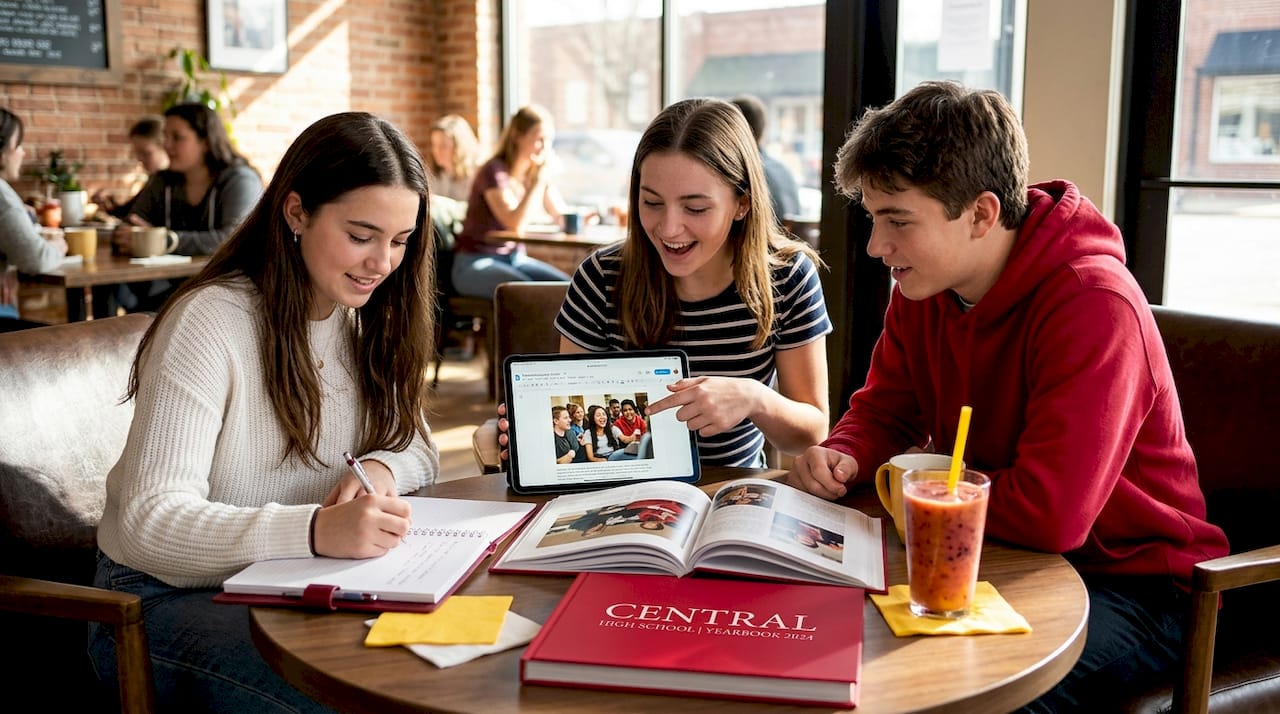
Captions are the most-read text in any yearbook. Not the feature stories, not the editor's note. The captions. That fact alone should change how much attention you give them.
Strong captions enhance rather than simply describe visible content, using a formula of name, action, context, and theme connection. That formula sounds simple, but most student-written captions stop at the first two elements. Teaching your staff to complete all four transforms a flat description into a sentence that actually adds meaning.
The four-part caption formula:
- Identification. Name every person visible, left to right or front to back. Never use "a student" or "a player."
- Present-tense action. Describe what is happening in the photo using present tense ("sprints," "accepts," "laughs"), which creates immediacy.
- Context. Add a detail the photo cannot show, such as the final score, the occasion, or what led to the moment.
- Theme connection or quote. Tie the caption to a broader story or include a brief, attributed quote that adds personality.
Keep captions between 20 and 40 words. Anything shorter often skips context. Anything longer loses readers. And never describe what is visually obvious ("Three students stand in front of the school"). That wastes words the reader could use to learn something new.
Common caption mistakes to avoid:
- Starting every caption with a person's name (vary your sentence openings)
- Using past tense instead of present tense
- Including clichés like "having a blast" or "making memories"
- Forgetting to identify every person in the photo
- Using inside jokes that will confuse readers in five years
For longer feature stories, the structure is different but the principle is the same: every sentence should tell the reader something they could not get from the photos alone.
Writing a feature story, step by step:
- Open with a specific scene or moment, not a broad statement about the year
- Introduce your subject with a detail that shows rather than tells
- Include at least two direct quotes from different students or staff
- Provide factual background (dates, numbers, context)
- Close with a forward-looking or reflective line that gives the story weight
Interview students who are not the obvious choices. The team captain gets quoted everywhere. The equipment manager, the student who traveled three hours to every away game, the first-year club member who did not expect to love it, those are the voices that make a yearbook feel real. Diverse voices are one of the most underused yearbook content ideas in school publications.
Pro Tip: Have student editors write three versions of each caption, short, medium, and long, then choose the one that fits the layout. This practice builds writing instincts fast. You can also contact your yearbook rep to ask about copy style guides that match your school's design theme.
After learning how to write compelling copy, it's essential to understand how to avoid common errors and use proofreading techniques to ensure quality.
Proofreading and verifying your yearbook copy for accuracy and professionalism
A misspelled name in a yearbook is not a typo. It is a permanent record of a mistake that follows a student for life. That is the standard you are working to.
Using multiple proofers, a minimum of three sets of eyes including staff and stakeholders, catches errors in names, facts, and formatting that a single reviewer will miss every time.
"Proofing is not just about grammar. It's about accuracy, fairness, and making sure every student in that book is represented correctly. One wrong name can undermine trust in the entire publication." — Julie Faulkner, yearbook adviser and educator
Proofreading stages and responsible parties:
| Stage | Focus area | Who is responsible |
|---|---|---|
| First pass | Spelling, grammar, punctuation | Copy editor |
| Second pass | Name accuracy vs. roster | Adviser or registrar contact |
| Third pass | Dates, scores, titles | Fact-checking editor |
| Fourth pass | Layout, spacing, visual flow | Design editor |
| Final fresh-eyes pass | Everything, cold read | Teacher, parent, or outside staff |
Step-by-step proofreading process:
- Print a physical copy of every spread. Screen reading causes fatigue and the brain auto-corrects errors it recognizes.
- Read captions out loud. Awkward phrasing becomes obvious when spoken.
- Check every name against the most current roster, not last year's list.
- Verify every date, score, and title against an official source, not memory.
- Have a coach, club sponsor, or department head review spreads that cover their area.
- Schedule a final fresh-eyes pass at least three days before your deadline.
Pro Tip: Set up proofreading stations in your classroom with task cards that assign each station a specific focus, names only, dates only, grammar only. Rotating students through stations keeps attention sharp and distributes responsibility. Check yearbook production resources for additional workflow tools that support this kind of structured review.
Once your copy is flawless, consider adding personalized touches to help students connect with the yearbook on a deeper level.
Personalizing yearbook copy to make the book truly theirs
The yearbooks students actually keep are the ones that feel like they belong to them, not just to the school. Personalization is what creates that feeling, and it works differently at every grade level.
Elementary and middle school students benefit most from "About Me" prompts where they fill in favorites, handwriting, and memories. High schoolers prefer signature sections or inserts distributed before graduation. Matching the personalization format to the developmental stage of your students is not optional. It is the difference between a feature students use and one they ignore.
Personalization ideas by grade level:
- Elementary (K-5): "About Me" fill-in pages with favorite subject, food, and what they want to be when they grow up. Include space for a small self-portrait or photo.
- Middle school (6-8): Memory polls ("Best lunch of the year?"), local inside references tied to school culture, and short space for friends to write notes.
- High school (9-12): Full signature pages, autograph inserts, or dedicated "senior shoutout" sections distributed at end-of-year events.
Avoid forcing traditions that do not fit your school's culture. A small rural elementary school and a large urban high school have completely different communities. The best yearbook caption writing tips and personalization ideas are the ones that reflect your actual students, not a template borrowed from another school's approach.
Also think about how copy connects to personalization. When you write about a student by name in a feature story, that student will show that page to their family. When a caption includes a direct quote from a seventh grader, that student reads it ten times. Copy is personalization too.
Pro Tip: Introduce personalization pages at school events like picture day or club sign-ups. When students fill in their "About Me" prompts in person with their friends, participation rates go up significantly. Explore personalization options for high school yearbooks to see how different formats can work within your layout.
With strong, personalized copy complete and verified, you're ready to reflect on important considerations to keep your program thriving.
The overlooked power of fresh eyes in yearbook copywriting success
Here is something most yearbook guides will not tell you directly: the people who have worked hardest on your yearbook are the least qualified to catch its final errors. That is not a criticism. It is brain science.
Fresh eyes from non-design staff catch name mismatches and factual errors that self-review misses because the brain auto-corrects familiar text. When you have read a caption fifteen times, your brain stops reading the words and starts reading what it expects to be there. This is why professional publications use copy editors who had nothing to do with writing the piece.
Most yearbook programs rely entirely on the people who built the book to proof it. That is a structural problem, not a staffing problem. The fix is not working harder. It is bringing in people who are seeing the content for the first time.
Office aides, parent volunteers, teachers from other departments, even a trusted student from a different grade who is not on yearbook staff, all of these people will find things your team missed. They will also ask questions like "Who is this person?" or "What event is this from?" that reveal gaps in your copy that felt obvious to your team because they were there.
The other underrated benefit of outside readers is that they represent your actual audience. Your yearbook is not made for the people who made it. It is made for the whole school. When a parent volunteer cannot figure out what sport is being played in a photo, that is feedback your caption needs more context, not a sign the parent is not paying attention.
Schedule your fresh-eyes pass with enough runway to actually act on what reviewers find. A fresh-eyes review the night before print is theater. A fresh-eyes review five days before deadline is quality control. Request a sample from a professional yearbook provider to see how well-proofed copy reads compared to a first draft. The difference is instructive.
How TrailMark Yearbooks supports your yearbook copywriting journey
Writing great yearbook copy is hard enough without also wrestling with production logistics, pricing surprises, and design software you barely had time to learn.

At TrailMark Yearbooks, we built our process specifically for advisers who are doing this alongside a full teaching load. Our templates are designed so copy integrates cleanly with layouts, which means less reformatting and more time writing. We offer free design assistance, flexible tools including Canva and InDesign, and a 2 to 3 week turnaround with no hidden fees and shipping included. When you are ready to see what a well-produced yearbook actually looks like before you commit, request a sample and evaluate the copy style and layout together. And when you have questions mid-project, our team is one message away. Contact a yearbook representative and get answers from people who have been doing this for decades.
Frequently asked questions
What is the most important step to avoid yearbook copy errors?
Cross-checking every name against the latest roster and involving at least three proofreaders significantly reduces errors. No single reviewer, no matter how careful, catches everything.
How can I make yearbook comments more meaningful for students?
Encourage students to write specific, full-name comments and avoid inside jokes or generic phrases that will not age well. Thoughtful, named comments create lasting memories far better than a two-word signature.
What age-appropriate personalization can I include in yearbooks?
About Me prompts work well for elementary and middle schoolers, while high schoolers respond best to signature pages or pre-graduation inserts. Match the format to where students actually are developmentally.
Why is printing physical copies important during proofreading?
Printing your spread surfaces layout and color issues that screens hide and makes it easier for proofreaders to annotate errors directly on the page. Screen fatigue is real and it causes reviewers to miss things they would catch on paper.