

Yearbooks are not just photo albums. At their best, they are the kind of artifact a student pulls out decades later and immediately feels something. But that emotional power does not happen automatically. It starts at the very first thing a student sees: the cover. Yearbook cover customization is the process of tailoring every visual and material element of a cover to reflect your school's unique identity and student voice. Done well, it transforms a purchase into a possession students genuinely care about. This guide explains what it involves, why it matters, and how to do it right.
Table of Contents
- What is yearbook cover customization and why does it matter?
- How yearbook cover customization differs across school levels
- Popular design choices and materials for customizable yearbook covers
- Engaging students in the yearbook cover customization process
- Comparing standard covers and customized covers: impact and value
- How to implement yearbook cover customization effectively
- A fresh take on yearbook covers: making the book truly yours
- Get started with customizable yearbook covers today
- Frequently asked questions
Key Takeaways
| Point | Details |
|---|---|
| Definition and significance | Yearbook cover customization allows schools to create personalized covers that increase student emotional connection and engagement. |
| Customization varies by school level | Elementary, middle, and high schools require different personalization strategies to match student development stages. |
| Student involvement boosts ownership | Engaging students in cover design or selection fosters pride and makes the yearbook a meaningful keepsake. |
| Design and material choices matter | Selecting appropriate materials and artistic features creates visually distinctive yearbooks reflecting school identity. |
| Early planning ensures success | Starting customization discussions early with vendors and students helps meet deadlines and balance budget with creativity. |
What is yearbook cover customization and why does it matter?
Yearbook cover customization means going beyond a generic template. It encompasses the physical materials used, the visual design applied, and the personal elements incorporated to make the cover feel specific to your school, your students, and your year. That can mean anything from a custom color scheme and embossed school name to student-submitted artwork or a theme chosen by the student body through a vote.
Personalization transforms yearbooks from static records into personal artifacts students treasure long-term. That shift matters because a yearbook no one identifies with is a yearbook that ends up forgotten in a closet. A yearbook with a cover that students helped shape is one they show to their own kids someday.
The benefits of yearbook customization extend beyond sentiment. When students have a voice in design decisions, they feel ownership over the final product. That ownership drives sales, increases excitement at distribution, and gives yearbook staff a tangible goal to work toward all year.
"The cover is the first promise you make to your students about what's inside. If it feels generic, the whole book feels generic."
Here is what yearbook cover customization typically includes:
- Materials: Hardcover leatherette, soft-touch laminate, fabric wraps, or acrylic panels
- Finishing techniques: Embossing, foil stamping, spot UV coating, debossing
- Visual design: Custom artwork, school mascot illustration, themed photography, original student art
- Typography: Custom fonts matching school branding or student-selected styles
- Personalization details: Individual student names printed on covers, signature panels, or custom color blocking
You can request a sample from a yearbook vendor to feel the difference between material options before committing. This is a step most advisers skip and later wish they had not.
How yearbook cover customization differs across school levels
Personalization is not one-size-fits-all. What resonates with a fifth grader looks completely different from what speaks to a high school senior. Personalization features should match students' developmental stages and school culture, and ignoring that distinction leads to covers that feel out of touch with the actual students holding them.
Here is how customization strategies break down across levels:
| School level | Common cover priorities | Personalization approach |
|---|---|---|
| Elementary | Fun, colorful, identity-affirming | Student name on cover, simple favorites, bright mascot art |
| Middle school | Theme-driven, independence-reflecting | Student vote on theme, broader color palettes, peer-submitted photography |
| High school | Tradition-balancing, milestone-marking | Senior input, embossed details, typography reflecting school brand |
Elementary schools benefit most from individual touches. A cover printed with each student's name, a space for them to write in their grade, or a favorite color scheme chosen by classroom vote makes the book feel personal before it is even opened. The goal is joy and recognition.

Middle schools are navigating a complex developmental moment. Students want to feel seen as individuals but also as part of something larger. Covers that incorporate peer photography, student-submitted artwork, or a theme voted on by the student council strike that balance well.
High schools face a dual obligation: honoring tradition while capturing what makes this particular graduating class unique. Senior class input matters here, as does the balance between timeless design and year-specific references. Explore the school type customization options available for your level before settling on an approach.
Pro Tip: Survey students in September with just three questions: What word best describes this school year? What color should the cover be? What image would you most want on the front? Those three answers will give your design committee more direction than hours of brainstorming.
Popular design choices and materials for customizable yearbook covers
Knowing how customization varies by school type, it is time to look at the specific design and material options your school can actually choose from. A variety of design choices and materials allow schools to create personalized covers that resonate with their students, and the range is wider than most advisers realize.
Cover materials worth considering:
- Hardcover leatherette: Classic and durable. Takes embossing beautifully and communicates quality.
- Soft-touch laminate: A velvety finish that photographs love and students cannot stop touching.
- Fabric wrap: Warm, tactile, and distinctive. Works especially well for schools that want a boutique feel.
- Acrylic panel: Modern and eye-catching. Works well for high schools leaning into a contemporary identity.
Design finishing techniques that create impact:
- Embossing and debossing: Raised or indented lettering and imagery create a premium feel without heavy cost.
- Foil stamping: Gold, silver, holographic, or custom color foil adds visual drama to text and logos.
- Spot UV coating: A glossy coating applied to specific areas creates contrast against a matte background.
- Full-bleed custom artwork: Student-created or professionally designed art printed edge to edge.
How to run a step-by-step cover design process with your students:
- Decide on the cover material and finish before involving students in artwork decisions.
- Choose a theme or visual direction by vote, narrowing options to three clear choices.
- Solicit original artwork or photography submissions from students with a clear deadline.
- Present two or three finalized designs to a representative student group for feedback.
- Approve the final design and submit it to your yearbook production services provider with all specifications confirmed.
Color selection matters more than most advisers acknowledge. School colors are a natural starting point, but the most memorable unique yearbook cover designs often use unexpected secondary colors, creative contrast combinations, or textures that make the cover stand out on a shelf.
Engaging students in the yearbook cover customization process
Design options only matter if students actually feel connected to the result. Effective student engagement in the cover process is what separates a yearbook that gets bought out of obligation from one that gets pre-ordered in October.
Student-led yearbook projects build teamwork, creativity, and ownership in the final product, boosting school pride. The cover is the most visible opportunity to apply that principle.
Here is a practical engagement process that works:
- Form a small cover design committee that includes students from different grade levels or interest groups, not just the yearbook class.
- Run an all-school poll asking students to vote on the cover theme from three committee-curated options.
- Open a submission window for student artwork, photography, or quote contributions that match the chosen theme.
- Narrow submissions to finalists and hold a second vote or let the yearbook adviser make the final selection with clear criteria.
- Announce the winning design publicly, credit the student or team behind it, and build pre-sale momentum around the reveal.
Pro Tip: If your school uses Google Forms or a simple survey tool, the entire voting process can happen in under a week. Announce the winner in a morning announcement or social media post to create genuine school-wide buzz before the book even goes to print.
For hands-on guidance specific to your school's needs, reaching out through the yearbook rep contact page can help you identify which engagement approaches work best given your timeline and available tools.
Comparing standard covers and customized covers: impact and value
To help you decide, here is a clear comparison of standard versus customized yearbook covers.
| Feature | Standard cover | Customized cover |
|---|---|---|
| Student emotional connection | Low to moderate | High |
| Design flexibility | Minimal | Extensive |
| Production cost | Lower | Moderate to higher |
| Yearbook sales impact | Neutral | Positive |
| Long-term keepsake value | Moderate | High |
| School identity reflection | Generic | Specific and memorable |
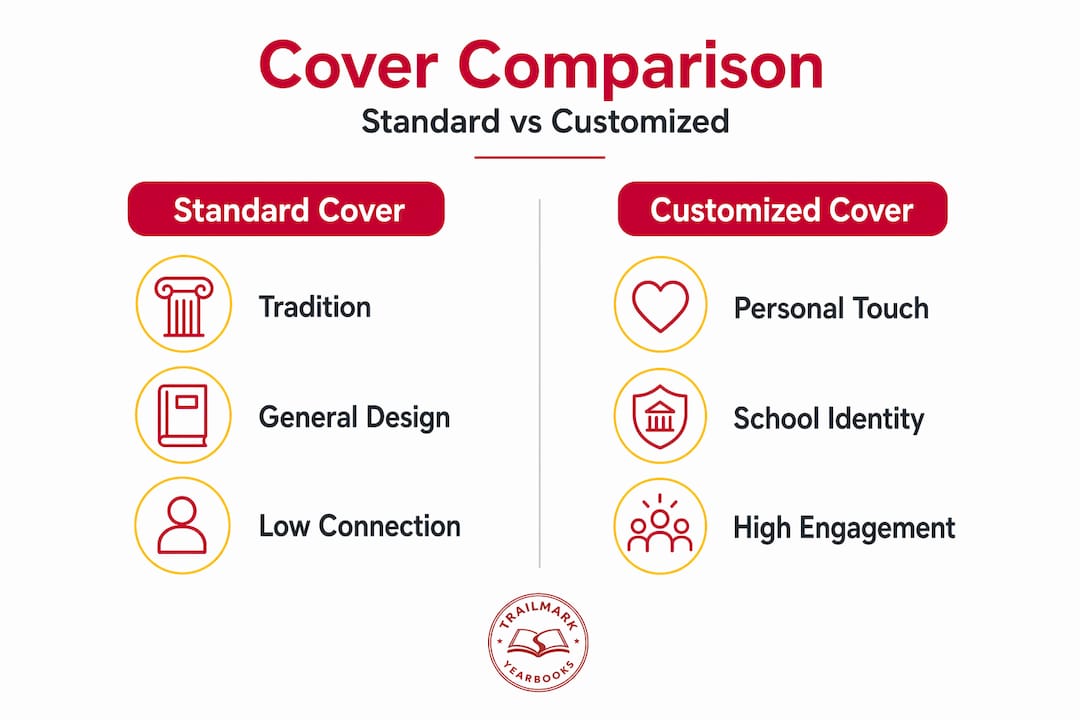
Standard covers are not failures. They offer simplicity, predictable costs, and faster production decisions. For schools with very limited budgets or first-year advisers managing an already complex process, a clean standard cover is a reasonable choice.
But the tradeoff is real. A yearbook with a generic cover signals to students that their specific year and their specific community did not merit the extra thought. Contrast that with a personalized yearbook cover that includes a phrase the senior class voted on, or a color combination a fifth-grade class chose together. That cover means something.
"A yearbook that students can personalize becomes something they'll keep forever, not just because of photos but because it includes pieces of themselves."
For high school yearbook customization in particular, the investment tends to pay off in higher pre-sale numbers, stronger yearbook class recruitment the following year, and a lasting reputation for the program.
How to implement yearbook cover customization effectively
Understanding options and their benefits leads naturally to how you can successfully implement cover customization in your school. The most common failure point is not budget. It is timing.
- Start in September. Introduce the concept of cover customization to students and staff at the beginning of the year so design decisions are not rushed into.
- Consult your vendor early. Ask specifically which customization options are available, what the production lead times are, and what file formats they require for custom artwork.
- Set internal deadlines three weeks ahead of vendor deadlines. Schools carefully manage production timelines to deliver customized yearbooks on schedule, and that buffer protects you from revision delays.
- Prioritize your budget. If you cannot afford every finish you want, rank them. Embossing often delivers the highest perceived value per dollar. Foil stamping and spot UV are strong second choices.
- Approve a final design proof before print. Request a digital proof and, where possible, a physical sample. Catching a color shift or layout error at proof stage costs nothing. Catching it after print costs everything.
Pro Tip: Build your customization budget into the yearbook sale price at the start of the year, not as an afterthought. A $2 to $4 increase in price per book almost always funds a significantly more impressive cover, and students rarely notice the price difference when they are excited about the product.
You can request a sample to evaluate material and finish quality before finalizing any decisions, and you can reach your yearbook rep contact for guidance on exactly what customization is achievable within your timeline and budget.
A fresh take on yearbook covers: making the book truly yours
Here is something most yearbook guides will not tell you: a lot of "custom" yearbook covers are not actually custom. They are templates with a school name dropped in. The colors change. The font stays the same. The layout is identical to three hundred other schools. That is not customization. That is branding with extra steps.
Real customization means the cover could only have come from your school, this year, with these students. And that requires a mindset shift that goes beyond asking what design options are available.
The goal, as one perspective frames it well, is to give students ways to make the book truly theirs, to see themselves not just in photos but in the personality they bring to the pages. The cover is where that promise lives or dies before a single page is turned.
We see advisers sometimes default to tradition because it feels safe. The school has used blue leatherette with gold embossing for fifteen years, so the path of least resistance is doing it again. But tradition is only worth repeating if it still resonates. Ask your students if they feel connected to the current cover style. The answer might surprise you.
The yearbooks that become genuinely treasured artifacts tend to share one quality: the students who hold them can point to something on the cover and say "we chose that." Not the adviser. Not the vendor. The students. That sense of authorship is what the high school yearbook insights from experienced programs keep pointing back to, and it applies equally at the elementary and middle school levels.
Innovating does not mean abandoning all continuity. It means being honest about what your students actually find meaningful and letting that drive your decisions, even if it means breaking from what the previous adviser did for a decade.
Get started with customizable yearbook covers today
Ready to bring these ideas to life? TrailMark Yearbooks makes it straightforward to explore the full range of custom yearbook covers without a sales pitch or hidden costs. Whether you are coordinating a small elementary school yearbook or a large high school production, the customization options are real, the pricing is transparent, and the support comes from people who have been doing this for a long time.
Start by requesting a sample to see and feel the actual materials before you commit to anything. From soft-touch laminate to embossed hardcover, holding the options in your hands makes the decision much easier. If you want to talk through what is possible for your specific school, contact a yearbook rep and get honest answers without pressure. And when you are ready to explore pricing and production options in full, TrailMark's yearbook services give you instant all-inclusive quotes with no signup required, 2 to 3 week turnarounds, and shipping included.
Frequently asked questions
What does yearbook cover customization include?
It includes personalized design elements like cover materials, color schemes, text treatments, embossing, foil stamping, and student-influenced artwork. A variety of design choices and materials let schools build a cover that genuinely reflects their community rather than a generic template.
How can I involve students in customizing the yearbook cover?
Form a small cover design committee, run school-wide polls on theme options, and open submissions for student artwork and photography. Student-led yearbook projects build pride and ownership that carry through to higher engagement and sales.
Do customization options differ by school level?
Yes. Younger students typically connect most with simple, name-specific personalization, while middle and high schools can support more complex themes and design systems. Personalization should match developmental stages for it to feel authentic rather than forced.
What is the impact of customized yearbook covers on student engagement?
Custom covers increase emotional connection and make the yearbook feel like a meaningful possession rather than a school commodity. Personalization transforms yearbooks into personal artifacts students are far more likely to treasure and keep long-term.
When should schools start planning yearbook cover customization?
Planning should begin at the start of the school year, typically September, to allow time for student input, design development, and vendor coordination. Early coordination with printing vendors is one of the most consistent factors in delivering customized yearbooks on schedule without last-minute compromises.