
Yearbook printing turnaround is defined as the time between final proof approval and the delivery of printed yearbooks to your school, typically spanning two to four weeks. This window covers three distinct production phases: printing, binding, and shipping. Printers like Mixbook, Entourage Yearbooks, and Trailmarkyearbooks each advertise specific turnaround windows, but the number you see on a website rarely tells the full story. Understanding what drives that timeline, and how to plan around it, is what separates a smooth delivery from a last-minute scramble.
What is yearbook printing turnaround, exactly?
Yearbook printing turnaround is the production interval that begins the moment your printer receives an approved proof, not when you submit your first draft. This distinction matters more than most advisers realize. Printers typically quote turnaround as two to six business days of production time, excluding the days or weeks spent reviewing and approving proofs. That means a "two-week turnaround" could easily become four weeks once you factor in back-and-forth revisions before the press even starts.
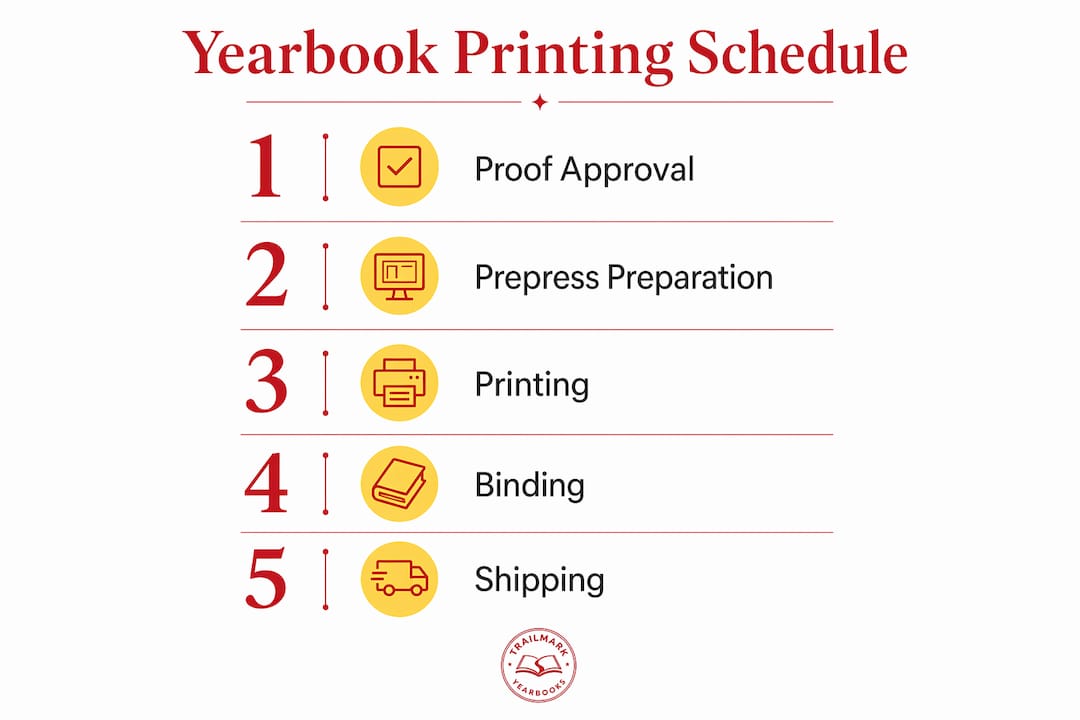
The full yearbook printing process includes prepress preparation, imposition, proof cycles, actual press time, binding, and shipping. Each phase runs sequentially, so a delay in one pushes everything downstream. Schools typically begin yearbook projects months in advance, with final printing scheduled backward from the end-of-year delivery date. Treating turnaround time as a fixed number rather than a range is the single most common planning mistake advisers make.
What factors affect yearbook printing turnaround times?
Several variables determine how long your specific yearbook takes to move from approved proof to your hands. Knowing these in advance lets you build a realistic yearbook production schedule instead of guessing.
Binding type is one of the biggest factors. Saddle stitched yearbooks can print in roughly three business days, while perfect bound books take three to five days, and hardcover editions can run five days or more. That difference compounds when you add shipping time on top.
Printing method also shifts the clock. Digital printing handles shorter runs faster and skips the plate-making step required for offset printing. Offset delivers superior color consistency for large orders but adds setup time at the front end.
Here are the other key variables that influence your yearbook printing time:
- Order quantity: Larger print runs take longer on press, particularly for offset jobs.
- Page count and complexity: Signature planning and imposition grow more complex with higher page counts, requiring earlier file confirmation to avoid prepress delays.
- Proof cycles: Every round of corrections adds days. A single reprint request after an imposition error can set your schedule back by a week or more.
- Shipping distance: Shipping times range from next-day delivery for schools near the print facility to several days for schools in distant regions.
- Rush printing: Some providers offer expedited options, but rush printing typically costs more and may limit your paper stock or finish choices.
Pro Tip: Request your printer's production calendar before you finalize your own. Printers often have blackout periods near major holidays or peak school seasons that can add days to your quoted turnaround without warning.
Typical yearbook printing timelines and scheduling benchmarks
Understanding what the industry actually delivers, versus what it advertises, helps you set realistic expectations with your school administration and yearbook staff.
Popular yearbook providers generally deliver printed yearbooks within two to three weeks after finalization. Mixbook advertises delivery in two weeks or less, Entourage Yearbooks quotes turnarounds as short as three weeks, and providers like Picaboo and Remember Me target roughly 15 business days. Trailmarkyearbooks operates on a two to three week turnaround window with shipping included, which aligns with the faster end of the industry range.
Those numbers, however, assume a clean proof approval with no corrections. A realistic yearbook production schedule should add a two to four week buffer before the printer's quoted turnaround even begins. That buffer covers your internal review, adviser sign-off, and any proof corrections that come back from the printer.
The table below shows how binding type and print method interact with typical production time:
| Binding type | Print method | Estimated production time | Recommended total buffer |
|---|---|---|---|
| Saddle stitch | Digital | 3 business days | 2 weeks |
| Perfect bound | Digital or offset | 3 to 5 business days | 2 to 3 weeks |
| Hardcover | Offset | 5+ business days | 3 to 4 weeks |
Imposition workflow guidance recommends submitting imposed files three to four weeks in advance and leaving a two-week buffer for proof corrections and production. That two-week buffer is not optional padding. It is the minimum safety net between a clean file and a delivered book.
Pro Tip: Build your internal content deadline at least six weeks before your target delivery date. That gives you four weeks for design finalization and proof cycles, plus the printer's two to three week production window.
How to integrate printing turnaround into your yearbook production schedule
Backward scheduling is the most reliable method for building a yearbook production schedule that actually holds. Start with your desired delivery date and work backward through every phase, assigning firm deadlines to each milestone.
Here is a practical sequence that accounts for realistic yearbook printing time:
- Set your delivery date first. Identify the last school day or distribution event and lock that date as your fixed endpoint.
- Subtract the shipping window. Add three to five business days for shipping, depending on your distance from the print facility.
- Subtract the printer's production time. Use the binding type estimates from the table above, not the best-case scenario from the provider's homepage.
- Subtract the proof review period. Allow at least two weeks for proof delivery, internal review, correction requests, and re-approval. Imposition errors during prepress are a leading cause of reprint costs and schedule setbacks, so this buffer is non-negotiable.
- Set your content finalization deadline. This is the date your design files must be complete and ready for submission. Signature imposition planning requires page count confirmation eight to ten weeks before delivery to avoid downstream delays.
- Separate creative deadlines from production handoff. Your photography and copy deadlines should land at least one to two weeks before the design finalization date to give your layout team breathing room.
- Build a contingency window. Reserve five to seven business days somewhere in the middle of your schedule for unexpected content changes, staff illness, or a second proof cycle.
A school targeting a May 20 delivery would work backward to a May 15 shipping date, a May 1 proof approval, an April 17 file submission, and a March 6 page count confirmation. That math leaves no room for wishful thinking, which is exactly the point. You can find a ready-made deadline management checklist to map these milestones against your specific calendar.
Comparing yearbook printing options: speed, cost, and quality
Not every printing option delivers the same balance of speed, cost, and finished quality. The right choice depends on your school's budget, page count, and how much schedule flexibility you actually have.
Here is how the major considerations break down:
- Ultra-fast options (48-hour print): Some digital printers advertise 48-hour production for simple saddle stitched books. These work for small schools with low page counts, but they typically restrict paper weight, cover finish, and color calibration options.
- Standard two to three week turnaround: This is the industry norm for most school yearbooks. Providers in this range, including Trailmarkyearbooks, can accommodate full-color printing, multiple binding types, and custom covers without sacrificing quality.
- Four-plus week timelines: Offset printing for large orders or hardcover editions falls here. The quality ceiling is higher, but the schedule demands are significant. Missing a single milestone can push delivery past the school year.
The full-color printing process adds prepress complexity that digital-only jobs skip, which is why offset jobs consistently land at the longer end of the turnaround range. Cost also scales with speed. Expedited production fees can add meaningfully to your per-book price, which matters when you are managing a fixed school budget.
The most practical approach is to match your binding type and print method to your confirmed delivery date, then select a provider whose standard turnaround fits that window without requiring a rush fee. Paying for speed you did not need to buy is a budget drain that compounds across every order.
Key takeaways
Yearbook printing turnaround runs two to four weeks from proof approval, and advisers who plan backward from their delivery date with a two-week proof buffer consistently hit their deadlines.
| Point | Details |
|---|---|
| Turnaround starts at proof approval | The clock begins after your printer receives an approved proof, not when you submit your first draft. |
| Binding type changes production time | Saddle stitch takes roughly three days; hardcover can take five or more, before shipping is added. |
| Buffer time is non-negotiable | Add at least two weeks for proof corrections and prepress before the printer's quoted production window. |
| Backward scheduling prevents late delivery | Lock your delivery date first, then assign every upstream deadline by subtracting each production phase. |
| Page count must be confirmed early | Signature imposition planning requires page count confirmation eight to ten weeks before your delivery date. |
Why I tell every adviser to add two weeks they think they don't need
The most consistent mistake I see in yearbook production is treating the printer's advertised turnaround as the only number that matters. A printer quoting two weeks is telling you how long the press and bindery take once your file is clean and approved. They are not accounting for the three rounds of proof corrections your staff will request, the cover photo that needs a color adjustment, or the page that comes back with a bleed error.
I have worked with schools that submitted files six weeks before their delivery date and still felt the pressure in the final days. I have also worked with schools that submitted eight weeks out and distributed yearbooks with a week to spare. The difference was almost always the proof cycle, not the printer's speed.
My honest advice: choose a printer whose standard turnaround fits your schedule without a rush fee, confirm your page count earlier than feels necessary, and treat your content deadline as a hard stop rather than a suggestion. The yearbook packages you choose also affect how much prepress complexity lands on your timeline, so factor that in before you finalize your production plan.
Speed matters, but a yearbook that arrives on time and looks right is worth more than one that arrives two days early with a color error on the cover. Plan for the full process, not just the press time.
— Jace
How Trailmarkyearbooks supports your printing schedule

Trailmarkyearbooks was built specifically for the scheduling pressures school advisers face. With a standard two to three week turnaround, no order deadlines, and shipping included in every quote, you get a production window that fits a real school calendar rather than an ideal one. Free design assistance, flexible file options through Canva, InDesign, or the Trailmarkyearbooks online creator, and transparent all-inclusive pricing mean you spend less time chasing quotes and more time managing your production schedule. Request a sample to evaluate print quality before committing to a full order, or download the adviser planning resources to build your production calendar around a confirmed turnaround window.
FAQ
What does yearbook printing turnaround mean?
Yearbook printing turnaround is the time from final proof approval to delivery of printed books, typically two to four weeks. It covers press time, binding, and shipping but does not include design or proof revision phases.
How long does yearbook printing take from start to finish?
From initial design to delivery, the full process typically runs eight to twelve weeks. The printer's production window is two to four weeks, but proof cycles and content finalization add significant time before press work begins.
Does binding type affect how long printing takes?
Yes. Saddle stitched books take roughly three business days to print, perfect bound books take three to five days, and hardcover editions can take five or more days before shipping is added.
When should I submit my yearbook files to the printer?
Submit your finalized files at least four to six weeks before your target delivery date. Page count confirmation for signature imposition planning should happen eight to ten weeks out to avoid prepress delays.
Can I get a faster turnaround if I miss my deadline?
Some printers offer rush production, but expedited printing typically costs more and may limit your paper or finish options. Building a two-week buffer into your schedule is a more reliable strategy than relying on rush availability.