
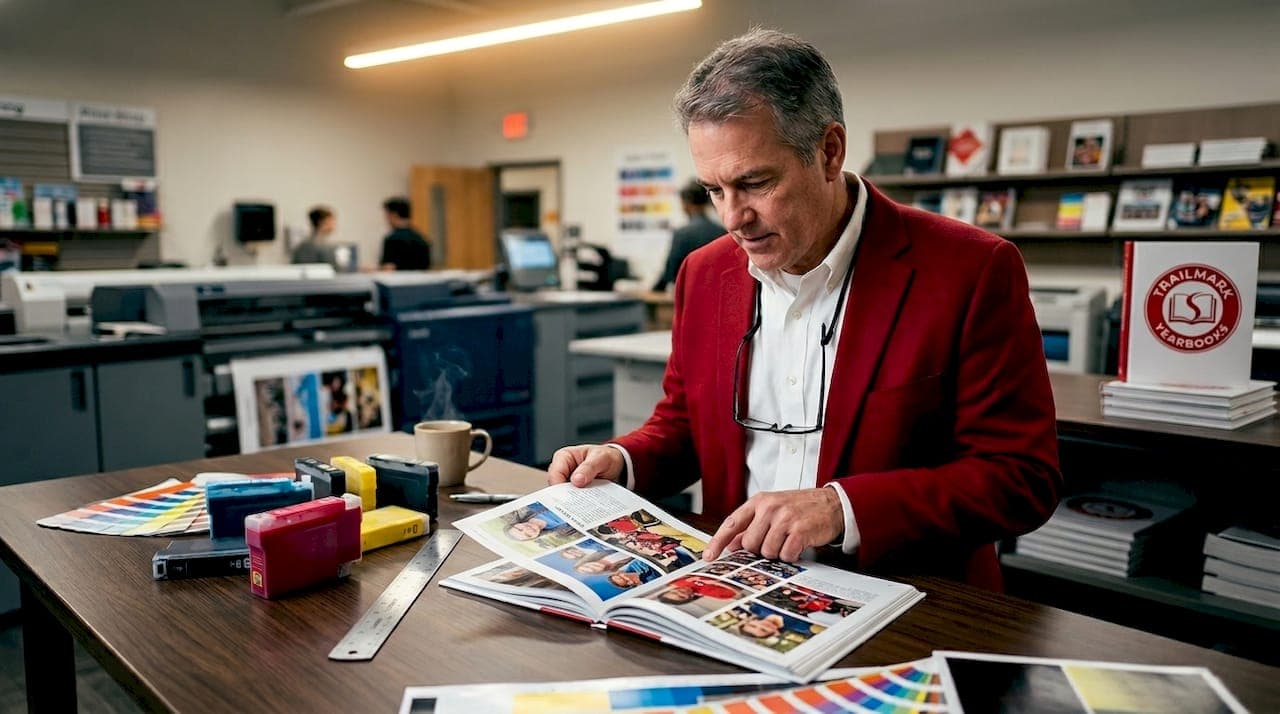
Most yearbook committees assume black-and-white or hybrid printing is the practical choice. It keeps costs down, right? The reality is more nuanced. The role of full-color printing in yearbook production goes far beyond aesthetics. It shapes how students experience the book, how long it holds up, and whether it actually feels like something worth keeping. This article walks you through the technical process behind color printing, the real cost structure, production pitfalls you need to avoid, and why the emotional payoff of a well-printed yearbook is worth understanding before you make your next budget decision.
Table of Contents
- Key takeaways
- The role of full-color printing in yearbook quality
- Cost considerations and budgeting for color yearbooks
- Common production challenges to avoid
- Benefits of full-color yearbooks for school pride and memory
- My honest take on color yearbooks
- How Trailmarkyearbooks makes full-color production simpler
- FAQ
Key takeaways
| Point | Details |
|---|---|
| Color printing uses CMYK | Full-color output requires four ink plates, which creates fixed setup costs that shrink per book as your order grows. |
| Bleed and proofing matter | Setting correct bleed margins and understanding CMYK proofs prevents costly white-edge errors and color surprises. |
| Larger orders save money | Fixed prepress costs spread over more books, making full-color printing significantly more affordable at higher quantities. |
| Paper stock affects quality | Coated or heavyweight paper is required to hold four-color ink properly and produce vibrant, lasting images. |
| Color builds school pride | Students and staff consistently respond more positively to vivid, well-printed yearbooks than to flat, low-color alternatives. |
The role of full-color printing in yearbook quality
The industry term for what most people call "full-color printing" is four-color process printing, or CMYK printing. CMYK stands for Cyan, Magenta, Yellow, and Key (Black). Every color you see in a printed yearbook photo is built from combinations of those four inks printed in overlapping dot patterns. It's a surprisingly precise process, and understanding it helps you make smarter decisions before your files ever go to press.
Full-color printing uses four ink plates for CMYK output, and each plate requires separate setup. That's why there are fixed costs attached to color printing regardless of how many books you order. The good news is that those costs become negligible when spread across a larger run.
Why does this matter for print quality? Because CMYK produces a wider visual range than you get from simple two-color or black-and-white printing. Student portraits, candid shots, and team photos look true to life instead of flat. Colors in graphics and backgrounds stay consistent across every page. The visual difference between a black-and-white senior portrait and a full-color one isn't subtle. It's the difference between a document and a memory.
Paper choice plays a direct role in how well that color translates. Standard thin paper doesn't hold four-color ink well, which leads to dull, muddy results even from a good press. Coated or heavier stocks are designed to accept wet ink across all four layers without bleed-through or spreading, keeping colors sharp and true.
A few key print terms every yearbook staff member should know:
- Bleed: The extra image area beyond your page's trim edge. You need this so photos run fully to the edge without leaving a thin white line.
- Registration: How precisely the four ink layers align. Poor registration creates blurry or color-shifted edges on text and images.
- Color gamut: The total range of colors a printing process can reproduce. CMYK's gamut is smaller than your screen's RGB, so colors may shift slightly from what you see on your monitor.
- Color profile: A standardized description of how colors should be reproduced on a specific press and paper combination.
Pro Tip: Ask your printer which ICC color profile they use for their yearbook press. Designing to that profile from the start, rather than converting at the end, produces noticeably more accurate colors in the final book.
Cost considerations and budgeting for color yearbooks
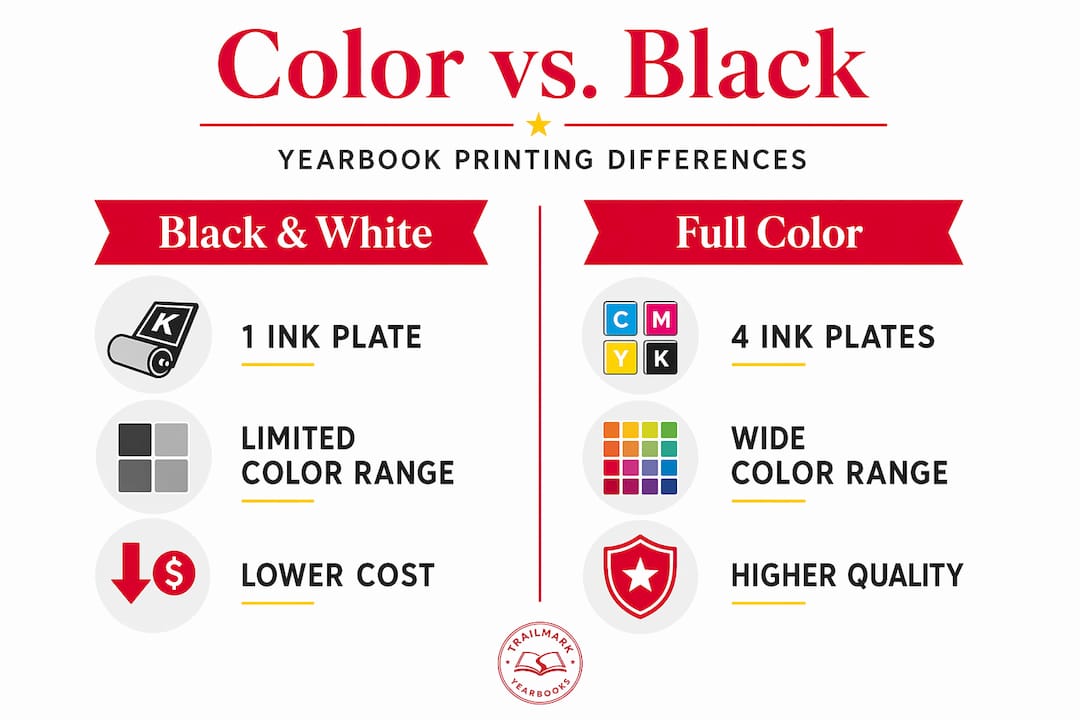
Full-color printing costs more upfront than black-and-white, but the per-book cost story is more interesting than most staff realize. Setup costs are fixed regardless of order size but amortize over the full run. Doubling your print quantity sometimes increases total cost by only 30%, because the expensive prepress work is already done.
Here's a simplified comparison of how cost structures differ:
| Factor | Black & white | Full-color |
|---|---|---|
| Ink plates per run | 1 (black only) | 4 (CMYK) |
| Setup cost impact | Low | Fixed but spread over run |
| Paper requirement | Standard uncoated | Coated or heavyweight |
| Per-book cost at low qty | Lower | Noticeably higher |
| Per-book cost at high qty | Lower | Approaches competitive range |
| Visual output quality | Limited | Vibrant and true to life |
The practical takeaway: if your school is ordering fewer than 100 books, full-color costs more per unit and that gap is real. But schools ordering 300 or more books will find the per-book premium shrinks considerably. Run length and design complexity are the two biggest levers you control when managing a color printing budget.
A few ways to stretch your budget without sacrificing quality:
- Consolidate pre-orders early to hit a higher quantity tier before submitting your final order.
- Keep spreads with heavy ink coverage (dark backgrounds, full-bleed photos) intentional. Decorative pages with dense color cost more to print and add less value than a strong photo.
- Request tiered quotes at multiple quantities (200, 300, 400 books). The cost curve often has a meaningful drop at specific thresholds.
- Ask whether paper upgrades are bundled into pricing or add-ons. Sometimes a slightly heavier stock is included at a given tier.
Pro Tip: Treat full-color yearbook costs as a fixed plus variable model. The fixed prepress cost is unavoidable, but every extra book beyond your minimum is cheaper. This framing helps you make the case to administration for a slightly larger print run, which usually makes financial sense.
You can also review yearbook package options to understand which combinations of color, paper, and binding align with different budget ranges before you commit.
Common production challenges to avoid
Even schools with experience printing yearbooks run into avoidable problems. Most of them come down to three areas: bleed setup, gutter planning, and color proofing. Getting these right before files go to print saves both money and frustration.
Here are the most common issues and how to handle each one:
-
Missing or insufficient bleed. Bleed margins must extend at least 0.125 inches beyond the trim edge for any photo that runs to the page edge. Without this buffer, even minor trim shifts leave a visible white sliver. Build bleed into your templates before your design team starts placing photos, not after.
-
Content too close to the gutter. Inside margins should be at least 0.5 inches for images near the spine in perfect-bound books. Photos that spread across the gutter are particularly vulnerable. If someone's face falls directly over the binding, it will either be hidden in the spine curve or partially lost when the book is trimmed.
-
Misreading soft proofs. This one trips up even experienced staff. Soft proofs often look muted compared to your screen because they simulate CMYK gamut and paper absorption, not your monitor's RGB output. Many people see a muted proof and try to correct colors further, which actually makes the final print worse.
-
Double color correction. Disabling redundant color enhancements on proof printers is critical for accurate results. If both your design software and the printer's driver are independently adjusting colors, they compound each other and the output looks nothing like your intent.
-
Not working with vendor-specific ICC profiles. Consistent use of a specific CMYK profile, such as GRACoL, helps your screen preview match what the press produces. Ask for your printer's recommended profile early and apply it in your design program's color settings before you begin.
Pro Tip: When you receive a physical proof, evaluate it under natural daylight or a daylight-balanced lamp. Fluorescent office lighting shifts colors toward yellow and green, which can make you overcorrect perfectly good print files.
For a broader look at how photo quality affects print outcomes, the yearbook photography checklist covers what your team should capture and how to format images for clean color reproduction.
Benefits of full-color yearbooks for school pride and memory
There's a reason schools that switch to full-color printing rarely go back. The difference isn't just visual. It's emotional.
"Students and staff report heightened connection and appreciation for vibrant yearbooks." Full-color printing doesn't just document a year. It makes students feel like their year was worth documenting. That distinction matters.
Well-executed full-color yearbooks strengthen school community pride through vivid photography and engaging visual storytelling, something black-and-white production simply cannot replicate with the same emotional weight.
The benefits extend well beyond first impressions:
- Longevity. Archival-quality paper and binding can preserve yearbooks for over a century. A Smyth-sewn hardcover on acid-free paper is a genuinely different object than a staple-bound black-and-white booklet. Students pull these out 30 years later.
- Visual storytelling. Color photos carry context that black-and-white cannot. The purple and gold of a school's jersey, the bright red leaves during a fall soccer game, the expression on a student's face during graduation. Color turns a record into a story.
- Reader engagement. Bright, consistent color keeps readers turning pages. A flat, low-contrast yearbook gets flipped through once. A vibrant one gets passed around, pointed at, laughed over.
- Staff and faculty recognition. Faculty portraits, staff highlights, and club pages look significantly more professional in full color. This matters to the people being recognized.
The importance of yearbook printing quality becomes most obvious years after graduation. A faded, poorly printed book feels disposable. A book with vivid color, quality paper, and clean typography feels like an artifact. That's the gap full-color production closes.
My honest take on color yearbooks
I've seen yearbook committees agonize over whether full-color printing is worth the cost, run the numbers, and still choose black-and-white because it felt "safer." And then watch students flip through the result with noticeably less excitement than the prior year's full-color book.
The thing most staff miss isn't the cost calculation. It's that the importance of yearbook printing quality directly affects how students value the product they're paying for. When a yearbook looks genuinely good, students show it to their parents. They post photos of pages. They want their friends to sign it. When it looks mediocre, it goes in a drawer.
What I've learned is that color proofing is where most production problems actually start, not at press. Staff spend weeks on design and then rush through the proofing stage. A muted soft proof creates panic, someone overcorrects the files, and the final print ends up with blown-out or muddy colors that could have been avoided by simply understanding how CMYK simulation works.
My practical advice: get a physical sample from your printer before your first real order. Hold it. Look at it under different lighting. Ask specifically how they handle CMYK profiles and what their trim tolerances are. A vendor who answers those questions confidently is one you can trust with your files. A vendor who says "it'll look great" without specifics is one to push harder.
Full-color production with proper planning is less stressful than hybrid approaches where you're constantly deciding which pages get color. Commit to it, plan for it, and design to its strengths.
— Jace
How Trailmarkyearbooks makes full-color production simpler
Choosing full-color printing doesn't have to mean complicated vendor negotiations or surprise costs.
Trailmarkyearbooks gives school staff transparent, all-inclusive pricing online with no hidden fees and no sales pitch required. You can get an instant quote, explore high school yearbook options designed for full-color production, and request a physical sample to evaluate paper stock and print quality before committing to an order. The team also offers free design assistance, whether you work in Canva, InDesign, or the Trailmarkyearbooks online creator. With a two to three week turnaround and 50 years of combined experience behind every order, Trailmarkyearbooks gives your committee a real partner, not just a printer. If you want to talk through options before deciding, you can also connect with a rep directly.
FAQ
What does full-color printing mean for yearbooks?
Full-color printing, technically called four-color process or CMYK printing, uses four ink layers (Cyan, Magenta, Yellow, Black) to reproduce photographs and graphics in true-to-life color across every yearbook page.
Why are full-color yearbooks more expensive?
Four-color printing requires four ink plates and coated paper stock, which creates fixed setup costs. Those costs drop significantly per book when you order larger quantities.
How do I avoid color problems in a printed yearbook?
Work in your printer's recommended CMYK profile, avoid double color correction during proofing, and build bleed margins of at least 0.125 inches into your page templates before placing photos.
How long does a full-color printed yearbook last?
With the right materials, a long time. Acid-free paper and quality binding can preserve a printed yearbook for more than 100 years, far outlasting digital-only alternatives.
Is full-color printing worth it for smaller schools?
Yes, if you plan your order size carefully. Getting tiered quotes and consolidating pre-orders helps smaller schools reach a quantity where full-color printing becomes genuinely affordable without sacrificing the quality that makes yearbooks worth keeping.