
Planning a yearbook across several campuses works when you decide a small number of things once, centrally (theme, style guide, ladder, calendar, proof sign-off), and leave everything else to each campus. The print order follows the same logic: one clear price and one production partner for every building. At TrailMark Yearbooks, schools get instant all-inclusive pricing online with no signup and no sales pitch, so a district or multi-division school can price every campus the same way before the planning meeting starts.
TL;DR
- Set the theme, color palette, fonts and ladder centrally, then give each campus its own pages and a named editor.
- Keep two tiers of authority: a lead adviser who has the final word, and one student editor-in-chief per campus who reports up.
- Work backward from the print date, give every campus internal deadlines with a one-to-two-week buffer, and hold a weekly check-in.
- Run the same four-read proofing sequence on every campus, and have someone outside the campus read the pages last.
- Price every campus the same way up front, so budget and book specs are settled before design begins.
Table of Contents
- What changes when you have more than one campus
- Set shared goals, a theme and campus priorities
- Divide roles so every decision has an owner
- Build one master ladder
- Build a calendar every campus can meet
- Keep photos and coverage consistent
- Proof the same way on every campus
- Problems that show up, and how to head them off
- Print order and budget for several campuses
- Why the print partner matters for multi-campus schedules
- Get pricing for every campus
- FAQ
- Sources
What changes when you have more than one campus
A single-campus yearbook has one adviser, one staff room and one set of hallway conversations. A multi-campus book has none of those. Photos arrive in different formats, names are spelled from different rosters, and two campuses can both cover the same district event without knowing it. Most problems come from missing structure, not missing effort.
Three-campus schools do this every year. The Academy at the Lakes, a school with three campuses, covers more than 30 sports teams and 55 clubs plus assemblies and performances. Its published account of how the yearbook is made credits a spreadsheet ladder and a written style guide for keeping the book coherent no matter who designs a given spread. Those two documents are the backbone of everything below.
A research team that worked across three campuses found the same thing from another angle. Its authors report that they stated goals, roles and expectations explicitly at the first meeting and repeated them regularly. Do the same: the first meeting of the year is where you settle what is shared and what is local.
Set shared goals, a theme and campus priorities
Start with the question every campus has to answer the same way: what is this book for? A district keepsake, a set of separate books with a common look, and a single combined volume are three different projects with different page counts and budgets. Decide which one you are making before anything else.
Then separate three layers:
- Shared by every campus: the theme, the color palette, the fonts, the cover concept, the page size and binding, and the print date.
- Assigned by campus: which sports, clubs, grade levels and events each campus covers, and how many spreads each gets.
- Free for each campus: the spread concepts, headline voice and student-life angles inside the shared frame.
The theme should be a place for content to land, not a decoration. The Academy at the Lakes chose a theme to match its visual style and its outlook for the year, and the school says it lets images and stories shape each spread. A theme that is too specific forces campuses into awkward fits. A theme that is flexible lets a kindergarten art show and a varsity playoff sit in the same book.
Write the theme down in one paragraph that includes what it means for photos, headlines and captions. If one person at each campus can explain it in two sentences, it is ready.
Give someone ownership of the thread
A theme only holds if one person at every campus is responsible for it. The Academy at the Lakes names a Theme Continuity Editor and Design Editors who check theme consistency across the whole book. Even a small program can copy the idea: one student per campus who reads every spread for the theme and the style guide. The same principle applies when many contributors add to one shared story, as in collaborative family storytelling books: one owner for the thread keeps the voice steady while others contribute.
Divide roles so every decision has an owner
Multi-campus programs break down when it is unclear who decides. The simplest model has two tiers, and it is an old one. A documented high school yearbook program describes the adviser as the person with the final word, who checks layouts, copy and picture ideas, manages finances and answers to the administration. The editor-in-chief is responsible for production, sets and monitors deadlines and checks layouts, copy and cropping. Section editors oversee their sections and report to the editor.
For several campuses, stack the model:
| Role | Scope | Core responsibility |
|---|---|---|
| Lead adviser | District or whole school | Final word on theme, style guide and sign-off; manages the budget; reports to administration |
| Campus adviser | One campus | Supervises the local staff, checks local content and policy compliance |
| Lead editor-in-chief | Whole book | Master ladder, master calendar, cross-campus consistency |
| Campus editor | One campus | Local deadlines, local photo and copy collection, local section editors |
| Index and names editor | Whole book | One roster, one spelling for every name |
Student staff manuals show how detailed these jobs can get. Chippewa Valley High School's publication guide has the editor-in-chief set and enforce the production schedule, proofread every spread and make sure no photo runs twice, while a managing editor checks individual deadlines and keeps files organized. A staff manual from another high school gives the index editor ownership of rosters and name spellings and grades students on weekly beat checks and in-progress spread work. Copy that last habit: weekly, visible progress is what keeps a distant campus from going quiet for two months.
For job descriptions you can hand out, see our guide to yearbook staff roles and the explainer on adviser responsibilities.
Administrators have one job in this structure: choose the lead adviser, confirm the budget and the print date, and make the sign-off authority clear. Everything else should flow down from that.
Build one master ladder
A ladder is the page-by-page plan of the book. For a multi-campus yearbook it is the single most important shared document. The Academy at the Lakes describes its ladder as a spreadsheet listing page numbers, spread titles, content details and assigned staff. Add a column for the campus and you have the multi-campus version.
A workable ladder has these columns:
- Page or spread number
- Section (campus, grade level, sports, clubs, events, ads)
- Campus responsible
- Assigned editor
- Photo status, copy status, approval status
- Internal due date
Every spread gets one topic and one responsible person. That prevents the two classic multi-campus failures: the district event covered twice and the district event covered by nobody. Lock the page count early. Printed books come in multiples of pages, so deciding the total before design starts keeps one campus from squeezing another out. Our ladder planning steps walk through building one from scratch.
Write the style guide on one page
The style guide is the ladder's partner. The Academy at the Lakes documents its theme, color palette and fonts so every spread looks consistent regardless of who designs it. Keep yours to one page covering:
- Two or three typefaces and where each is used
- The color palette with exact color values
- Photo sizes, margins and gutters
- Caption format and how names are written (first and last, grade or not)
- Template files each campus must start from
If campuses design in different tools, that is fine as long as the output follows the guide. TrailMark supports Canva, Adobe InDesign and Illustrator, and its own online creator, so a campus with a Canva-savvy staff and a campus with a design class on InDesign can still deliver files for the same book. Our guide to template customization shows how to lock the shared parts and leave the local parts open.
Build a calendar every campus can meet
Work backward from the print date. A common pattern for a school-year book is summer for theme, staff and budget, fall for training and portraits, winter for a mid-year review, spring for final deadlines and proofing, and late spring for sign-off and print. Our year-round production calendar lays out those phases in detail.
For several campuses, add these rules:
- Internal deadlines sit one to two weeks before the real ones. Slipped deadlines pile up at the end, and the final review is where errors get through. The buffer absorbs one late campus without moving the print date.
- Stagger campus deadlines by section, not by campus. If every campus submits everything on the same day, the lead editor reviews a mountain at once. Spread the deadlines so something arrives every week.
- Hold a weekly check-in with a fixed agenda. The three-campus research team mentioned above used weekly videoconferences with a structured agenda: a catch-up, a recap, work on the agenda items and a wrap-up in which each person's tasks went onto the calendar. A fifteen-minute version works for yearbook leads: what is done, what is late, what is blocked.
- Put every deadline in one shared calendar, not in separate campus calendars.
Also check when other events collide. Testing windows, spring breaks and graduation dates differ by campus. Map them on the master calendar in August so a deadline never falls in a week one campus is closed.
Keep photos and coverage consistent
Photo collection is where multi-campus books drift. Set three rules early. First, every campus uses the same photo file requirements, so nothing arrives too small to print. Second, every photo has a caption note with full names, checked against the school roster. Third, each campus has a named photo editor who sends photos in one shared folder structure that mirrors the ladder.
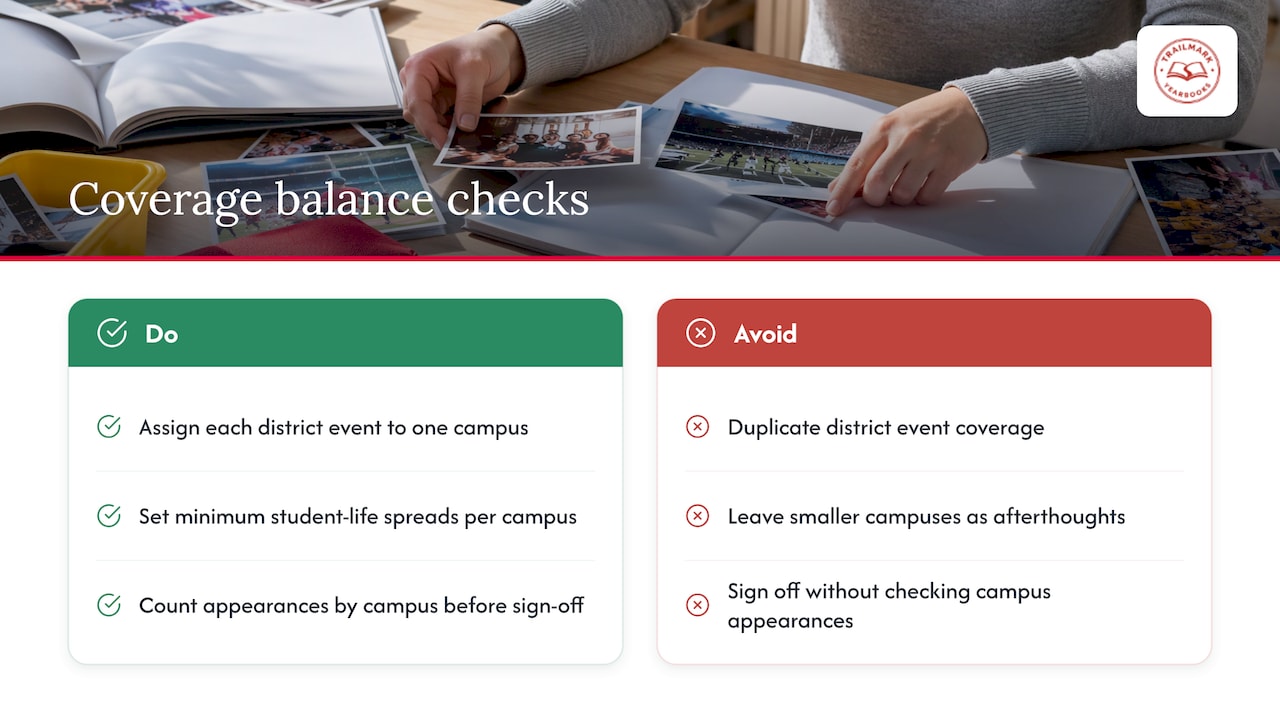
Coverage should follow the ladder, not enthusiasm. Assign the district events (a joint concert, a rivalry game, a graduation ceremony) to one campus and let the others pull from that coverage. Give each campus a minimum number of student-life spreads so smaller campuses are not an afterthought. Students tend to look for themselves first, so counting how many students appear in the book, by campus, is a fair test of balance before final sign-off.
Proof the same way on every campus
Proofing is where the whole plan pays off. Use one method everywhere so that every campus's pages are held to the same standard.
A good model is a four-read sequence, like the proofing checklist from Montana State University's communications office. It reads first for typos and proper nouns, second for headings, captions and footnotes, third for facts and figures checked by someone other than the writer, and fourth for dates, times and contact details. It also covers photo placement, font consistency, alignment and page numbers. For a yearbook, translate that as:
- Names: check against the official roster, not memory. Our name misspelling checklist shows how.
- Captions and headlines: each caption matches its photo and the style guide.
- Facts and numbers: scores, dates and records checked by someone who did not write them.
- Layout: photo quality, margins, page order and theme consistency.
Place a different campus's editor on the last read. They are unfamiliar with the pages, so they catch what the original team no longer sees. The campus adviser approves content and policy compliance, and the lead adviser gives the final sign-off. Pasco High School's staff describe a similar flow in their account of the yearbook process: pages go into proof, then a pre-submit double-check before the file goes to the printer.
The printed proof is the last gate. TrailMark offers printed proof books, two litho copies with shipping included, for $100. For hands-on routines, see our guides to the proofing process, handling printing proofs, soft versus hard proofs and a pre-submission QA checklist.
Problems that show up, and how to head them off
| Problem | What causes it | Prevention |
|---|---|---|
| Duplicate or missing coverage | No single owner per spread | One topic and one named editor per ladder row |
| Books that do not look like one book | Campuses designing from scratch | Shared templates and a one-page style guide |
| Late campus holds up the print date | Everything due the same day | Internal buffer and staggered section deadlines |
| Name errors | Different rosters per campus | One master roster, one index editor |
| Rushed final review | Earlier deadlines slipped | Reserve final review time on the calendar and protect it |
The common thread: each problem is a missing decision, and each fix is written down once and shared.
Print order and budget for several campuses
Budget decisions belong in the summer meeting, before design. Decide the binding, cover and extras for the whole project so the layout fits the specs. TrailMark publishes its per-book options on its printing page: for example, a perfect bound soft cover adds $1.60 per book, a 150 point board hard cover $1.50, Smyth sewn binding $2.00, printed endsheets for a hard cover $2.75, and a flat foil stamp or spot UV $4.25. Personalized covers run $3.00 to $6.00 per book, recognition ads are $5 each and lovelines are $1 each.
With that kind of price list you can lay out each campus's version side by side, for example an elementary campus with a soft cover and a high school with a hard cover and foil, and approve them together.
Why the print partner matters for multi-campus schedules
A multi-campus plan has more moving parts, so a print partner should remove constraints, not add them. TrailMark has no order minimums and no submission deadlines, and turnaround is typically two to three weeks. In practice, a campus that runs a few days behind does not force a rush across the district. Schools also get a dedicated adviser and free design assistance, and a password-protected online resource hub holds curriculum and design resources for advisers and students.
Our view from the adviser's desk
Multi-campus yearbooks do not fail because one campus is careless. They fail because nobody wrote down who decides what. We build our service around the idea that the school sets the plan and the printer keeps it simple: instant, all-inclusive pricing online with no signup, no hidden fees, and no pressure.
That is why we do not impose order deadlines or minimums. A district should be able to price a small elementary book and a large high school book the same way, and a campus that needs another week should not trigger a scramble. Our support team brings more than 50 years of combined experience, and our design assistance is free, so a new adviser at a new campus is not starting alone.
Our advice to every administrator: appoint the lead adviser first, publish the ladder and style guide second, and ask for prices third. In that order, the rest of the year gets much easier.
Jace
Get pricing for every campus
If you are ready to put numbers on your plan, TrailMark gives schools instant pricing online with shipping included, no signup and no sales pitch, plus optional full-service design for campuses that want us to create the book for them. Start at TrailMark Yearbooks for production services and on-demand printing, or see the middle school and K-8 options for design-it-yourself or we-create-it-for-you.

FAQ
Should each campus have its own yearbook or should there be one combined book?
It depends on the purpose. One combined book suits a small district or a school with divisions that share events. Separate books with a common look let each campus tell its own story at its own price point. Decide this first, because it sets page counts, budget and the number of editors.
Who should have the final say across campuses?
One lead adviser. Campus advisers approve local content, but a single person signs off on theme, style guide and print files. Administration confirms the budget and the print date and names that person.
How far ahead should we start planning?
In summer, before the school year. That is when theme, staff, budget and the print partner get settled. Fall is for training and photos, and spring for final deadlines and proofing. Build internal deadlines one to two weeks ahead of the real ones.
Can campuses design in different software?
Yes, provided each campus follows the shared style guide and template. TrailMark accepts designs from Canva, Adobe InDesign and Illustrator, and its own online creator, so campuses can use what their staff already knows.
Sources
- From Concept to Keepsake: How Our School Yearbook is Made, The Academy at the Lakes
- Lessons Learned from an Academic, Interdisciplinary, Multi-Campus Research Team (PMC)
- ERIC: yearbook program abstract (ED091696)
- Yearbook Publication, Chippewa Valley High School
- Yearbook Staff Manual
- University Communications Interactive Proofing Checklist, Montana State University
- The Process of the PHS Yearbook, Pasco High School
- Collaborative family storytelling books