
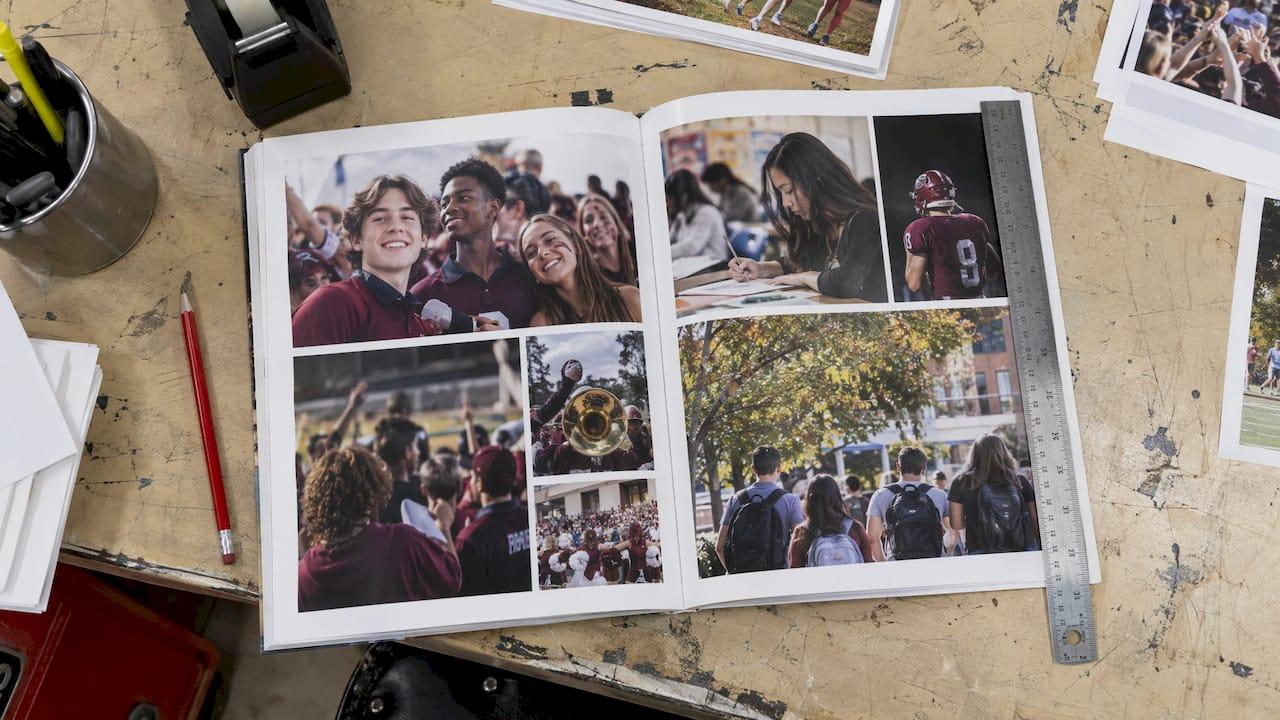
A yearbook QA checklist works when it is split into three passes: every spread, the whole book, and the files themselves. Each pass has a different owner and a different kind of error to catch. Most yearbook mistakes are small: a misspelled name, a caption that points to the wrong student, a blurry photo, a missing page number. They are also permanent once the book is printed. Below is the checklist we would hand an adviser, with who checks what and where each step usually goes wrong.
If you want the production side handled with less pressure, our 2–3 week turnaround and no order deadlines give your staff room to proof properly instead of rushing the last pass. More on that in the promo section below.
TL;DR
- Check each spread against a fixed list: names, captions, photo quality, text, layout, and page numbers. Have someone other than the creator do it.
- Verify every name against a current roster, and confirm that each caption names the person actually pictured.
- Check coverage across the whole book: every student, club, team and event the year included.
- Run a separate final pass on the finished file: page count, order, cover, bleeds, links and QR codes.
- Build internal deadlines ahead of your printer's cutoff so QA has protected time.
Table of Contents
- Who owns QA, and when does it happen?
- The per-spread checklist
- Checking the whole book for fairness and coverage
- Special content: ads, seniors and extras
- The final pre-submission checks
- Why a printed proof is worth reviewing
- What to do when QA finds a problem late
- Perspective
- Give your QA the time it needs
- FAQ
- Sources
Who owns QA, and when does it happen?
A checklist nobody owns does not get done. Before the first spread is proofed, decide three things.
Who creates and who checks. The person who built a page is the worst person to proof it, because the brain fills in what it expects to see. Set a rule that no one signs off their own spread. A common structure is student designer, then a peer editor, then an editor-in-chief or section leader, then the adviser.
What each reviewer looks for. Give each pass a single job. One reviewer reads only text. Another looks only at design and photo quality. A third checks names against the roster. Reviewers who try to catch everything in one read catch less.
When the checkpoints fall. Set internal deadlines well ahead of your production deadline so that adviser review and file submission are not squeezed into the last day. Our yearbook deadline management checklist lays out how to work backward from a ship date, and the yearbook production calendar shows the year-round rhythm.
A simple tracking sheet is enough: one row per spread, with columns for creator, text proof, name check, design check, adviser sign-off, and date. A spread is not done until every column is filled.

The per-spread checklist
Print this and attach it to every spread review. Each item is a yes or no.
Names
- Is every name spelled the way the student spells it, not the way it sounds?
- Does each name match your current roster for that grade?
- Is anyone listed twice, or listed in the wrong grade?
- Does every recognizable person in a photo have a name in the caption?
The University of Kansas journalism handout on fact-checking advises comparing names across photos, captions, stories and graphics and treating names that look familiar as still needing a check. That last point matters in a school: names like Sara and Sarah, Jon and John, or siblings with the same last name are where errors hide.
The National Scholastic Press Association's yearbook evaluation guidelines say captions should identify recognizable people by first and last name and grade, generally left to right. Pick one convention for your book and apply it to every page.
Where it goes wrong: names pulled from a sign-up sheet, a text message or memory instead of the roster. Use the roster as the single source of truth, and have a second person compare it line by line.
Captions
A caption does two jobs: it identifies, and it adds something the photo does not show. The same NSPA evaluation notes that captions should give context beyond what is obvious in the photograph. So ask:
- Does the caption say who, and also what, where or why?
- Does the left-to-right order match the photo?
- Is the caption about the picture it sits beside?
- Are verbs in a consistent tense?
Where it goes wrong: captions copied from one photo to the next in a series, leaving the order or even the event wrong. Read each caption while looking at the photo, not on a separate text list.
Quotes, dates and numbers
Quotes, scores, dates, event names and records should each be checked against a source. The KU handout recommends checking dates, locations, numbers and quotes against evidence, and NPR's public editor describes a newsroom practice of double- or triple-checking names, dates, places, numbers and titles before copy reaches an editor.
For a yearbook, that means:
- Season records and final scores match the athletic department's records.
- Event dates match the school calendar.
- Staff names, titles and room assignments are current.
- Student quotes are exactly what the student approved.
- Class and club titles are spelled as the school writes them.
Where it goes wrong: the quote was paraphrased from memory, or the score was taken from a social post. Keep a note of the source for each fact, even a single line, so the reviewer can check it in seconds.
Photo quality and permissions
The NSPA evaluation says photos should be in focus, not pixelated or distorted, and not altered in a way that changes their content, and that copyrighted images need written permission. In practice:
- Is the photo sharp at the size it is printed?
- Is it stretched, cropped through a face, or placed across the gutter where it will fold?
- Did you get permission for any image that came from outside your staff, such as a parent's photo or a professional's shot?
- Does the photo tell the story of the event, or just fill a hole?
Low resolution is the most common technical flaw. Our guide to common yearbook photo quality issues covers what to look for before a blurry image reaches print.
Text, layout and page elements
- Spelling and grammar checked by someone other than the writer.
- Fonts and sizes consistent with the book's style sheet.
- Text not running into the gutter or the trim edge.
- Page numbers present and in order.
- Headlines, folios and section labels consistent from spread to spread.
- Nothing overlapping that should not overlap.
Where it goes wrong: reviewers read on screen at a size that hides margin problems. Zoom to the spread at print scale, and look at the edges deliberately.
Checking the whole book for fairness and coverage
A spread can be perfect and the book can still fail the students in it. Coverage is a book-level check, and it should happen well before the final deadline, while there is still time to add pages or photos.
- List every student and staff member, and count appearances. Use your roster and tally each name in the index or page files. Anyone with zero appearances is a problem to fix, and anyone with an unusually high count is worth a look.
- Check groups against the year's calendar. Walk through the school calendar month by month: homecoming, assemblies, field trips, concerts, plays, service projects, championships. Is each represented? Are all clubs and teams present, with photos taken during the season rather than a staged group shot only?
- Look for imbalance. Review each section by grade, gender, sport, club type and neighborhood or program where relevant. If the book is mostly one friend group, one team or one grade, rebalance.
- Check sensitive content. Look at captions and photos for anything that could embarrass or harm a student. Follow your school's photo-release and privacy policies, and ask your administrator when you are unsure.
- Confirm that the book reflects what really happened. A yearbook is a record. Check that event pages show the actual year's events, not last year's template with new names.
Run this check when the book is roughly half to two-thirds built, then again after final pages are in.
Special content: ads, seniors and extras
Paid or personal content has its own failure points because money and family expectations are involved.
- Recognition ads and senior ads: match every ad to a payment record, a signed order form and a final proof the buyer approved. Count them against the page space you reserved. Our senior ads checklist for advisers walks through how to avoid overselling space.
- Personalized pages and covers: confirm each name and the number of copies against the order.
- Quantities: make sure the number of books ordered matches your presale and expected walk-up sales. The school yearbook quantity ordering checklist helps with this.
The final pre-submission checks
The last pass is about the file, not the content. It should be done by someone who has not proofed the earlier versions. Schedule it ahead of submission, not on submission day, so that a problem found in it can still be fixed calmly.
Book structure
- Page count is correct and matches what you ordered.
- Page order is right, with no missing or duplicate pages.
- Page numbers run in sequence and the index, if you have one, points to the right pages.
- Title page, dedication, table of contents, and colophon are present and correct.
- Blank pages fall where you intended them.
Cover and endsheets
- School name, year, volume number and theme text spelled correctly.
- Spine text present and the right way up, if applicable.
- Cover art at the required resolution, with nothing important near the trim.
- Endsheets match the plan: plain or printed.
Technical file checks
- Images are at print resolution and in the right color mode.
- Full-bleed images extend to the bleed area, and text sits inside safe margins.
- Fonts are embedded or outlined, depending on the tool you use.
- Every phone number, URL and QR code in the book works. Dial it, type it, scan it.
- File names and the submission format follow what your printer requires.
Sign-off
- Adviser and administrator have signed off in writing.
- A backup copy of the final files is saved in two places.
- Any proofs you ordered have been reviewed page by page, not just flipped through.
For a production plan that covers the rest of the schedule, the checklist for developing educational books is a helpful companion when you are working through final review and release steps.
Why a printed proof is worth reviewing
A screen shows color and edges differently than paper does. A printed proof lets you see trim, folds and color on the real stock. Review it the way a reader would, then a second time the way a proofreader would, with a ruler on the margins. Mark every correction on the proof with initials and date, then check each correction made in the file before you approve.

What to do when QA finds a problem late
The point of the checklist is to find problems while they are cheap to fix. When one shows up late:
- Log it in the tracking sheet with the page number and the fix.
- Fix it in the file, then have a different reviewer verify the fix.
- Re-check the neighboring pages, because late changes often shift text or photos.
- Re-run the final structure checks above.
If delays pile up, our guide to common yearbook timeline delays helps you recover without skipping QA. For true emergencies, see how to finish a last-minute yearbook in days rather than weeks.
Perspective
Every adviser we talk to has the same fear: the typo that shows up in 400 copies. The fix is not more heroics on the last night. It is time. A staff that has room to run a name check, a coverage check and a fresh-eyes pass will almost always find the problem before the printer does.
That is why we built our process around fast turnaround and no order deadlines. Our 2–3 week production window means you can hold your own internal deadlines and still deliver on time, and you are not pushing pages out the door to beat an artificial cutoff. Our team brings more than 50 years of combined experience, and free design assistance is there when a spread needs a second pair of eyes. We would rather your staff spend an extra day proofing than an extra month explaining a misspelled name.
Use the checklist above. Adapt it to your staff. Then give it the time it deserves.
Jace
Give your QA the time it needs
TrailMark Yearbooks provides yearbook production for elementary, middle and high schools, with instant all-inclusive pricing online, no signup, no sales pitch, no hidden fees and shipping included. Turnaround is 2–3 weeks, there are no order deadlines, and you can design in Canva, InDesign or our online creator, with free design assistance if you want it. You can read how the schedule works in our 2–3 week production guide for advisers.

If a printed proof is part of your QA routine, we offer printed proof books, litho only, two copies with shipping included, for $100. See options and per-book pricing on our printing page, or get your school's price at TrailMark Yearbooks.
FAQ
How many people should proof each yearbook spread?
At least two people besides the creator: one for text and names, and one for design and photo quality. The adviser then does a final review. Giving each reviewer a single job catches more than asking everyone to check everything.
When should we start the QA process?
From the first spread. Per-spread checks should happen as each page is finished, the coverage check when the book is about half to two-thirds built, and the file check just before submission. Waiting until the end compresses everything into the days when there is the least room for fixes.
What is the most common yearbook error to look for?
Names: misspelled, in the wrong grade, or attached to the wrong face. Compare every name against a current roster and have a second person confirm that each caption identifies the person actually pictured.
Who should do the final check before submitting the book?
Someone who has not reviewed any earlier version, ideally with the adviser or administrator signing off in writing. Fresh eyes notice what familiar reviewers no longer see.
Sources
- University of Kansas: fact-checking handout
- National Scholastic Press Association: yearbook evaluation
- NPR Public Editor: Seeking to cut down on corrections