

Set your internal cutoff several days before the printer's real deadline, triage pages into must-have and nice-to-have, and assign one person per role right now: content, photos, layout, proofing, and upload. Do those three things today and a rushed yearbook becomes a manageable sprint instead of a crisis. Everything else in this guide fills in the details.
TL;DR:
- Focusing on the top priority pages like cover, senior portraits, and class pages ensures crucial content is completed first and is harder to replace later.
- Assigning a dedicated lead for each stage and locking in design choices within the first hour prevents delays caused by repeated decision-making.
- Simplified, reusable templates such as autograph pages and montages can fill space credibly when time is short, maintaining visual coherence throughout the book.
- Implementing a rigorous, staged proofing process involving specific owners reduces errors and avoids costly last-minute fixes.
- Confirming printer requirements and scheduling checkpoints early, with buffers, helps prevent last-minute mishaps that could delay or spoil the final product.
Table of Contents
- Quick Triage Checklist: Who Does What in the Next 72 to 168 Hours
- How Do You Collect Photos and Quotes Fast?
- What Are Some Fast Page Ideas That Still Look Good?
- Layout Shortcuts That Save Real Hours
- Proofing on a Deadline: Pre-Check, Mid-Check, Final Check
- What Should You Do When the Printer's Deadline Is Days Away?
- TrailMark Yearbooks: What We Offer Advisers Who Need Fast, Reliable Production
- What Happens If Content Still Doesn't Arrive?
- Short CTA: How TrailMark Can Help With a Last Minute Book
- A Note From Jace
- Sources
- FAQ
Quick Triage Checklist: Who Does What in the Next 72 to 168 Hours
Start by ranking pages, not tasks. Cover, senior portraits, class pages, index, and the year's main events come first because they're the hardest to fake later. Filler spreads, clubs with thin coverage, and optional theme pages come last.
- Assign one lead per stream (content, photos, layout, proofing, upload) so four people can work at once without waiting on each other.
- Freeze design decisions on color palettes, fonts, and page templates within the first hour. Revisiting them later burns hours you don't have.
- Build the priority page list and post it somewhere everyone can see, ranked from must-have to nice-to-have.
- Set decision rules in advance: if a portrait is missing, swap in a candid shot; if a spread is thin, drop in a single repeating filler module rather than designing something new.
Advisers who succeed under pressure tend to treat the deadline as a planning tool, breaking it into smaller checkpoints instead of reacting to it at the last minute. That mindset shift, more than any single tool, is what actually gets books out the door on time.
How Do You Collect Photos and Quotes Fast?
Coverage gaps are the number one reason yearbooks stall in the final week. Closing them quickly means making it painfully easy for students and staff to hand over what you need.
- Create one shared cloud folder with subfolders by event, and require a standard filename format (event, date, photographer) so nobody has to guess what's inside.
- Send a short phone-photo intake form with three required fields: student name, event, and photo credit. Anything longer gets ignored.
- Before repurposing social media photos, confirm the poster is comfortable with school use and note the photo credit right away. Skipping this step creates cleanup work later.
- Run a 30 to 60 minute "senior selfie" clinic during lunch. Ask each senior to submit one candid photo and a one-line quote on the spot, using their phone.
Pro Tip: Print a QR code linking straight to your intake form and tape it near the cafeteria line. Students will scan it out of curiosity before you even explain what it's for.
What Are Some Fast Page Ideas That Still Look Good?
You don't need a fresh design for every spread. You need a handful of templates that scale to how much time you actually have.
- One day left: autograph pages, a 6-up thumbnail grid of event photos, and a single-photo feature page for the cover story.
- Three days left: add candid montages, a "best of the year" list spread, and teacher shout-outs using a repeating three-photo narrative layout.
- A full week: layer in a timeline spread of the school year and a few themed lists (best quotes, most improved, class superlatives) built on the same modules you already used elsewhere.
Keep the whole book coherent by reusing one color key, one overlay style, and one typography set across every rescue page. A Mixbook production guide makes the same point: repeatable modules move faster than bespoke page-by-page design, and readers rarely notice the repetition when the type and color system stays consistent. Simple ideas like autograph pages and candid montages fill space credibly even when you're short on original content.
Layout Shortcuts That Save Real Hours
Master pages and a modular grid are the single biggest time savers in a rush job. Set them up once, apply them everywhere, and pagination stops being a design decision and becomes a data-entry task.
- Limit yourself to two fonts, then build paragraph styles so a global fix (wrong caption size, inconsistent headline weight) takes one click instead of forty.
- Batch-process images in one pass: crop ratios, color correction, and export settings applied to a whole folder at once rather than photo by photo.
- Check resolution and color profile before you drop images into layout, not after. Printers expect CMYK, not RGB, and low-resolution phone photos stretched to full-page size will look soft in print.
Export checklist: bleeds and margins set correctly, linked images packaged with the file, fonts embedded or outlined, and the color profile confirmed. Missing any one of these is the most common reason files bounce back from a printer, costing a full turnaround cycle you don't have.
Proofing on a Deadline: Pre-Check, Mid-Check, Final Check
A staggered proofing process is what keeps rush jobs from shipping with names spelled wrong on the cover. Break the review into three stages, each with a named owner who signs off before work moves forward.
- Pre-check: content lead confirms every required page has text and at least one image, no placeholders left behind.
- Mid-check: layout lead reviews bleed, margins, and image placement against the print template.
- Final check: someone outside production, ideally a teacher or parent volunteer who hasn't stared at these pages for days, reads every name and caption cold.
Log every fix in a shared spreadsheet so nothing gets lost between checks. This staggered approach is the same logic behind breaking deadlines into checkpoints with buffer time before the printer's hard cutoff, and it's echoed in advice to set pre-check, mid-check, and final check dates well ahead of the real due date.
Pro Tip: Ask your outside proofreader to read captions out loud. Misspelled names jump out faster when you hear them than when your eyes skim past them for the tenth time.
What Should You Do When the Printer's Deadline Is Days Away?
Confirm the printer's exact file specs and upload method before you build another single page. Formats, resolution requirements, and submission platforms vary, and finding out too late is how good books misprint.
- Call or email the printer today to confirm the hard deadline, file format, and whether the upload is a single package or a multi-step release process.
- Map your internal checkpoints backward from that date, leaving several business days of buffer for uploads and payment authorization. Starting the project early with milestones for photos, layout, and final edits is standard advice from production teams for exactly this reason.
- Verify the final upload landed correctly, page count matches, and you have written confirmation before you consider the book done.
- Keep a fallback in mind: a digital-first release or a smaller initial print run buys time if physical coverage still has gaps. Some digital and hybrid yearbook options exist specifically for late-stage projects.
TrailMark Yearbooks: What We Offer Advisers Who Need Fast, Reliable Production
Some yearbook vendors offer live captions for events and turnaround times of a few weeks, which matters most when your internal deadline already ate into the calendar. Free design assistance may be included, and you can submit files from Canva, Adobe InDesign, or an online creator, whichever your team already knows. Jace, who writes our adviser content, leans on the same deadline management checklist and proofing process guide referenced throughout this article. Reach out and expect a real conversation about your timeline, not a sales script.
What Happens If Content Still Doesn't Arrive?
Some pages will stay incomplete no matter how well you triage. Plan for that now instead of discovering it the night before upload.
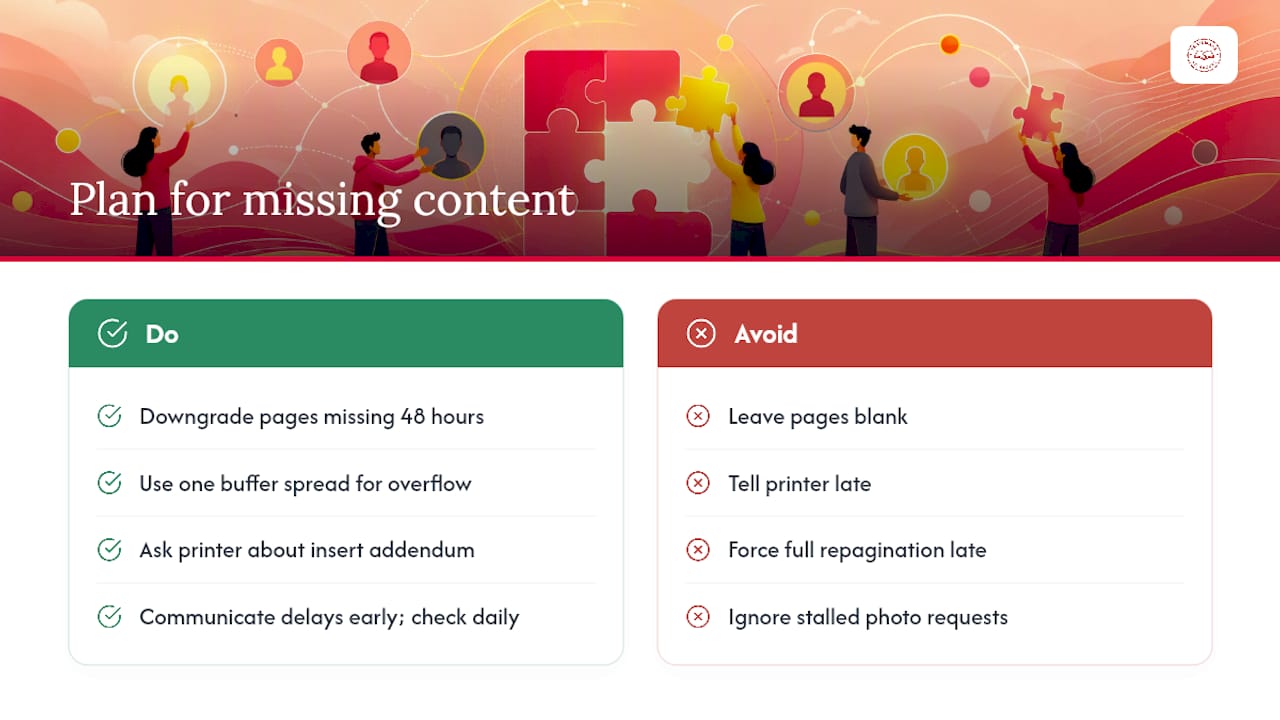
Set a hard internal rule: any page missing content 48 hours before your final check gets downgraded to a simpler template rather than left blank. A missing senior portrait becomes a candid group shot with a caption. A club with no submitted photos becomes a single-paragraph writeup pulled from the advisor's own memory or a quick text message to the club sponsor.
Keep one buffer spread in your layout that isn't assigned to anything specific. If a section falls through entirely, that spread absorbs the overflow instead of forcing a full repagination two days before deadline. Repagination is expensive in a rush job because it touches every page after the gap, not just the one that's missing.
If an entire section is genuinely unsalvageable, talk to your printer about a follow-up insert or an on-demand reprint addendum rather than delaying the whole book. Most production partners would rather ship the bulk of the book on time and handle a small addition later than push the full print run back a week.
Communicate delays early and specifically. Tell your printer contact exactly which pages are at risk and by when you'll know for certain, rather than staying silent until the deadline passes. A printer who knows about a two-page gap on Monday can often work around it; one who finds out Friday afternoon cannot. The same goes for your own team: a quick daily check-in, even five minutes, catches a stalled photo request before it becomes a missing page.
Short CTA: How TrailMark Can Help With a Last Minute Book
Some yearbook vendors offer instant online pricing with no sales calls or signup walls, and turnaround times around 2 to 3 weeks that fit books running behind. Quotes may be all-inclusive with shipping included, avoiding hidden fees that could affect a rush budget.

If you're staring down a printer deadline right now, request a sample to see the print quality before you commit, or head straight to the production and pricing page to see turnaround options and get a number for your school today. Free design help is available whether you're building in Canva, InDesign, or the online creator, so your last-minute pages don't have to look last-minute.
A Note From Jace
Every rushed yearbook I've reviewed had the same fix: someone finally wrote down a real internal cutoff. Set yours, split the roles, trust the staged proofing, and the book gets done.
— Jace
Sources
- How to design a yearbook: step-by-step guide for students & advisors | Touch Archive
- 10 tips for meeting yearbook deadlines | Friesens
- Everything you need to know about meeting yearbook deadlines | Julie Faulkner's blog
- Yearbook tutorial: how to create your first school yearbook with Mixbook
FAQ
Can You Order a Yearbook Late?
Yes, many printers including Trailmarkyearbooks accept last-minute orders, though you should confirm the exact hard deadline and file specs immediately since options narrow the closer you get to production cutoffs.
What Are Some Cool Ideas for a Yearbook When You're Short on Time?
Autograph pages, candid photo montages, six-up event grids, and a school-year timeline spread all deliver strong content fast without demanding original design work for every page.
Do Online Yearbooks Exist?
Yes, digital and hybrid yearbook formats exist as faster alternatives or interim options when a full print run isn't feasible on a tight timeline.
Can You Still Get a Yearbook Years Later?
Many production companies offer on-demand reprints of past yearbooks, so a missed year isn't necessarily lost, though availability depends on whether the original files were retained by the school or printer.