

Most yearbook advisers enter the school year with good intentions and a mental list of "things to get done." By February, that list has turned into a fire drill. The truth is that a well-structured yearbook production calendar is what separates teams that deliver a polished book on time from those scrambling at the last minute. Understanding what is yearbook production calendar means recognizing it as a living, year-round planning document that aligns your entire team around specific tasks, deadlines, and accountability checkpoints. This guide walks you through every phase.
Table of Contents
- Key takeaways
- What is a yearbook production calendar?
- The year-round timeline framework
- Key milestones and what makes them non-negotiable
- How to create your school's production calendar
- Common challenges and how to handle them
- My take: the calendar is your most important leadership tool
- How Trailmarkyearbooks supports your production timeline
- FAQ
Key takeaways
| Point | Details |
|---|---|
| Plan backward from delivery | Set your delivery date first, then work backward to assign every deadline and task across the school year. |
| Break the year into phases | Organize production into summer, fall, winter, and spring blocks with distinct goals for each period. |
| Hard deadlines are non-negotiable | Senior photo cutoffs and print submission dates cannot slip without serious consequences for the final book. |
| Assign roles inside the calendar | Every task on the calendar should have a name attached to it, not just a date. |
| Use tools that your team will actually use | Cloud-based, shared calendars reduce missed updates and keep everyone accountable in real time. |
What is a yearbook production calendar
A yearbook production calendar is a structured, year-round planning document that maps every major task, milestone, and deadline from the first day of staff recruitment through final delivery. It is not a single page with a few due dates. Think of it more like a project management system built specifically around the rhythms of your school year.
Yearbook production is a year-round process planned backward from the delivery date. That means your calendar does not start in January when the pressure builds. It starts in summer, often before school even begins. The backward-planning approach is critical because every phase depends on the one before it. If portrait sessions slip in October, your winter draft timeline collapses. If ad sales close late, your layout team loses weeks.
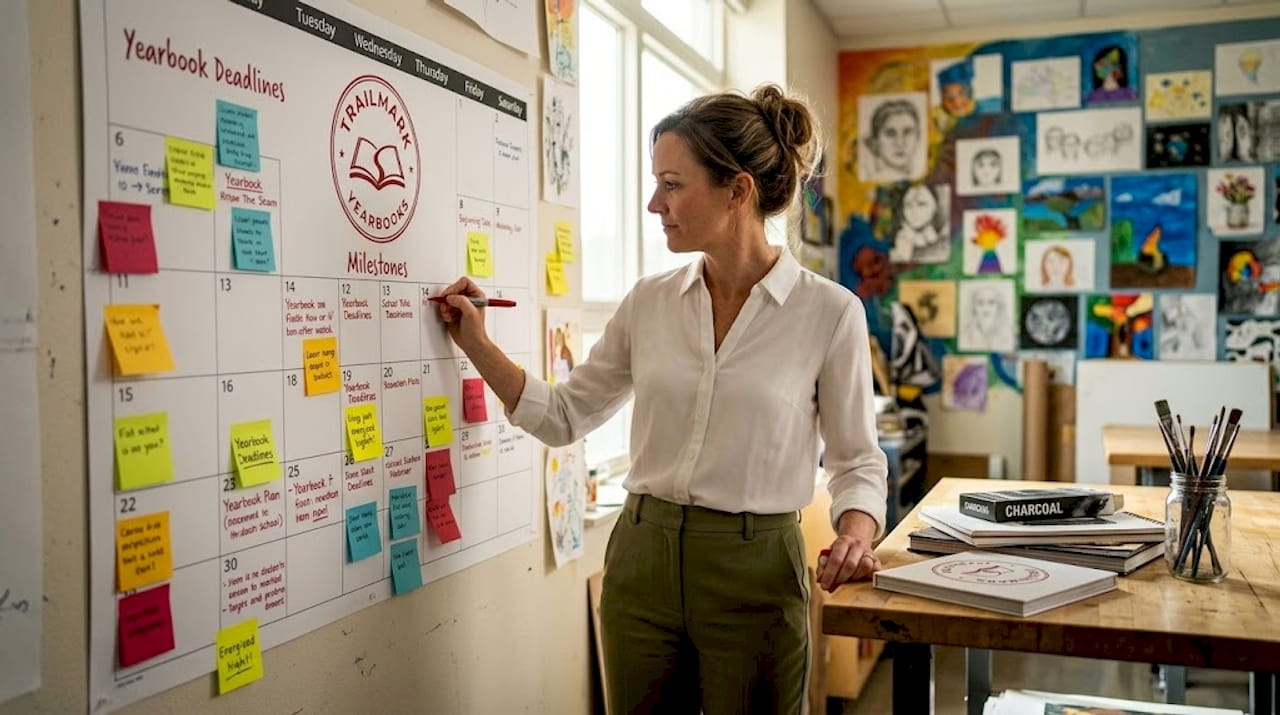
Advising a yearbook program is closer to running a mini-publishing company than supervising a school project. Budgets frequently exceed $100,000, and the stakes for missing a press deadline are very real. A production calendar is how professional advisers manage those stakes without burning out their staff.
The calendar also doubles as a communication tool. When every team member can see what is due, who owns it, and what comes next, you spend less time in status meetings and more time on actual production.
The year-round timeline framework
A strong yearbook planning schedule divides the school year into four distinct phases. Each phase has a specific purpose, and understanding that purpose helps your team stay focused rather than reactive.
Here is how the production year typically breaks down:
- Summer (June to August): Recruit and onboard staff, finalize the theme concept, get budget approval, and set up your design tools. This phase is entirely about infrastructure. Decisions made here shape everything downstream.
- Fall (September to October): Tasks during this block include staff training, portrait days, early event coverage, and initial content collection. This is your highest-volume photography window.
- Winter (November to December): Senior photo deadlines lock in, winter sports and events are covered, and ad sales close. This phase has the highest concentration of hard cutoffs.
- Early spring (January to February): First drafts are created, section editors review layouts, and internal proofing begins.
- Late spring (March to April): Final proofing rounds, last corrections, and submission to the printer. Marketing and pre-sale distribution follow in April through June.
The logic behind this structure is simple. The school year has natural pauses and peaks. Winter break, final exams, and spring sports all affect your team's availability. A yearbook timeline guide that ignores those realities will fail by December.
Pro Tip: Build your production calendar inside your school's existing academic calendar. Color-code exam weeks, holiday breaks, and major school events so your team can see potential conflicts before they happen, not after.
Key milestones and what makes them non-negotiable
The difference between a yearbook planning schedule and a wish list comes down to how seriously you treat your milestones. Some deadlines are flexible. Many are not.
Here is a breakdown of the most critical milestones by phase:
Summer milestones
- Staff selection and role assignments completed before the first day of school
- Theme concept finalized with design direction and color palette approved
- Budget reviewed and approved by administration
- Design software and access credentials set up for all staff members
Fall milestones
- Portrait days scheduled and confirmed with the photography vendor
- All staff trained on design tools and editorial workflow
- Fall sports and homecoming coverage assigned and completed
- Initial content collection begins for clubs, academics, and community events
Winter milestones
This is where the calendar becomes most critical. Senior photo submission deadlines are among the firmest in yearbook production. A typical hard cutoff falls around December 1, with late submissions replaced by stock school photos. Missing this deadline is not just an inconvenience for students. It creates layout gaps and can delay your entire first draft.
Ad sales also close during this phase. Senior recognition ads range in price from $45 for a one-eighth page to $225 for a full page, and families need several weeks of notice to submit them. If your ad sales calendar is vague, you will chase submissions into January, which pushes everything back.
Spring milestones
- First full draft reviewed by section editors and adviser
- Proofreading cycle one completed with corrections applied
- Final submission sent to the printer before the hard press deadline
- Proof copy reviewed and approved within the printer's correction window
The consequence of missing any of these spring milestones is not just a delayed book. It is a book that may arrive after graduation, which defeats its entire purpose.
| Phase | Key tasks | Consequence of missing |
|---|---|---|
| Summer | Staff hiring, theme, budget | Disorganized start, poor coverage planning |
| Fall | Portraits, training, event coverage | Missing photos, content gaps |
| Winter | Senior photos, ad sales | Delayed first draft, layout holes |
| Spring | Drafts, proofing, submission | Late delivery or missed graduation |
How to create your school's production calendar
Building your own yearbook production calendar does not require a specialized tool. What it requires is a clear process and consistent follow-through. Here is how to set it up in a way your team will actually use.
Start by pulling your printer's delivery date. That is your anchor point. Work backward from there, adding the final submission deadline, the proofing window, the first draft date, and every milestone above it. This backward-planning method forces realism into your schedule from the very first step.
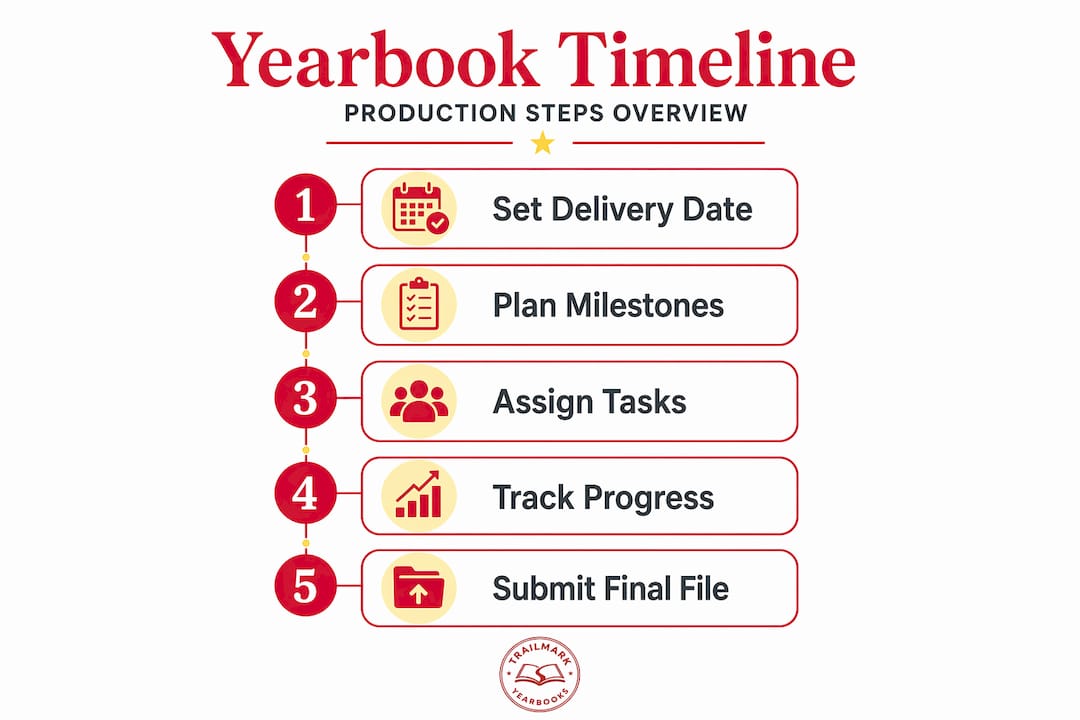
Next, assign every task to a specific person. A calendar with tasks and no owners is just a list of hopes. When your photography checklist is tied to a student's name, that student has accountability. Same goes for ad sales, section drafts, and proofing rounds.
Cross-reference your completed calendar against your school's academic and athletics calendars. Aligning with school event dates is one of the most overlooked steps in calendar creation. Most missed events in yearbooks come from teams that never checked whether a playoff game or a spring play conflicted with a layout deadline.
For your tools, consider these options:
- Google Calendar or Google Sheets: Free, shareable, and familiar to most students and educators
- Trello or Asana: Better for tracking task completion and assigning ownership across larger teams
- Your yearbook company's online platform: Many platforms include built-in deadline trackers and production checklists
- Printed master calendar posted in your classroom: Still one of the most effective visual accountability tools for student staff
Using cloud-based shared calendars improves both communication and deadline adherence, especially on teams where students rotate in and out of responsibilities throughout the year.
Build buffer time between your internal deadlines and the actual cutoffs. If your printer needs the final file by April 10, set your internal submission goal for April 3. That week of buffer has saved more than a few books from last-minute disasters.
Pro Tip: Run a brief weekly check-in, even five minutes, where section editors report on their progress against the calendar. Small slippage caught in week two is fixable. The same slippage discovered in week six is a crisis.
Common challenges and how to handle them
Even the best yearbook deadline overview does not prevent every problem. Here are the most common roadblocks and concrete ways to get past them.
-
Late senior photo submissions. This is the single most frequent issue in yearbook production. Counter it by communicating the deadline at least three times through different channels, including email, social media posts, and announcements. Make the consequence explicit: late submissions mean a stock school photo in the yearbook, not a personal one. This tends to motivate families more than any reminder alone.
-
Workload buildup around holidays and exams. December and April are brutal for student teams. Proactive planning means shifting your heaviest layout work to the weeks before those crunch periods, not during them. Build the school break into your calendar as a dead zone and plan accordingly.
-
Accountability gaps on student staff. Students change their schedules, quit, or lose motivation. When a section editor disappears in February, their section cannot disappear with them. Solve this by cross-training at least one backup for every major role, and document every assignment in your shared calendar so coverage is never locked inside one person's head.
-
Unexpected events changing your coverage plan. Schools reschedule events, add assemblies, and cancel games. Treat your coverage plan as a living document. Review it every two weeks and update assignments as needed. A team that adapts quickly stays on schedule. A team that waits for the adviser to notice the change does not.
-
Team motivation fading mid-year. The excitement of August rarely survives March. Transparent calendars help here because students can see the finish line. Celebrate milestones openly. When the first draft is done, say so. Recognition tied to the calendar keeps teams engaged through the final stretch.
My take: the calendar is your most important leadership tool
I have worked with yearbook teams that had great photographers, talented designers, and motivated students. Some of those teams still delivered mediocre books. Almost every time, the reason was the same. Nobody owned the timeline.
In my experience, advisers who treat the production calendar as a core leadership responsibility, not an administrative chore, consistently produce better books with less staff burnout. The calendar forces you to make decisions early when they are still low-stakes. It surfaces problems before they become emergencies. It gives students clarity about what is expected of them and when.
The advisers I have seen struggle most are the ones who believe their experience makes a detailed calendar unnecessary. That confidence is exactly what gets them into trouble in March. No one's memory is a substitute for a shared, updated, visible plan.
My top recommendation for anyone starting fresh: spend two hours in July building your calendar before you do anything else. Every hour you invest there saves three hours of panic later. And if you are recruiting yearbook staff for the first time, share the calendar with them during orientation. Students who see the full picture from day one are far more reliable than those who get information one deadline at a time.
— Jace
How Trailmarkyearbooks supports your production timeline

At Trailmarkyearbooks, we built our entire process around the reality that advisers are managing a year's worth of moving parts with limited time and support. Our adviser resources include planning templates, deadline checklists, and step-by-step guidance designed to plug directly into the kind of production calendar this article describes. Not sure what a finished yearbook should look like at each stage? You can request a sample yearbook to see production quality firsthand before committing to anything. And if you want personalized help building your timeline, our team is one click away at our rep contact page. No sales pitch. Just real support from people who have been doing this for decades.
FAQ
What is a yearbook production calendar?
A yearbook production calendar is a year-round planning document that maps all tasks, deadlines, and milestones from staff recruitment through final delivery. It is built backward from the printer's delivery date to keep every phase of production on track.
When should yearbook production planning start?
Planning should begin in summer, before the school year starts. Key setup tasks including staff hiring, theme development, and budget approval need to be complete before portrait season begins in the fall.
What happens if senior photo deadlines are missed?
Late senior photo submissions are typically replaced with stock school photos, with hard cutoffs often falling around December 1. Missing this deadline can also delay first drafts and disrupt the entire spring production schedule.
What tools work best for managing a yearbook calendar?
Shared digital tools like Google Calendar, Google Sheets, or project management platforms work well for teams. Cloud-based shared calendars improve communication and make it easier to update assignments and track progress across the full staff.
How many phases does yearbook production have?
Yearbook production typically breaks into five phases: summer setup, fall content collection, winter deadlines and ad sales, early spring drafting and proofing, and late spring final submission and distribution.