

Every yearbook needs an Editor-in-Chief, Managing Editor, Copy Editor, Photo Editor, Design Editor, and Business Manager, with the adviser overseeing all of it. These roles matter because they split the workload across coverage, quality, deadlines, and funding, and no single student can do all four alone. The immediate move for any adviser: assign leads this week and build your first production-ladder deadline around them.
TL;DR:
- Smaller yearbook teams benefit from clear role assignments and a beat list, which prevent overlapping responsibilities and coverage gaps during production.
- Grading staff performance based on specific deadlines and deliverables encourages accountability and improves overall quality control.
- Assigning optional specialist roles like index or social media early, even if part-time, avoids last-minute coverage issues and last-minute errors.
- Building a detailed production ladder with interim deadlines helps teams manage workflow and reduces crisis points before printing deadlines.
- Using a structured six-week training plan accelerates student readiness, ensuring actual spreads are produced early and deadlines are met efficiently.
Table of Contents
- What Are the Core Yearbook Staff Roles?
- Detailed Job Descriptions for Common Positions
- How to Structure Staff, Assign Beats, and Map Deadlines
- Grading, Accountability, and Quality Control
- Specialist and Optional Roles Worth Adding
- Launch and Training Checklist for the First Six Weeks
- Quick Production Tips From TrailMark Yearbooks
- How TrailMark Yearbooks Supports Busy Advisers
- Sources
- FAQ
- A Publisher's Take on Why Role Confusion Kills Yearbooks
What Are the Core Yearbook Staff Roles?
Each lead role carries a one-sentence mission. Once students understand that mission, the rest of the job description falls into place.
- Editor-in-Chief: Owns final approvals, budget decisions, and the daily class meeting agenda; this is the person who troubleshoots production problems, before they reach the adviser.
- Managing Editor: Runs the schedule, tracks which spreads are late, and keeps section editors accountable day to day.
- Copy Editor: Reads every caption, headline, and story for grammar, style, and factual accuracy before a spread ships.
- Photo Editor / Lead Photographer: Organizes the photo library, picks final images, and makes sure every photo has a correct caption.
- Design Editor: Builds page templates, keeps fonts and colors consistent, and trains staff on layout software.
- Business / Advertising Manager: Sells ads, runs fundraising, and promotes the finished book to families.
- Adviser: Holds final oversight, manages the vendor relationship, and controls grading and accountability.
These seven positions cover yearbook staff positions at nearly any school size. Smaller programs combine roles; larger programs add layers underneath each one.
Detailed Job Descriptions for Common Positions
Turn each role into a one-page sheet with purpose, weekly tasks, deliverables, and common pitfalls. That structure alone cuts down on the "wait, whose job was that?" conversations that eat class time.
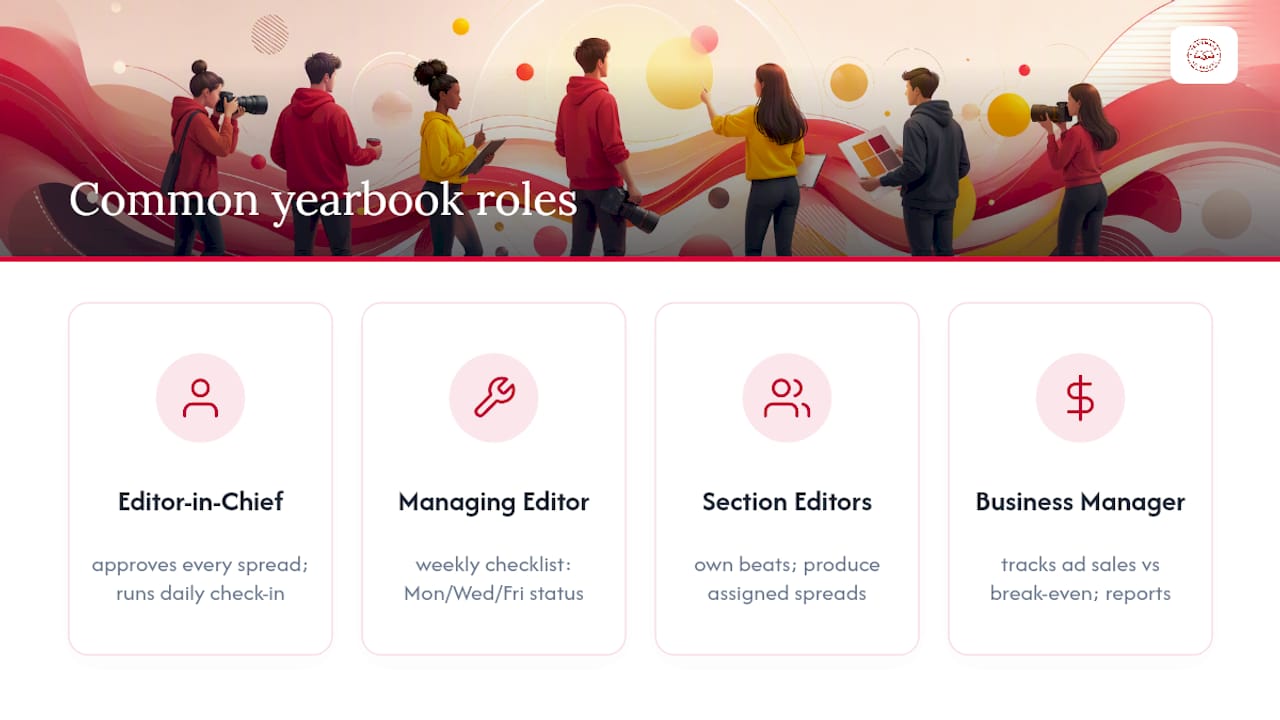
The Editor-in-Chief signs off on every finished spread, sits in on budget conversations with the adviser and business manager, and leads a short daily check-in. Deliverables: final spread approval, meeting notes, and a running list of unresolved issues. The most common pitfall is trying to personally fix every problem instead of delegating it to the right section editor.
The Managing Editor keeps a weekly checklist: staff check-ins on Monday, spread-status tracking by Wednesday, and a Friday report to the Editor-in-Chief. This role catches slipping deadlines two weeks before they become a crisis instead of two days.
Section editors and staff writers own specific beats, sports, clubs, academics, or portraits, and each beat has its own spread deliverable and due date. The club section is a good training ground for new writers since it has clear, repeatable structure.
The Copy Editor runs a two-pass workflow: a first read for clarity right after a draft comes in, and a final pass right before the spread locks. Photo and design roles work against a shooting quota, since photographers are expected to shoot a high volume with only a percentage coming back usable, which is why photo editors need buffer time built into every deadline.
The Business Manager tracks ad sales against a break-even target and reports progress at each staff meeting, often using a senior ads checklist to avoid overselling space that design hasn't planned for.
How to Structure Staff, Assign Beats, and Map Deadlines
Two structures dominate school yearbook programs. A small-generalist staff has everyone doing a bit of everything, writing, shooting, and laying out their own pages, which works fine under roughly 15 students. An editorial-board model splits leadership (Editor-in-Chief, Managing Editor, section editors) from production staff, which scales better past that size.
Either way, build a beat list before you assign a single spread. Sports, clubs, academics, portraits, and any recurring school event each need a named owner.
Pro Tip: Map your beat list against last year's book first. Whatever got skipped or rushed last year is exactly where this year's staff needs a dedicated owner.
Getting started:
- List every beat your school covers in a typical year.
- Assign one primary owner and one backup per beat.
- Convert your production ladder into interim deadlines, not just a final due date.
- Post spread ownership somewhere visible, a whiteboard or shared doc, so nobody wonders who owns what.
Grading, Accountability, and Quality Control
A workable rubric ties grades directly to deadlines and spread quality, not vague "effort" scores. Tie points to specific checkpoints: first draft submitted, copy edit completed, photos selected, final quality check signed off.
- First draft due, graded on completeness, not polish.
- Copy edit pass, graded on error count per spread.
- Photo selection, graded on caption accuracy and usable-photo ratio.
- Final sign-off, requiring both editor and adviser approval before a spread locks.
Many staff manuals build weekly beat checks directly into the rubric, which gives advisers an early warning system instead of a surprise at deadline week. In practice, Editors-in-Chief often help grade staff participation after each major checkpoint, which spreads accountability beyond just the adviser.
Specialist and Optional Roles Worth Adding
Not every staff needs these, but once you pass eight students, they start paying for themselves.
- Index editor: Checks that every student's name appears correctly and the target number of times; this role becomes worth a dedicated person once your staff grows past eight.
- Social media / events manager: Coordinates photo days and keeps the school community engaged before the book ships.
- Multimedia manager: Handles video or interactive content if your book includes a digital supplement.
Small staffs can fold index duties into the Copy Editor's job and hand social media to whoever already runs photo day logistics. Index and social media roles get overlooked often, but assigning them early closes coverage gaps that are painful to fix in March.
Launch and Training Checklist for the First Six Weeks
New staffs need a sequence, not just a role sheet. Here's a six-week ramp that gets students producing real spreads instead of just learning software.
- Week 1: Hand out role sheets, lock the theme, walk through your design software, and set photo-submission protocol.
- Weeks 2 to 3: Run timed caption-writing drills and copy-edit exercises, then practice template layouts on throwaway spreads.
- Weeks 4 to 6: Rotate real beat assignments, submit first spreads, and run your first round of rubric grading.
Templates and copy-ready role sheets save the most time in week one. Use whatever your school already has, or adapt a published staff manual instead of writing job descriptions from scratch.
Quick Production Tips From TrailMark Yearbooks
Three habits save real headaches: finalize captions before photo selection locks, keep a kill file of unused photos instead of deleting them, and schedule one final proof day before shipping. Vendor turnaround typically runs a few weeks, so build your internal deadlines around that window, not against it.
How TrailMark Yearbooks Supports Busy Advisers
Some yearbook production services give coordinators a way to hand off printing without losing control of design or budget. Where a traditional print vendor forces a choice between doing everything yourself or paying an agency premium, some providers offer instant, transparent pricing online, no sales calls, no hidden fees, with a typical turnaround of a few weeks and no order deadlines pressuring your staff's schedule.

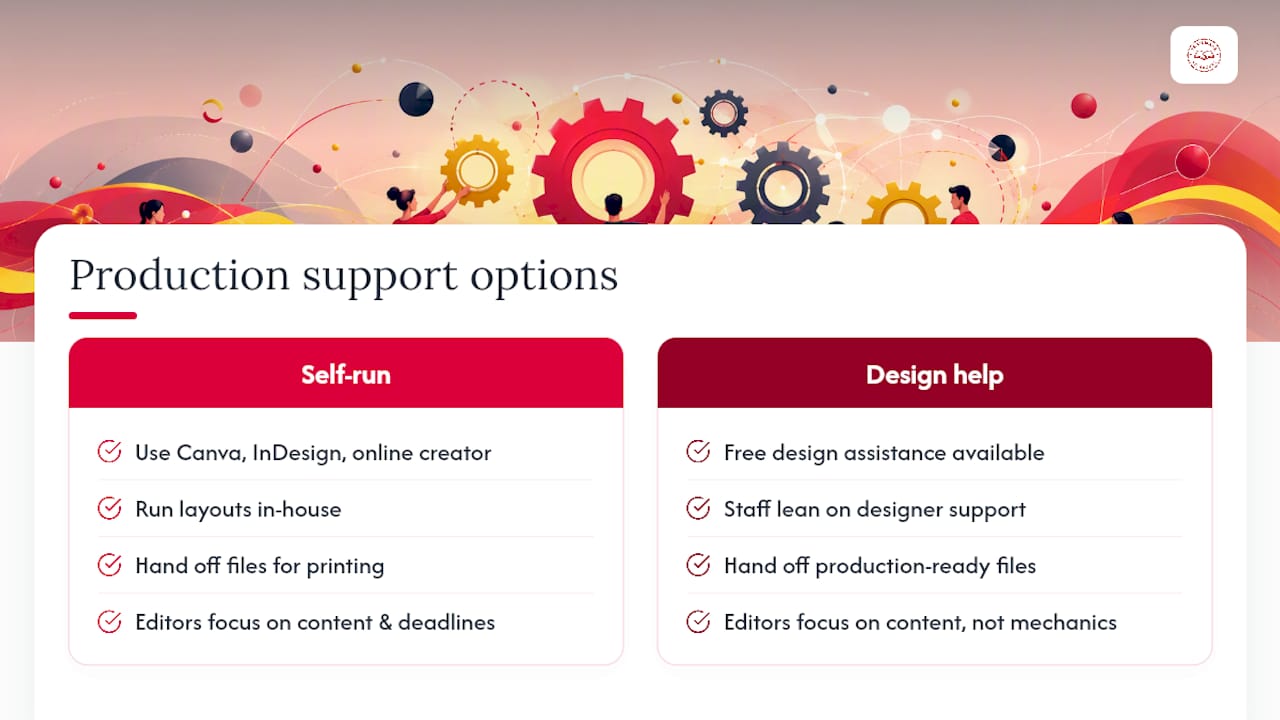
Staffs with strong design editors can run their own layouts in Canva, Adobe InDesign, or an online creator and simply hand off files for printing. Staffs stretched thin on time or design talent can lean on free design assistance instead, letting your Editor-in-Chief and Managing Editor focus on content and deadlines rather than production mechanics. Either path runs through the same production services, so nothing about staffing structure has to change based on which option you pick.
If you're weighing binding options, cover finishes, or freight costs while planning your budget, check current printing and binding pricing before locking your business manager's fundraising target. Getting a quote takes minutes, with no signup required.
Sources
Three staff manuals cover most of what's above in more detail: BHS's job descriptions include grading weight by role, Lincoln High School's manual covers weekly beat checks, and CHS's job descriptions list measurable staff goals.
FAQ
Why should a student join yearbook staff?
Yearbook staff gives students real deadlines, portfolio-worthy design and writing work, and leadership experience running meetings, managing budgets, or editing peers' work, skills that transfer directly to journalism, design, and management roles later.
What does a yearbook adviser do?
The adviser oversees the entire production ladder, manages the vendor relationship, controls grading and accountability, and makes final calls when editors reach an impasse, without doing the day-to-day writing or design work themselves. Read more on adviser responsibilities.
What skills does yearbook staff require?
Writing and editing for the Copy Editor role, photography and photo curation for the Photo Editor, layout software fluency for the Design Editor, and organizational or sales skills for the Managing Editor and Business Manager.
What sections make up a typical yearbook?
Most books cover student portraits, sports, clubs and organizations, academics, and school events, with each section assigned to a specific staff member or team as a beat.
How much does TrailMark Yearbooks cost?
Pricing varies by binding, cover finish, and add-ons like foil stamping or personalized covers; current printing and binding prices are listed on the TrailMark Yearbooks site with instant, no-signup quotes.
A Publisher's Take on Why Role Confusion Kills Yearbooks
Most yearbook programs don't fail because students lack talent. They fail because nobody wrote down who owns what, and by October, three people think they're in charge of the sports section while nobody's tracking the academics pages at all.
The conventional advice tells advisers to "build a strong team" and "communicate clearly," which sounds right and helps nobody. What actually works is boring: written role sheets, a rubric tied to specific checkpoints, and a beat list that assigns literally every page before the first deadline hits. The schools whose books arrive on time and mostly error-free aren't the ones with the most talented editors. They're the ones where a ninth grader can read a one-page job description and know exactly what Friday's deliverable is.
The specialist roles get skipped most often, and that's the real mistake. An index editor sounds like a luxury until you're fielding angry calls in May about a misspelled name that appeared four times. Assign that role in September, even if it's a part-time addition to someone's existing job, and you'll never have that call.
— Jace