
The greenest yearbook is the one where every printed copy ends up in a student's hands. For most schools, that comes down to three decisions: how many books you print, what paper and page count you choose, and whether you can add copies later instead of guessing everything up front. We built TrailMark around the last one: there are no order minimums and no submission deadlines, turnaround is 2 to 3 weeks, and on-demand reprints are available, so you can order closer to real demand.
This guide is for yearbook advisers and school administrators who want a measurably lower-impact book without a bigger budget or a longer production schedule.
TL;DR
- Paper is where most of a printed book's footprint sits, so fewer wasted copies and fewer unnecessary pages matter more than any single label on the cover.
- Right-size your run from prior-year sales and presales, then cover late demand with reprints instead of a large safety margin.
- Recycled content and certified sourcing are worth specifying, but pick them with the right numbers in hand (see the paper section below).
- Design choices such as page count and trim size are made before printing starts and shape the footprint of every copy.
- TrailMark offers instant all-inclusive pricing online, no order minimums, no deadlines, free design assistance and on-demand reprints.
Table of Contents
- What makes a yearbook eco-friendly
- Start with quantity: the biggest lever you control
- Choosing paper: what recycled content really tells you
- Design choices that shrink the footprint before printing starts
- Printed or digital: what the evidence says
- A year-round checklist for a greener yearbook program
- Our perspective
- See your price and plan your run
- FAQ
- Sources
What makes a yearbook eco-friendly
A yearbook is a printed book, so its footprint follows the same pattern as other printed products. A Cal Poly graphic communication study found that tree harvesting, paper production and printing together account for about 65% of the print industry's carbon footprint. The Green Book Alliance, a sustainability group for publishers and printers, says paper production is usually the largest share of a book's carbon footprint.
For an adviser, that gives a simple rule: the best way to cut impact is to use less paper per student actually served. That means:
- Print the right number of copies. A book that is never picked up carries the full footprint of one that is treasured.
- Print the right number of pages. Every blank or filler page is paper you pay for and the planet absorbs.
- Choose paper deliberately. Recycled content and responsibly sourced fiber reduce the virgin wood behind each copy.
- Avoid reprinting or rushing. Late corrections and emergency reorders waste material and time.
If you want to compare paper choices on evidence rather than labels, the Paper Calculator from the Environmental Paper Network uses a life cycle assessment, which counts impacts from raw materials through disposal. Its version 4.1 draws on North American industry data, including more than 300 mills. The EPA also points to this calculator for comparing wood use, energy, emissions and water across paper choices.
Start with quantity: the biggest lever you control
Most advisers feel pressure to order a little extra "just in case." The cost of that habit is paper, ink, freight and storage space for books nobody wanted. Publishing Scotland's carbon guide notes that print-on-demand for runs under 1,000 copies eliminates emissions wasted on overproduction. Most school yearbook runs sit comfortably under that figure, so the principle applies directly to you.
A practical way to size your order:
- Start with last year's sales. School Photographers of America advises schools to estimate sellable books from prior-year sales and not to order more than a handful above that number.
- Use presales as your real number. A presale window turns a guess into a count. The same guidance recommends using presales to set quantities.
- Plan a small cushion, not a large one. A few extra copies for staff, the library and late buyers is reasonable. Hundreds is not.
- Account for school size. Enrollment changes the per-book math, and our guide on why school size affects yearbook pricing walks through it.
Our quantity ordering checklist for advisers turns this into a step-by-step routine you can run before you submit.
Why flexible ordering matters for waste
The reason advisers over-order is usually fear of running out, because many printers set minimums and deadlines that punish late demand. When there is no order minimum and no submission deadline, the fear loses most of its force. You can order for the students who have committed, and if a late wave of families asks for copies, an on-demand reprint covers them. That is the structure we offer, and it is the practical route to a lean print run.
Choosing paper: what recycled content really tells you
Paper decisions are where "eco-friendly" gets confusing, because the labels vary. A few facts help you decide with confidence.
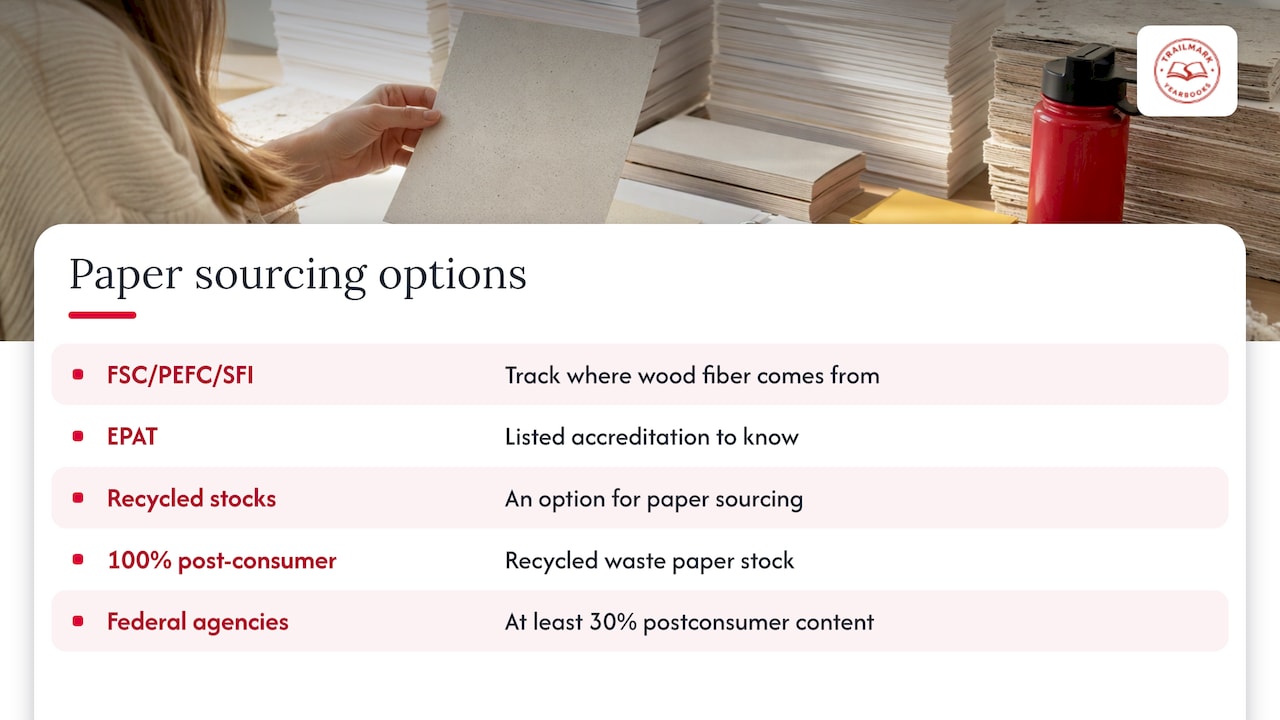
Recycled content is a spectrum. The EPA's paper guidance states that federal agencies must acquire paper with at least 30% postconsumer recycled content. That is a useful reference point when you write a paper specification for your own book. Postconsumer means the fiber came from paper that had already been used by consumers and recovered, not from mill trimmings.
Sourcing matters as much as content. The Green Book Alliance's guide lists the accreditations worth knowing about: FSC, PEFC, SFI and EPAT. FSC, PEFC and SFI are forest certification programs that track where wood fiber comes from. It also points to recycled stocks, such as 100% post-consumer waste papers, as an option.
Trade-offs are real, so decide with your budget in view. In the Cal Poly study, editors cited technical, budget and appearance concerns about going sustainable, and only 15% of 200 alumni magazines in the sample used recycled paper, most at just 10% recycled content. That is a 2010 snapshot, but it explains why recycled stock is still a deliberate choice rather than a default. Settle your paper choice early in planning, when the budget conversation is still open.
For a plain-language tour of the stocks and finishes available for school books, read our yearbook paper options explained for staff. If paper is part of your sustainability plan, that is the page to have open while you plan.
Design choices that shrink the footprint before printing starts
Publishing Scotland's guide makes a point advisers rarely hear: design decisions bake in emissions before a press ever runs. Its high-leverage moves include standardizing trim sizes and designing to 32-page signatures so no blank pages are printed. A signature is a large sheet printed and folded into a block of pages, and page counts that do not fit that block leave waste.
For a yearbook team, that translates into habits you can adopt this year:
- Build your page count deliberately. Decide the number of spreads early, then fill them with real content rather than padding at the end.
- Cut low-value pages. Duplicate group photos and half-empty spreads add weight without adding memories.
- Keep the layout efficient. The EPA's office-printing guidance shows how much page layout matters: cutting margins from 1 inch to 0.5 inch raises the usable area of a sheet from 63% to 80%. A yearbook is not an office document, but the principle holds: thoughtful layout puts more content on every page.
- Finish proofs on screen first. Fewer printed corrections means less waste. Our risk management checklist for yearbook printing covers the checks that prevent costly reprints.
A team that starts early also designs better. Our guide to yearbook design help for schools shows how a school can get its book underway in two weeks. At TrailMark, design assistance is free, and you can work in Canva, Adobe InDesign or our online creator, so students use tools they already know.
Printed or digital: what the evidence says
Schools often ask whether going digital is automatically greener. The research says the answer depends on how the book is used, not on the medium alone.
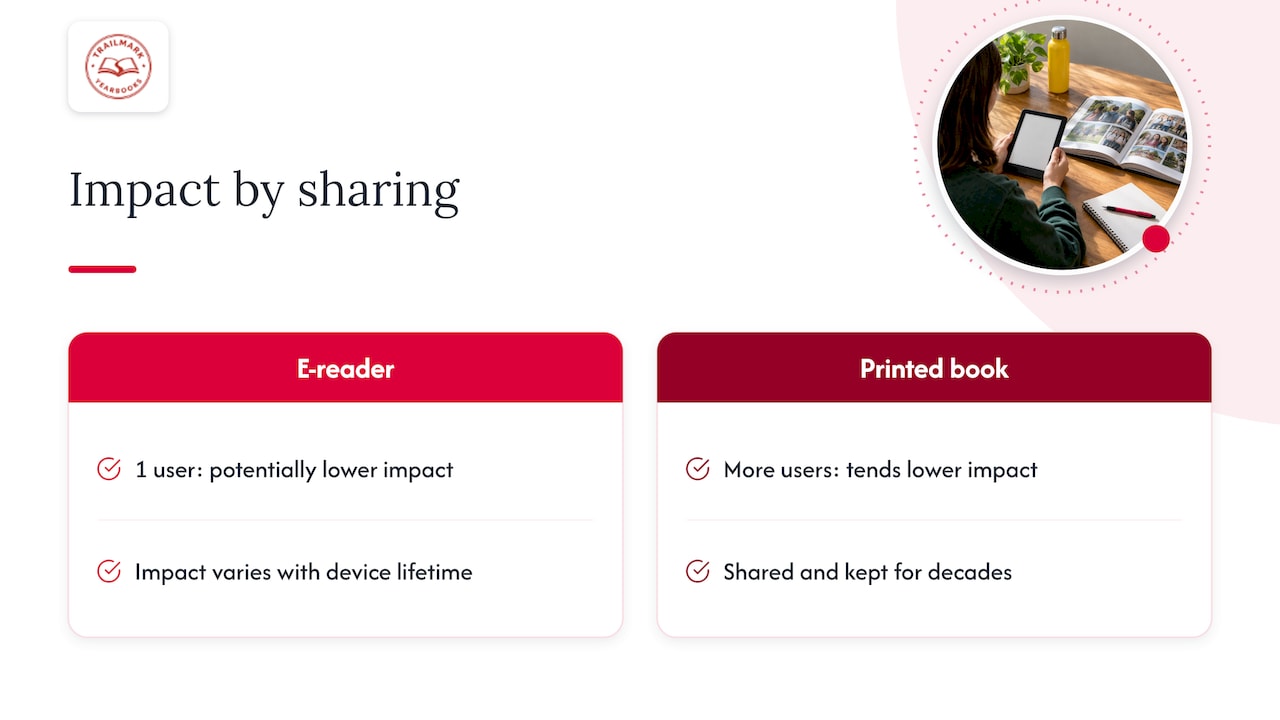
A 2012 Rochester Institute of Technology thesis comparing an e-reader with a printed book found that with one user per book the e-reader may have less impact, but as the number of users per book increased, the printed book tended to have less impact. A yearbook is a shared object: it is passed around at signing parties, kept on shelves, pulled out at reunions and shown to family for decades. Broader reviews agree that results swing widely with assumptions. A systematic review in Environmental Research Letters found that device lifetime, how many people use an item and what it replaces can lead to very different energy estimates.
The takeaway for your planning: a well-sized printed book that is kept and shared is a sound sustainable choice, and the footprint question is mostly about not printing more than you need.
A year-round checklist for a greener yearbook program
Use this as a working list for your yearbook room and your budget meeting.
- Count first. Pull last year's sales, then run a presale and use that count to set your starting quantity.
- Set a small cushion. Add a handful of copies for staff and late buyers, not a large reserve.
- Write a paper spec. Name the recycled content you want and the sourcing programs you prefer, using the reference points above.
- Fix your page count early. Plan the spreads, then fill them with content that earns its place.
- Send clean files. Proof on screen and follow a pre-flight routine so you do not pay for a reprint of an error.
- Plan for late orders. Decide in advance how you will serve families who ask after the presale closes.
- Write it down. A short policy keeps the approach consistent when advisers change. Our school yearbook policy best practices gives you a starting point.
- Keep the budget honest. Sustainable choices are easier to defend when they sit inside a clear plan; see our 2026 yearbook budget planning guide.
Our perspective
Advisers tell us they want a book they feel good about, and they also want to stop losing sleep over one number: how many to order. Those two worries are connected. When a printer demands a big minimum or a hard deadline, the school pads the order, and the padding becomes waste.
That is why we built TrailMark the way we did. You get instant, all-inclusive pricing online with no signup, no sales pitch and no hidden fees, and shipping is included. There are no order minimums and no submission deadlines. Turnaround is 2 to 3 weeks, and on-demand reprints are available, so a late request does not force you to over-order in September to stay safe in May.
We also think a greener book starts with a calmer production schedule. Our free design assistance, a dedicated adviser and a team with more than 50 years of combined experience are there so your students spend their time on the pages rather than on rework. Fewer corrections and a right-sized order are the most practical sustainability steps most schools can take.
Jace
See your price and plan your run
If you are ready to size an order, you can see TrailMark's all-inclusive pricing online without signing up or talking to a salesperson. Our production services cover printing, on-demand reprints and optional full-service design, with a dedicated adviser and a password-protected online resource hub for curriculum and design materials.
Start at trailmarkyearbooks.com to get your school's price. Middle schools and K-8 programs can choose to design their own yearbook or have us create it, and the printing options page lists binding and cover choices with per-book pricing.
FAQ
Are recycled paper yearbooks worth specifying?
Yes, when you set a clear target. A good reference point is the EPA's standard of at least 30% postconsumer recycled content for federal paper purchases. Settle your paper choice at the start of planning so it fits the budget, and see our paper options guide for the stocks school books commonly use.
What is the single most effective way to make a yearbook greener?
Print closer to real demand. Paper production is usually the largest share of a printed book's footprint, so every copy that is never picked up is the most avoidable impact. Use prior-year sales and presales to set your run, and plan reprints for late requests.
Is a digital yearbook always more eco-friendly than a printed one?
Not necessarily. Research comparing digital and printed books finds that results depend on how many people use each item and on device lifetime. A printed yearbook is shared, kept and revisited by many readers, which works in its favor.
How can my team reduce waste during production?
Fix your page count early, proof on screen, and send clean files so you avoid paying for reprinted errors. Standardized sizes and page counts that fit the printer's signatures also reduce blank pages.
Does TrailMark have order minimums or deadlines?
No. We have no order minimums and no submission deadlines, and turnaround is 2 to 3 weeks. On-demand reprints are available for later requests.
Sources
- Paper Calculator v4.1 Methodology Summary, Environmental Paper Network
- Digital and Printed Magazines' Effects on the Environment, Cal Poly
- Printer-Publisher Sustainability Guide, Green Book Alliance
- Individual Book CO2 Footprints, Publishing Scotland
- Reducing Paper and Printer Ink Usage, U.S. EPA
- Yearbook Best Practices: Building a Successful Program, School Photographers of America
- Kindle vs. Printed Book: An Environmental Analysis, Rochester Institute of Technology
- Digitalisation of goods: a systematic review, Environmental Research Letters