

A strong, well-developed yearbook theme measurably increases student engagement by creating emotional connection, editorial focus, and clear opportunities for student participation. When students recognize a motif tied to shared school experiences, they feel ownership over the book and are far more likely to submit photos, show up to events, and actually buy a copy. Three mechanisms drive this: emotional resonance (students see themselves in the story), cohesive narrative (every spread reinforces a single idea), and participatory marketing (teasers, contests, and calls-to-action tied to the theme give students a reason to care before the book ships).
The practical implication is straightforward. Run a 20-minute ideation session with your student editors this week, narrow to one implementable theme brief, and you have the foundation for every design, photo, and promotion decision that follows.
- Emotional connection: A theme grounded in real school moments creates the feeling that the book belongs to students, not just the yearbook staff.
- Cohesive narrative: One central idea gives section editors a filter. When a spread doesn't fit the theme, the editor knows to revise it.
- Participatory marketing: Theme-based teasers, hashtags, and photo contests pull the broader student body into the process months before the book arrives.
Pro Tip: Pick a theme you can photograph. If you can't picture at least ten distinct images that represent the idea, the theme is too abstract to execute consistently.
Table of Contents
- Why yearbook themes improve engagement: goals and success signals
- How do you generate strong yearbook theme ideas?
- What makes a yearbook theme actually work?
- Turning your theme into a consistent visual and editorial system
- How to promote your theme all year and actually build momentum
- Common theme mistakes and how to fix them fast
- Ready-to-use theme examples with execution notes
- Does research actually support themed design for engagement?
- Key Takeaways
- The part most advisers underestimate
- Trailmarkyearbooks makes theme-driven yearbooks easier to produce
- Useful sources and further reading
Why yearbook themes improve engagement: goals and success signals
Before you pick a theme, define what success looks like at your school. A theme that works at a 2,000-student high school may fall flat at a 300-student elementary school, and the reverse is equally true. Outcome-driven selection prevents the most common mistake: choosing a theme because it sounds good in a meeting rather than because it serves the book.
According to Jostens adviser guidance, a theme is the single most powerful force behind the yearbook process. That framing is useful because it reframes the theme as a production tool, not just a creative choice. With that in mind, aim for these five outcome goals when selecting and pitching a theme to your team.
Five outcome goals for a yearbook theme:
- Student buy-in — Students outside the yearbook staff can describe the theme and feel represented by it.
- Clearer staff roles — Editors and photographers know what to shoot and what to cut without asking the adviser every time.
- Smarter photo coverage — The theme creates a natural checklist of moments, groups, and settings that need to be documented.
- Higher yearbook sales — A recognizable theme gives students a reason to want the book before it arrives.
- Increased submissions — Students submit more photos and features when they understand the theme and see a clear purpose for their contribution.
Goal-setting prompts for staff meetings:
- "What is the one thing students will remember about this school year?"
- "What moments do we consistently fail to capture, and does our theme give us a reason to capture them?"
- "How will we know in March whether the theme is working?"
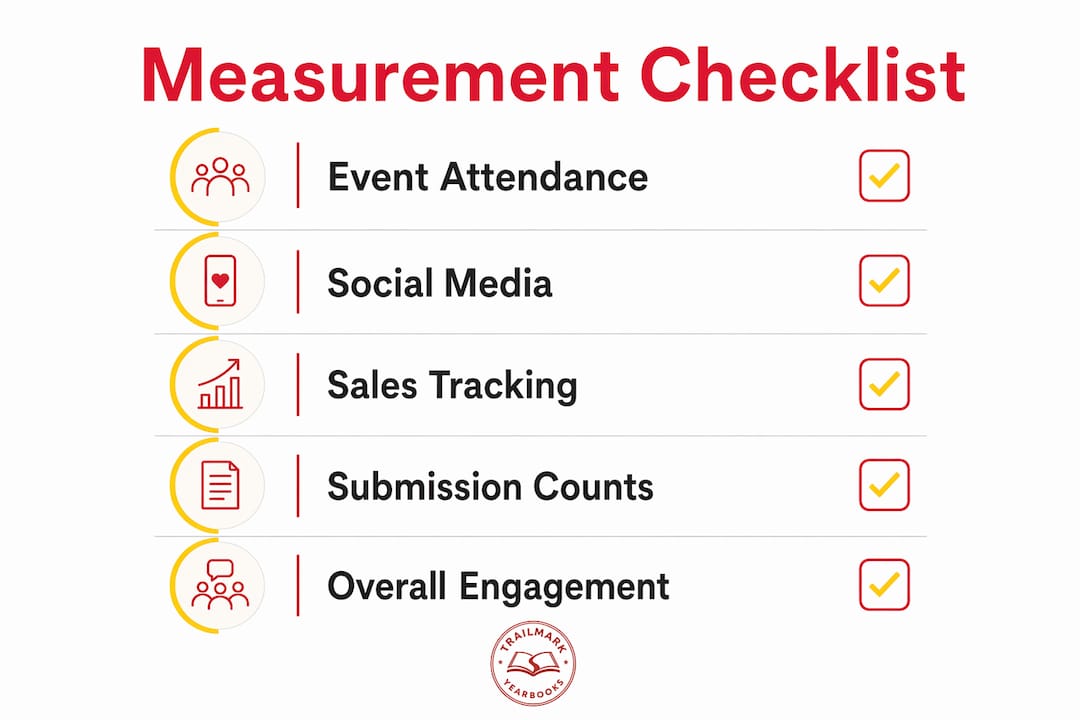
For success indicators, keep it simple. Track attendance at theme-based photo events, count social media interactions on theme teasers, and log the number of student-submitted features each month. You don't need analytics software. A shared Google Sheet updated weekly by a student editor is enough. Printed yearbooks build school community in ways that themes amplify directly, so the investment in a clear theme pays off in both the book and the culture around it.
How do you generate strong yearbook theme ideas?
Most weak themes come from weak ideation. A five-minute brainstorm at the end of a staff meeting produces generic ideas: "Together," "Our Story," "Rise." Those aren't bad words, but they aren't themes. A theme needs enough specificity to drive design decisions and enough flexibility to cover every section of the book.
Two structured exercises reliably produce better candidates.
Activity 1: Fast ideation and dot voting (20 minutes)
- Give every participant five sticky notes and three minutes of silent writing. One idea per note.
- Post all notes on a wall or whiteboard without discussion.
- Group similar ideas into clusters. Name each cluster in three words or fewer.
- Each participant gets three dot stickers. Vote on clusters, not individual notes.
- The top two or three clusters become your theme candidates for deeper development.
Sample prompts to read aloud before the silent writing phase:
- "What moment from this school year would you most want to show a student ten years from now?"
- "What does our school do that no other school does?"
- "What would students say if you asked them what this year felt like?"
- "What do we not want this yearbook to be about?" (This negative prompt often surfaces the most honest answers.)
Activity 2: Affinity mapping with photographed moments (30–45 minutes)
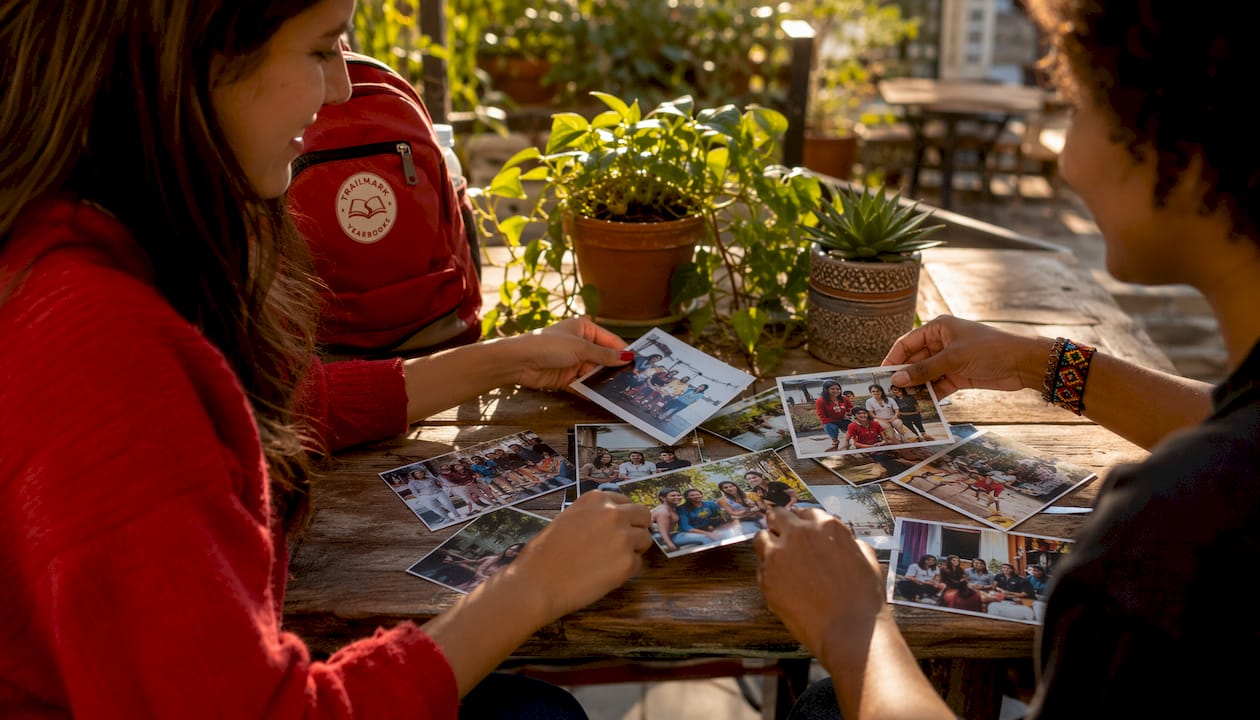
Print 20–30 photos from the current school year and spread them on a table. Ask participants to group photos by feeling, not by event. Label each group with an emotion or a phrase. The groups that generate the most discussion usually point toward the strongest theme territory.
This exercise works especially well with a mixed group of students and staff because it grounds the conversation in real images rather than abstract ideas. Harvard Business Review research on group brainstorming consistently shows that structured individual ideation before group discussion produces more and better ideas than open group brainstorming alone, which is exactly what both activities above are designed to do.
What makes a yearbook theme actually work?
Not every idea that survives the ideation session deserves to become a theme. Before committing, run each candidate through a quick two-part checklist: creative criteria and operational criteria.
Creative criteria
Emotional relevance — Does the theme connect to something students actually experienced this year, or is it aspirational in a way that feels disconnected? "Finding Our Way" works if the school navigated real change. It falls flat if the year was uneventful.

Visual flexibility — Can the theme generate at least five distinct visual motifs? A theme built around a single image (a specific building, one color) will exhaust itself by the third section. A theme built around a concept (light, movement, roots) can produce dozens of visual interpretations.
Verbal shorthand — Every strong theme has a tagline short enough to fit on a poster and specific enough to mean something. "We Were Here" is better than "Our School Year 2026." The tagline becomes the thread that connects cover copy, section openers, and social posts.
Storytelling hooks — The theme should suggest natural narrative questions. "What brought us here?" "What did we build?" "What did we leave behind?" Those questions become caption prompts, interview starters, and spread concepts.
Operational criteria
Scalability — The theme must work on the cover, endsheets, section dividers, senior spreads, club pages, and candid sections without looking forced. Test it mentally against your most difficult section before committing.
Ease of promotion — Can a student explain the theme to a friend in one sentence? If not, it's too complex to promote effectively.
Inclusivity check — Does the theme represent the full range of students at your school, including students who don't participate in sports, clubs, or high-profile events? A theme centered on athletics, for example, will alienate a significant portion of the student body. Review yearbook inclusion and accessibility planning before finalizing any theme that leans heavily on one group or activity.
Policy alignment — Confirm the theme doesn't conflict with school communication guidelines or district policies before you invest design time in it.
Turning your theme into a consistent visual and editorial system
A theme that lives only in the adviser's head will be applied inconsistently. The fix is a one-page theme brief every editor, photographer, and designer can reference without asking questions.
One-page theme brief template
| Element | What to include |
|---|---|
| Core idea | One sentence describing the central concept and emotional tone |
| Tagline | 3–5 words, usable on cover, posters, and social posts |
| Visual motifs | Three specific images or design elements that represent the theme |
| Color notes | Two primary colors and one accent; hex codes if possible |
| Font style | Serif or sans-serif direction; one headline font, one body font |
| Dos | Three specific things editors should do to apply the theme |
| Don'ts | Three specific things that would undermine the theme |
Keep the brief to one printed page. A brief that requires scrolling won't get read. Flexible design tools make it easier to apply the brief consistently across sections without rebuilding layouts from scratch each time.
Photo direction for staff and student photographers
- Shoot for the feeling of the theme, not just the subject. A theme about "roots" calls for photos of hands, hallways, and familiar faces, not just the school building.
- Prioritize candid moments over posed shots. Candids carry more emotional weight and are harder to fake.
- Identify three recurring lighting conditions that match the theme's tone (warm and golden for a "legacy" theme; clean and bright for a "new chapter" theme) and brief photographers before each event.
- Create a shot list tied to the theme for every major event. Photographers who arrive without a shot list default to the obvious images.
Adapting theme assets across sections
Senior spreads, club pages, sports sections, and candid pages each have different visual demands. The theme brief should include one adaptation note per section type so editors don't have to guess.
Pro Tip: Don't apply the theme's primary visual motif to every single element on every spread. Use it as a punctuation mark, not wallpaper. One strong thematic element per spread is more effective than five weak ones.
How to promote your theme all year and actually build momentum
A theme that students don't know about can't increase engagement. Promotion isn't a one-time announcement. It's a season-long campaign with a few well-timed touchpoints.
A simple four-phase timeline
Phase 1: Reveal (September–October) Tease the theme before you announce it. Post a single visual element on the school's social accounts with no explanation. Put a small motif on a poster in a high-traffic hallway. Let students speculate. The reveal itself should feel like an event, not a memo.
Phase 2: Mid-year tease (November–January) Reinforce the theme through student-facing mechanics. A photo-of-the-week contest tied to the theme, a classroom prompt that asks students to submit a photo representing the theme's tagline, or a themed photo booth at a winter event all work well. School event entertainment ideas can help you plan low-cost theme activations that fit a school budget.
Phase 3: Build to sales (February–March) Connect the theme directly to the sales pitch. "This is the book that tells the story of [tagline]. Pre-order now." Show students a preview spread that demonstrates the theme in action. When students can see what they're buying, conversion rates improve.
Phase 4: Launch (April–May) The book's arrival should feel like a payoff. A themed distribution event, a social post showing the cover, and a call for students to share their favorite spread all extend the theme's life beyond the book itself.
Low-budget promotion tactics that work
- Staff shirts featuring the tagline worn on picture day and at events
- In-class prompts distributed to teachers asking students to submit one photo that represents the theme
- A theme-specific hashtag used consistently across all school social accounts
- Themed photo frames at dances, games, and assemblies (a cardboard frame with the tagline costs almost nothing to produce)
Consistent thematic and mechanical alignment, where the theme's visual language shows up in every contest, post, and event, sustains student interest far longer than a single announcement. This is the same principle that makes themed digital experiences so effective at driving repeat engagement: when every touchpoint reinforces the same world, users (or students) feel immersed rather than marketed to.
Common theme mistakes and how to fix them fast
Even well-chosen themes can go sideways in execution. Most problems fall into a handful of predictable categories.
Selection mistakes:
- Chasing a trend — A theme built around a specific meme, song, or pop-culture moment will feel dated by the time the book ships. Pick a concept with a longer shelf life.
- Too narrow — A theme that only applies to one grade level, one sport, or one demographic will alienate the rest of the school. If you can't picture every student group represented in the theme, widen it.
- Too abstract — "Infinity," "Essence," "Beyond" are not themes. They're words. A theme needs a concrete visual anchor.
Execution mistakes:
- Insufficient buy-in — If the student staff didn't participate in selecting the theme, they won't apply it consistently. Run the ideation session with students, not just advisers.
- Visual clutter — Applying too many theme elements to a single spread creates noise. One strong motif per spread, as noted in the design section, is the rule.
- Inconsistent application — When the cover uses the theme and the club section ignores it, the book feels disjointed. The one-page brief and a section-by-section review at mid-year prevent this. Reviewing common yearbook design errors before production begins catches most inconsistency problems early.
Inclusivity and sensitivity:
- Before finalizing the theme, ask: does this theme require students to have participated in a specific activity, belong to a specific group, or share a specific background to feel represented? If yes, revise.
- Run the tagline and visual motifs past a small group of students from different backgrounds before committing. What reads as neutral to the adviser may carry unintended associations for students.
Ready-to-use theme examples with execution notes
The following themes work across elementary, middle, and high school settings. Each includes a sample tagline, a primary visual direction, and a note on where it works best.
| Theme concept | Sample tagline | Visual direction | Best for |
|---|---|---|---|
| Roots | "Where We Grew" | Hands, hallways, founding photos, close-up textures | Schools with strong history or tradition |
| Light | "Bright From Here" | Window shots, golden-hour candids, high-contrast portraits | Any school; visually flexible |
| Maps and paths | "Every Road We Took" | Aerial views, footprints, journey metaphors | Schools with major transitions (new building, new principal) |
| Chapters | "Our Story, Our Pages" | Book-inspired layouts, typewriter fonts, library settings | Literary-focused schools; strong English programs |
| Seasons | "All Four of Us" | Color-coded by season, outdoor candids, weather moments | Schools with distinct seasonal events |
| Voices | "Heard" | Portraits with quotes, microphone motifs, speech-bubble graphics | Schools with strong performing arts or debate programs |
| Home | "This Is Where We Belong" | Interior spaces, group shots in familiar settings, warm tones | Elementary schools; community-focused schools |
| Momentum | "Still Moving" | Action shots, motion blur, dynamic layouts | Athletic-heavy schools; high-energy student bodies |
| Connections | "Linked" | Hands together, group candids, network-style graphic elements | Schools emphasizing collaboration or new programs |
| Discovery | "What We Found" | Science, nature, exploration imagery; curiosity-driven captions | STEM-focused schools |
Mini execution example: "Light" at a small school
A small middle school adopted "Bright From Here" as its theme after a difficult year. The staff identified three visual motifs: window light, student smiles in natural settings, and the school's yellow hallway lockers. The tagline appeared on the cover, on section openers, and in a social media teaser campaign that asked students to submit a photo of "something bright in your school day." Submissions doubled compared to the previous year. The endsheets used a gradient from deep blue to gold, and senior ads carried a small sun icon that tied back to the cover. The consistency made the book feel intentional rather than assembled.
Execution prompts you can paste into briefs:
- For photographers: "Shoot for warmth. Every image should feel like something worth remembering."
- For section editors: "Before you place a spread, ask: does this page feel like it belongs in our book, or could it belong in any school's book?"
- For designers: "Use the theme's primary color as a punctuation mark, not a background. Let the photos carry the story."
Does research actually support themed design for engagement?
The short answer is yes, and the mechanism is well-documented. Themed environments, whether digital or physical, create what designers call a coherent environmental narrative. Every element reinforces the same world, and that consistency reduces cognitive friction. When readers don't have to work to understand the visual language of a page, they spend more time with the content itself.
Structured content themes raise reader retention and engagement metrics compared with non-themed content, with themed content showing higher average session duration and return visit rates. In digital contexts, thematic design can triple average session duration by inducing a flow state, the psychological condition where a person is so absorbed in an experience that they lose track of time. The yearbook parallel is direct: a student who opens a book with a strong, consistent theme is more likely to keep turning pages, more likely to show it to a friend, and more likely to submit content the following year.
Themes also increase participation when they're paired with student-facing mechanics. When thematic and mechanical alignment is consistent, contests, badges, and submission calls tied to the theme motivate students and sustain interest through narrative-driven participation rather than one-off announcements.
Measurement checklist for advisers
| Metric | How to track it | What success looks like |
|---|---|---|
| Event attendance | Sign-in sheets at theme-based photo events | — |
| Theme hashtag use | Manual count or school social account analytics | Consistent weekly posts from non-staff students |
| Yearbook pre-orders | Sales tracking spreadsheet | Pre-orders up before February deadline |
| Student submissions | Monthly log kept by section editors | Submissions increase month-over-month |
| Social engagement | Likes, shares, comments on theme teasers | Engagement higher on themed posts than generic posts |
Small-scale tests to try this semester
Run two versions of a theme teaser: one that shows the tagline and one that shows only a visual motif with no text. Track which generates more comments or questions. That's a simple A/B test that tells you whether your verbal or visual hook is stronger, and it costs nothing to run. A themed photo frame at one event versus a standard backdrop at another gives you a similar comparison for in-person participation.
Key Takeaways
A well-executed yearbook theme increases student engagement by unifying the book's narrative, giving staff clear creative direction, and creating participatory moments that pull the broader student body into the process.
| Point | Details |
|---|---|
| Theme drives measurable outcomes | Track event attendance, submission counts, and pre-orders to confirm the theme is working. |
| Ideation needs structure | Use silent individual brainstorming before group discussion to generate more and better theme candidates. |
| A one-page brief prevents drift | List tagline, three visual motifs, color notes, and dos/don'ts so every editor works from the same reference. |
| Promotion is a season-long campaign | Reveal, tease, build to sales, and launch with distinct touchpoints from September through May. |
| Trailmarkyearbooks supports theme execution | Free design assistance, fast 2–3 week turnaround, and adviser resources reduce the production workload for theme-driven books. |
The part most advisers underestimate
The hardest part of a yearbook theme isn't choosing one. It's sustaining it. Most advisers I've spoken with describe the same pattern: the theme is strong in September, visible in October, and quietly abandoned by February when deadlines pile up and section editors start making independent design decisions. By the time the book ships, the cover and the club section look like they came from two different schools.
The one-page brief is the most underrated tool in the process because it removes the need for constant adviser intervention. When an editor can look at a single page and answer "does this spread fit our theme?" without asking anyone, the theme survives production. When that reference doesn't exist, it doesn't.
There's also a morale dimension worth naming. A theme gives the yearbook staff a shared identity. Students who feel like they're building something specific, not just filling pages, show up more consistently, argue less about design decisions, and produce better work. One small school's staff adopted a "Roots" theme after a year of significant staff turnover. The theme gave new editors a framework and returning editors a sense of continuity. Submissions from non-staff students increased noticeably because the call for photos was specific: "Send us a photo of something that feels like home at this school." Specific asks get specific responses.
Trailmarkyearbooks makes theme-driven yearbooks easier to produce
Executing a theme consistently across 80 or 120 pages is a real production challenge, especially under tight timelines. Trailmarkyearbooks is built for exactly that situation: schools that want a cohesive, theme-driven book without the stress of managing every production detail alone.
Trailmarkyearbooks offers free design assistance, a dedicated adviser, and flexible design options through Canva, Adobe InDesign, or a proprietary online creator, so your theme brief translates directly into production-ready layouts. Fast 2–3 week turnaround means you're not waiting months to see whether the theme landed. All-inclusive pricing with no hidden fees and shipping included makes it easier to plan your budget from the start.
- Free design assistance to help translate your theme brief into cover treatments, section openers, and endsheets
- Adviser resources and downloadable templates to support theme development and promotion planning
- No order deadlines so you can finalize the theme without rushing the creative process
- On-demand reprints if sales exceed your initial estimate
Request a sample to see how a theme-driven layout looks in print, or browse the adviser resources for templates and planning guides you can use this week.
Useful sources and further reading
The following resources support the guidance in this article and are worth bookmarking for your planning process.
Jostens Yearbook Adviser Guide — Theme The primary industry reference for theme development. Covers the 5 W's and H approach and explains where the theme should appear throughout the book. Start here if you're new to theme-based production.
Julie Faulkner's Blog — Yearbook Theme Ideas and Development A practical, adviser-written guide covering the full workflow from purpose-setting through promotion. Useful for advisers who want a narrative walkthrough alongside the checklist approach in this article.
Greenlit Content — The Ultimate Guide to Content Themes The source for engagement metrics comparing themed and non-themed content. Useful if you need to make the case to an administrator or principal for investing time in theme development.
Harvard Business Review — Why Group Brainstorming Is a Waste of Time The research behind the structured ideation activities in this article. Worth reading if you want to understand why silent individual brainstorming outperforms open group discussion.
Imprint Digital — How a Printed Yearbook Benefits Students and Schools Background on the community-building value of printed yearbooks. Useful for advisers making the case for yearbook investment to school leadership.
Trailmarkyearbooks — Adviser Resources Downloadable templates, checklists, and planning guides for theme development, photo direction, and production timelines. Free for all schools working with Trailmarkyearbooks.
Trailmarkyearbooks — Request a Sample See a physical example of a theme-driven yearbook before committing to production. Recommended for advisers evaluating design options or presenting to a principal.
Trailmarkyearbooks — Yearbook Cover Customization Guide Practical guidance on translating a chosen theme into an effective cover treatment. The cover is the first place students encounter the theme, so this is worth reading before you finalize your brief.
Trailmarkyearbooks — Yearbook Visual Hierarchy: A Layout Guide for Advisers Typography and layout guidance to keep theme visuals readable and consistent across spreads. Particularly useful for advisers working with student designers who are new to layout.