
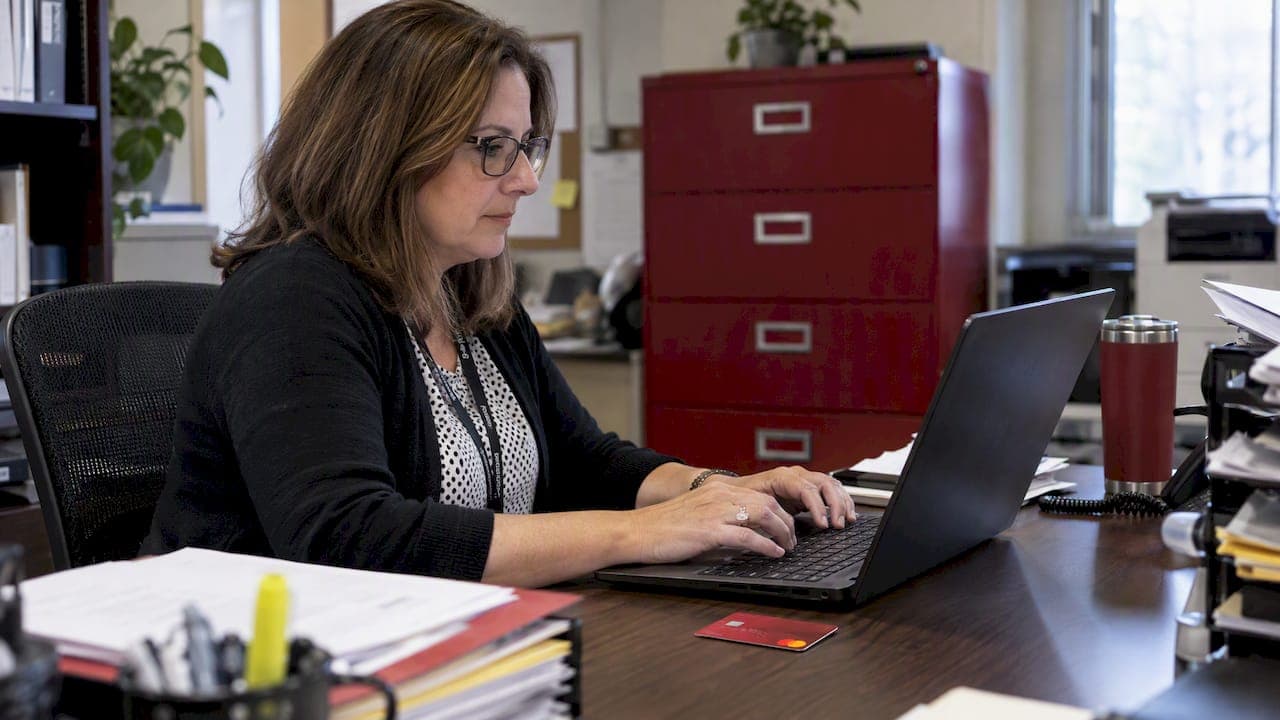
Yes, a school can often pay for yearbooks with a purchasing card, but only if your district's policy allows it for the amount involved and the vendor accepts card payment. Some districts name yearbooks as an approved p-card purchase. Others cap each transaction or each month, and a full yearbook order can run past those caps. This guide covers what to check before you swipe, how to keep the paperwork clean, and when a purchase order is the safer route.
TL;DR
- A p-card is a district-issued purchasing card for routine, lower-value buys. Whether yearbooks qualify is set by your district or school board policy, not by the vendor.
- Many district cards carry per-transaction and monthly limits. One example policy bars items over $1,000, or more than $1,000 a month, without prior written authorization.
- Never split one yearbook order into several smaller charges to stay under a limit. Policies treat that as a violation.
- Keep the itemized quote, receipt and approval, and reconcile against the monthly statement on your district's deadline.
- If the total is above your card limit, a purchase order is the normal path. Confirm accepted payment methods with your vendor before you order.
Table of Contents
- What a p-card is, and why schools use it for yearbooks
- Who can use the card for a yearbook purchase
- The limits that decide whether a card will work
- P-card or purchase order: which one fits your order?
- Step by step: paying for a yearbook by card
- Records to keep and when to reconcile
- When the vendor gets paid
- Common problems and how to avoid them
- Perspective
- Get a clear price before you ask for approval
- FAQ
- Sources
What a p-card is, and why schools use it for yearbooks
A purchasing card, or p-card, works like a credit card issued to a district or school for official purchases. The cardholder is an employee. The district, not the individual, pays the bill. Using the card does not touch the employee's personal credit, and accounting pays the monthly statement rather than the cardholder.
The point is speed and less paperwork. Portland Public Schools describes its PCard as an efficient, cost-effective way to make simple district purchases, and notes that governments and businesses often use these cards instead of purchase orders, petty cash or employee reimbursements. The Wisconsin Association of School Business Officials makes the same case for its program: fewer purchase orders and paper checks save time and money.
Yearbooks fit that logic in some districts. The same Portland manual lists yearbooks as an acceptable PCard purchase. That is one district's rule, though. Yours may say something different, so read your own manual first.
Who can use the card for a yearbook purchase
Not every teacher or adviser holds a card. In the example policy from one school district, employees authorized by the Superintendent or Business Manager may use district cards, and the Business Office prepares the purchase order, which the Business Manager reviews and approves.
That gives you a practical rule of thumb. The person who advises the yearbook and the person who holds the card are often not the same. Before you request a quote or start a design, answer three questions:
- Who in our building or district office holds a card with enough limit?
- Does our policy require a purchase order or written approval before the card is used?
- Who signs off on the final reconciliation?
An adviser who orders without asking these questions often ends up waiting on a purchase order after the pages are already done. Our guide to the yearbook ordering process covers the other mistakes that slow a school down.
The limits that decide whether a card will work
The biggest barrier is not the vendor. It is the card limit.
The example policy cited above says district cards may not be used for items over $1,000 or more than $1,000 a month without prior written authorization. Other districts set different numbers. Some schools set far lower caps for individual buyers. Banks also let administrators adjust controls: WASBO says administrators can manage limits on transaction amounts, purchases and locations through a secure web portal at any hour.

A worked example shows how fast a yearbook order passes a $1,000 cap. Say you order 300 books and add a few finishing options. At the per-book fees on our price list, freight to the school is $1.00 per book, so that single line comes to $300. Printed endsheets on a hard cover add $2.75 per book, or $825 across 300 books. Those two lines alone total $1,125, and that is before the printing itself. A real order will usually sit well above a small-purchase threshold.
When that happens you have two legitimate options:
- Ask the Business Office for written authorization to exceed the limit on this one purchase.
- Pay with a purchase order instead of the card.
The third option, which you should not take, is to break the order into pieces.
Why splitting an order is a bad idea
It can be tempting to charge half now and half later. Cornell University's purchasing card rules say plainly that splitting a single large transaction into several smaller ones to get around per-transaction limits is strictly prohibited. School districts write nearly identical language. The same example school policy also says cards must not be used to circumvent competitive bidding requirements or board policies on dollar thresholds.
If a yearbook contract is large enough to require quotes or bids in your district, a card does not remove that step. Our yearbook RFP template shows how districts compare bids and spot hidden fees.
P-card or purchase order: which one fits your order?
The choice usually comes down to order size, district rules and how much approval you need. This table is a general guide. Your own policy wins.
| Question | P-card | Purchase order |
|---|---|---|
| Typical use | Small, routine purchases within a set limit | Larger or contracted purchases |
| Approval | Cardholder authority, sometimes prior written approval | Business Office prepares it, an administrator approves it |
| Spending cap | Per-transaction and monthly limits | Set by board policy and bid thresholds |
| Paperwork | Receipts, reconciliation to the monthly statement | Purchase order, invoice, receiving record |
| Best for yearbooks when | The total is inside the limit and policy names yearbooks as allowed | The total is above the card limit or bidding rules apply |
Some districts require both. One district's procedures say a purchase order must be in place before a p-card is used, and that a violation can bring discipline. So do not assume the card replaces the order. For the purchase order route, see our walkthrough on how to write and submit a yearbook purchase order.
If you are still deciding how big the order should be, the quantity ordering checklist for advisers helps you settle the number of books before you fix the amount you need approved. For schools starting a yearbook program from scratch, this guide to planning a yearbook class also helps you map the school year and the budget decisions that come with it.
Step by step: paying for a yearbook by card
Here is the order of operations that keeps an adviser out of trouble.

1. Read your district's p-card manual
Look for three items: whether yearbooks or printing services are allowed, the per-transaction and monthly limits, and whether a purchase order must exist first. Do this before anything is quoted.
2. Get an itemized, all-in quote
Ask for a quote that shows every line: books, cover and binding options, shipping, and any add-ons. A hidden shipping or setup charge can push a total over a limit after you have already received approval. We publish all-inclusive pricing online with shipping included, so the number you approve is the number you pay.
3. Compare the total to your limit
If it is within the limit, go ahead. If not, request written authorization or move to a purchase order. Do not split.
4. Confirm the payment method with the vendor
Most card-accepting vendors take standard Visa or MasterCard. Broward County Public Schools' manual says that vendors who accept Visa or MasterCard can accept its P-Card. Still, ask the yearbook company directly which payment methods it takes for your order size, and get the answer in writing.
5. Place the order and save the confirmation
Keep the quote, the order confirmation and the receipt together. Note the approval, whether that is an email from the principal or a signed authorization form.
6. Reconcile on time
Match the charge to the monthly statement, attach the receipt, and submit the required form before the deadline. More on that next.
Records to keep and when to reconcile
Card purchases are only as safe as the paper trail behind them. The example school policy requires cardholders to attach receipts for each purchase, reconcile purchases and credits to the monthly statement, and file the Payment Request Form within five days of receiving the statement. Your deadline may differ, so check the manual, but the habit is the same everywhere.
For a yearbook order, keep this file:
- The itemized quote and the final invoice or receipt
- The order confirmation with quantity, specifications and ship-to address
- The written approval, including any exception to a card limit
- Any credit or reprint charge that appears on later statements
- The monthly statement page showing the charge, marked as reconciled
Auditors and business officers look for exactly this. If your school also handles yearbook money through a booster club or a student activity fund, the same discipline applies, and this overview of financial paperwork for nonprofit organizations explains why clear records matter when someone asks where the money went.
Watch sales tax too. Whether tax applies to a school's yearbook purchase depends on the state and on the contract language, so read our note on yearbook sales tax and the contract before the receipt goes in the file.
When the vendor gets paid
The vendor side matters for your timeline. In Broward's program, suppliers do not need to send invoices and receive payment from the bank through the card association within 48 hours. That is how that district describes its own program, and it gives vendors faster funds than a standard invoice cycle.
For you, the school, the district typically pays the card issuer once a month. So the charge hits your budget when the statement is paid, not necessarily the day you ordered. Check with your Business Office which fiscal year the charge lands in, especially for orders placed near the end of a budget year.
Common problems and how to avoid them
The card declines. Usually the amount is over a limit, or the merchant category is blocked. Call the Business Office rather than trying a second card or splitting the charge.
The purchase order is missing. If your policy requires one first, the card charge is a violation even when the purchase was legitimate.
The total changed after approval. Late add-ons such as extra pages, personalized covers or more freight can lift the total. Get approval for a range, or approve the final quote only.
Reprints. A reorder later in the year is a new transaction with its own limit check. Our guides on the yearbook reorder process and reorder availability explain how to plan for it.
A sales pitch in place of a price. A quote that requires a call before you see numbers makes approval harder. Read what a yearbook sales pitch means for schools if you are comparing vendors.
Perspective
Advisers tell us the same thing: the yearbook is easy to plan and hard to pay for. The student work is done, the pages are proud and ready, and then the order stalls in a purchasing office because nobody knew the card limit.
That is why we built our pricing around being clear up front. A school can see an all-inclusive price online with no signup and no sales call, and shipping is included. When you know the full number on day one, you can decide in minutes whether a card, a purchase order or a written exception fits. There is no guessing, and no surprise line that pushes you over a threshold.
We also do not impose order deadlines or minimums, and our turnaround is typically two to three weeks. For a school that needs approvals to clear first, that flexibility is the difference between a calm spring and a scramble. Our team brings more than 50 years of combined experience, and our job is to make the paperwork side as light as the design side.
Our advice is simple. Read your district manual, ask your Business Office two questions about limits and purchase orders, and bring us the quote that needs to match. We will help you get the details right.
Jace
Get a clear price before you ask for approval
A purchasing office cannot approve a number it has not seen. At TrailMark, schools can get instant all-inclusive pricing online with no signup and no sales pitch. Our printing price list shows per-book options such as perfect bound soft cover at $1.60 per book, 150 point board hard cover at $1.50 per book, and Smyth sewn at $2.00 per book, so your Business Office can see what each choice adds before it signs off.

We also offer design help, flexible tools including Canva, InDesign or our online creator, and optional full-service design for schools that want a hands-on partner. Tell your Business Office which payment method you plan to use, and confirm it with us when you request your quote.
FAQ
Can I pay for a yearbook with a school p-card?
Often yes, if your district policy allows it and the total is within your card limits. Some districts list yearbooks as an approved purchase, while others require a purchase order first. Check your manual and ask your Business Office before you order.
What if the yearbook order is more than my p-card limit?
Ask for written authorization to exceed the limit, or use a purchase order. Do not split the order into several smaller charges, because policies prohibit that practice. The Business Office can tell you which route your district prefers.
Do I need a purchase order if I use a p-card?
It depends on the district. Some treat the card as a payment method that still requires a purchase order in place beforehand, and others allow the card for small purchases without one. Your p-card manual will say which applies.
What records should I keep after paying by card?
Keep the itemized quote, the receipt, the order confirmation and any written approval. Then match the charge to the monthly statement and submit your district's reconciliation form by its deadline. One example policy sets that at five days after the statement arrives.
How fast does the vendor get paid on a p-card?
In Broward County's program, vendors are paid by the bank through the card association within 48 hours and do not need to send invoices. Your own district's program may differ, but card payment generally reaches the vendor faster than an invoice cycle.
Sources
- Portland Public Schools PCard Manual
- WASBO p-Card Program
- Broward County Public Schools Purchasing Card Manual
- School district p-card policy resource
- Cornell University purchasing card procedures
- Guide to planning a yearbook class
- Financial paperwork for nonprofit organizations