

The yearbook ordering process runs in a fixed sequence: request pricing, choose your production options, submit assets, approve the proof, pay the invoice, then receive the books. Some yearbook vendors run that whole cycle with a production window of roughly two weeks after final proof approval. The fastest way to get moving is to request instant pricing or a sample book before you commit to a page count.
TL;DR:
- Request instant pricing and a free sample book to compare quality and lock in costs before finalizing page counts or design choices.
- Lock production options such as trim size, paper weight, and cover treatment early, since changes after approval often cause delays and additional costs.
- Set internal milestones for cover lock, page layout, portrait deadline, and proof approval at least four to ten weeks in advance of vendor deadlines.
- Most vendors require final proof sign-off and payment before production, with typical turnaround times around two weeks after approval.
- Overrun copies are usually billed at the average cost for your order size, and requesting a sample helps verify paper quality and binding suitability upfront.
Table of Contents
- What Is the Step-by-Step Yearbook Ordering Process?
- How Long Does the Yearbook Ordering Process Take?
- What Drives Yearbook Pricing and How Do You Budget for It?
- What Files and Assets Do You Need to Submit?
- How Does Proofing and Approval Work?
- What Happens at Delivery, and How Do Reorders Work?
- What Mistakes Cause the Most Yearbook Ordering Delays?
- Publisher Perspective: What a School-First Vendor Should Offer
- Get Instant Pricing and a Free Sample Before You Commit
- Where to Verify Pricing and Procurement Details
- Sources
- FAQ
What Is the Step-by-Step Yearbook Ordering Process?
Every school yearbook order moves through the same handful of checkpoints, whether you're running a 40-page elementary book or a 200-page high school edition with a full ad section. Knowing who owns each step keeps the project from stalling in someone's inbox.
1. Request pricing. Give the vendor your estimated page count, expected copy quantity, binding preference, and any personalization add ons (name stamping, icon patches, and the like) so the quote reflects your real book, not a generic package.
2. Lock production options. Confirm trim size, paper weight, cover treatment (softcover, hardcover, laminate, foil), and personalization before design work starts. Changing these mid production almost always costs you time or money.
3. Decide how you'll collect orders. Schools generally handle copy counts one of two ways:
- School-paid bulk order, where the school buys a set quantity and distributes or resells copies itself.
- Parent or district-driven pre-sale, where a sales window determines the final print quantity before the deadline.
4. Submit your assets. Portraits, candid photos, ads, and written copy all need to arrive in the format and folder structure the vendor specifies. Consistent file naming here saves real time on the design end.
5. Approve the proof and pay the invoice. Proof sign-off is the last checkpoint before printing. Once it's approved, the invoice is typically due before the book enters production.
A resource like this quantity ordering checklist for advisers is worth keeping open while you plan your copy count, since guessing too low means an overrun charge and guessing too high means unsold inventory sitting in a closet.
How Long Does the Yearbook Ordering Process Take?
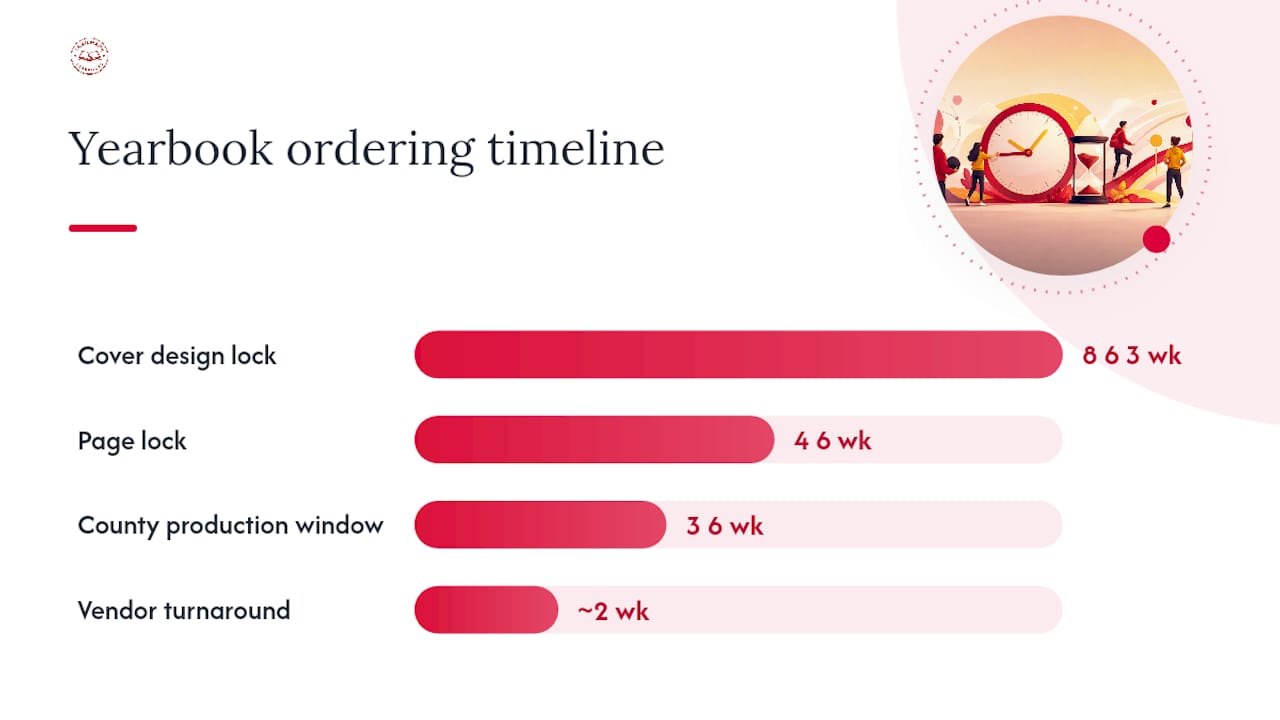
Vendor turnaround typically runs about two weeks from final proof approval to shipment, based on how most yearbook services structure their production schedules. District RFPs often build in a wider buffer. One county contract sets a final submission deadline on the last Monday in April with delivery targeted for the third Friday in May, giving the printer roughly three to four weeks to produce and ship a full run.
Internally, set your own milestones well ahead of the vendor's deadline:
- Cover design lock, 8 to 10 weeks before final submission.
- Page lock (layout and copy finalized), 4 to 6 weeks before submission.
- Portrait deadline, at least 3 weeks before page lock so retakes don't blow the schedule.
- Final proof sign-off, the last checkpoint before the vendor's cutoff.
Some vendors also let advisers choose between a single all-at-once deadline and a multi-deadline program that lets sections come in on staggered dates. A staggered schedule suits large high school staffs juggling sports, clubs, and senior sections separately; a single deadline works better for smaller staffs who'd rather finish once and move on.
What Drives Yearbook Pricing and How Do You Budget for It?
Page count and copy quantity are the two biggest levers on price, but they're far from the only ones. A realistic budget accounts for:
- Page count and binding type (softcover vs. hardcover).
- Total copies ordered, since per-unit cost drops as volume rises.
- Cover treatment, foil stamping, and lamination upgrades.
- Personalization (name printing, icons, patches).
- Shipping, which some vendors include rather than itemize separately.
- Correction fees and missed-deadline penalties, which can appear if changes come in after page lock.
Itemized, BAFO-style pricing schedules, the kind you'll find in public school procurement documents, break out cost per page and per quantity band. That level of detail is exactly what a purchasing office wants to see before approving a contract, and it's also what you should expect from any vendor quote even outside a formal RFP process.
Pro Tip: Ask how overrun copies are priced before you sign anything. Most vendors calculate overage at the average per-book cost for your specific quantity and page count, not a flat rate, so that number should be in writing from the start.
What Files and Assets Do You Need to Submit?
Vendors generally need print-ready PDFs, InDesign packages, or completed pages built in the platform's own design tool. Photos should be high-resolution, 300 dpi minimum, with covers built to the vendor's bleed and safe-area specs so nothing gets trimmed off in printing.
- Portraits and ID photos should follow the vendor's folder structure and naming convention exactly. Mismatched names are the single most common cause of missing portraits in a proof.
- Canva works fine for schools that want a simpler, browser-based workflow; InDesign suits staffs with design experience who need finer typographic control.
- Confirm compatibility before you start building. Not every vendor's proofing system reads every file type cleanly.
How Does Proofing and Approval Work?
Digital proofs let you catch errors early and cheaply. Printed proofs, when a vendor offers them, are the last real check before ink hits paper, and whichever one your contract designates as final is the one that actually locks the book.
Route sign-off through a clear chain: adviser reviews first, then principal, then whoever holds purchasing authority for the invoice. Each proof review should check names against the roster, page order, ad placement, color accuracy, and personalization data before anyone signs off.
- Most vendors allow a defined change window after the proof goes out, often just a few days.
- Corrections requested after final approval typically carry a fee, and a rush correction can push your delivery date back.
Pro Tip: Print the portrait pages full size and physically check names against your roster instead of just scrolling a PDF. Small font sizes hide misspellings that a screen skim will miss every time.
What Happens at Delivery, and How Do Reorders Work?
Bulk shipping needs a confirmed delivery address, loading dock access if applicable, and a named signatory who can receive and count boxes on arrival.
- Vendors commonly include shipping in the base contract rather than billing it separately.
- Complimentary copies (some contracts specify around 15) and sales materials like banners or signage are often bundled into school programs.
- Overrun copies are typically priced at the average per-book cost for your order size, not a separate premium rate.
- Reorders go through a shortened version of the original process, and reprint turnaround is usually faster than the initial run since design work is already done.
What Mistakes Cause the Most Yearbook Ordering Delays?
Most delivery disasters trace back to the same handful of preventable issues, not printing problems.
- Late or missing portrait files that hold up page lock for the whole book.
- Sign-off sitting with no single named approver, so nobody feels responsible for the deadline.
- Invoice line items nobody clarified until the bill arrived.
- Personalization data (names, icons) submitted with typos that don't get caught until the proof.
Build a calendar with cover lock, page lock, portrait deadline, and proof sign-off marked well before the vendor's actual cutoff. Recurring timeline delays tend to repeat year over year at the same schools until someone fixes the internal calendar, not the vendor relationship.
Pro Tip: Request a sample book before signing anything. Comparing proposals on paper hides quality differences that show up the moment you hold a finished book, and it's the cheapest insurance policy in this entire process.
Publisher Perspective: What a School-First Vendor Should Offer
A vendor worth keeping year over year gives you all-inclusive pricing up front, free design help when your staff runs thin, and a 2 to 3 week turnaround you can actually plan around. When you're vetting a new vendor, ask directly about delivery terms, design support, reorder policy, and how invoicing works, before you ask about price. Vendors who dodge those questions are telling you something.
— Jace
Get Instant Pricing and a Free Sample Before You Commit
Some yearbook vendors offer instant, all-inclusive pricing online with no signup and no sales call, shipping included, a 2 to 3 week turnaround, and free design help whether your staff works in Canva, InDesign, or the built-in online creator.
There's no order deadline forcing your hand, so you can lock pricing now and finalize page counts closer to production. If you want to see print quality before committing, request a free sample book. If you're ready to see numbers for your school's actual page count and copy quantity, get instant pricing here.
Where to Verify Pricing and Procurement Details
For deeper contract language, review a public BAFO pricing schedule and a district RFP for yearbook printing. For copy-count planning, the group-order resources for schools cover the mechanics of coordinating bulk sales.
Sources
- Yearbook Services, Elementary School, Middle School, High School (BAFO pricing schedule)
- Yearbook planning guide: Bulk ordering and timeline notes
FAQ
When Is the Final Copy Count Deadline?
It depends on your vendor's program. TrailMark Yearbooks has no fixed order deadline, but most traditional publishers set a final submission date months ahead of delivery, often the last Monday in April for a mid May delivery.
How Long Does a Reprint or Reorder Take?
Reorders generally move faster than the original print run since design work is already finished. Check your vendor's reorder policy directly, since availability windows vary by publisher.
What Does an All-Inclusive Yearbook Quote Typically Include?
An all-inclusive quote usually bundles page count, copy quantity, cover treatment, and shipping into one price with no separate line items. TrailMark Yearbooks structures pricing this way specifically so schools can get budget approval without chasing add-on fees later.
How Are Overrun or Extra Copies Priced?
Overrun copies are typically billed at the average per-book cost for your original order size, not a flat surcharge, a standard practice reflected in public procurement pricing schedules.
Should I Request a Sample Book Before Ordering?
Yes. Comparing print quality on paper is unreliable, and requesting a physical sample is the most direct way to confirm paper stock, binding, and color before you commit a school budget.