

The yearbook reorder process is a structured extension of the initial print run, enabling schools to fulfill late or replacement yearbook requests without starting the production process from scratch. For school advisers managing student expectations and tight budgets, understanding how reorders work is the difference between a smooth distribution and a logistical headache. Costs typically range from $20 to $60 per student depending on quality and order volume. Knowing the steps to reorder yearbooks before a crisis hits puts you in control of both inventory and communication.
What are the typical methods for reordering yearbooks?
Yearbook reordering usually extends the initial print run, and the method you use depends on where you are in the production timeline. Schools using digital design platforms can increase order quantities directly before the print deadline, which typically falls in late spring. That window is your most cost-effective option because the book is already set up and ready to print.
Once the print deadline passes, the process shifts. Post-deadline reorders are often fulfilled by directing families to third-party vendor portals, with deadlines commonly landing around mid-May for late purchases. Late reorders through these portals frequently ship directly to homes, which removes the burden of school-based redistribution.

The key distinction advisers need to understand is the difference between a pre-print adjustment and a post-print reorder. Pre-print adjustments are cheaper, faster, and simpler. Post-print reorders involve a separate production run with its own setup costs and shipping timeline.
The main reorder methods are:
- Pre-deadline quantity increase: Adjust your order count through your digital platform before the print cutoff. This is the most affordable path.
- Vendor portal late orders: Families place orders directly through a third-party portal after the school deadline. Books ship to homes.
- Direct reprint request: Contact your printing partner to request a new run of the same file. This requires archived digital files and carries a higher per-unit cost.
- Replacement orders: Triggered by production defects or damage. These follow a separate process covered in a later section.
Pro Tip: Check your yearbook deadline management checklist well before the print cutoff. Catching late student requests even one week before the deadline can save your school the cost of a full post-print reorder.
How do schools handle inventory to minimize reorder needs?
The most effective way to reduce reorder volume is to order more copies than you think you need from the start. Printing experts recommend ordering 5–10% more copies than your initial anticipated count to cover last-minute requests, replacements, and new student arrivals. That small buffer eliminates the need for a costly separate reprint in most cases.
Estimating student interest accurately is the foundation of good inventory planning. Survey students early, track pre-orders through your school's payment system, and compare numbers against prior years. Schools that use a formal yearbook quantity ordering checklist catch gaps before they become reorder problems.
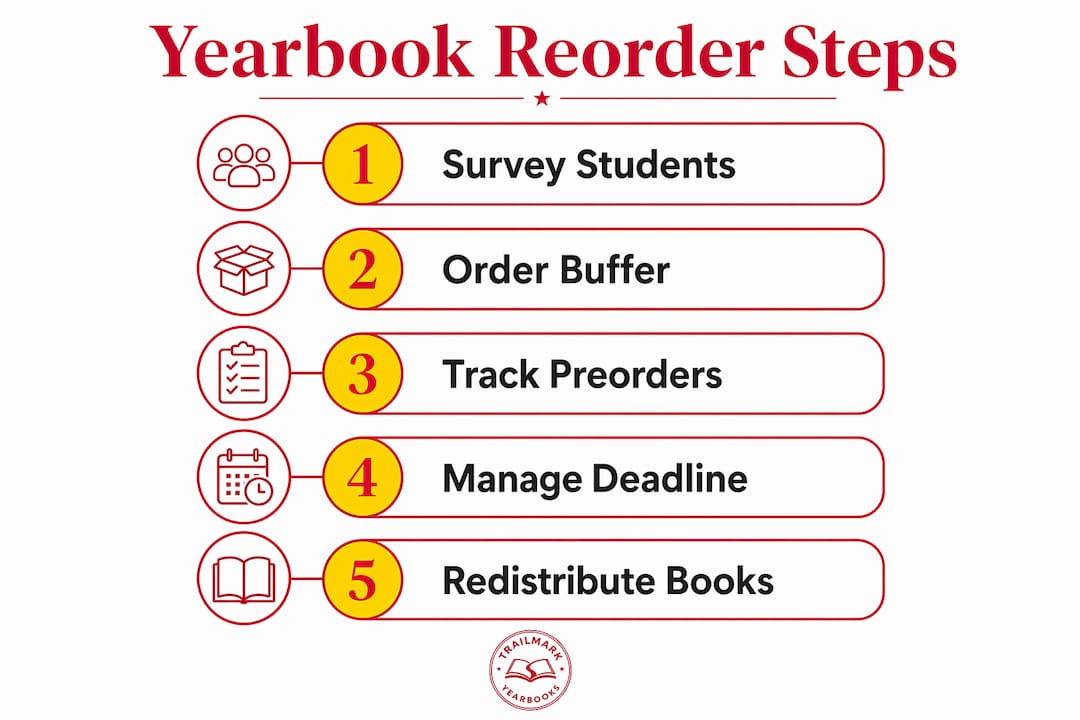
Bulk ordering also carries a direct cost advantage. The per-unit price drops as volume increases, so ordering 10% more copies upfront costs far less than placing a separate reorder later. The table below shows how ordering strategy affects your per-copy cost and reorder risk.
| Ordering approach | Per-copy cost impact | Reorder risk |
|---|---|---|
| Order exact anticipated count | Lowest upfront cost | High. Any late request triggers a reprint. |
| Order 5% buffer above estimate | Moderate cost increase | Low. Covers most late requests. |
| Order 10% buffer above estimate | Higher upfront cost | Very low. Handles replacements and new arrivals. |
| Order below anticipated count | Lowest upfront cost | Very high. Reorders almost certain. |
Archiving your digital files during initial production is equally critical. Archiving digital files transforms a future reorder from a fresh design process into a simple re-run. Without those files, your printing partner may need to rebuild the layout from scratch, which adds time and cost.
Pro Tip: Save your final print-ready files in at least two locations, such as a school server and a cloud backup. One file loss can delay a reorder by weeks.
- Survey students early. Send a pre-order form at least 8 weeks before the print deadline to gauge real demand.
- Compare to prior-year data. Use last year's leftover count as a baseline for your buffer calculation.
- Add your 5–10% buffer. Apply it to your confirmed pre-order count, not your total enrollment.
- Lock in your order before the deadline. Late additions after the cutoff cost more and take longer.
- Archive all final design files. Store them in a named folder with the school year clearly labeled.
For a deeper look at print quantity planning, advisers can find a full 2026 guide covering cost models and ordering timelines.
What is the standard process for replacing defective yearbooks?
Production errors require immediate action. When defective yearbooks arrive, advisers must document the issue and contact their printing partner right away. The typical replacement turnaround is approximately 3 weeks from the date of notification. That timeline is non-negotiable, so the faster you report the problem, the faster students receive their corrected books.
"When production issues occur, immediate documentation and securing a dedicated contact at the printer are the two steps that determine how quickly replacements arrive. Every day of delay adds to student frustration and adviser workload."
The steps for handling a defective yearbook replacement are straightforward:
- Document the defect immediately. Photograph every affected copy. Note the specific error, whether it is a misprint, binding failure, or color problem.
- Contact your printing partner the same day. Ask for a named contact who will own the replacement order. Generic support queues slow everything down.
- Submit a formal replacement request in writing. Email creates a paper trail and a timestamp for your records.
- Communicate the timeline to families. Tell them the 3-week window upfront. Silence creates more frustration than a clear, honest timeline.
- Track the replacement shipment. Confirm the new order is in production within 48 hours of your request.
Managing student disappointment is as much a part of this process as the logistics. Clear communication with families about realistic timelines is critical. A brief email or school newsletter update goes a long way toward maintaining trust during a delay.
What are the common challenges in yearbook redistribution?
Redistribution is where many reorder processes break down. Sorting books correctly, especially when personalization is involved, creates significant manual overhead for school staff. Reassigning mislabeled copies can become 100% manual work, meaning every book must be checked by hand before it reaches a student.
Pre-sorting is the most effective way to reduce that burden. Sorting yearbooks alphabetically and separating personalized copies before distribution significantly reduces mistakes and speeds up the handout process. Set up a sorting station before books arrive, not after.
Communication with families during redistribution is just as important as the physical logistics. Advisers who plan proactively experience fewer logistical issues and better student satisfaction with delivery. A short message explaining when and where students can pick up reordered books prevents a flood of individual inquiries.
Common redistribution challenges and how to address them:
- Personalized copies mixed with standard copies. Pull all personalized books first and set them aside before general distribution begins.
- Students who have moved or changed homerooms. Keep an updated roster tied to your order list. Cross-reference it before distribution day.
- Late reorders arriving after the main distribution event. Designate a specific pickup window and location for late arrivals. Avoid holding them indefinitely in the office.
- Families who ordered through vendor portals. Confirm those books ship directly to homes so you are not waiting for them to arrive at school.
For schools managing bulk orders alongside other end-of-year products, the graduation folder workflow guide from Honor U offers useful parallels on managing multi-item distribution logistics.
Key Takeaways
A well-managed yearbook reorder process starts with a buffer order, archived digital files, and a clear communication plan before a single reorder request arrives.
| Point | Details |
|---|---|
| Order a buffer upfront | Add 5–10% to your confirmed pre-order count to cover late requests and replacements. |
| Archive digital files | Store final print-ready files in two locations to make any future reorder a simple re-run. |
| Act fast on defects | Document errors immediately and contact your printer the same day to hit the 3-week replacement window. |
| Pre-sort before distribution | Separate personalized and standard copies before books arrive to cut manual redistribution overhead. |
| Communicate timelines clearly | Tell families the exact pickup or delivery window upfront to reduce individual inquiries and frustration. |
What I've learned from watching reorders go wrong
Most reorder problems are not printing problems. They are planning problems that show up at the worst possible time, usually the last week of school when everyone is already stretched thin.
The advisers I have seen handle reorders well share one habit: they treat the reorder possibility as part of the original production plan, not as an afterthought. They archive files on day one. They order their buffer before the deadline. They have a printer contact saved in their phone, not buried in an email thread from october.
The 3-week replacement window sounds manageable until you realize it lands during finals, graduation, or summer break. That is when families get frustrated and advisers get overwhelmed. The fix is not a faster printer. The fix is reporting defects on the day they arrive, not three days later after you have had time to "look into it."
One more thing: do not underestimate the communication side. A single proactive email to families explaining the reorder timeline does more for your reputation as an adviser than a perfectly sorted distribution table. People forgive delays. They do not forgive silence.
— Jace
How Trailmarkyearbooks supports your reorder process
Managing reorders is far easier when your printing partner is built for school advisers, not against them.

Trailmarkyearbooks offers fast 2–3 week turnaround times with no order deadlines, so advisers are never locked into a rigid production calendar that makes late requests impossible to handle. The school-first support model means you have a real contact when something goes wrong, not a generic ticket queue. Before committing to a bulk order, advisers can request a sample to verify print quality firsthand. When you are ready to review full production options, the complete range of yearbook production services is available with all-inclusive pricing and no hidden fees.
FAQ
What is the yearbook reorder process?
The yearbook reorder process is a structured extension of the initial print run that allows schools to fulfill late or replacement yearbook requests. It involves adjusting order quantities before the print deadline or placing a separate reorder through a vendor portal or printing partner after the deadline passes.
How long does a yearbook replacement take after a production error?
Replacement orders for defective yearbooks typically take approximately 3 weeks from the date the error is reported to the printer. Advisers should document defects and contact their printing partner the same day books arrive to start that clock immediately.
How many extra yearbooks should a school order?
Printing experts recommend ordering 5–10% more copies than your confirmed pre-order count. That buffer covers last-minute student requests, new arrivals, and replacement needs without requiring a costly separate reprint.
Can families reorder yearbooks after the school deadline?
Yes. Post-deadline reorders are typically handled through third-party vendor portals, with books shipping directly to family homes. School deadlines for these portals often fall around mid-May, so families should act quickly once the school's main order closes.
What is the best way to prepare for a smooth yearbook reorder?
Archive all final print-ready design files during initial production and order a small buffer of extra copies upfront. These two steps convert most reorder situations from a full reprinting event into a simple re-run or a draw from existing stock.