
Yearbook print quantity planning is the process of determining exactly how many yearbooks a school should print to control costs, meet student demand, and avoid waste. The industry term for this practice is print run planning, and it sits at the center of every successful yearbook production cycle. Get it wrong and you face two bad outcomes: paying for hundreds of unsold books or turning away students who wanted one. The right number depends on enrollment size, historical sales data, budget limits, and your printer's minimum order requirements. This guide gives yearbook advisers and school administrators a clear framework for making that call with confidence.
What is yearbook print quantity planning and why does it matter?
Print run planning is the practice of estimating and locking in the number of yearbook copies before production begins. The decision affects every line item in your budget. Yearbook costs range from $20 to $60 per student depending on volume and specs. That spread is wide enough to determine whether your program breaks even or runs a deficit.
Typical print runs fall into three tiers: 50–199 copies for small schools, 200–999 for medium schools, and 1,000 or more for large schools, with per-unit costs dropping as quantity grows. Knowing which tier your school falls into is the first step toward accurate budgeting. Advisers who skip this step often discover the cost gap mid-production, when changing course is expensive.

Key factors that influence yearbook print quantity decisions
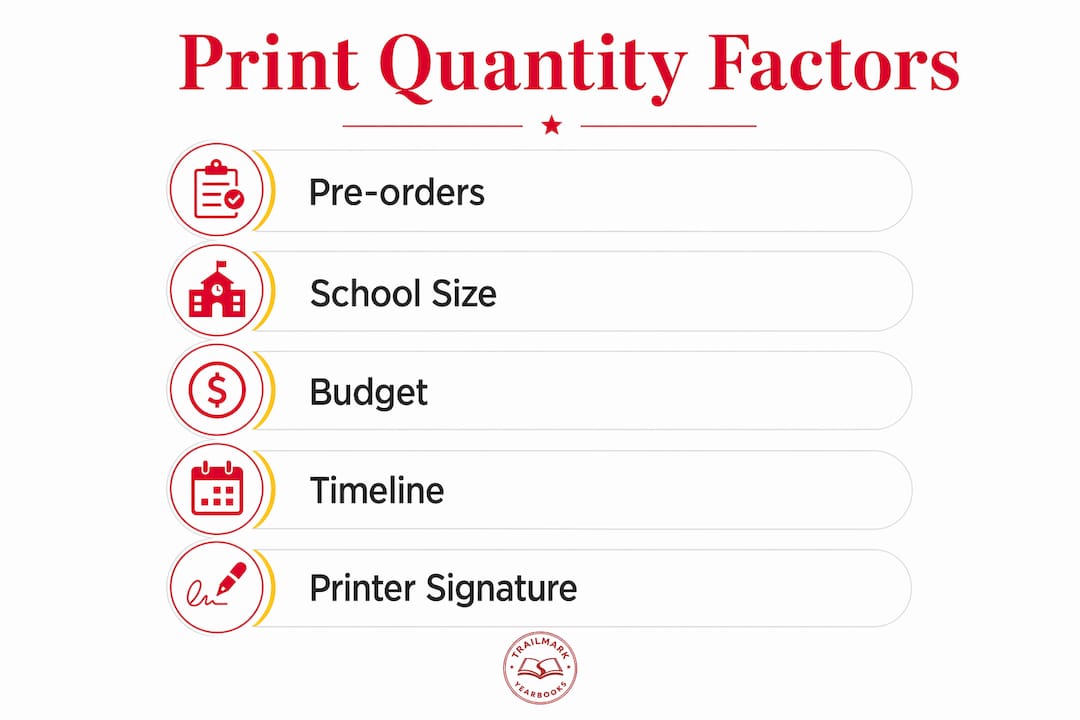
Several variables drive the right print number for your school. None of them work in isolation.
- Student enrollment: Total enrollment sets the ceiling. You will never sell more books than you have students, and most schools sell to a fraction of that number.
- Historical sales data: Last year's final sales count is your single most reliable data point. If you sold 312 books in 2025, printing 500 in 2026 without a clear reason is a budget risk.
- Pre-order totals: Confirmed pre-orders give you a hard floor. Build your print run from that number upward, not downward from enrollment.
- Budget constraints: A lower per-unit cost at higher quantities sounds attractive. But printing 200 extra books to hit a discount threshold only saves money if those books sell.
- Printer minimums: Minimum order sizes vary from 1 to 100 or more copies depending on the vendor's technology. Print-on-demand options start as low as 1 copy, while offset printers often require larger minimums.
- Physical specs: Page count, binding type, and paper finish all affect per-unit cost. A thicker book costs more per copy, which shifts the break-even point on your print run.
Pro Tip: Review your yearbook ordering checklist before finalizing any quantity. A structured checklist catches the variables advisers most often overlook.
How do you forecast demand and avoid surplus or shortage?
Accurate demand forecasting is the skill that separates advisers who run tight budgets from those who end up storing boxes of unsold books. These five steps build a reliable forecast.
- Run a pre-order campaign early. Pre-order campaigns eliminate surplus and rush orders by converting interest into confirmed sales before you commit to a print quantity. Open pre-orders at least 8 weeks before your print deadline.
- Pull three years of sales history. One year of data can be an outlier. Three years reveals a trend. If sales have grown by 20 copies each year, factor that trajectory into your estimate.
- Adjust for enrollment changes. A new grade level, a school merger, or a significant enrollment drop changes your baseline. Recalibrate your historical average to reflect the current student population.
- Budget for walk-up sales. Not every family pre-orders. Add a walk-up buffer of 5–10% above your confirmed pre-order count to capture late buyers without overcommitting.
- Evaluate print-on-demand for small schools. Digital printing produces short-run yearbooks in as few as 5 working days. For schools with fewer than 100 students, print-on-demand removes the risk of a large minimum order entirely.
Pro Tip: Track your pre-order close rate each year. If 68% of students who expressed interest actually paid, use that rate to discount raw interest numbers into a realistic print quantity.
How does print quantity affect yearbook cost?
The relationship between quantity and cost is not linear. Fixed costs like setup fees, litho plate charges, and proofing fees stay the same whether you print 50 books or 500. Setup fees distort cost comparisons across order sizes, making small runs look deceptively affordable on a per-unit basis until you add those fixed charges back in.
Here is how the math plays out across typical school sizes:
| Print quantity | Estimated cost per book | Notes |
|---|---|---|
| 50–199 copies | $25–$60 | Setup fees dominate; high per-unit cost |
| 200–499 copies | $18–$30 | Fixed costs spread across more units |
| 500–999 copies | $14–$20 | Volume discounts begin to apply |
| 1,000+ copies | $12–$16 | Lowest per-unit cost; offset printing typical |
Small runs cost around $25 per book while larger runs of 500 or more drop to approximately $12 per book. That $13 difference per copy adds up to $13,000 on a 1,000-copy run. The school size and pricing relationship is one of the most direct levers advisers have on total program cost.
"Unit cost quotes can be misleading if setup fees are hidden. Comprehensive budgeting must consider both fixed and variable costs to understand true per-unit cost across quantities."
Always request an itemized quote that separates setup fees from per-unit printing costs. A quote showing $10 per book means nothing without knowing what fixed charges sit underneath it.
What is the right timeline for finalizing print quantities?
Locking in your print quantity too late is one of the most common and costly mistakes in yearbook production planning. The production calendar has hard deadlines, and missing them triggers fees that eat into your budget.
- 6 months out: Open pre-orders and begin collecting enrollment data. Set a preliminary print range based on last year's sales.
- 3–4 months out: Confirm your print quantity 3–6 months ahead to avoid capacity constraints during peak printing season. Close pre-orders and calculate your confirmed floor.
- 8–10 weeks out: Submit final quantity and specs to your printer. This is when page count, binding, and paper choices must be locked.
- 4–6 weeks out: Approve proofs and confirm delivery address and date. Changes at this stage carry rush fees.
- Delivery week: Coordinate with school administration for distribution logistics.
Rush fees and last-minute layout changes are major hidden costs. Planning quantities and specs well in advance reduces those premiums and keeps your program on budget. A yearbook production calendar turns these milestones into a trackable schedule rather than a mental checklist.
One technical detail most advisers miss: yearbook page count must be a multiple of the printer's signature size, commonly 16 or 32 pages. A 153-page book requires printing 160 pages. Those 7 blank pages cost real money. Plan your content to fill the nearest signature multiple, or add meaningful content like student spotlights or index pages to fill the gap.
Common challenges and expert tips for better print quantity planning
Even experienced advisers run into the same traps year after year. Knowing where the problems cluster helps you avoid them.
- Overestimating demand: Printing too many books is the more common error. Unsold inventory has no resale value and represents a direct budget loss. Anchor your estimate to confirmed pre-orders, not optimistic projections.
- Underestimating demand: Running short means turning away students who wanted a book. Build a 5–10% contingency buffer above your pre-order count to cover late buyers and staff copies.
- Ignoring hidden fees: Setup fees like litho plate costs and proofing charges make small print runs disproportionately expensive. Always ask for a full cost breakdown before comparing quotes.
- Missing signature page counts: Failing to plan page count in multiples of 16 or 32 forces blank filler pages that waste budget. Advisers who understand printer signature requirements avoid this entirely.
- Weak parent and student communication: Pre-order campaigns only work when families know about them. Send reminders through multiple channels: school email, social media, and classroom announcements.
Pro Tip: Ask your printer for a tiered quote showing cost at three quantity levels: your pre-order floor, your pre-order floor plus 10%, and your pre-order floor plus 20%. That comparison makes the trade-off between cost and risk concrete and easy to explain to administrators.
Key Takeaways
Yearbook print quantity planning requires confirmed pre-order data, a clear understanding of fixed versus variable printing costs, and a production timeline locked in at least 3–4 months before your print deadline.
| Point | Details |
|---|---|
| Anchor to pre-orders | Use confirmed pre-order totals as your floor, then add a 5–10% buffer for walk-up sales. |
| Understand cost tiers | Per-unit costs drop from $25 to $12 as print runs grow; fixed setup fees make small runs expensive. |
| Plan page count carefully | Page count must be a multiple of 16 or 32; blank filler pages waste budget and should be filled with content. |
| Lock quantities early | Confirm print quantity 3–4 months out to avoid rush fees and capacity shortages during peak season. |
| Request itemized quotes | Always ask for a breakdown separating setup fees from per-unit costs before comparing printer quotes. |
What I've learned after years of watching advisers get this wrong
The most consistent mistake I see is advisers treating print quantity as a late-stage decision. They spend months on design, photography, and layout, then scramble to pick a number two weeks before the deadline. That scramble costs money every single time, whether through rush fees, inflated per-unit costs from a rushed quote, or a print run that misses the signature page multiple by a handful of pages.
The advisers who run the tightest programs treat quantity as the first decision, not the last. They open pre-orders in september or october, close them in january, and submit a confirmed number to their printer by february. That timeline gives them leverage. Printers give better pricing and more scheduling flexibility to clients who plan ahead. It is not complicated. It is just discipline applied early.
The other thing I have seen trip up even experienced advisers is the hidden fee problem. A quote that looks cheap on a per-unit basis can be the most expensive option once setup charges, plate fees, and proofing costs are added. I always tell advisers to ask for a full cost breakdown before they compare any two quotes. The number that matters is total cost divided by copies delivered, not the per-unit price on the front page of the quote.
Balancing optimism with caution is the real skill here. You want enough books to serve every student who wants one. You do not want a storage room full of unsold copies in june. Pre-orders, historical data, and a modest buffer get you to that balance faster than any formula.
— Jace
Trailmarkyearbooks makes print quantity planning less stressful
Choosing the right print quantity is easier when you can see and feel the product before you commit. Trailmarkyearbooks offers a straightforward way to evaluate quality before locking in your order.
Request a free sample to assess paper quality, binding, and color accuracy before finalizing your print run. Trailmarkyearbooks provides instant all-inclusive pricing online with no signup, no sales pitch, and no hidden fees, so the number you see is the number you pay. With flexible order quantities, a 2–3 week turnaround, and a team with 50+ years of combined experience, Trailmarkyearbooks gives advisers the information and support they need to plan print quantities with confidence.
FAQ
What is yearbook print quantity planning?
Yearbook print quantity planning is the process of determining how many yearbook copies a school should print to meet demand, control costs, and avoid surplus. It involves analyzing pre-order data, enrollment figures, historical sales, and printer requirements before committing to a final number.
How far in advance should I confirm my yearbook print quantity?
Confirm your print quantity at least 3–4 months before your delivery date. Locking in early avoids rush fees and secures capacity during peak printing season.
Why does print quantity affect yearbook cost so much?
Fixed setup fees like plate making and proofing stay constant regardless of how many books you print. Spreading those fixed costs across a larger print run lowers the per-unit price, which is why larger quantities cost significantly less per book.
What is a printer signature and why does it matter for yearbook planning?
A printer signature is the unit of pages a press prints at once, typically 16 or 32 pages. Your yearbook's total page count must be a multiple of that number, or you pay for blank pages. Planning content to fill the nearest signature multiple eliminates that waste.
How do pre-order campaigns improve print quantity accuracy?
Pre-order campaigns convert interest into confirmed sales before you commit to a print run. They give advisers a hard floor number to build from, reducing the risk of overprinting and the financial loss that comes with unsold inventory.