

Yearbook reorder availability is the defined window or on-demand option your printer offers for ordering extra copies after the main school order closes. Four elements determine whether a reorder is possible and when: whether the printer uses a limited window or open on-demand reprints, whether proof approval has been completed (the production trigger), how orders are sequenced (typically first-in, first-out), and whether a rush option exists. Reorders are generally allowed in these situations:
- After the main order deadline passes and late requests come in
- When families miss the original purchase window
- When the school needs staff or archive copies beyond the original quantity
- When books are lost or damaged after distribution (typically 2–5 additional copies for reserves)
Table of Contents
- When are yearbook reorders actually available?
- How to submit a yearbook reorder, step by step
- What turnaround time should you realistically expect?
- What does a reorder cost, and how does rush pricing work?
- How do delivery and distribution options work?
- How many extra copies should you order?
- Announcing the reorder to families and collecting payment
- Common reorder problems and how to fix them
- Payment, invoicing, and communication with families
- Key Takeaways
- Why the approval step is the one advisers underestimate
- Trailmarkyearbooks makes reorders straightforward for advisers
- Useful sources
When are yearbook reorders actually available?
Printers handle reorder availability in three common patterns. The first is a short post-sale window, usually a few weeks after the main order ships, during which the printer holds the file open for additional copies. The second is a scheduled periodic reorder, where the printer announces one or two fixed reorder dates per year. The third, and most flexible, is on-demand reprints, where there is no hard cutoff and schools can request copies at any time.
What triggers production to start is almost always the same regardless of model: final proof approval. Until the school signs off on the proof, the printer cannot begin the press run. Schools typically announce reorder windows via a parent newsletter or school payment portal, and they close the window once the order is submitted to the printer.
Pro Tip: Set your reorder announcement deadline at least five business days before the printer's submission date. That buffer absorbs the inevitable late payments and gives you time to consolidate the order.
A community PTO reorder example shows how schools often choose a fixed placement date and then communicate an estimated arrival window to parents, which keeps expectations clear and reduces follow-up questions.
How to submit a yearbook reorder, step by step
- Confirm availability. Contact your printer to verify the reorder window is still open and get the current per-book price.
- Collect orders and payment. Use your school's payment portal or a paper order form to gather family requests and funds before submitting.
- Complete the reorder form. Fill in school name, contact information, quantity, PO number or payment method, and delivery preference. Trailmarkyearbooks provides a Yearbook Decision Form and reorder templates that cover every required field.
- Approve the proof. If the printer generates a new proof, the principal or designated adviser must sign off before production begins. This is the single most common delay point.
- Submit and confirm. Send the completed form, confirm receipt, and log the expected turnaround date.
- Coordinate distribution. Decide whether books ship to school or go directly to families, and communicate pickup or delivery details.
Pro Tip: Assign one person at your school as the reorder contact. When payment questions and proof approvals route through multiple staff members, delays compound fast.
The reorder process guide for advisers walks through each of these steps with form references and common sticking points.

What turnaround time should you realistically expect?
The service clock does not start at the moment you submit the form. Proof production takes about 2 days, and the production timer begins only after the proof is officially approved. That approval lag inside the school is often the biggest driver of delays, not the printer's schedule.
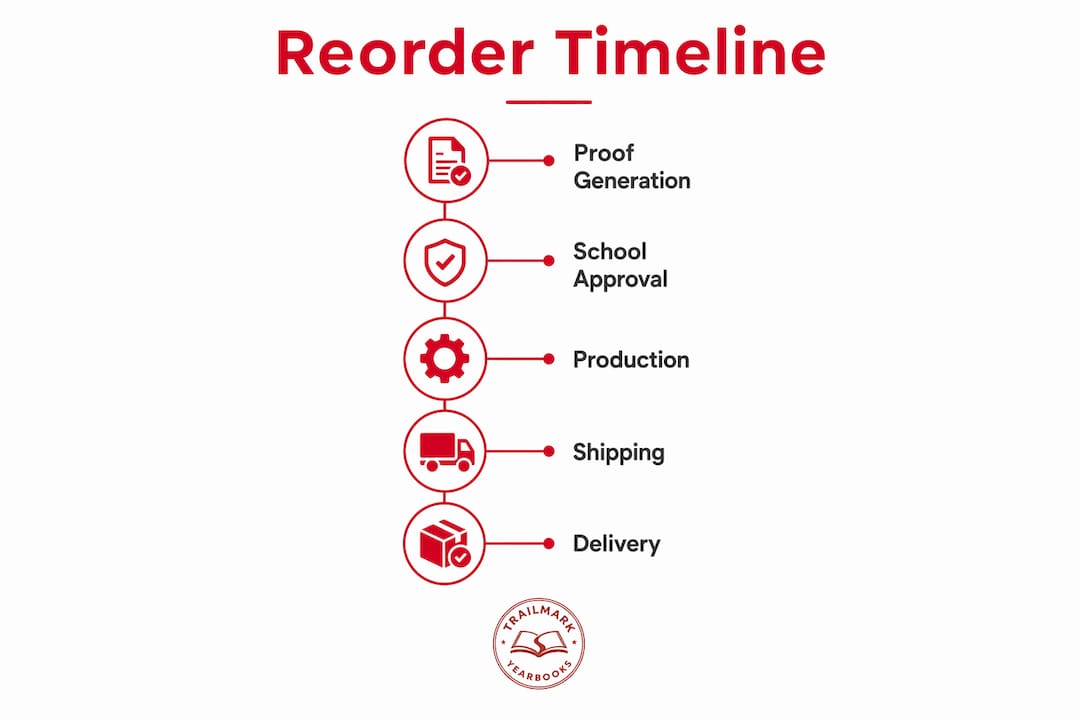
| Stage | Typical Time |
|---|---|
| Proof generation | ~2 business days |
| School proof approval | Varies (1–5 business days) |
| Production after approval | ~10 business days (standard) |
| Trailmarkyearbooks production | 2–3 weeks total turnaround |
During peak season, FIFO prioritization means a reorder placed in April competes with dozens of other schools' main orders. If your school is mid-queue, add a few extra days to the standard estimate before you publish a pickup date to families.
What does a reorder cost, and how does rush pricing work?
Reorder pricing typically has three components: a per-book price, a possible minimum-order fee if your quantity falls below the printer's threshold, and shipping. The per-book price on a small reorder is almost always higher than the main-order price because the fixed setup costs are spread across fewer copies.
Rush orders follow a predictable pattern: rush typically doubles cost while cutting service time in half. That math matters when a family needs a book before graduation week. Trailmarkyearbooks uses shipping-included pricing, which removes one variable from your budget calculation and shortens the payment-to-production cycle.
- Per-book price rises as quantity falls below main-order levels
- Minimum-order quantities may apply; check before collecting family payments
- Rush fees can double the unit cost, so build that into family communications
- Shipping-included models simplify accounting and reduce surprise invoices
Pro Tip: If you are ordering fewer than 10 copies, check whether the minimum-order fee makes a slightly larger quantity more cost-effective per book.
How do delivery and distribution options work?
Most printers offer two or three delivery paths for reorders. Bulk school delivery ships all copies to the school in one box for staff to distribute. Porch pickup (sometimes called local pickup) lets families collect books directly from a designated location, which works well for summer reorders when school is not in session. Limited home delivery is available from some printers but is location-dependent and usually carries an additional fee.
Shipping-included pricing simplifies the school's budget, but it does not automatically mean home delivery. Confirm with your printer whether "shipping included" covers the school address only or extends to individual family addresses. Trailmarkyearbooks's all-inclusive pricing covers shipping to the school, which means your distribution plan should account for how families will pick up their copies.
For schools coordinating senior portrait deadlines alongside reorders, guidance on senior photo timing can help advisers align photo submission cutoffs with reorder windows.
How many extra copies should you order?
Getting the quantity right on a reorder saves money and prevents a second reorder. Work through this checklist before submitting:
- Last year's late-order count (a reliable baseline for this year's demand)
- Graduating seniors who missed the main window
- Staff and administration copies (principal, library, yearbook room archive)
- Reserve copies for lost or damaged books (typically 2–5 copies)
- Any unsold copies from a previous reorder that can offset new demand
A simple calculation: if last year saw 12 late orders and you want a reserve buffer of 2–5 copies, start at 14–17 copies, then adjust up if enrollment grew or down if you sold out early. Order minimums can push that number higher. The yearbook order minimum quantities guide explains how minimums and quantity breaks affect the final number, and the quantity ordering checklist gives a structured framework for the calculation.
Announcing the reorder to families and collecting payment
A clear announcement prevents the most common reorder headache: families who say they never heard about it. Your message needs four elements: the order deadline, the per-book price, how to pay, and when and where to pick up the book.
Payment collection works best when it runs through your school's existing portal (MySchoolBucks, SchoolPay, or a similar platform) so payments are tracked automatically. If your school uses purchase orders for staff copies, keep that invoice separate from family payments to avoid reconciliation confusion.
Pro Tip: Set a firm cutoff and stick to it. A "soft" deadline trains families to pay late, which delays your submission to the printer and pushes the entire reorder timeline back.
For tracking, a simple spreadsheet with columns for student name, payment status, and pickup confirmation is enough. Flag unpaid reserved copies three days before your submission deadline and follow up directly.
Common reorder problems and how to fix them
- Proof approval stalls: Designate one approver before the reorder starts. Waiting for a principal who is out of the building for a week can cost you the entire production window.
- Payment delays: Set a payment deadline that is at least three days before your printer submission date. Collect payment before reserving a copy.
- Stock shortages: If the printer no longer holds your file, you may need to resubmit the full design. Keep a final-approved PDF on file.
- Longer in-season lead times: During April and May, FIFO queues fill fast. Submit early, even if you have not collected every family payment yet.
- Shipping confusion: Confirm the delivery address with the printer at submission. A book shipped to last year's school address is a fixable but frustrating problem.
When escalating to your printer, have the order confirmation number, proof approval date, and expected ship date ready. That information cuts the back-and-forth in half.
Payment, invoicing, and communication with families
Schools typically pay for reorders one of three ways: a school purchase order billed to the district, a credit card charged at submission, or prepaid family orders collected through the school portal. Mixing payment methods on a single reorder invoice creates reconciliation problems, so decide on one method before you open the reorder window to families.
Invoicing timing matters. If your school requires a PO, request it before you open family orders so the paperwork does not hold up submission. For family-funded reorders, collect payment first and submit the consolidated order once the window closes.
Key Takeaways
Yearbook reorder availability opens and closes based on proof approval, printer capacity, and your submission timing, so acting early and assigning clear ownership inside the school determines whether families get their books on time.
| Point | Details |
|---|---|
| Proof approval starts the clock | Production time begins only after the school approves the proof, not at form submission. |
| Rush doubles cost | Requesting rush service typically doubles the per-book price while cutting production time in half. |
| FIFO queue affects timing | In-season reorders compete with other schools; submit early to avoid extended lead times. |
| Quantity math matters | Base your reorder count on last year's late orders plus a small reserve buffer for lost or damaged copies. |
| Trailmarkyearbooks | Offers 2–3 week turnaround with shipping included and on-demand reprints, backed by 50+ years of combined experience. |
Why the approval step is the one advisers underestimate
Most advisers focus on the printer's production time and overlook the days lost waiting for an internal signature. A two-day proof turnaround means nothing if the proof sits in a principal's inbox for a week. The real variable in any reorder timeline is the school's own approval process, not the press.
Build your reorder calendar backward from the date families need their books. Subtract production time, subtract proof approval time (be honest about how long it actually takes at your school), and that is your real submission deadline. Everything else, the form, the payment, the announcement, has to be done before that date.
Trailmarkyearbooks makes reorders straightforward for advisers
No hidden fees, no shipping surprises, no chasing down a sales rep to get a price. Trailmarkyearbooks gives school advisers instant all-inclusive pricing with shipping included, a 2–3 week production turnaround, and on-demand reprints so there is no hard deadline forcing families to miss out. The school-first approach, backed by 50+ years of combined experience, means you get a dedicated adviser who knows the reorder process and can move quickly when you need books before a graduation or end-of-year event.

Ready to check availability or validate paper and print quality before committing? Request a sample or download the adviser resources and decision forms to get your reorder started today.
Useful sources
| Resource | What it covers |
|---|---|
| Soft Cover Yearbooks, H&H Color Lab | Proof timelines, FIFO prioritization, and rush pricing details |
| 2025–26 Valley Yearbook Reorder, HVPTO | Community PTO reorder example with fixed placement date and 10-business-day arrival window |
| Yearbook Reorder Process Explained for Advisers | Step-by-step reorder workflow with form references |
| Adviser Resources PDFs | Decision forms, proof approval templates, and reorder checklists |
| Yearbook Order Minimum Quantities: 2026 Adviser Guide | How minimums and quantity breaks affect reorder strategy |
| Yearbook Shipping Included: Benefits for Schools | How all-inclusive shipping pricing simplifies school budgeting |
| Trailmarkyearbooks | All-inclusive pricing, turnaround times, and adviser support overview |