
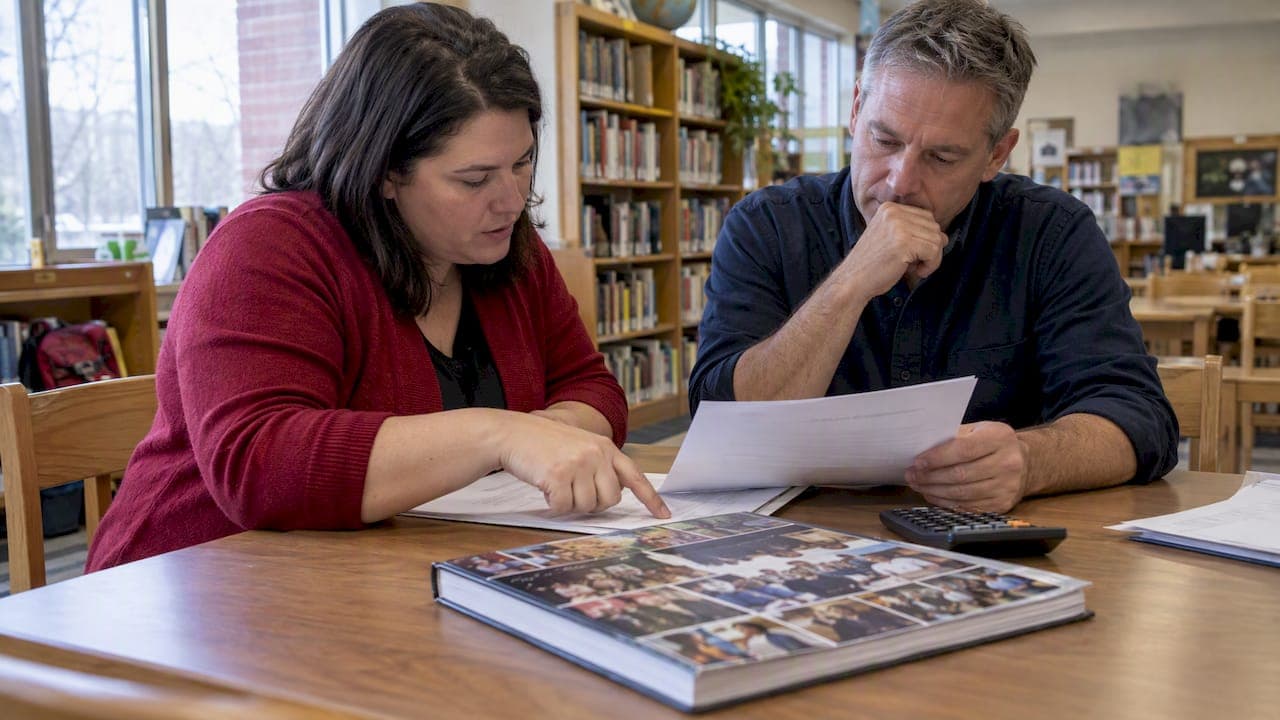
A new printed school yearbook in the US typically sells to students for roughly $50 to $100, according to Classmates' 2026 pricing overview. What the school pays to print it is a different number, and it depends on page count, binding, cover options, quantity and shipping. This guide covers both sides: what families see at the order table, and what advisers and administrators see on the printing quote.
TL;DR
- Students typically pay about $50 to $100 for a new printed yearbook, and the figure varies with school size and print quality (Classmates).
- For the school, page count is the biggest cost lever. Binding, covers and extras come second, and quantity and freight decide whether a quote is really comparable to another.
- Our published add-on fees run from $0.40 per book for inside cover printing to $4.25 per book for a flat foil stamp or spot UV.
- The cheapest-looking quote is often not the cheapest order. Ask for all-inclusive pricing, shipping included, before you compare.
- Old or vintage yearbooks are a separate market: common ones sell for $5 to $35, per WorthPoint.
Table of Contents
- Two prices: what families pay and what the school pays
- What students typically pay
- What actually drives the printing bill
- Add-on costs: a transparent look
- Watching for hidden fees
- How to build a yearbook budget in five steps
- Where we stand
- See your school's price
- What about old yearbooks?
- FAQ
- Sources
Two prices: what families pay and what the school pays
When someone searches for what a yearbook costs, they usually mean one of two things.
The retail price is what a student or parent pays the school. This is the number on the order flyer. It is set by the school, and it has to cover the printing bill, any design or software costs, and whatever the school wants to keep for the yearbook program.
The production price is what the school pays the printer or yearbook company. It is a per-book cost multiplied by the number of copies, plus add-ons and freight.
The gap between the two is where a yearbook budget lives. If you are an adviser, your job is to set a retail price that clears the production bill without pricing out families. If you are an administrator, your job is to make sure the production quote has no surprises in it. Our guide to yearbook pricing and break-even walks through that math in worksheet form.

What students typically pay
The most recent consumer-side figure we found puts a new physical yearbook at about $50 to $100, with variation by school size and local pricing models (Classmates). That is a wide range, and it is wide for good reasons:
- A 60-page elementary book and a 300-page high school book are different products.
- A school with 150 students spreads fixed costs over fewer copies than a school with 1,500.
- Some schools subsidize the book through fundraising or ad sales. Others price it to break even.
- Early-bird pricing, late-order premiums and bundled extras (a name stamp, a personalized page) change what a family sees.
If your school's price sits at the low end, check that it is not being held down by a printing quote that will grow later. If it sits at the high end, look at page count, hidden fees and leftover copies before you blame the printer.
What actually drives the printing bill
Page count comes first
Yearbook printing is, in practice, billed by the page. Reducing pages is the most direct way to lower the per-book price, and it is a decision the yearbook staff controls. A common planning rule is about one spread for every 16 to 24 students; our page count guide for advisers shows how to turn enrollment into a page target before you start designing.
A quick way to feel the impact: going from 96 pages to 80 saves 16 pages of production on every single copy. Multiply that by 400 books and the saving is real, while most students will never notice the difference.
Binding and cover
Binding is the second major choice. Hard covers cost more than soft covers, and sewn bindings cost more than glued ones. Covers can also carry finishes (foil, spot UV) or be personalized per student. These are per-book charges, so they scale with quantity.

Quantity
Ordering fewer books raises the price per book at most companies because setup costs are spread over fewer copies. But ordering too many leaves the school with unsold stock. We cover that trap in why leftover yearbook copies are costly and give a planning method in our quantity ordering checklist.
School size matters here as well. A small school and a large school face different curves, which we explain in why school size affects yearbook pricing.
Shipping and freight
Freight is the line item most often left off an early quote. A price that looks low until shipping is added is not low. With us, shipping is included in the instant pricing a school sees online. If a school prefers to add freight to the school as a line item on a custom quote, our published rate is $1.00 per book.
Timing and deadlines
Some companies attach price increases to order deadlines or season changes. Others require an early commitment months before graduation. Our guide on why yearbook price increases happen explains the usual causes, so you can tell a justified increase from a padded one.
Add-on costs: a transparent look
Most schools do not pay for a bare book. They choose a binding, a cover finish and a few extras. Here are the add-on fees we publish on our printing page, so you can see what each choice costs per book.
| Option | Published fee |
|---|---|
| Perfect bound soft cover | $1.60 per book |
| 150 point board (hard cover) | $1.50 per book |
| Smyth sewn | $2.00 per book |
| Printed endsheets (hard cover) | $2.75 per book |
| Inside cover (duplex) printing, soft cover or saddle-stitched | $0.40 per book |
| Flat foil stamp or spot UV | $4.25 per book |
| Personalized covers | $3.00 to $6.00 per book |
| Include freight to the school | $1.00 per book |
| Split binding | $100 one-time |
| Printed proof books, litho only, 2 copies, shipping included | $100 one-time |
| Recognition ads | $5 per ad |
| Lovelines | $1 each |
These are add-on and option fees, not the full price of a book. The total depends on your page count, trim size and quantity, which is why we show school-specific pricing instantly online rather than quoting a single number here.
A worked example
Say a school wants a hard cover book with printed endsheets and a foil stamp on the cover, and wants 300 copies.
- Hard cover board: $1.50
- Printed endsheets: $2.75
- Flat foil stamp or spot UV: $4.25
Those three options add up to $8.50 per book, or $2,550 across 300 copies, before the base book price. That is a useful number to know when you are deciding whether the foil stamp is worth it. If each family pays the same price either way, the stamp is a decision about what you would rather spend $1,275 on for 300 copies at $4.25 each.
Now compare a soft cover with inside cover printing: $1.60 plus $0.40 is $2.00 per book, or $600 across 300 copies. The difference between the two builds is $6.50 per book. Seeing it laid out like this makes it easier to defend a decision to a principal or a parent council.
Revenue add-ons
Some of the items above bring money in rather than cost it. Recognition ads at $5 each and Lovelines at $1 each let families add a message to the book. Many schools use them to offset production costs. The more of those a school sells, the less the retail price has to carry.
Watching for hidden fees
A low per-book price means little if setup, proofs, design support, shipping or late-order fees show up afterward. Typical examples include separate charges for proofs, rush production, color pages and delivery. Our article on types of yearbook hidden fees lists the ones to ask about.
A simple test: ask for a written quote that states the total for your page count, quantity, binding and delivery, and then check whether anything else can be added later. If the answer is vague, the quote is not finished. Our own approach to this is laid out in all-inclusive yearbook pricing.
How to build a yearbook budget in five steps
- Estimate enrollment and expected buyers. Use last year's sales rate, not total enrollment.
- Set a page target. Work from students per spread, then adjust for sports, clubs and events.
- Choose binding and finishes. Decide which options are essentials and which are extras.
- Get an all-inclusive quote. It should include shipping and show the total, not only the per-book price.
- Set the retail price. Divide the production total by expected sales, then adjust for ad revenue, fundraising and a small buffer.
Our 2026 budget planning guide for advisers goes deeper on each step, with the timeline for when to do them.
Where we stand
We get asked a lot why yearbook pricing is so hard to pin down. In our experience, it is hard because of how it is usually sold. A school fills out a form, waits for a rep, and receives a quote that may or may not include shipping. By the time the real number appears, the school has already invested time in the process.
So we do it differently. Schools can see all-inclusive pricing online instantly, with no signup and no sales pitch. Shipping is included, and there are no hidden fees. There are no order minimums or submission deadlines, and turnaround is 2 to 3 weeks. Our team brings more than 50 years of combined experience, and we use that to help advisers who are new to the job as much as veterans.
We also believe the biggest saving is rarely in a clever negotiation. It is in the plan: a sensible page count, a realistic quantity and no surprises on the invoice. Most of the price problems we see come from one of those three.
— Jace
See your school's price
If you want to see what your own book would cost, you can get school-specific pricing on our home page without signing up. Elementary and middle schools can look at the options on our K-8 page, where schools can either design the book themselves or have us create it for them. Advisers who want to check paper and print quality first can request a sample.
Design tools are flexible too: you can work in Canva, InDesign or our online creator, and design help is free.
What about old yearbooks?
Some searchers land on this topic because they want a yearbook from decades ago, not a new one. That market works differently. Common vintage yearbooks usually sell for about $5 to $35 at estate sales and antique stores, while books tied to a famous alumnus can reach far higher prices (WorthPoint). Condition, scarcity and historical interest matter more than age alone.
If you are trying to find a lost yearbook from your own school years, an online archive may be quicker than antique stores. Classmates' yearbook finder lets you search its collection by school, and its reprints cost about $80 to $100.
FAQ
How much does it cost to print a school yearbook?
It depends mostly on page count, binding, quantity and delivery. Add-ons such as foil stamps, personalized covers and printed endsheets are charged per book on top of the base price. The most reliable way to get a real number is an all-inclusive quote for your exact specifications.
Why are yearbooks so expensive?
A yearbook is a full-color, custom book produced in a small run, so setup costs are spread over relatively few copies. Page count, hard covers and finishes add to the per-book cost, and unsold copies add waste. Schools can lower the price by trimming pages, choosing simpler binding and ordering closer to expected sales.
What should a student pay for a yearbook?
New printed yearbooks typically retail for about $50 to $100, according to Classmates. Your school sets its own price, based on its production bill, ad revenue and fundraising. Ask the yearbook adviser how the price was set if it seems high.
How can a school lower its yearbook cost?
Start with the page count, since printing is billed by the page. Then order a realistic quantity based on past sales, limit costly finishes to what the school values, and sell recognition ads to offset the bill. Always compare quotes with shipping included.
How much are old yearbooks worth?
Most common vintage yearbooks sell for roughly $5 to $35, though rare or celebrity-linked editions can fetch much more (WorthPoint). Condition and the school's notability affect value.
Sources
- How Much Do Yearbooks Usually Cost | Yearbook Pricing in 2026, Classmates
- Valuable Vintage: School Yearbooks, WorthPoint
- High School Yearbook Finder, Classmates