

Leftover yearbook copies are a direct financial loss for schools because printers require minimum production runs, and the school absorbs every unsold copy at full production cost. A published school case documented a significant deficit from excess production alone, with advisers forced to raise prices the following year to recover. The school pays, not the printer, and not the families who didn't buy.
Three things you can do right now:
- Pause any pending over-orders. If you haven't finalized quantities, hold until you have deposit data in hand.
- Launch a pre-order campaign with deposits. Even a two-week drive through student government or ASB can sharpen your demand forecast significantly.
- Set a contingency reserve. Build a small percentage of total production cost into your yearbook budget as a buffer before you place the order.
Table of Contents
- What does a school actually pay for when ordering yearbooks?
- Why unsold copies become a real budget problem
- How does order quantity change your risk exposure?
- Practical strategies to cut leftover costs before they happen
- How Trailmarkyearbooks helps reduce leftover-copy risk
- Key Takeaways
- The lesson most advisers learn the hard way
- Trailmarkyearbooks: a practical next step for advisers
- Useful sources for advisers
What does a school actually pay for when ordering yearbooks?
Yearbook pricing has two layers that most advisers don't fully separate until they're staring at an invoice. The first layer is fixed costs: press setup, plate preparation, proofing rounds, and any design-support fees your vendor charges. These costs exist whether you print 100 copies or 500. The second layer is variable: paper, ink, binding per copy, and finishing options like spot UV coating or embossing. Cover upgrades, personalization add-ons, and page-count overages sit in a gray zone, since they're often quoted as per-unit but trigger minimum charges.
Hidden fees are one of the most common sources of unexpected yearbook deficits. Personalization packages, cover upgrades, and page overages can push a school's actual per-unit cost well above the quoted base price — often without a clear warning in the original contract.
Logistics add another layer that's easy to underestimate. Inbound shipping to the school, storage if books arrive before distribution day, custodial labor for handling boxes, and the handoff to ASB or the main office all carry real costs. When you divide total shipping across a smaller order, per-copy shipping cost rises sharply. A vendor that includes shipping in an all-inclusive price removes that variable, but you still need to account for it in your budget math.
Timeline matters here too. Standard print runs typically require weeks of lead time. On-demand reprints, by contrast, can turn around in 2–3 weeks, but they carry a premium per-unit price. Missing the main production deadline doesn't just create stress; it changes your cost structure entirely. Advisers who track timeline risks early avoid the reprint premium that compounds leftover losses.
A practical note on hidden fees: always request a full line-item quote before signing. Ask specifically about proofing rounds, cover finish options, and what triggers a page-overage charge.
Why unsold copies become a real budget problem
The core issue is sunk fixed costs. Once you've paid for press setup and plate preparation, those dollars are gone regardless of how many copies sell. Every unsold book carries its proportional share of those fixed costs plus its own variable production cost. That's the per-copy loss, and it compounds fast.
Here's how the math works in practice:
- Calculate your all-in cost per copy. Divide total production cost (fixed + variable) by the number of copies ordered. Example: $8,000 total cost ÷ 400 copies = $20 per copy.
- Count your unsold copies. If 40 books go unsold (10% of the run), your direct production loss is 40 × $20 = $800.
- Add post-production costs. Storage, handling, and distribution labor add to that figure. If you eventually sell surplus copies at $5–$20 each to clear storage, you recover only a fraction.
- Factor in depreciation. Books stored past the school year lose value quickly. Damage, obsolescence, and the simple reality that last year's yearbook is a hard sell reduce any resale recovery further.
- Total the real loss. Production loss + storage/handling + any write-off on unsold inventory = the true cost of leftover copies.
The accounting impact reaches beyond a single line item. A deficit in the yearbook fund often forces the program to raise retail prices the following year, which can suppress demand and create the same problem again. Some schools cut page counts or drop cover upgrades to recover margin. In the worst cases, the ASB fund absorbs the shortfall, pulling money from other student programs. Advisers who link price to program sustainability openly with families tend to get more buy-in for modest price increases that prevent this cycle.
How does order quantity change your risk exposure?
Ordering more copies lowers your per-unit price, but it raises your total exposure if demand falls short. That trade-off is the central tension in yearbook ordering, and it's worth running the numbers before you commit.

| Order Size | Total Cost | Per-Unit Cost | Loss at 5% Unsold | Loss at 10% Unsold | Loss at 20% Unsold |
|---|---|---|---|---|---|
| 300 copies | — | — | — | $630 | — |
| 500 copies | — | — | — | $875 | — |
Note: These figures are illustrative examples based on typical pricing tier structures. Your actual costs will vary by vendor, page count, and cover options.
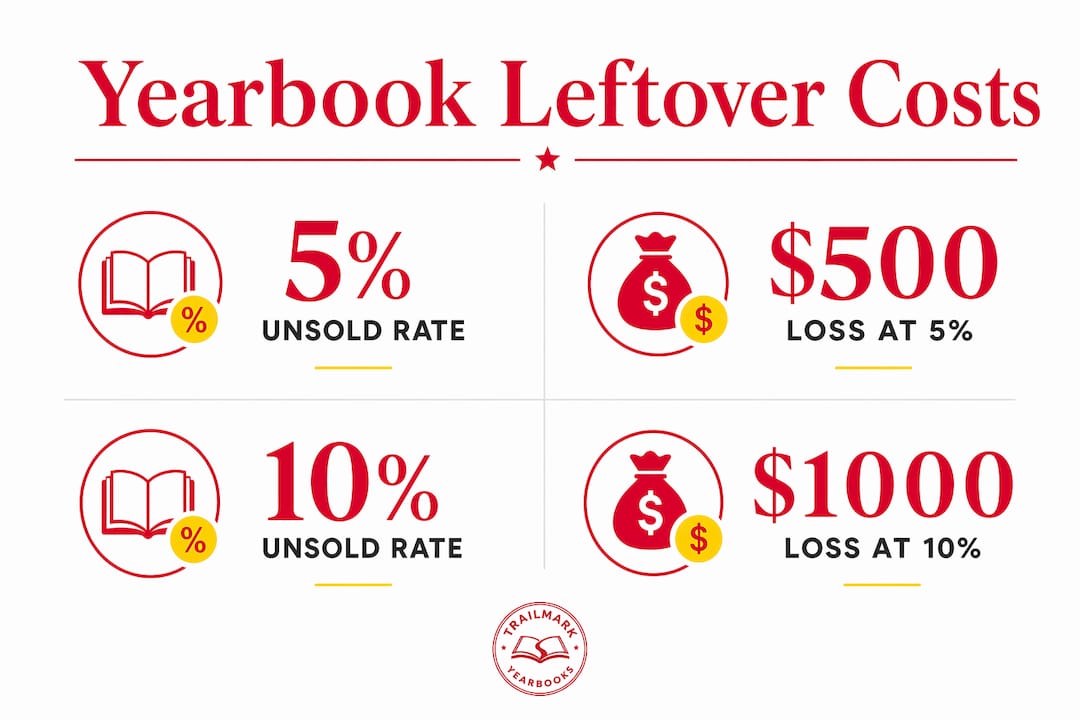
The table shows something counterintuitive: the dollar loss at a given unsold percentage is actually higher for larger orders, even though the per-unit cost is lower. A 10% unsold rate on 500 copies costs $875 in production loss versus $630 on 300 copies. The per-unit savings don't offset the larger absolute exposure when demand is uncertain.
Forecasting errors drive most of this risk. Schools that overestimate enrollment growth, assume last year's participation rate holds, or fail to account for a competing event (graduation trip, spring sports fees) often end up with a substantial share of unsold inventory. Using a structured ordering checklist that ties order quantity to historical sales data and confirmed deposits is the single most reliable way to tighten that forecast.
Print-on-demand (POD) changes the equation differently. POD eliminates leftover risk almost entirely because you print only what's ordered. The trade-off is a higher per-unit cost, which makes it less economical for large guaranteed runs. For a school confident it can sell 400+ copies, traditional bulk printing wins on unit economics. For a school with volatile demand or a new program, POD for the uncertain portion of the run is worth the premium.
Practical strategies to cut leftover costs before they happen
The most effective mitigation happens before the order is placed, not after boxes arrive.
Pre-orders and deposits are the highest-leverage tactic. Requiring a modest deposit to hold a yearbook converts soft interest into a committed sale and gives you real demand data before you finalize quantities. Schools that avoid requiring deposits often end up with unsold books and then stop ordering extras entirely, which hurts students who want a copy.
Early-bird pricing creates urgency. A $5–$10 discount for orders placed before a hard deadline moves sales forward in time, which improves your forecast accuracy and reduces the risk of ordering too many.
Buyback and resale windows give you a recovery option after distribution. Wenatchee High School's ASB office, for example, sold surplus yearbooks from prior years at $5–$20 to clear storage. Third-party services like Yearbook Cash will make a cash offer on unsold inventory, though the rebate price is typically well below production cost. Collector marketplaces exist too, but resale value is inconsistent and not a dependable recovery channel for current-year inventory.
Contract and policy language protects you at the vendor level. When negotiating, ask for:
- The exact minimum-run commitment and what happens if you order below it
- Reprint pricing and turnaround time in writing
- Whether the vendor offers a POD option for late or small-batch orders
- A clear statement of what fees are included versus billed separately
On the school side, set a written deposit deadline, a refund policy for canceled orders, and a hold-for-pickup window (typically 30 days after distribution) after which unclaimed books revert to the school for resale.
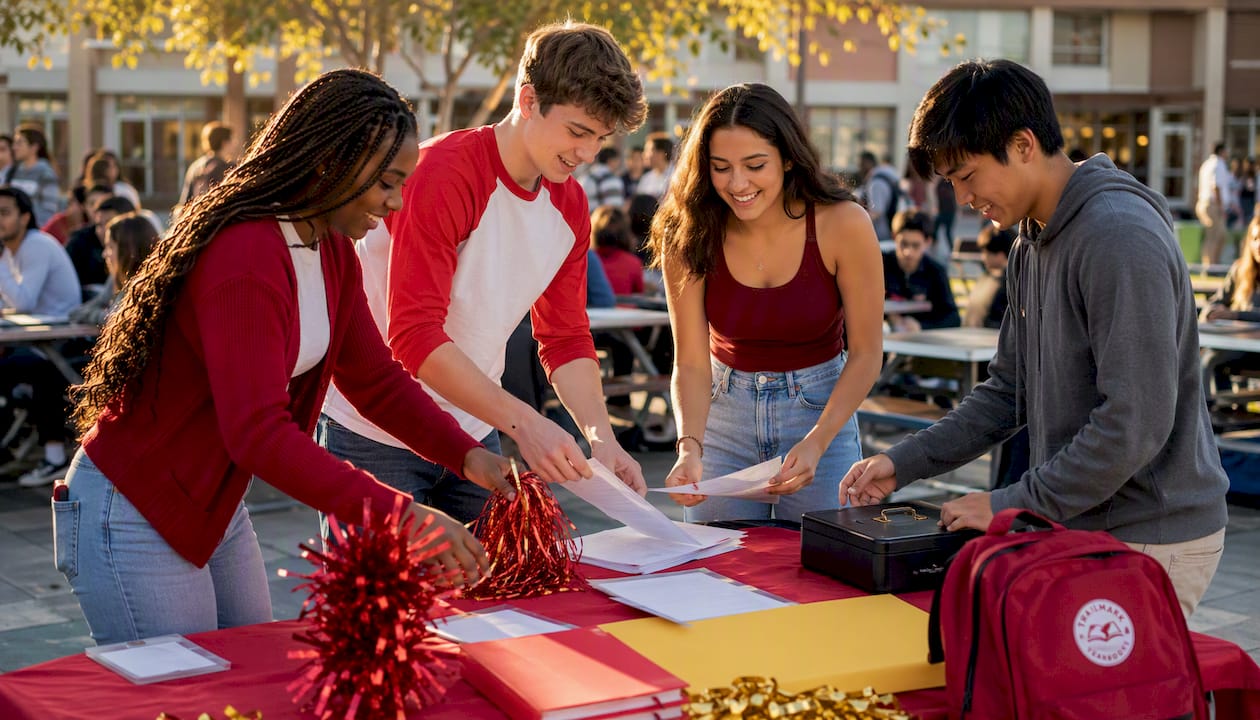
Pro Tip: Run a two-week sales drive where student leaders set up in the cafeteria, at after-school events, and at parent nights with a sign-up sheet and deposit collection. Student-led drives consistently outperform flyer campaigns because they create social proof in real time.
Transparent communication with families also matters. Explain in your sales emails that the yearbook price includes a small contingency for program sustainability. Families who understand the economics are more receptive to modest price increases and more likely to buy early.
How Trailmarkyearbooks helps reduce leftover-copy risk
Trailmarkyearbooks is built around the specific problems that create leftover losses: opaque pricing, surprise fees, and inflexible reprint options.
The all-inclusive pricing model means advisers see the full cost upfront, including shipping, with no hidden add-ons that inflate the per-unit figure after the order is placed. That transparency makes budget planning more accurate and removes the hidden-fee surprises that push actual costs above estimates.
Fast turnaround changes what's possible when demand is uncertain. A 2–3 week reprint window means advisers can start with a conservative order, sell through it, and reprint for late buyers without the long lead times that force over-ordering in the first place.
On-demand reprints are the structural answer to leftover risk. Instead of padding the initial order to cover every possible late sale, advisers can order conservatively, distribute to confirmed buyers, and reprint small batches as needed. The per-unit cost on a small reprint run is higher, but it's almost always lower than the loss on 50 unsold copies sitting in a storage closet.
Free design assistance and a dedicated adviser resource hub mean schools don't have to absorb the cost of design errors or page-count overages that add unexpected charges late in production. Flexible design options through Canva, Adobe InDesign, or Trailmarkyearbooks's own online creator give advisers control over page count and finish choices before the quote is finalized.
Key Takeaways
Leftover yearbook copies cost schools money because fixed production minimums create sunk costs that every unsold book must absorb, and post-production storage and write-offs compound that loss year over year.
| Point | Details |
|---|---|
| Fixed costs amplify losses | Setup and press minimums are sunk costs; each unsold copy carries its full share of those charges. |
| Deposits are the first fix | Requiring a modest deposit before finalizing quantities converts soft interest into real demand data. |
| Conservative orders beat large ones | A 10% unsold rate on 500 copies costs more in absolute dollars than the same rate on 300 copies. |
| POD reduces risk for uncertain demand | Print-on-demand eliminates leftover inventory at the cost of a higher per-unit price on small runs. |
| Trailmarkyearbooks | All-inclusive pricing, 2–3 week turnaround, and on-demand reprints directly address the root causes of leftover losses. |
The lesson most advisers learn the hard way
The first time a yearbook program runs a deficit, it's almost always the same story: the adviser ordered a cushion of extra copies "just in case," demand came in lower than expected, and suddenly there are dozens of books left in a storage room and a multi-thousand dollar hole in the ASB fund. The instinct to order extra feels responsible. The math says otherwise.
What actually changed the outcome for programs that recovered wasn't a better guess at demand. It was removing the guess entirely. Deposits, pre-order deadlines, and a conservative base order with a reprint option on standby turned an unpredictable process into a manageable one. The programs that moved to that model stopped having deficits. They also stopped having to explain to families why prices went up again.
Pro Tip: Before your next ordering cycle, pull three years of actual sales data (not enrollment, actual sales) and use that as your base quantity. Add 5% for growth, subtract 5% as your contingency buffer, and require deposits for anything above that floor. You'll order fewer copies than you think you need, and that's exactly the point.
Trailmarkyearbooks: a practical next step for advisers
Advisers dealing with leftover risk don't need a longer vendor pitch. They need transparent pricing, a fast reprint option, and resources they can actually use when planning the next order cycle.

Trailmarkyearbooks offers all-inclusive instant pricing with no signup required, free design support, and on-demand reprints with a 2–3 week turnaround. There are no hidden fees, no minimum-order surprises, and shipping is included. If you're heading into a new ordering cycle and want to see what the numbers actually look like before you commit, request a physical sample to verify quality and turnaround firsthand. Or download the adviser resources and budgeting tools to get checklists, sample contract language, and ordering templates you can use right now.
Useful sources for advisers
- The Cost of a Yearbook – The Paw Print — Real-school case documenting a $5,000 deficit and the pricing decisions that followed.
- WAWA Yearbook Surplus Sale – Wenatchee High School — Example of a school clearing surplus inventory at $5–$20 per copy through the ASB office.
- Tricks to Avoid Common Yearbook Disappointments – Yearbook Groupie — Practical guide on hidden fees and budgeting calculators for advisers.
- Students Purchase Yearbooks Despite High Cost – Scot Scoop News — Student-reporter coverage of how leftover risk changes adviser ordering behavior.
- School Yearbook Quantity Ordering Checklist – Trailmarkyearbooks — Step-by-step checklist for translating enrollment and sales history into a defensible order quantity.
- Yearbook Shipping Included: Benefits for Schools – Trailmarkyearbooks — Explains how logistics costs contribute to per-copy cost and why all-inclusive pricing matters.