

A yearbook colophon is a concise, informative statement that documents how the yearbook was created, who made it, and the production details behind it. Every school yearbook deserves one. A well-written colophon is more than a list of names and printer specs. It is a snapshot of collaborative effort that honors every student editor, adviser, and designer who contributed. This yearbook colophon writing guide walks you through exactly what to include, how to write it, where to place it, and what mistakes to avoid.
What should a yearbook colophon writing guide cover?
A colophon is the section of a yearbook that records its production history. Think of it as the book's birth certificate. It tells future readers, archivists, and next year's staff exactly how the book came to life.
Colophons evolved from handwritten statements in ancient manuscripts to printed details in modern publications. That history matters. It means the colophon carries real weight as a document of record, not just a formality tucked into the back pages.

Historians note that colophons elevate printed materials from simple photo albums to professionally designed keepsakes with their own creation histories. For a school yearbook, that distinction is meaningful. A yearbook with a thoughtful colophon signals that the staff took their work seriously.
What essential components should a yearbook colophon include?
Yearbook colophons typically include printer names, number of copies printed, paper types, fonts used, and staff credits. Each element serves a purpose. Together, they give the colophon its authority and usefulness.
Here is a breakdown of the core components:
| Component | What to include |
|---|---|
| Book title and edition | Full yearbook title, school name, volume number, and year |
| Printing details | Printer name, location, paper stock, and cover material |
| Print run | Total number of copies printed |
| Typography | Font names used for headlines, body copy, and captions |
| Staff credits | Names and roles of all editors, photographers, and advisers |
| Design notes | Software used (Canva, InDesign, or an online creator), color palette, and theme name |
| Distribution | School address and approximate delivery date |
Beyond the factual entries, strong colophons also include a short thematic statement. If your yearbook theme is "Roots and Routes," for example, a sentence or two explaining how that theme shaped the design choices adds real depth. Production details like printer, paper stock, and fonts also serve a practical purpose: they give future staffs a starting point when they plan the following year's book.
Pro Tip: Collect font names and paper stock details directly from your printing partner before you start writing. Waiting until the final week creates errors.
How do you write a yearbook colophon step by step?
Writing a colophon is straightforward when you treat it as a structured task rather than an afterthought. Advisers and editors should coordinate early to gather accurate production information and contributor names before drafting begins.
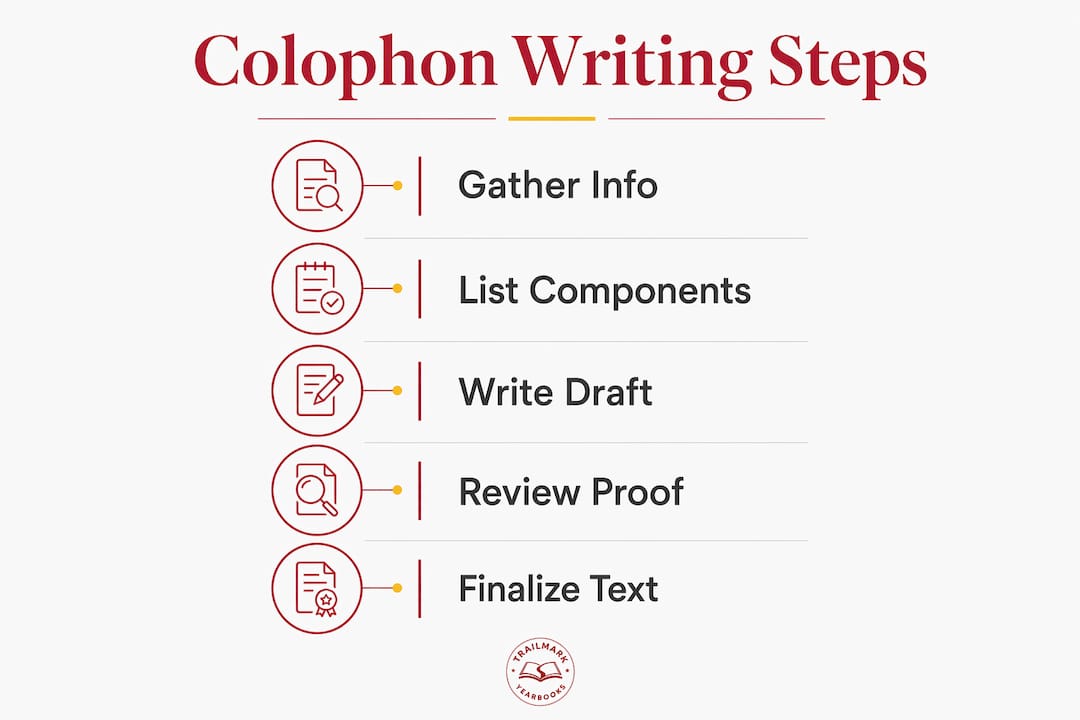
Follow these steps to write a complete, accurate colophon:
-
Gather all production facts first. Contact your printer for paper stock names, cover specifications, and print run numbers. Confirm font names from your design files. Do this at least two weeks before your final deadline.
-
Build your staff list. Collect every contributor's name and their specific role. Include editors, section editors, photographers, designers, and the faculty adviser. Accuracy matters here. Missing a name is the kind of mistake that stings.
-
Choose your tone. Colophon length and tone vary, but the best ones balance formality with personality that reflects the yearbook's overall style. A formal, list-heavy colophon works for some schools. A brief narrative voice that describes the creative process works for others. Match the tone to your book's character.
-
Write a short thematic statement. Two to four sentences explaining the year's theme, why it was chosen, and how it shaped the design gives the colophon real storytelling value. This is the section that makes readers pause and actually read it.
-
Draft the production block. List all technical details in a clean, readable format. Use consistent punctuation. Avoid abbreviations that future readers might not recognize.
-
Credit every contributor by name. List staff members in a logical order: editor-in-chief first, then section editors, then staff members, then the adviser. Some schools list contributors alphabetically within each role category.
-
Edit and get approval. Run the draft past your adviser and at least one other editor. Cross-check every name spelling, every font name, and every print specification. Submit the colophon for final approval before sending files to print.
Pro Tip: Use the yearbook proofing process as your final checkpoint for colophon accuracy. Treat it like any other page proof.
How do you integrate the colophon into your yearbook design?
Placement and design are as important as the words themselves. A colophon buried in tiny gray text on a cluttered page will go unread. A colophon designed with intention becomes part of the book's identity.
Effective colophon placement is usually in the back matter or last pages of the yearbook. This is where readers expect to find it, and it is where archivists and future staffs will look first. Some schools place it on the inside back cover. Others use the final spread's verso page.
Key design principles for colophon integration:
- Match your typography. Use the same font families established in your yearbook's design system. Mixing unrelated fonts in the colophon breaks visual consistency.
- Use your theme colors. Pull accent colors from your cover or section dividers to tie the colophon visually to the rest of the book.
- Keep it readable. Body text should be no smaller than 8 points for print. White space around the text block improves legibility significantly.
- Add a visual anchor. A small graphic element, a logo, or a themed illustration gives the colophon a finished look without overwhelming the text.
- Coordinate with print specs. Clear typography consistent with the yearbook theme enhances colophon readability and visual harmony.
Understanding yearbook structure elements like folios and back matter helps you place the colophon where it belongs within the book's physical layout.
Common mistakes to avoid when creating your yearbook colophon
The most damaging mistake is treating the colophon as purely administrative text. Yearbook design experts recommend using the colophon to celebrate the student staff's effort and creative journey, not just to list printer specs.
Watch for these specific pitfalls:
- Omitting contributors. Every person who worked on the book deserves to be named. Leaving someone out is a lasting oversight that cannot be corrected after printing.
- Cluttering with jargon. Technical printing terms like "coated 80 lb. text stock" are useful for future staffs, but bury them after the human elements. Lead with people, follow with specs.
- Ignoring design integration. A colophon set in a default font with no visual connection to the rest of the book looks like a forgotten footnote. Common pitfalls include omitting key contributors and treating the colophon as mere administration.
- Writing it at the last minute. Colophons written under deadline pressure contain errors. Names get misspelled. Print run numbers get guessed. Both problems are permanent.
- Skipping the revision step. Every colophon needs at least one full proofread by someone who was not the primary writer.
"A colophon written with care tells the reader that the people who made this book cared about every page, not just the photos." This is the standard worth holding.
Revision is not optional. Check every name against your official staff roster. Verify every technical detail with your printer in writing before you finalize the file.
Key Takeaways
A yearbook colophon is the definitive record of who made the book, how it was made, and why the creative choices were made, and it deserves the same care as any other page in the yearbook.
| Point | Details |
|---|---|
| Gather production facts early | Collect printer specs, font names, and paper stock details at least two weeks before the deadline. |
| Credit every contributor | List all editors, photographers, designers, and advisers by name and role. |
| Balance tone with personality | Match the colophon's voice to the yearbook's overall style, not just a dry list of specs. |
| Design it intentionally | Use consistent typography and theme colors so the colophon fits the book visually. |
| Proofread before final submission | Cross-check every name and technical detail against source documents before sending to print. |
The colophon deserves more than a last-minute paragraph
I have reviewed a lot of yearbooks over the years, and the colophon is almost always the last thing the staff thinks about. It gets written in a rush, squeezed onto whatever white space is left on the back page, and proofread by nobody. That pattern produces colophons full of misspelled names, wrong print run numbers, and zero personality.
The schools that get it right treat the colophon as a storytelling element from the start of the production cycle, not the end. They assign it to a specific editor. They build it into the design template early. They treat it the way they treat the opening spread: with intention.
What I find most compelling about a well-crafted colophon is what it does for the staff. When students see their names printed in a professional, thoughtfully designed section of the book, it validates the work they put in all year. That recognition matters. It is one of the few places in the yearbook where the creators are visible, not just the subjects.
The colophon also serves future staffs in ways that are easy to underestimate. A detailed record of fonts, paper stock, and printer information saves the next team hours of research. It is a gift forward in time.
— Jace
Trailmarkyearbooks supports your full yearbook production process
Trailmarkyearbooks works with elementary, middle, and high schools nationwide to make yearbook production straightforward and affordable. From design assistance to print production, the team brings over 50 years of combined experience to every project.

Advisers can request a sample yearbook to review print quality and layout options before committing to a full order. Trailmarkyearbooks also offers downloadable adviser resources including guides and templates that cover every stage of production, from opening spreads to colophon writing. With no hidden fees, no order deadlines, and a 2–3 week turnaround, Trailmarkyearbooks removes the production stress so your staff can focus on the creative work.
FAQ
What is a yearbook colophon?
A yearbook colophon is a statement at the back of the yearbook that records production details, staff credits, printer information, and design notes. It serves as both an acknowledgment of contributors and a practical record for future yearbook staffs.
Where should the colophon be placed in a yearbook?
The colophon belongs in the back matter, typically on one of the final pages or the inside back cover. This placement follows publishing tradition and makes it easy for readers and future staffs to locate.
How long should a yearbook colophon be?
Most colophons run between 100 and 300 words. The length depends on the number of contributors and how much thematic context the staff wants to include alongside the production facts.
What are the most common colophon mistakes?
The most common mistakes are omitting contributor names, writing the colophon at the last minute, and treating it as purely administrative text rather than a creative record of the staff's work.
Do you need to include font names in a yearbook colophon?
Yes. Listing the fonts used in the yearbook gives future staffs a reference point and adds transparency to the design process. It is a small detail that carries real practical value for the team that follows.