

The yearbook is your school's flagship branded publication. When it reflects your identity consistently, it protects tuition value, deepens community ties, and keeps working as a marketing asset long after distribution day. Three things make that true:
- Values alignment drives enrollment: 69% of enrolling families cited it as their primary factor, according to NAIS survey data.
- A branded yearbook shifts parent conversations from price to fit. Schools with undifferentiated branding get compared on cost; schools with a clear identity get chosen for what they stand for.
- The physical book travels into homes and stays there for years, quietly shaping how families remember and recommend your school, as Aliant Brands notes in their analysis of yearbooks as brand ambassadors.
Table of Contents
- Why does school branding in a yearbook matter for admissions and alumni?
- Which brand elements belong in every yearbook?
- What does a realistic production timeline look like?
- How do you run the project and keep brand decisions consistent?
- Step-by-step: embedding brand into this year's book
- How do you measure the yearbook's brand impact after distribution?
- Key Takeaways
- The part most schools skip
- Trailmarkyearbooks makes on-brand yearbook production straightforward
- Useful sources and further reading
Why does school branding in a yearbook matter for admissions and alumni?
Weak school branding forces families to compare you on tuition. Strong branding makes price a secondary consideration because the school's personality is unmistakable. That dynamic shows up most clearly in admissions, but it runs through every stakeholder relationship you manage.
Admissions. A well-branded yearbook placed in a welcome pack during a campus tour does something a brochure cannot: it shows, not tells. Prospective families flip through candid photos, read student voices, and absorb the school's culture in a way that a PDF never replicates.
Community and internal culture. Branding aligns faculty and staff around a shared vision. When the yearbook reflects that same vision, it reinforces the message internally, not just externally. Students who see their school's values reflected in the book feel a stronger sense of belonging.
Alumni and legacy. The yearbook is one of the few school publications alumni actually keep. That makes it a durable touchpoint for donor cultivation, reunion outreach, and annual giving campaigns. A book that looks and feels like your school, not a generic template, is one alumni are more likely to display and share.
- Place a copy in every admissions welcome pack.
- Share selected feature spreads on your school's social channels after distribution.
- Keep a small stock of prior-year books for alumni events and fundraising tables.
Pro Tip: Ask your admissions team to note, informally, how often prospective families mention the yearbook during tours. Even anecdotal feedback over two cycles will tell you whether the book is doing brand work.
Which brand elements belong in every yearbook?
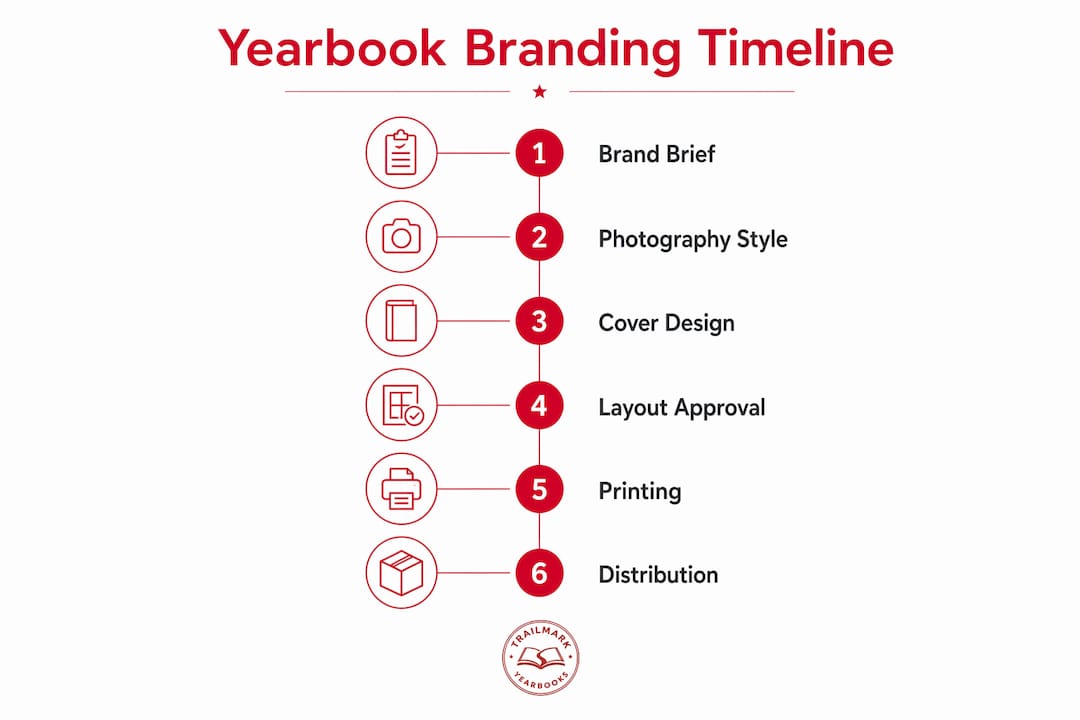
The answer goes well beyond the cover. A yearbook that reads as an extension of your school's communications system standardizes both visual and editorial elements across every spread.
Visual elements
- Cover treatment: school crest, embossing, foil, or soft-touch finish tied to your brand palette
- Logo lockups: consistent placement, clear space, and approved color versions only
- Color specs: exact Pantone or CMYK values, not approximations
- Typography pairings: one serif for body, one display font for headlines, both matching your broader communications
- Endsheets: school colors, crest patterns, or branded motifs; endsheets are underused branding real estate that create a professional bookend effect
- Photography style guide: consistent lighting, cropping ratios, candid-to-posed ratio, and diversity of subjects
Editorial elements
- Voice and tone guidelines matching your school's communications
- Tagline usage rules (where it appears, how it is set)
- Standards for covering traditions and milestones
- Caption and byline format
Expanded coverage including interviews, department features, and student artwork tells a broader school story than posed portraits alone. A yearbook photography checklist helps advisers standardize shot lists before the first event of the year.
Pro Tip: Paste your color codes, logo usage rules, and photography dos/don'ts into a single one-page PDF and share it with every student editor at kickoff. Trailmarkyearbooks supports file uploads from Canva and Adobe InDesign, so your brand assets transfer directly into production without reformatting.

A themed yearbook should be customized to your school's specific events, not a generic concept that could belong to any school. The theme is the brand expression for that year; it should reference something only your community experienced.
What does a realistic production timeline look like?
Brand decisions made late cost money and dilute quality. The cover treatment, photography style, and endsheet design need to be locked before the first major event shoot, not after.
| Milestone | Typical timing | Brand decision due |
|---|---|---|
| Brand brief circulated | August/September | Cover concept, color specs, photo style |
| Photography kick-off | September/October | Shot list approved, style guide distributed |
| Design begins | October/November | Logo files, typography, endsheet art |
| Internal brand review | January/February | Spreads reviewed against brief |
| Final proof | March/April | All approvals signed off |
| Print and delivery | April/May | 2–3 week turnaround from final file |
Print options that change perception include embossing, foil accents, soft-touch covers, heavier paper stock, and full-color printing throughout. These are tactile brand signals. Parents who receive a book with a premium cover are more likely to display it.
Cost levers to know:
- Per-copy quantity (larger runs lower unit cost)
- Cover finish type (soft-touch and foil add cost; matte laminate is mid-range)
- Page count and custom section inserts
- In-house design vs. outsourced or supported design
To lower cost without losing brand impact, apply premium finishes only to the school's admissions and alumni copies. Use cost-effective binding for the main student distribution run.
Pro Tip: Request a physical sample before committing to a cover finish. Trailmarkyearbooks offers a sample book request so you can feel the difference between finishes before the order is placed.
How do you run the project and keep brand decisions consistent?
Name a small steering group early: Head of School or designee, communications lead, yearbook adviser, two or three student editors, and a production partner contact. Each person has one job. The communications lead owns brand compliance. The adviser owns the editorial calendar. Student editors own spread execution within the guardrails the brief sets.
Branding that aligns faculty and staff around a shared vision produces measurable gains in public perception. The same principle applies internally: when everyone working on the book understands the brand brief, fewer corrections happen at proof stage.
Stakeholder responsibilities:
- Head of School: approves cover treatment and final proof
- Communications lead: reviews all spreads for brand compliance
- Yearbook adviser: manages timeline, coordinates photography, submits files
- Student editors: execute spreads, caption writing, and layout within the brief
- Production partner: flags technical issues, confirms file specs
Document every brand decision in writing. Staff turnover is real; a one-page brand brief that lives in a shared folder survives a personnel change. Include: audience, brand pillars, mandatory assets, photography notes, must-cover school events, tone guidance, and a photo-release reminder.
Pro Tip: Getting staff buy-in early is the single biggest time-saver in production. A 20-minute kickoff meeting with faculty, where you share the brief and explain why brand consistency matters, prevents weeks of revision later.
Step-by-step: embedding brand into this year's book
Prioritize decisions with the biggest brand impact first. Cover, endsheets, and photography style are set early or they become expensive corrections.
- Circulate the brand brief (August) to all editors, photographers, and faculty contacts.
- Lock the cover treatment (September) including finish, crest placement, and color.
- Create the photography shot list tied to the academic calendar (September/October).
- Schedule batch shoots for major events: homecoming, winter concert, prom, graduation.
- Begin editorial spreads using approved templates and typography (October onward).
- Run an internal brand review at the halfway point (January/February) before too many spreads are locked.
- Final proof and print (March/April), with sign-off from the Head of School.
- Delegate micro-decisions (caption style, photo cropping) to student leads within the brief's guardrails.
- Use an approval email template: subject line "Yearbook Proof: [Section Name] — Approval Needed by [Date]" keeps the process moving.
- For elementary schools, a planning guide tailored to shorter timelines and simpler governance can help advisers new to the process.
Pro Tip: Delegate micro-decisions to student leads, but keep brand guardrails non-negotiable. A student can choose which candid photo to use; only the communications lead approves a new color or font.
How do you measure the yearbook's brand impact after distribution?
Measure both immediate engagement and longer-term brand signals. The book's value does not end on distribution day.
KPIs worth tracking:
- Distribution rate (percentage of enrolled families who received a copy)
- Admissions team anecdotal conversion notes tied to yearbook mentions
- Social engagement on yearbook content shared by the school
- Reprint and sample requests in the months after distribution
- Alumni recontact rate at reunions where books are displayed
Reuse ideas that extend reach: place copies in admissions welcome packs, share selected feature spreads on the school website, and build a digital alumni gallery from scanned spreads. Yearbooks document what schools achieved even in difficult years, which makes feature spreads covering resilience or notable milestones especially valuable for brand credibility.
Simple measurement tactics: a two-question survey to families at pickup, a brief feedback form for admissions staff after each tour season, and QR codes inside the back cover linking to an inquiry or alumni registration page.
Key Takeaways
A branded yearbook is a long-lived school asset that protects tuition value, supports admissions, and deepens alumni engagement when brand decisions are made early and documented.
| Point | Details |
|---|---|
| Brand decisions come first | Lock cover treatment, endsheets, and photography style before the first major event shoot. |
| Values alignment drives enrollment | 69% of enrolling families cited values alignment as their primary factor; the yearbook makes those values visible. |
| Endsheets are brand real estate | Use school colors, crests, or patterns on endsheets to reinforce identity from the first page. |
| Document every decision | A one-page brand brief in a shared folder survives staff turnover and prevents costly late-stage revisions. |
| Trailmarkyearbooks supports brand-first production | All-inclusive pricing, free design assistance, Canva and Adobe InDesign support, and a 2–3 week turnaround make brand-consistent production practical. |
The part most schools skip
Schools that treat the yearbook as a checklist item, something to finish and ship, consistently underuse it. The cover gets picked from a template catalog. The endsheets stay white. The photography style varies spread to spread because no one wrote a shot list. The result is a book that could belong to any school, which is exactly the problem.
Three things production partners see work consistently: use the endsheets deliberately (a school crest pattern costs almost nothing extra and changes how the book feels to open), pick one premium finish and apply it to the cover rather than spreading the budget thin, and standardize photo treatment in September rather than October. Late photo sign-off is the single most common cause of rushed layouts and inconsistent visual quality.
The other pitfall is missing logo files. When the adviser cannot locate a vector version of the school crest in September, the cover design gets delayed or compromised. Keep a shared folder with approved logo files, color codes, and the brand brief. Trailmarkyearbooks provides free design assistance and a dedicated adviser, so if files are missing or specs are unclear, there is someone to call before it becomes a production problem. The 2–3 week turnaround means a school that has its files organized can move from final proof to delivery faster than most advisers expect.
Trailmarkyearbooks makes on-brand yearbook production straightforward
Schools that want a yearbook that actually reflects their identity, without a complicated production process, get the most from Trailmarkyearbooks. All-inclusive instant pricing means no hidden fees and no sales pitch before you know what it costs. The 2–3 week turnaround from final file to delivery is one of the fastest in the market. Free design assistance and a dedicated adviser are included, and the platform accepts files from Canva, Adobe InDesign, and its own online creator, so your existing brand assets transfer directly.
Cover customization options include embossing, foil, soft-touch finishes, and full-color printing. On-demand reprints mean you can order additional copies for admissions packs or alumni events without a minimum run. The yearbook production services page shows current options and pricing. To see the finish quality before committing, request a sample book and hold the difference in your hands.
Useful sources and further reading
- Why Is School Branding Important? (State of Assembly) — covers the NAIS values-alignment stat and the pricing-power argument; essential background for admissions conversations.
- Your Yearbook Is a Brand Ambassador (Aliant Brands) — practical analysis of endsheets, premium finishes, and the yearbook's long shelf life in family homes.
- Brand. Theme. Same Thing. (IHSPA) — explains why yearbook themes must be customized to school-specific events to avoid generic messaging.
- Case Study: Yearbooks in an Increasingly Online World (Schoolhouse Agency) — covers expanded editorial coverage and how yearbooks document achievement during disruptive years.
- School Branding as a Driver of Institutional Competitiveness (JUMPA Journal) — qualitative case study on how integrated branding improves public perception and enrollment.
- Why Yearbook Builds School Community (Trailmarkyearbooks Blog) — practical guide to using the yearbook as a community-building tool.
- Yearbook Cover Customization: A Guide for Advisers (Trailmarkyearbooks Blog) — detailed breakdown of cover treatments, finishes, and what each signals to families.
- The Real Role of Full-Color Printing in Yearbooks (Trailmarkyearbooks Blog) — technical and perceptual guidance on when full-color printing justifies the investment.