

Your yearbook company's customer service representative (CSR) is your dedicated production partner, managing technical uploads, proof coordination, deadline tracking, and cross-department communications so you can stay focused on content, students, and your program. The role of customer service in a yearbook company goes well beyond answering phones. A strong CSR reduces your workload at every stage of production and is often the single reason a yearbook ships on time.
Three things advisers rely on CSRs for most:
- Production troubleshooting: Portrait upload errors, file-format issues, and software glitches get routed to your CSR first, who either resolves them directly or escalates to technical support.
- Deadline and proof coordination: Your CSR tracks submission windows, sends reminders, and manages the approval chain for cover and interior proofs.
- Cross-team communication: When a question touches sales, finance, or the print floor, your CSR routes it to the right person and follows up so you don't have to chase anyone.
Research consistently shows that reducing customer effort predicts loyalty more reliably than any surprise-and-delight tactic. For school advisers juggling class schedules and student staff, a CSR who makes every interaction simple is worth more than one who promises the moon.
Table of Contents
- What does a yearbook CSR actually do?
- How do CSRs support you from planning through delivery?
- How CSRs connect your school, sales, and the production team
- What should you provide your CSR, and what should you ask?
- What makes a strong CSR, and what are the red flags?
- What are realistic turnaround times, and what can a CSR influence on cost?
- What is the measurable impact of strong CSR support?
- How does Trailmarkyearbooks approach customer service?
- Key Takeaways
- What advisers often get wrong about working with a CSR
- Trailmarkyearbooks makes yearbook support straightforward
- Sources and further reading
What does a yearbook CSR actually do?
The CSR role is distinct from sales, finance, and production, and understanding those boundaries saves you time. Your sales rep handles contracts, pricing, and renewals. Finance owns invoices and payment plans. The print floor manages press schedules. Your CSR sits in the middle, owning your account day-to-day and routing anything outside their scope to the right team.
Core CSR responsibilities break into four areas:
Account ownership. Your CSR knows your job number, your school's contract terms, your design software, and your deadline calendar. They are your institutional memory for the project.

Technical assistance. File prep, portrait CD uploads, software login issues, and page-submission errors all land with your CSR. They have direct access to your software account and can often fix problems without transferring you anywhere. For deeper software questions, they escalate to a dedicated computer support line, but they stay in the loop.
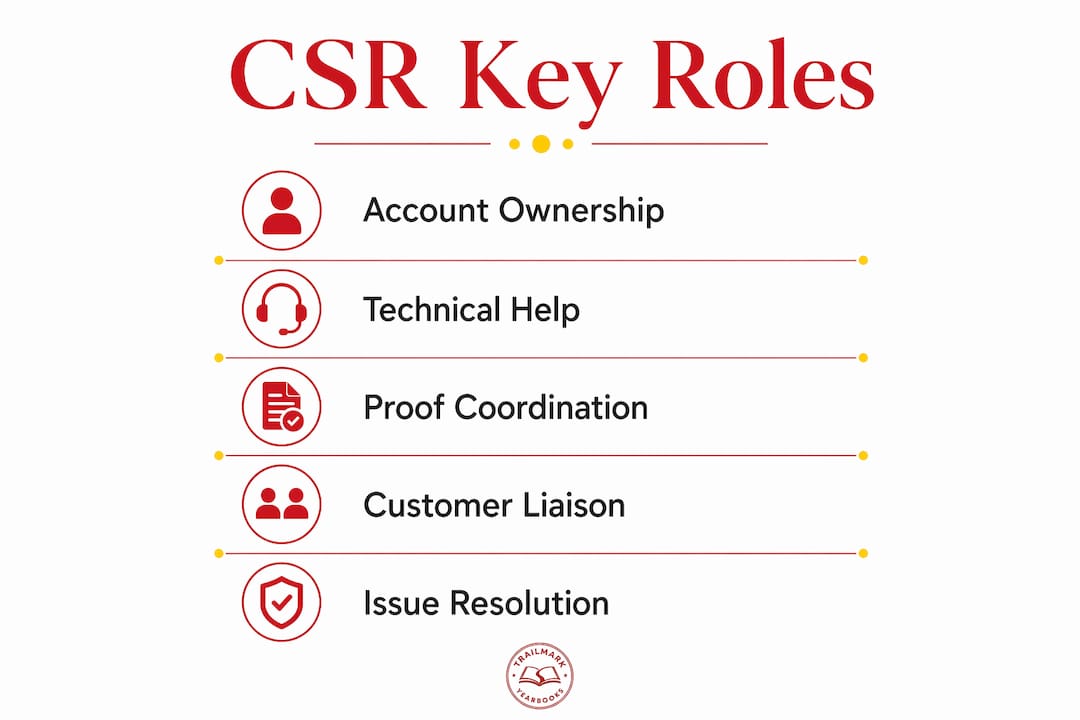
Proof coordination. When your cover or interior proofs are ready, your CSR notifies you, explains your options (approve as-is, request changes, request a hard-copy proof), and tracks your response against the due date. Late approvals can trigger fees, so this function alone has real financial consequences.
Escalation routing. Billing dispute? That goes to sales or finance, and your CSR makes the handoff. Print quality concern after delivery? Your CSR documents it and routes it to production with your job number and evidence attached.
Three quick examples of routine CSR interactions advisers have:
- A portrait upload stalls mid-transfer. The adviser emails the CSR, who checks the account, identifies a file-size issue, and walks the student photographer through the correct export settings.
- The cover proof arrives but the school mascot color looks off. The CSR explains the email-proof vs. hard-copy-proof options, notes that the first of each is free, and flags the deadline for returning changes.
- A spread was submitted with a typo. The adviser calls the CSR, who un-submits the page so edits can be made before the print deadline.
How do CSRs support you from planning through delivery?
Customer support integrated across the full experience — not just at the end — is what separates a smooth yearbook cycle from a stressful one. Here is how CSR touchpoints map to each production stage.
-
Planning (August–October). Your CSR confirms your job number, reviews your contract timeline, and sets up your software account. Send them your school calendar, portrait session dates, and any known scheduling conflicts at this stage. Ask: What are my hard submission deadlines, and what happens if I miss one?
-
Content collection (October–December). Portrait uploads, club photos, and candid submissions flow in. Your CSR monitors upload status and flags missing portraits before they become a layout problem. A yearbook photography checklist shared with your photographer at this stage reduces the troubleshooting calls your CSR has to field later.
-
Layout and design (November–February). Pages get built and submitted section by section. Your CSR can un-submit pages for corrections, help with overflow text issues, and confirm that submitted spreads are received on the production side. Escalation trigger: if a section sits "submitted" for more than a week with no production acknowledgment, contact your CSR immediately.
-
Proofing (January–March). Cover and interior proofs arrive by email first. Review carefully, respond before the due date on the proof, and copy your CSR on all approval or change requests. Missing a proof deadline is one of the most common sources of late fees and schedule slippage.
-
Print and production (March–April). Once final approval is given, the book goes to press. Your CSR cannot alter the print run at this point, but they can give you a status update and an estimated ship date. Ask for that date in writing.
-
Delivery (April–May). When books arrive, inspect a copy immediately. If there are quality issues, document them with photos and your job number, then contact your CSR the same day. Fast documentation speeds resolution.
How CSRs connect your school, sales, and the production team
The single-point-of-contact model exists for a practical reason: every time you repeat your school's situation to a new person, you lose time and risk miscommunication. Your CSR holds the account context and routes issues without making you start over.

Two scenarios show how this works in practice.
A technical issue surfaces during layout: a spread won't save correctly in the online editor. You contact your CSR. They check your account, confirm the software version, and either resolve it directly or conference in computer support. You make one call. The CSR owns the follow-through.
A billing question comes up mid-project: you notice a charge on the invoice you don't recognize. Your CSR cannot adjust invoices, but they pull up the contract notes, explain what the charge likely corresponds to, and connect you with the sales or finance contact who can authorize a correction. You don't have to hunt for the right person.
This liaison function is why customer support integrated into the full experience matters so much. A CSR who knows your account history can flag a potential problem before you even notice it.
What should you provide your CSR, and what should you ask?
Yearbook advisers carry a wide range of responsibilities — coordination, design oversight, budget management, and liaison work. Clear handoffs with your CSR prevent overlap and dropped tasks.
Adviser checklist for a clean project start:
- Job number (found on your contract or the title page of your planning notebook)
- High-resolution portrait files and candid photo folders, organized by section
- Contract or purchase order details, including any agreed-upon deadlines
- Approved copy for covers, dedications, and any locked sections
- Your preferred contact method (email, phone, or live chat) and best hours
- Known scheduling constraints (testing weeks, school breaks, administrator approval windows)
Questions to ask your CSR at project kickoff:
- What are my hard deadlines for each section, and what is the late-submission policy?
- How do I reach you if I need a same-day response?
- Who is your escalation contact if you are unavailable?
- What is the proof turnaround time, and how many free proofs do I have?
Sample email: initial handoff
Sample email: urgent deadline escalation
What makes a strong CSR, and what are the red flags?
Qualities of an effective CSR:
- Responds to emails and calls within one business day, ideally faster for urgent issues
- Knows your account details without you having to re-explain your situation each time
- Sends proactive deadline reminders before you have to ask
- Communicates proof options clearly, including cost implications for additional proofs
- Routes billing and contract questions to the right team without leaving you in limbo
- Documents issues and follows up after escalation to confirm resolution
Red flags that signal a service problem:
- You have to re-explain your school's situation on every call
- Deadline reminders arrive after the deadline has passed
- Billing questions get deflected with no clear routing to finance or sales
- Proof approvals sit unacknowledged for days with no status update
- Escalated issues disappear with no follow-up
When you spot a pattern of red flags, document it. Keep a log of dates, what you asked, and what response (or non-response) you received. When escalating, contact the CSR's supervisor with your job number, a brief timeline of the issue, and any email threads as evidence. A clear, factual summary resolves disputes faster than a frustrated phone call.
What are realistic turnaround times, and what can a CSR influence on cost?
A CSR can keep your project on schedule, but they cannot compress the print run or waive fees that are written into your contract. Knowing the difference helps you ask the right questions at the right time.
| Production Stage | Typical Turnaround | Notes |
|---|---|---|
| Cover proof (email) | 6 weeks from cover spec submission | Per industry playbook guidance |
| Interior page review | 1–2 weeks per section batch | Varies by submission volume |
| Full print run | 2–3 weeks after final approval | Trailmarkyearbooks standard |
| Shipping to school | Included in production window | Confirm ship date with CSR in writing |
Pro Tip: Request your CSR's escalation contact and confirm their response-time commitment at project kickoff. A clear SLA and escalation path at the start of the project materially reduces resolution time when something goes wrong mid-production.
Cost factors your CSR can help you navigate:
- Additional proofs: First email and hard-copy proofs are typically free; subsequent proofs carry a charge. Your CSR can tell you exactly what those charges are before you request one.
- Late fees: Proof approvals and section submissions returned after the due date often trigger fees. Your CSR can sometimes flag a grace window, but they cannot waive contractual penalties unilaterally.
- Expedited services: If your timeline slips, ask your CSR whether rush production is available and what it costs. For yearbook budget planning, knowing these contingency costs in advance prevents surprises.
What is the measurable impact of strong CSR support?
Good CSR support has direct, operational consequences for your program. Resolving problems in the first support interaction prevents a significant share of customer churn, and the same principle applies to yearbook programs: an adviser who gets a fast, complete answer the first time is far less likely to switch companies the following year.
Industry CSAT benchmarks for service operations typically sit around 75–85%, with first contact resolution averages of 70–75% and should be targeted higher with empowered agents. Programs that receive proactive CSR outreach, not just reactive support, tend to outperform in customer satisfaction and issue resolution metrics, with first-contact resolution rates commonly reaching 70–75% in strong operations.
Consider a practical scenario: an adviser submits portraits two weeks before the section deadline, but the file format is wrong. A CSR who catches that error proactively and contacts the adviser immediately saves a missed deadline. A CSR who waits for the adviser to notice creates a crisis. That difference in approach is what service quality outweighing price actually looks like in practice.
For administrators who need justification for service choices, the case is straightforward: strong CSR support reduces adviser time spent on production logistics, lowers the rate of proofing errors that reach print, and improves the likelihood of on-time delivery. A well-produced yearbook also strengthens school community in ways that matter to parents and students alike.
How does Trailmarkyearbooks approach customer service?
Trailmarkyearbooks operates on a school-first support model built around reducing adviser workload at every stage. Key service features include:
- Dedicated support with 50+ years of combined team experience across production and design
- Free design assistance available throughout the project, not just at kickoff
- Flexible design tools: advisers can work in Canva, Adobe InDesign, or Trailmarkyearbooks's own online creator
- 2–3 week turnaround from final approval to delivery, with shipping included and no hidden fees
- Transparent, all-inclusive pricing available instantly online, with no signup or sales pitch required
A typical Trailmarkyearbooks support flow starts with account assignment and a review of your school's timeline and design preferences. From there, the support team assists with file setup, design questions, and proof review. When the book goes to print, the 2–3 week production window runs with shipping included, so advisers get a firm delivery window rather than an open-ended estimate. For advisers exploring types of yearbook support services, this model sits at the full-service end of the spectrum.
Key Takeaways
A yearbook CSR's primary job is to reduce adviser effort at every production stage, from portrait uploads through final delivery, and that effort-reduction is the clearest predictor of a smooth, on-time yearbook.
| Point | Details |
|---|---|
| CSR role boundaries | CSRs handle production, proofs, and technical issues; route billing and contract questions to sales or finance. |
| Stage-by-stage contact | Confirm deadlines, proof options, and escalation contacts at project kickoff — not after a problem surfaces. |
| Red flag response | Document missed responses with dates and job numbers; escalate with a written timeline to the CSR's supervisor. |
| Turnaround expectations | Print runs typically take 2–3 weeks after final approval; cover proofs arrive 6 weeks after spec submission. |
| Trailmarkyearbooks | Offers a school-first support model with free design assistance, flexible tools, and 2–3 week turnarounds. |
What advisers often get wrong about working with a CSR
Most advisers treat their CSR as a reactive resource: call when something breaks, email when a deadline is missed. That approach works, but it leaves a lot of value on the table.
The advisers who get the most out of their CSR relationship treat it like a collaboration from day one. They send their school calendar in September. They copy the CSR on portrait session confirmations. They ask about proof timelines before the proof arrives, not after. That proactive posture means the CSR can flag problems early, when they are still cheap to fix.
Three quick habits that make the relationship work: approve proofs the day they arrive rather than waiting until the due date; send file handoffs with a brief note explaining what is included and what is still pending; and when something goes wrong, lead with your job number and a one-paragraph summary of the issue rather than a long narrative. That last one alone cuts resolution time significantly.
When escalation is necessary, keep it professional and factual. A message that says "I've emailed three times over five days with no response, and our proof deadline is tomorrow — I need to speak with a supervisor today" is far more effective than one that leads with frustration. Your CSR's supervisor needs facts, not emotion, to act quickly.
Trailmarkyearbooks makes yearbook support straightforward
Advisers who want a support model built around their school's schedule, not a vendor's sales cycle, will find Trailmarkyearbooks worth a close look. There are no order deadlines, no hidden fees, and no pressure to sign up before you see pricing. The all-inclusive cost is available online in seconds, and the 2–3 week turnaround means you are not waiting months to see a finished book.
Two practical next steps: request a physical sample to inspect print quality and paper stock before you commit, or review the full range of production options and service tiers to find the right fit for your school's size and budget. Both are available without a sales call.
Sources and further reading
- Customer service best practices — ContactCenterUSA: practical guidance on reducing customer effort and building loyalty, directly applicable to evaluating CSR performance.
- The growing importance of customer-centric support services — ScienceDirect: peer-reviewed research on integrating support across the full customer experience journey.
- Customer service best practices worth prioritizing — Decagon: CSAT benchmarks, first-contact resolution targets, and prioritization frameworks for service teams.
- Customer support: Definition, importance + strategies — HubSpot: data on churn prevention and the operational value of first-contact resolution.
- Why customer service is important — HubSpot: evidence linking service quality to repeat purchases and retention.
- The role of the yearbook adviser — Yearbook Life: overview of adviser responsibilities and how they align with CSR handoffs.
- Yearbook Playbook — Industry planning guide: detailed CSR role descriptions, proof timelines, and escalation contacts for school yearbook programs.