

A dedicated yearbook adviser is the production company's own support specialist assigned to your school, the person who handles design guidance, software troubleshooting, and ordering logistics so your yearbook staff doesn't have to figure it out alone. This is not a replacement for your school's yearbook teacher or student staff. It's a vendor employee working alongside them.
Does it actually help? For most schools, yes. The right adviser cuts down the hours your staff spends untangling software problems, chasing proof approvals, or guessing at print quantities. TrailMark Yearbooks backs its adviser service with three concrete proof points worth knowing before you request one:
- Several years of combined staff experience supporting school yearbook programs
- A production turnaround of 2 to 3 weeks once files are approved
- Design assistance included at no extra cost
If your program has ever missed a deadline because nobody knew how to fix a broken InDesign template at 9 p.m., this is the service built to prevent that.
Key Takeaways
A dedicated yearbook adviser is a vendor-assigned specialist, not a school employee, and clarifying that scope in writing before signing prevents most of the disputes schools run into during production.
| Point | Details |
|---|---|
| Vendor role, not school role | The adviser supports design, software, and ordering, while your school keeps editorial control. |
| Time savings are the core benefit | Offloading troubleshooting and proofing gives faculty advisers back classroom hours. |
| Fixed production windows demand fast asset delivery | A 2 to 3 week print run only starts after final approval, so photo and data deadlines matter early. |
| Confirm scope before comparing price | Get review rounds, response times, and included tasks in writing before judging cost. |
| TrailMark includes adviser support standard | TrailMark pairs a 2 to 3 week turnaround with free design assistance and flexible software options across every order. |
Table of Contents
- What Does a Dedicated Yearbook Adviser Do Day to Day?
- What Are the Real Benefits of Adviser Support?
- How Does the Adviser Workflow Run From Kickoff to Delivery?
- What Should You Ask Before Requesting a Dedicated Adviser?
- Why the Industry Undersells This Role
- Getting Started With TrailMark's Dedicated Adviser Support
What Does a Dedicated Yearbook Adviser Do Day to Day?
The role breaks into four practical buckets: technical support, design guidance, production logistics, and curriculum help. None of it touches your school's editorial decisions.
- Design guidance. This covers template selection, layout review, photo cropping advice, and a second set of eyes on spreads before they go to proof. It is guidance, not a takeover of your book's voice.
- Production logistics. Timeline management, proof cycles, quantity recommendations, and shipping coordination all run through this contact. If a reprint is needed later, the same adviser typically handles it.
- Curriculum and training support. Many advisers offer teacher resources, suggested student staff roles, and occasional training sessions, which is where a resource like the Yearbook Adviser Success playbook earns its place in a new teacher's binder.
What the adviser does not do matters just as much. They don't approve final content, set school policy on student privacy or coverage, or make editorial calls on what goes in the book. Those decisions stay with your school, and any vendor implying otherwise is overselling the service. Reviewing your school's yearbook policy best practices before kickoff keeps that boundary clear from day one.
Pro Tip: Ask upfront whether the same person stays assigned to your project from kickoff to delivery. Rotating contacts is the single biggest cause of repeated explanations and missed context.
What Are the Real Benefits of Adviser Support?
The clearest benefit is time. A faculty adviser juggling a full teaching load doesn't have hours to spare for software troubleshooting or chasing print specs, and a vendor specialist absorbs that work instead of adding it to an already full plate.
- Faculty time goes back into classroom instruction and student mentorship instead of file formatting.
- Production stays on a predictable schedule tied to a published 2 to 3 week turnaround, so administrators can set internal deadlines with confidence.
- Design quality improves because someone with production experience reviews spreads before they're locked in, not after.
- Ordering accuracy improves too, especially when districts explore ways to offset costs through services like School & District iPad / Chromebook Buyback. Guidance on print run size, paired with resources like a quantity ordering checklist, cuts down on wasted copies sitting in a storage closet come June.
- Fewer technical errors reach the print stage, which means fewer costly reprints and less scrambling in the final week.
Schools without dedicated support often discover errors at the proof stage that a specialist would have flagged weeks earlier, when fixing them was still cheap and easy.
How Does the Adviser Workflow Run From Kickoff to Delivery?
The process follows a fixed sequence, and knowing it in advance lets your staff plan internal deadlines instead of reacting to them.
- Kickoff. You and the adviser agree on a project brief, an asset checklist (portraits, candid photos, roster data), a template or design path, and a working timeline.
- Design and review cycles. Draft spreads move through a set number of review rounds. This is usually where bottlenecks show up, typically because photos or roster data arrive late.
- Preflight and print approval. The adviser checks resolution, bleed, color, and page counts before you sign off on the final proof. Once you approve it, the file locks for print.
- Production and shipping. This is the 2 to 3 week window most vendors quote, and it starts counting only after final approval, not before.
- Post-delivery. Shortages get resolved, on-demand reprints get ordered if needed, and archival files are handed off for your school's records.
| Stage | Typical Adviser Touchpoint |
|---|---|
| Kickoff | Sets asset list, template, and timeline with staff |
| Design review | Checks layout, photo quality, and proofing rounds |
| Preflight | Verifies print-ready files before final approval |
| Production/shipping | Manages the 2–3 week print and delivery window |
| Post-delivery | Handles reprints and archival file transfer |
That fixed production window is exactly why internal deadlines for senior portraits and data merges matter so much. Miss the photo deadline by a week, and it pushes the entire print date back by the same amount, since the adviser can't compress the actual printing process to make up for it.
What Should You Ask Before Requesting a Dedicated Adviser?
Contract language around "dedicated adviser" varies more than most administrators expect. Confirm these five things before you sign anything.
- Service inclusion: Which specific tasks come free with the adviser role, and which trigger an extra charge?
- Turnaround and SLAs: What's the guaranteed production window, how fast does the adviser respond to a support request, and how many design review rounds are included?
- Ordering and budget terms: Is pricing all-inclusive or per-copy, is shipping included, are sample proofs available, and what's the reprint policy if quantities run short? A budget planning guide helps you frame these questions before the sales call.
- Training and contact structure: What training is included, who is the single point of contact, and how is that training scheduled around your school year?
Pro Tip: Get the number of included review rounds in writing. Vague language like "reasonable revisions" is where disputes and unexpected fees tend to start.
Why the Industry Undersells This Role
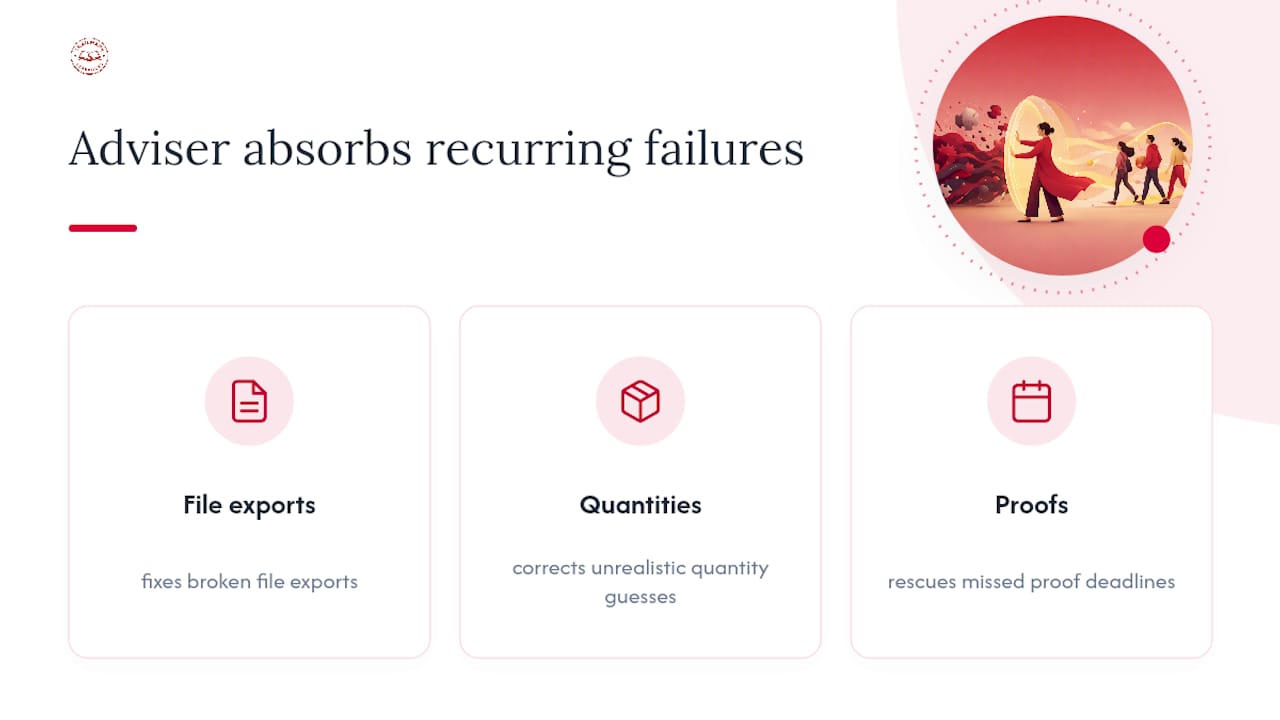
Most yearbook marketing treats "dedicated adviser" as a soft perk, a nice-to-have bundled into the package rather than a functional role with defined scope. That framing does administrators a disservice. The support specialist isn't there to make your program feel taken care of. They're there to absorb specific, recurring failure points: broken file exports, unrealistic quantity guesses, missed proof deadlines.
Conventional buying advice tells schools to compare price per book and turnaround time first, then treat adviser support as a tiebreaker. That gets the priority backward. A cheaper book with no real production support usually costs more in staff hours and reprint fees than the sticker price ever suggested. What should come first is scope: get the specific list of what the adviser handles, in writing, before comparing dollar figures at all.
The most overrated part of the "dedicated adviser" pitch is the training component. Training sessions matter far less than a stable point of contact who already knows your school's history. Continuity of contact beats a polished onboarding webinar every time, and it's the detail administrators should press hardest on during vendor calls.
— Jace
Getting Started With TrailMark's Dedicated Adviser Support
TrailMark Yearbooks builds its adviser service around the same priorities this article just walked through: a single point of contact, free design assistance included in every package, and flexibility across Canva, InDesign, or TrailMark's own online creator so student staff of any skill level can work comfortably.

That support is backed by more than 50 years of combined staff experience and a production window of 2 to 3 weeks with no order deadlines forcing your hand early. In practice, that means your adviser helps set your photography and data-merge deadlines during kickoff, checks your files at preflight, and stays on the account through reprints if you need them, matching the workflow outlined above step for step.
If you're weighing whether this level of support fits your program, the fastest way to find out is to see it firsthand. Request a sample to evaluate print quality and get a feel for how the adviser process works, or head to the products page for instant, all-inclusive pricing before your next planning meeting.