
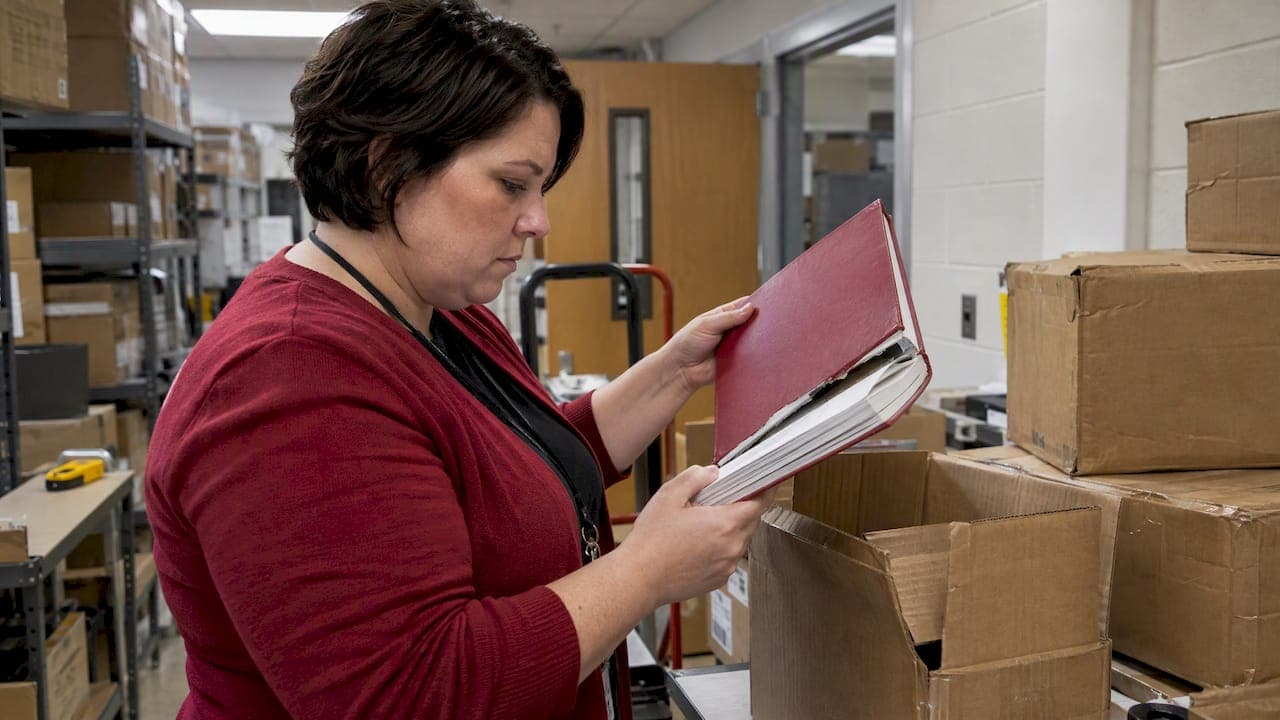
If a box of yearbooks arrives with scuffed covers or loose pages, or a student's copy gets soaked in a backpack, the fix usually runs through the school. The adviser contacts the printer, documents the damage, and either gets the affected copies reprinted or orders a small batch of new ones. Parents and students generally can't buy a replacement from a printer directly, because the printer's customer is the school. This guide walks advisers and administrators through the whole process, from the first look at a damaged box to the policy that keeps it from happening again.
TL;DR
- Photograph everything the day the books arrive, before you hand a single copy out. Dated photos of the carton, the spines and the worst pages make any replacement request faster.
- Sort the problem first: a printing or binding defect, shipping damage, or damage after delivery (water, a pet, a locker). Each one points to a different fix.
- Replacements are ordered by the school, not by parents. Keep your files and your final proof so a small reprint can be built from the same pages.
- A wet yearbook can sometimes be saved if you act within a day or two: freeze it, don't pull the pages apart, and don't use heat.
- Set a replacement policy before distribution day so your answers are the same for every family.
Table of Contents
- Start by working out what kind of damage you have
- What to do the day a box arrives
- How replacement or reprint requests usually work
- When the damage happens after distribution
- Can a wet yearbook be saved?
- Our perspective: plan for damage before it happens
- Writing a replacement policy for your school
- Preventing damage in the next run
- Replacing an old yearbook from years ago
- How TrailMark handles reprints and support
- FAQ
- Sources
Start by working out what kind of damage you have
The word "damaged" covers three very different situations, and the right response depends on which one you're in.
1. Manufacturing or binding defects. Pages falling out, covers that peel or scratch badly, pages out of order, blurry or misprinted spreads. These show up in many copies of the same run, not one.
2. Shipping damage. Crushed corners, dented spines, torn cartons, wet boxes. These are usually concentrated in particular cartons or pallets.
3. Damage after the book is in a student's hands. Rain, a leaking water bottle, a dog, a flooded basement. This one is no one's fault in the supply chain, and the question becomes whether the school keeps spare copies.
A quick way to tell the first two apart from the third: open ten books from ten different cartons. If the same flaw appears across them, it is a production issue. If it's limited to one or two cartons, think shipping. If one family emails you three weeks after distribution, it's category three.

How common is the first kind? One student newspaper reported that at least 300 of 900 yearbooks ordered had some kind of damage, including scratched covers and pages falling out, and the school sent the books back for reprinting. That is one school's account, not an industry rate, but it shows the scale a problem can reach and the route schools take: the adviser deals with the printer, and the printer corrects the run.
What to do the day a box arrives
Most replacement trouble becomes harder only because the damage wasn't recorded on day one. Build a short receiving routine.
- Check the cartons before you sign. Note crushed corners, tears or moisture on the delivery paperwork if the carrier is still there. If you can't, photograph the cartons before opening them.
- Count. Match the number of cartons and books to your order. Shortages and damage are separate issues, and you want them reported separately.
- Open a sample. Pull books from the top, middle and bottom of several cartons. Flip through every page of at least a few, front to back.
- Photograph the problems. Take wide shots showing the carton and its label, then close shots of the defect. Include one photo with a page number visible.
- Write it down. A short log with date, carton number, number of affected copies and a one-line description is enough.
- Hold distribution. If a defect is widespread, don't hand out books you may need to recall. Contact your printer first.
- Keep the damaged copies. The printer may want them returned or described in detail. Don't throw anything away.
This takes thirty minutes and saves weeks of back-and-forth. It is also the same routine we suggest whether you print with us or anyone else.
How replacement or reprint requests usually work
When you report a problem, expect your printer to ask for four things: your order or job number, photos, a count of affected books, and a description of what's wrong. A clear email with those four items gets a quicker answer than a phone call that starts from scratch.
What you ask for depends on the situation:
- A defect across a large share of the run: ask for the affected books to be reprinted, and ask about the timeline before you promise anything to students.
- A few damaged copies: ask whether a small reprint is possible, or whether replacements can be matched to the original run.
- Loss or damage after delivery: this is a new order, not a correction. You are buying extra copies.
Because policies differ from printer to printer, read your own order confirmation and terms for how damage is handled and how long you have to report it. We can't tell you what another company's terms say, and nobody should guess about yours.
Why your files matter
A reprint of a handful of books is only simple if the final pages still exist. Save the complete, final print-ready files and the approved proof in at least two places, and keep the same names the printer used. If your adviser leaves or your account is deleted, those files may be the only thing standing between you and a full rebuild. Our guide to how yearbook reorders work for advisers covers what to keep and what to ask for.
What a small reprint costs and how long it takes
It depends on the printer, the page count and the options you chose, so get a quote with your own specifications. What stays the same is that the price per book is driven by the cover, the binding and any special finishing. As an example, our published option prices include a perfect bound soft cover at $1.60 per book, a 150 point board hard cover at $1.50 per book, and Smyth sewn binding at $2.00 per book. Those are option charges listed on our page, not a total for a yearbook. Your all-inclusive price comes from the instant quote on our site.
For timing, plan on weeks, not days. Our standard turnaround is 2 to 3 weeks, and you can read how printing turnaround works for advisers before you tell a parent when a book will arrive.
When the damage happens after distribution
A student leaves the book in a car, a pipe bursts, a storm hits a home. These requests arrive in the weeks and months after distribution, and they can be emotionally heavy, because the signatures on the pages are the part nobody can reprint.
Three things help.
Be clear about what a replacement is. A reprint gives the family a clean copy of the printed pages. It does not bring back the handwritten notes. Say so kindly, and suggest the student ask friends to re-sign a page or a slip of paper that can be tucked inside.
Know who can order. Printers sell to schools. In our model, school staff with purchasing authority place the order, and parents and students don't buy from us directly. So a parent who asks you for another copy needs you to either have spares or place a small additional order. If you want to reduce these requests, build a modest buffer into your first order. Our quantity ordering checklist for advisers helps you size it.
Check your reorder window. Some printers keep files for years and let you order again; others don't. Ask before your first order, not after the flood. We explain what to look for in our guide to reorder availability.
Can a wet yearbook be saved?
Sometimes. The sources below come from libraries and archives, which deal with waterlogged books in bulk, and the same principles apply at a kitchen table. They won't rescue every book, and coated glossy paper, which most yearbooks use, is the hardest case.

The National Archives reports that in past disasters the heaviest losses were among books printed on coated stock, whose pages stuck together during drying, and says these could have been largely prevented if the materials had been frozen in time. That detail matters because yearbooks are nearly all glossy.
First steps for a family or school
- Don't try to pry pages apart. The same archive guidance says wet paper doesn't slide, so forcing a book closed or pulling leaves apart tears them.
- Act quickly. The National Park Service notes that mold may begin to grow on wet materials, and that paper loses strength when wet, so a wet book should be handled gently and not left sitting.
- Freeze if you can't deal with it right away. The Library of Congress explains that freezing halts water damage and mold growth and buys you time to decide what to do. Put the book in a bag, not wrapped tightly, and place it in a freezer.
- Skip heat. Hair dryers, ovens and radiators can warp covers and fuse coated pages. Cool, moving air and patience are the safer approach.
If the book is a sentimental one, such as a parent's 1980s yearbook or a senior's final year, consider contacting a professional book conservator rather than experimenting. If the book is simply a current copy and the pages are stuck beyond rescue, a clean reprint plus a signature page may be the better outcome for the student.
Our perspective: plan for damage before it happens
We work with schools that print everything from a first elementary yearbook to a 300-page high school book, and the stressful replacement stories we hear share a pattern. The damage itself is rarely the issue. The trouble is that no one wrote down what happens next.
What we'd tell any adviser:
- Treat the receiving check as part of the job. Thirty minutes with a box cutter and a phone camera is the cheapest insurance you have.
- Keep your final files safe. On-demand reprints are only easy when the pages exist. That is why we support Canva, Adobe InDesign and Illustrator, and our own online creator: you should be able to hold on to a working file in a format you control.
- Order a small buffer. A few extra copies cost far less than a rush reprint and an awkward conversation with a family.
- Choose a printer who answers. You should be able to reach a real person who knows your account. Our team brings more than 50 years of combined experience and a school-first approach, and each school gets a dedicated adviser contact.
- Publish your policy. One short paragraph in your distribution day email prevents a dozen separate questions.
No printer can promise that nothing will ever go wrong. What you can ask for is a clear process, honest communication and no pressure when you need to reorder.
— Jace
Writing a replacement policy for your school
A written policy protects you from making one-off decisions you can't repeat fairly. Keep it to a page. Cover these points:
| Question | What to decide |
|---|---|
| Who reports a problem? | Parent or student contacts the adviser, not the front office |
| By when? | A reporting window, such as a set number of days after distribution |
| What proof is needed? | A photo of the damage and the student's name |
| What is covered? | Printing defects only, or defects plus accidental damage |
| Who pays for accidental damage? | Family pays the per-book cost, school pays, or a spare-copy fund pays |
| How are replacements ordered? | Batched once or twice per term, not one at a time |
| Are signatures replaced? | No, but offer a signature insert |
Batching matters. Ordering one book at a time is slow and costly for everyone. Ordering a group once or twice per term fits better with printer scheduling. If you intend to charge families, make the per-copy price transparent and keep it close to what the school actually pays.
Spares, ads and extras
Some schools fund a reserve through yearbook ads or add-ons. Our published extras include recognition ads at $5 per ad and lovelines at $1 each, which some advisers use to help offset the cost of extra copies. Whether that suits your community is your call.
Preventing damage in the next run
Most damage is preventable if you look at it at three points in the process.
In the design stage. Heavy ink coverage near the gutter, tiny text on the spine, and photos set too close to the trim all increase the odds of a poor-looking finish. A free design review catches these. We offer free design assistance and, for schools that want it, full-service design.
In the choice of binding and cover. Thicker books need stronger binding. A soft cover may be fine for a slim elementary book, while a larger book may call for a hard cover or sewn binding. Ask for a free sample so you can bend, flip and test a real book before you commit.
In shipping and delivery. Know where the cartons are going and who will sign for them. A loading dock that sits for two days in the rain is a bad place for a pallet. Our shipping is included in our pricing, and the delivery options guide explains what to confirm about receiving. You can also read why shipping included pricing makes budgeting simpler.
If you want to see your final pages before the whole run is printed, we list printed proof books at $100 for two copies, shipping included, litho only. A proof isn't free, but it is a cheap way to catch a binding or color problem before 500 copies exist.
Replacing an old yearbook from years ago
Searches on this topic often come from adults who lost or ruined a book decades ago. This is a different problem, and the answer is rarely a printer.
- Call the school first. Many keep an archive copy and may let you view or scan pages.
- Ask the school who published it. Publishers sometimes keep a digital archive, though many don't survive.
- Try the library. Public and university libraries often hold local yearbooks; some charge small fees for copies. One university library, for example, says it sells a limited number of old yearbooks at $20 each, depending on the years available.
- Search secondhand marketplaces and alumni groups. Used copies show up on resale sites and in class reunion pages.
Schools that want to be the answer to these requests can build their own archive. Our piece on the historical value of a yearbook archive explains why a school should keep at least one copy of every year, and where.
How TrailMark handles reprints and support
We print yearbooks for elementary, middle and high schools across the United States. You get all-inclusive pricing online instantly, with no signup, no sales pitch and no hidden fees, and shipping is included. There are no order minimums or submission deadlines, and standard turnaround is 2 to 3 weeks. Our on-demand printing is built for exactly the situation in this article, where you need more copies of a book you've already made.
If you're an adviser planning your next book, get your instant price on our site, or request a sample to see the paper and binding in your hands. If you want help beyond printing, our guide to yearbook support services shows what levels of help are available.
FAQ
Can a parent order a replacement yearbook directly from the printer?
Usually not. Printers like us sell to schools, and the order is placed by staff with purchasing authority. A parent should contact the school's yearbook adviser, who can check for spare copies or include the request in a small additional order.
What should I do first if a box of yearbooks arrives damaged?
Photograph the cartons and the damage before distributing anything. Count the books, log which cartons are affected, and keep the damaged copies. Then email your printer with your order number, the photos and the number of affected books.
Can a wet yearbook be fixed?
Sometimes, if you act fast. Don't pull the pages apart or use heat, and freeze the book if you can't deal with it immediately, as the Library of Congress guidance on freezing describes. Glossy pages are the hardest to save, so for a sentimental book consider a professional conservator.
Will a reprint bring back the signatures?
No. A reprint replaces the printed pages only. Many advisers offer a blank signature insert or a page of notes so friends can write again.
How long does a replacement take?
It depends on the printer and the size of the order. Our standard turnaround is 2 to 3 weeks, and you can see the details in our turnaround guide.
Sources
- Damaged yearbooks, Three Penny Press
- Salvage of Water Damaged Library Materials, part 6, U.S. National Archives
- Preservation in Practice: Saving Wet Books after a Flood, National Park Service
- How to Freeze Collections, Library of Congress
- Library Archives, Hannibal-LaGrange University