
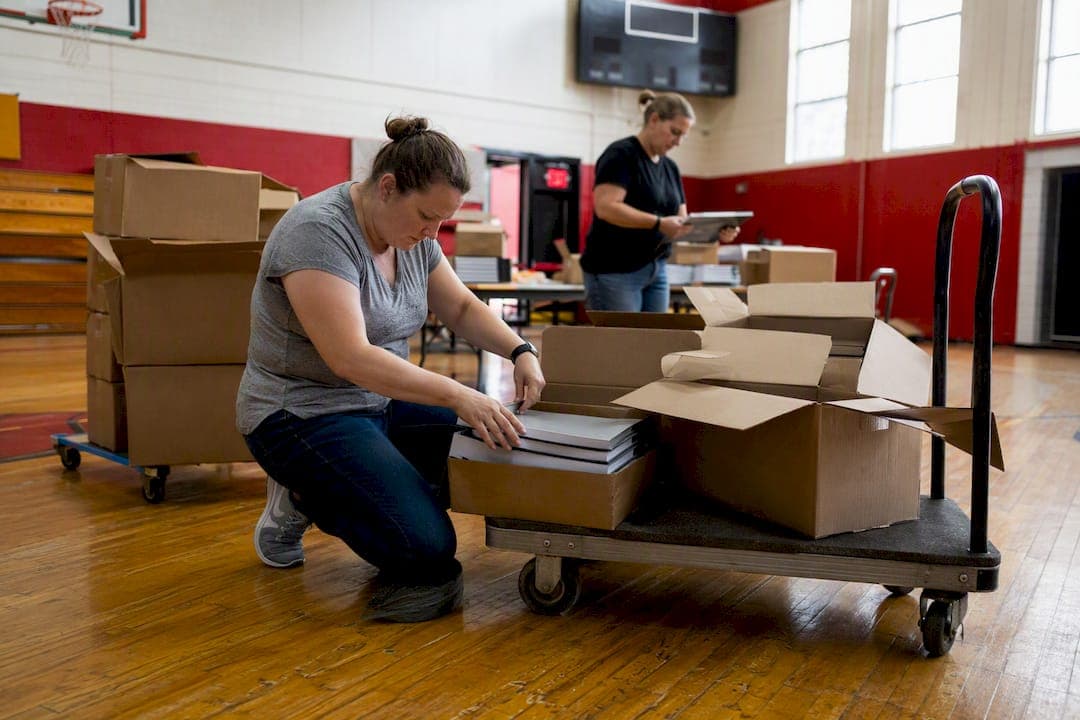
Bulk ship-to-school delivery, backed by a planned in-school distribution day and a small on-hand buffer of extra copies, is the right default for most elementary, middle, and high schools. TrailMark Yearbooks supports this model directly, with a production turnaround measured in weeks and shipping included in pricing, so nothing about the delivery itself adds cost or guesswork.
The four delivery paths worth knowing:
- Bulk ship-to-school — one shipment, one distribution event, lowest cost per book
- Staggered or class delivery — teachers hand out books in homeroom, good for large campuses
- School-managed ship-to-home — the school arranges individual mailing for remote or dispersed families
- On-demand reprints — small-batch orders after the main shipment for late signups or damage replacement
Two things push a school toward something other than the default: a student body spread across multiple sites or heavy remote enrollment, or a school calendar so tight that in-person pickup risks missing the year entirely.
Key Takeaways
Bulk ship-to-school delivery paired with a documented receiving and distribution plan is the most reliable default for schools of nearly any size.
| Point | Details |
|---|---|
| Choose a default method | Bulk ship-to-school fits most single-campus schools; layer in ship-to-home only for dispersed students. |
| Plan around turnaround | Confirm proof-to-delivery timing before setting your final copy count deadline. |
| Build a receiving checklist | Count boxes, log damage immediately, and sort personalized copies by teacher. |
| Keep a buffer stock | Hold 5 to 10 extra copies back for replacements before opening leftover sales. |
| Work with a shipping-included vendor | TrailMark Yearbooks bundles shipping into pricing and offers 2 to 3 week turnaround plus free design support. |
Where to Learn More
- A Pre-Yearbook Distribution Checklist — sorting and labeling steps for distribution day.
- How to Select a Yearbook Company — questions to ask about turnaround and minimums.
- Yearbook Printing Turnaround Guide for timing your final count submission.
Table of Contents
- How Do You Choose the Right Yearbook Delivery Method?
- What Are the Main Yearbook Distribution Methods?
- Receiving and Distribution Day: A Working Checklist
- Keeping Personalized Yearbooks With the Right Students
- Handling Damaged Shipments, Shortfalls, and Reorders
- How TrailMark Yearbooks Makes Delivery Simple
- Frequently Asked Questions
- Sources
How Do You Choose the Right Yearbook Delivery Method?
Start with the calendar. Work backward from your ideal distribution date using the proof-to-delivery timeline your printer quotes, then check that against your final copy count deadline. A vendor that quotes 2 to 3 weeks gives you far more scheduling room than one that needs six.
Next, look at your enrollment layout. A single campus with predictable pickup rates is the easiest case for bulk ship-to-school. A district with satellite campuses, a large homeschool cohort, or students who transferred mid-year changes the math, since those students physically won't be in the building on distribution day.
Budget and storage come next. Bigger bulk orders usually mean better per-unit pricing, but only if you have somewhere secure and dry to store boxes for a week or two. Small storage closets favor staggered delivery timed closer to the actual event.
Run through this quickly:
- If your campus is unified and pickup rates are historically high, choose bulk ship-to-school.
- If your school is large with tight hallways or limited storage, choose staggered class delivery.
- If a meaningful share of students won't be on-site, layer in school-managed ship-to-home for that group only.
- If you're worried about running short, plan for on-demand reprints as a fallback rather than over-ordering up front.
Pro Tip: Ask your vendor for both the proof-to-delivery window and whether that number holds during peak spring order season. A printer's advertised turnaround can slip when hundreds of schools are printing at once, and confirming plant location and production method up front avoids a scramble at the deadline.
What Are the Main Yearbook Distribution Methods?
Bulk ship-to-school is the workhorse option. One pallet or set of boxes arrives at the school, your team inspects and inventories it, and you run a single distribution event, often during an assembly or over a few designated class periods. It's the default because it's the cheapest per copy, the easiest to plan around, and the simplest to communicate to parents. Most schools with a centralized campus should start here.
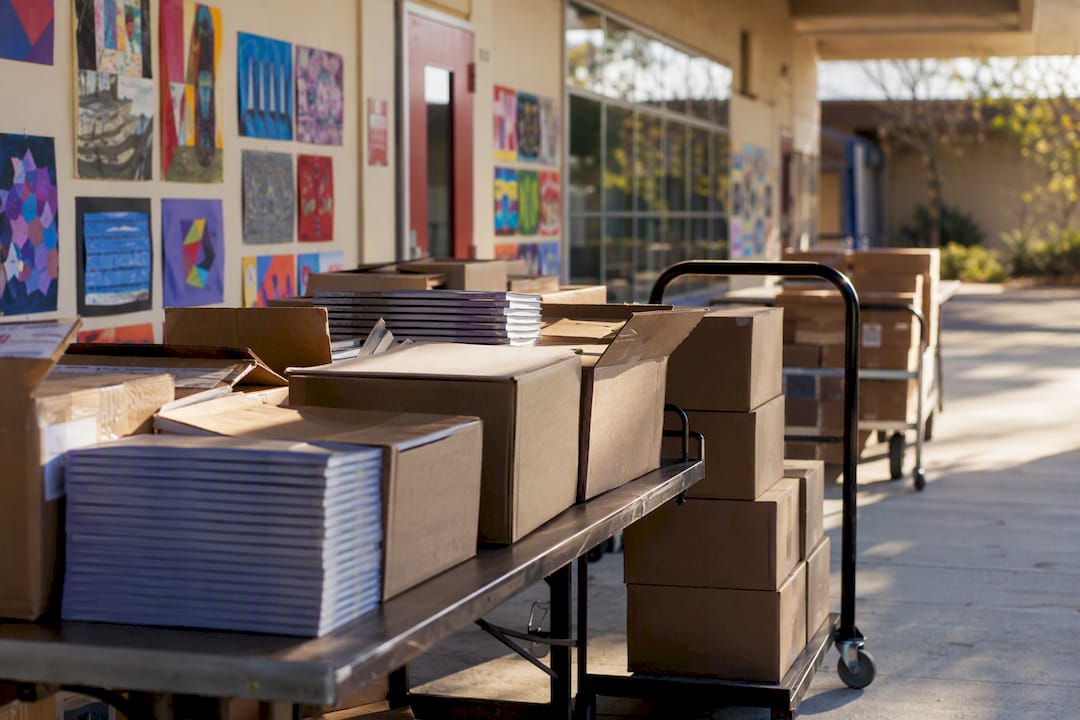
Staggered or class delivery breaks that single event into smaller pieces. Teachers or grade-level coordinators pick up pre-sorted boxes and distribute inside individual classrooms rather than funneling the entire school through one line. This matters most for larger schools where a single distribution point creates bottlenecks in hallways, or where storage space can't hold the full shipment at once.
School-managed ship-to-home covers students who won't be physically present, virtual academy enrollees, students who moved away, or families in a district with satellite campuses. The school collects addresses, pays for postage, and mails individual copies. It costs more per book and takes staff time to manage the mailing list, so it works best as a supplement for a small subset of students rather than a school-wide default.
On-demand reprints exist for what you missed the first time: a family that ordered late, a personalization error, or a shipment that came up short. These typically run on their own production cycle with a separate minimum order and lead time, so they're not a substitute for accurate initial counts, just a safety net.
| Method | Best fit | Tradeoff |
|---|---|---|
| Bulk ship-to-school | Single-campus schools with predictable pickup | Requires temporary storage space |
| Staggered/class delivery | Large schools, crowded hallways | More staff coordination across classrooms |
| School-managed ship-to-home | Dispersed or remote students | Added postage cost and address management |
| On-demand reprints | Late orders, damage replacement, shortfalls | Separate minimum and lead time apply |
Receiving and Distribution Day: A Working Checklist
Here's the sequence that keeps a shipment from turning into a headache.
When boxes arrive:
- Count boxes against the packing list before signing for delivery.
- Log any damaged or missing cartons immediately, with photos.
- Set aside pre-sold and personalized boxes by teacher or homeroom.
- Store the remaining inventory in a locked, dry space.
On distribution day, assign clear roles: one person checks names or receipts, another hands off books, and a third floats to handle problems and lost-receipt cases. That two-person minimum per line, one verifying identity and one distributing, cuts down on both errors and wait times, according to The Yearbook Ladies' distribution checklist.
A sample planning timeline:
| Timing | Action |
|---|---|
| 3 weeks out | Confirm final copy count with your printer |
| 1 to 2 weeks out | Shipment arrives; complete receiving checklist |
| 2 to 3 days out | Sort boxes by teacher, prep distribution sheets |
| Distribution day | Staff lines, verify IDs, hand off books |
| Following week | Reconcile leftovers, log issues, plan reorders |
Keep basic supplies on hand: labels, permanent markers, packing tape, and a cart or two for moving boxes between storage and the distribution point. For a school of a few hundred students, three to four staff on distribution day is usually enough; larger schools should plan one line per 150 to 200 students to avoid bottlenecks.
Keeping Personalized Yearbooks With the Right Students
Personalized copies need their own handling track. Sort them separately from general stock, and label each box by teacher or class before distribution day starts. Requiring a name check or receipt at pickup, especially for personalized books with names stamped on the cover, catches most mix-ups before they happen. Set up a small holding area for anyone without proof of purchase rather than guessing.
When a mismatch does happen:
- Pull a replacement from your buffer stock immediately, don't make the student wait for a reorder.
- Log the mismatch with the student's name, ID, and personalization details.
- Flag the error to your printer's support team so it doesn't repeat on a reorder.
Pairing each package with the student's name, ID, and personalization flag before boxes leave storage saves real time on distribution day.
Handling Damaged Shipments, Shortfalls, and Reorders
If a shipment arrives damaged or short, document it before you do anything else: photograph the boxes, separate the damaged copies from good stock, and contact your printer with the packing list and photos in hand.
To reconcile fast:
- Match physical counts against the packing list.
- Build a short exceptions log for anything missing or damaged.
- Pull replacement copies aside before opening any public or leftover sales.
On-demand reorders typically run on their own lead time and minimum order quantity, separate from your main print run, so they're not something to lean on for last-minute shortfalls. Assign one staff member to own parent communication if a delay happens, and one to own the printer relationship, so nothing falls through the cracks.
How TrailMark Yearbooks Makes Delivery Simple
TrailMark Yearbooks was built around the exact model this guide recommends. A turnaround time measured in a few weeks means less guesswork locking in your final copy count, and shipping included in every price means no surprise freight bill lands on your desk after the order is placed.

Every order comes with free design assistance from a dedicated adviser, so your staff isn't troubleshooting layout problems on top of managing distribution logistics. Need to confirm paper stock or personalization quality before you commit? Request a physical sample and see it firsthand. If a shipment runs short or a family orders late, on-demand reprints keep you from over-ordering just to be safe. Ready to see instant, all-inclusive pricing for your school? Browse production options and get a quote with no sales call required.
A Yearbook Adviser's Take on Delivery Day
Bulk ship-to-school with a solid receiving plan is what saved my sanity most years. My one hard-earned rule: keep a small number of spare copies after distribution. You will need them, usually the same afternoon. TrailMark's support made ordering those easier to plan for.
Frequently Asked Questions
What is the most common yearbook delivery option for schools? Bulk ship-to-school is the most widely used method. A single shipment arrives at the school, and staff run one organized distribution event, which keeps per-book cost low and logistics simple.
How far in advance should we plan our delivery method? Start planning at least a month before your target distribution date, working backward from your printer's proof-to-delivery turnaround so you know exactly when the final copy count needs to be locked in.
What happens if our yearbook shipment arrives damaged or short? Photograph the damaged boxes, separate them from good stock, and contact your printer immediately with the packing list attached. Most reputable vendors will address shortages quickly once documented.
Can we order more yearbooks after the initial shipment? Yes, on-demand reprints cover late orders and shortfalls, though they run on a separate minimum order and lead time from your main print run, so they work best as a backup rather than a primary plan.
How many extra yearbooks should a school keep on hand? A common practice among experienced advisers is holding back 5 to 10 copies after the main distribution specifically for replacing damaged or mismatched personalized books.
Sources
- A Pre-Yearbook Distribution Checklist – The Yearbook Ladies
- How to select a yearbook company - Yearbook Guru