
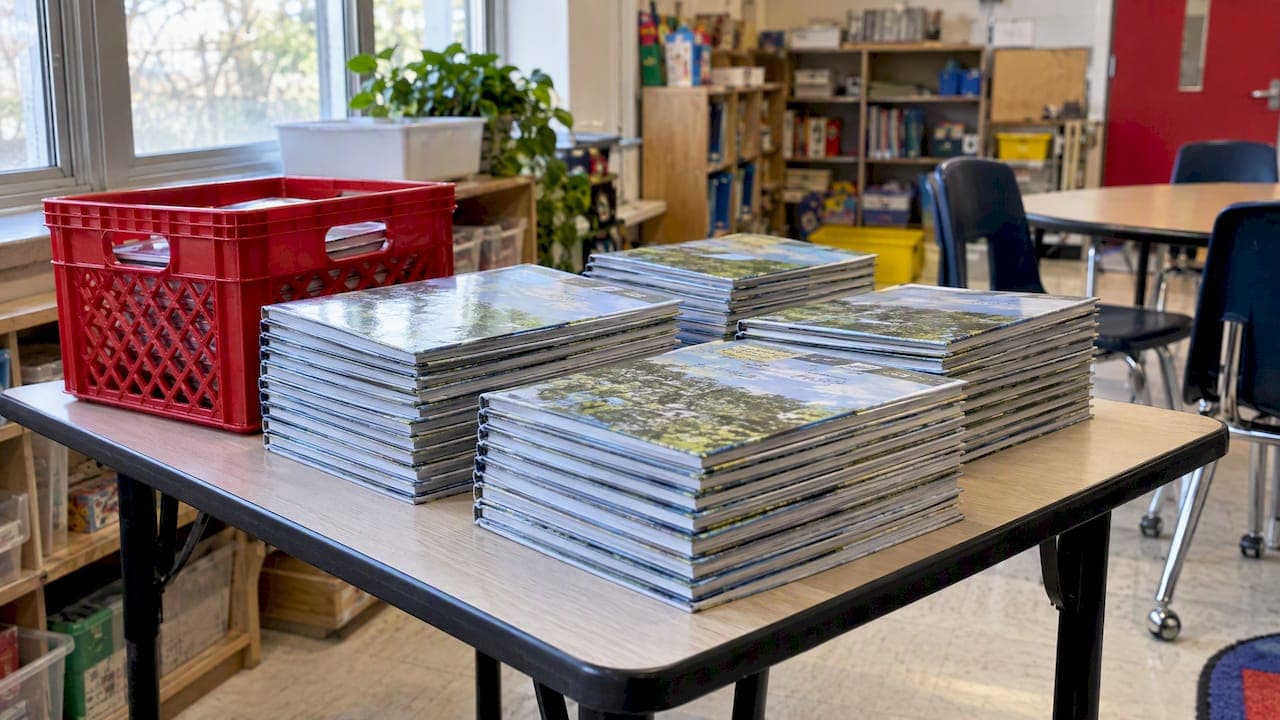
A classroom pack is a group of yearbooks set aside for one homeroom, class or teacher, so the books reach students in their own room instead of through one crowded pickup table. The idea is simple. Doing it well takes a firm copy count, clear labels and a list that follows every box. This guide walks an adviser or administrator through all three, from the first headcount to the last signature.
TL;DR
- Build packs from your pre-order list, not from enrollment, then add a modest buffer for distribution-day sales.
- Label every pack with school, year, grade or homeroom, teacher and copy count, and tape the recipient list to it.
- Hand books out against a name or proof of purchase, and have each student sign for a copy.
- Keep a small reserve of unassigned copies for absent students and late buyers, and decide in advance what happens when it runs out.
- Publish your pack and pickup policy early so teachers and families know what to expect.
Table of Contents
- What a classroom pack actually is
- How many yearbooks go in each pack
- Label and track every pack
- Handing out packs in class
- Absent students, extras and missing books
- Make the handout a good memory
- Our perspective: plan the pack before the print run
- Ordering books built for packs with TrailMark
- A pre-distribution checklist
- FAQ
- Sources
What a classroom pack actually is
The term is not a formal industry category. In practice it means a yearbook order broken down by classroom. A school receives its books in bulk, then sorts them into bundles: 24 books for Ms. Alvarez's homeroom, 27 for Mr. Chen's, and so on. The teacher, or the adviser on the teacher's behalf, checks the bundle against a list and passes out individual copies.
That workflow suits the way U.S. yearbooks work. A yearbook records and commemorates a school year, and in the United States it usually covers the whole school, with class, activity, event and student sections. Because everyone appears in it, everyone wants to see it on the same day, and a single distribution point becomes a bottleneck.
Classroom packs fit best in three situations:
- Elementary schools, where students move as a class and teachers already manage the day's transitions.
- Middle schools with advisory or homeroom periods, which give you a built-in 15 to 30 minutes with a stable group.
- High schools with a yearbook signing event, where you want students to get books in a controlled setting rather than all at once in the cafeteria.
They fit less well when you have a very small order, or when your school sells on a first-come basis at a table. In that case a single labeled box and a list can do the same job.
How many yearbooks go in each pack
Start from who has paid, not who is enrolled. A U.S. school yearbook manual explains that copy counts are based primarily on pre-purchases, with some extra copies ordered for sale on distribution day. That is the right model for packs too: your pre-order list is the backbone, and everything else is a buffer.
Step 1: Sort pre-orders by room
Export or copy your purchaser list and sort it by homeroom or first-period teacher. Count each room. If students move between rooms in middle and high school, pick one anchor class, such as homeroom or advisory, and use it for every student.

Step 2: Add the reserve
The reserve covers students who enroll late, buyers who decide at the last minute, and the books that get damaged or misplaced. How large it should be depends on your school's history. Look at what you sold on distribution day last year and how many students asked for a book after the sales window closed. For a deeper look at the math, see our yearbook print quantity planning guide and the quantity ordering checklist for advisers.
Step 3: Sanity-check against school size
Total order sizes vary a great deal by level. As one reference point, a 2026 request for proposals from Medford School District in Oregon lists about 1,100 copies each for its two high schools, 500 per middle school, 200 per elementary school and 80 for a small academy. Those are one district's estimates, not a rule, but they show how quickly quantities fall as buildings get smaller, and they give you a ratio to compare against your own history.
A quick worked example for a 400-student elementary school with 16 classrooms:
| Item | Count |
|---|---|
| Pre-orders received | 310 |
| Average per classroom | about 19 |
| Reserve for late buyers, absences, damage | decided from last year's sales |
| Total printed | pre-orders plus reserve |
Notice what is missing: no one is guessing at "every student gets one." If your school gives free books to every child, the pack count equals enrollment per room, plus the reserve. If families buy, the pack count equals purchasers per room.
If you are unsure about order sizes at all, our guide to yearbook order minimum quantities explains what to expect from printers before you commit to a number.

Label and track every pack
A pack with no label becomes a box nobody trusts. Good labeling takes two minutes per box and prevents most distribution-day problems.
What goes on the label
- School name
- Yearbook year
- Grade level or homeroom
- Teacher name and room number
- Copy count
Put the same information on the box lid and on one side, so it can be read when stacked. Tape a printed recipient list to the inside of the lid or to a folder on top.
Why the list matters more than the box
The recipient list is your control. A U.S. high school yearbook staff page describes the principle plainly: keep a purchaser database, and have students sign for their book at pickup. A book should not leave the building without a matching name or proof of purchase. The same logic applies to a pack. The teacher or adviser who receives the bundle checks it against the list, hands out copies, and records each collection.
A workable list has four columns: student name, purchased (yes or no), signature or initials at pickup, and notes. Notes is where you write "absent, hold in office" or "paid at the table, receipt shown."
Count twice, at two points
Count when the cartons arrive and again when you seal each pack. If a carton comes up short or damaged, you want to know while the printer's records are fresh, not in June when a teacher says her bundle is three books light. Open one carton from each pallet or delivery as soon as it lands, and check cover, binding and page order on a sample of books.
The way books arrive affects how easily you can sort them. Our overview of yearbook delivery options for schools covers what to plan for at your loading door, from who signs for pallets to where cartons will sit while you build packs.
Handing out packs in class
Timing is mostly set by your sales calendar. One middle school handbook from Highline School District in Washington says the yearbook is presold in the fall and distributed in June, with spring sales to later buyers if copies remain. Your own dates will differ, but the pattern is common: presale early, distribution near the end of the year, a short window of leftover sales in between.
A simple handoff routine
- Deliver packs to teachers the day before, or first thing that morning, with the list attached.
- Give teachers a one-paragraph script. Books go to the named student only, and the student signs the list.
- Hand out books at a set time, such as the last 20 minutes of homeroom, so no one misses instruction and everyone gets the book together.
- Collect lists and unclaimed books at the end of the day. Count what comes back. Returned books plus signatures should equal the original pack.
- Move absent students' books to a single office shelf, labeled by name.
The reconciliation in step 4 is the part schools skip, and it is the most valuable. If the numbers do not match, you find out that afternoon while students are still in the building.
Who should run it
At a school with a yearbook class, students can own much of this work. The National Federation of State High School Associations notes that a yearbook class tends to make the work more student-owned, and the same group describes staffs that handle photography, writing, editing, design, budgeting and sales. Student staffers can label boxes, build lists and run the office pickup table. The adviser's job is to check the totals and hold the line on the sign-out rule.
Absent students, extras and missing books
Three situations cause nearly every complaint.
Absent on distribution day. Keep the book in the office, not in the classroom, and note it on the list. Send a short message home with the pickup window. Do not let a classmate take it "for a friend" unless your policy allows it in writing.
A student who paid but is not on the list. Ask for a receipt or confirmation. If the payment is real, give them a copy from the reserve and fix the list afterward. If you have no way to confirm payment, hold the book until the front office can check.
A student who did not pre-order and wants one. This is where your reserve is tested. A May 2026 KUTV report on a Utah school shows the risk of relying on extras: a district review found everyone who ordered received a yearbook, but additional copies sold out, leaving families without pre-orders to organize a new group order. The lesson is not that the school did something wrong. It is that the extras were a finite number, and families expected them to be unlimited.
Three habits prevent that outcome:
- Tell families early, and more than once, that pre-ordering guarantees a book and extras are limited.
- Set a hard date after which the reserve is first come, first served.
- Decide in advance whether you can reorder. Some schools can add copies after the main run, and knowing that before distribution day changes what you tell parents.
Put all of this in writing. Our guide to school yearbook policy best practices covers what to include, from refund rules to pickup procedures, so teachers are not making decisions on the spot.
Make the handout a good memory
Packs give you something rare: a calm room with a known group of students, each holding a new book. Use it. The 2026 signing-party guidance from Touch Hall of Fame suggests structured signing rotations of 5 to 10 minutes, optional prompts, photo booths and memory walls as ways to keep the event organized and inclusive.
Translated into a classroom pack setting:
- Rotate signing. Students move to a new desk every few minutes so each person signs a handful of books, not everyone signs one.
- Offer prompts, not requirements. A card that says "a memory from this year" helps students who freeze at a blank page.
- Keep it inclusive. A student who did not buy a book can still sign a class poster or a shared memory page.
- Thank the teacher. A line on the board or a card from the class takes seconds and means a lot.
For upper elementary, Schoolhouse Engage describes a memory-book activity where students reflect on learning, friends, events, favorites and goals before signing each other's books, often with music in the background. That reflection gives younger students something to write beyond "have a great summer."
Our perspective: plan the pack before the print run
Most distribution problems we see start months earlier, with a quantity that was set by guess rather than by list. When the order is built from real pre-orders, sorted by room, the packs almost build themselves. When it is built from a rough enrollment number, advisers spend the last week scrambling.
So we encourage advisers to do the room-by-room count before they finalize the order, and to treat the reserve as a deliberate decision rather than an afterthought. It is also why we publish pricing openly and do not set order deadlines: you should be able to work out your numbers, adjust them, and see what they cost without a sales call. Our team has more than 50 years of combined yearbook experience, and the most common advice we give is the least glamorous: keep the list, keep the label, count twice.
— Jace
Ordering books built for packs with TrailMark
If you are planning your classroom packs now, the cost per book is the number that drives your quantity. TrailMark gives schools instant all-inclusive pricing online with no signup and no sales pitch, a 2 to 3 week turnaround, and no order deadlines. That last point matters for packs, because it lets you finalize your room-by-room count when your list is actually ready.
The options below come from our printing price page, shown per book unless noted:
| Option | Price |
|---|---|
| Perfect bound soft cover | $1.60 |
| 150 point board (hard cover) | $1.50 |
| Smyth sewn binding | $2.00 |
| Printed endsheets (hard cover) | $2.75 |
| Inside cover (duplex) printing, soft cover or saddle-stitched | $0.40 |
| Flat foil stamp or spot UV | $4.25 |
| Personalized covers | $3.00 to $6.00 |
| Include freight to the school | $1.00 |
| Split binding | $100, one time |
| Printed proof books, litho only, 2 copies, shipping included | $100, one time |
Personalized covers can also help with packs, since a name or room on a cover makes a book easy to match to its owner. Recognition ads are $5 each and Lovelines are $1 each, which gives families a way to add messages that help fund the book.
You can design with Canva, Adobe InDesign, or our online creator, and we offer free design assistance. For help estimating how many books to order and what they will cost against your budget, our school yearbook budget planning guide is a good companion. If you would like to see print quality before you commit, you can request a sample.
Elementary advisers building their first program can also read our elementary school yearbook planning guide, since classroom packs work especially well at that level.
A pre-distribution checklist
Use this the week before books arrive or are handed out.
- Purchaser list sorted by homeroom and checked against the office's payment records
- Reserve quantity set and a written rule for who can claim it
- Labels printed for every classroom, with a spare for the office
- Teacher instructions sent, including the sign-out rule
- A named place and person for absent students' books
- A plan for returned lists, unclaimed books and a final count
- A message to families about pickup dates and what happens to unclaimed copies
If every item is checked, the day itself should take about as long as a normal homeroom.
FAQ
Do I need classroom packs for a small school?
Not always. If your whole order is a few dozen books, one labeled box and a purchaser list can do the same job. Packs earn their keep when several teachers share the work and you want students to receive books in a familiar setting.
How many extra copies should I order beyond pre-orders?
There is no single right number, because it depends on how many late buyers and replacements your school has had in past years. Check last year's distribution-day sales, add a margin for students who enrolled late, and state clearly to families that extras are limited. Our quantity ordering checklist walks through the decision.
What should a teacher do if a student says they paid but is not on the list?
The teacher should not decide alone. Send the student to the office with the question, where staff can check the payment record or ask for a receipt. If the payment is confirmed, the student takes a book from the reserve and the list is corrected.
How do I keep books from going to the wrong student?
Use a purchaser list, ask for a name or proof of purchase at handoff, and have each student sign. Recording pickup is the control that prevents duplicates and disputes, and it gives you an answer if a family later says a book never arrived.
Sources
- Yearbook (Wikipedia)
- Medford School District yearbook RFP, 2026
- Yearbook Staff Manual, 2019-2020
- LCHS Yearbook Staff: About the Publication
- Highline School District middle school handbook, 2021-2022
- NFHS: High School Yearbook, Is It a Class or a Club?
- KUTV: Willowcreek families band together after some students don't receive yearbooks
- Touch Hall of Fame: Yearbook Signing Party
- Schoolhouse Engage: End-of-the-Year Activities for Upper Elementary