
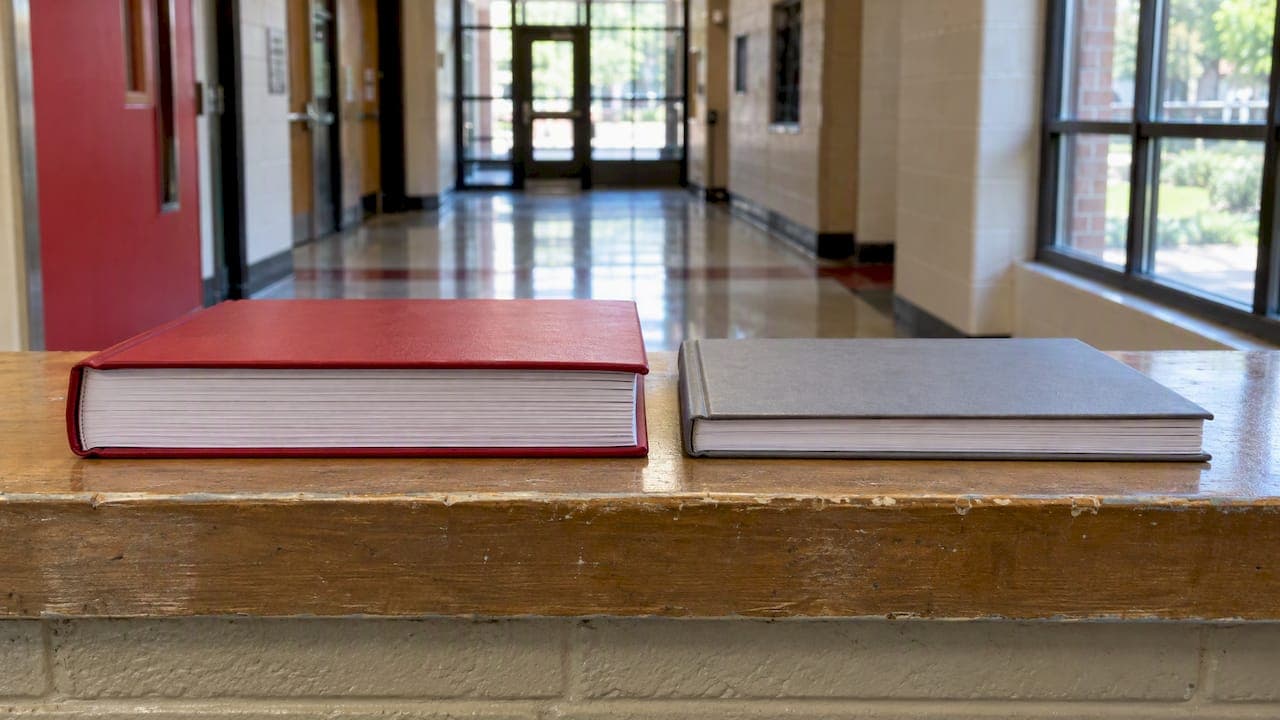
Page count is the biggest lever you control on a yearbook's price. In one published school contract, adding 16 pages to an elementary softcover added about $3 per copy, while adding 16 pages to a high school hardcover added about $9. The exact amount depends on the trim size, paper, binding and quantity, but the pattern holds: every page has a price, and the price per page rises with the book's grade level and construction.
This guide shows how to estimate that number before you ask for a quote, using real published pricing, a worked example and the add-ons that quietly change the total.
TL;DR
- Cost per copy is roughly a base cost (cover, binding, setup) plus a per-page cost multiplied by your page count, then adjusted for quantity and extras.
- In one Virginia school-division contract, the per-page step was about $0.20 for elementary softcover, about $0.47 for middle school hardcover and about $0.58 for high school hardcover.
- Binding, endsheets, foil, personalized covers and freight can add several dollars per book, often more than an extra 16 pages would.
- Trim the cost by planning pages around your real content, ordering the right quantity and choosing add-ons deliberately, not by thinning out the book at the last minute.
Table of Contents
- The basic formula: base cost plus pages
- What published pricing shows about page count
- How many pages does your school need?
- The costs that sit on top of the page count
- Setting the selling price from your cost
- Perspective: why we price by the whole book
- Get a price for your own page count
- Ways to lower the cost without hurting the book
- FAQ
- Sources
The basic formula: base cost plus pages
Most printers build a yearbook price from two parts. The first is a base cost that covers the cover, binding and setup. The second is a charge for each page. Publicly posted price lists commonly spell this out as a base price plus the number of pages times a page rate, and some list a starting price for a set number of pages with a fixed amount for each extra page.
That gives you a working formula:
Cost per book = base cost + (pages × page rate) + add-ons
Two things move the result. The page rate changes with trim size, paper weight and color. The base cost changes with the cover and binding. When you compare quotes, ask for both numbers, not just a single total for one page count. A price that looks low at 64 pages can climb quickly at 96 if the page rate is high.
Pages also come in multiples. Printed books are built from signatures, which are folded sheets, so page counts usually move in steps of 8 or 16. A quote for 100 pages may really be priced as 104 or 112. Ask which increments your printer uses so you do not pay for blank pages you did not plan.
What published pricing shows about page count
The cleanest public example we found is a Virginia school-division procurement schedule. It lists totals for 200 books at several page counts, with shipping included, so you can see the effect of pages on its own. These are one contract's prices, not a national rate card, but the way the numbers move is instructive.
Elementary softcover
The Fauquier County schedule lists elementary softcover totals of $2,966 for 200 books at 48 pages, $3,614 at 64 pages and $4,922 at 96 pages. That works out to $14.83, $18.07 and $24.61 per copy. Going from 48 to 64 pages adds about $3.24 per book, or roughly $0.20 per page. Going from 64 to 96 adds $6.54, which is about $0.20 per page again.
Middle school hardcover
The same schedule's middle school section lists hardcover totals of $8,940 for 200 books at 80 pages, $10,451 at 96 pages and $11,962 at 112 pages. Per copy, that is $44.70, $52.26 and $59.81. Each 16-page step adds about $7.55, or roughly $0.47 per page.

High school hardcover
For high school hardcovers, the schedule lists 200 copies at $31,898 for 240 pages, $37,465 for 288 pages and $41,181 for 320 pages. That is $159.49, $187.33 and $205.91 per copy. The specifications include 9-by-12-inch trim, 100-pound paper and sewn binding, with shipping included. The step is about $0.58 per page.
| Book type | Pages | Per copy (200 books) | Approx. cost per added page |
|---|---|---|---|
| Elementary softcover | 48 | $14.83 | n/a |
| Elementary softcover | 64 | $18.07 | $0.20 |
| Elementary softcover | 96 | $24.61 | $0.20 |
| Middle school hardcover | 80 | $44.70 | n/a |
| Middle school hardcover | 96 | $52.26 | $0.47 |
| Middle school hardcover | 112 | $59.81 | $0.47 |
| High school hardcover | 240 | $159.49 | n/a |
| High school hardcover | 288 | $187.33 | $0.58 |
| High school hardcover | 320 | $205.91 | $0.58 |
Notice two things. First, the page rate is nearly constant inside each book type, so a straight formula predicts the price well. Second, the jump between book types is much bigger than the jump between page counts. A hardcover with heavier paper and sewn binding costs far more per page than a stapled softcover, which is why choosing the format comes before choosing the page count.
These figures are high-end examples. Printing methods differ too. A Forbes report from 2019 put a typical traditional yearbook at $65 to $100 per copy, and noted a print-on-demand 100-page book at $24.75 and a 200-page book at $33.40. That is a different production model, with different tradeoffs in color, paper and support, and the figures are several years old.

How many pages does your school need?
The page count should come from your content, not the other way around. A common planning rule is one spread, which is two facing pages, for every 16 to 24 students. Our guide on yearbook page count for advisers walks through that rule and how to adjust it.
A practical way to build the page plan:
- Start with people. Count students and staff. Every student needs a portrait, and elementary and middle schools usually give every child a similar amount of space.
- Add the fixed sections. Cover pages, title page, table of contents, index, autographs and a closing page.
- Add the story. Sports, clubs, events, academics, student life. Give each a spread count based on how many photos you actually have.
- Reserve pages for ads and extras such as recognition ads and senior or eighth-grade tributes, if you sell them.
- Round up to the printer's increment, then fill the extra pages with real content, such as a candid photo spread or a class-wide collage, rather than leaving them blank.
A typical pattern is that elementary books run short, middle school books land in the middle, and high school books are the longest because of senior portraits, sports and clubs. The Virginia schedule above reflects that, with page counts from 48 for elementary to 320 for high school.
The costs that sit on top of the page count
Pages are only part of the bill. Binding, cover finish and delivery can add as much as another 30 pages would. On our printing page, we publish the per-book cost of the common options so you can add them up yourself.
| Option | Published cost |
|---|---|
| Perfect bound soft cover | $1.60 per book |
| 150 point board (hard cover) | $1.50 per book |
| Smyth sewn binding | $2.00 per book |
| Printed endsheets (hard cover) | $2.75 per book |
| Inside cover (duplex) printing, soft cover / saddle-stitched | $0.40 per book |
| Flat foil stamp or spot UV | $4.25 per book |
| Personalized covers | $3.00 to $6.00 per book |
| Include freight to the school | $1.00 per book |
| Split binding | $100 one-off |
| Printed proof books (litho only, 2 copies, shipping included) | $100 one-off |
| Recognition ads | $5 per ad |
| Lovelines | $1 each |
A worked example
Suppose a school orders 300 hardcover books with sewn binding, printed endsheets and a foil-stamped cover, and adds freight. Using the published add-on prices above, the per-book add-ons are:
- Smyth sewn: $2.00
- Printed endsheets: $2.75
- Flat foil stamp: $4.25
- Freight to the school: $1.00
That is $10.00 per book, or $3,000 across 300 books, before the page cost. Each option is reasonable on its own. Together they equal the cost of roughly 17 extra pages at the $0.58 per page rate in the high school example above. Seeing that comparison helps you decide whether the foil cover or an extra sports spread is the better use of the budget.
Other factors that change the price
- Quantity. Setup costs are spread across more books, so per-copy price falls as quantity rises. Our quantity ordering checklist shows how to settle on a count.
- School size. Smaller schools often pay more per book because the fixed costs are shared across fewer copies. See why school size affects yearbook pricing.
- Paper. Paper weight and finish affect both cost and feel. Our guide to yearbook paper options explains the choices.
- Trim size and color. Larger pages and full color on every page cost more than a mix of color and black and white.
- Shipping and deadlines. Some quotes leave freight out or charge extra for rush production. Ask for a total that includes delivery.
For a fuller list, read our breakdown of yearbook cost factors.
Setting the selling price from your cost
The printer's price is not the price families pay. Most schools set the sale price to cover printing, any design help, shipping and a margin for unsold copies, then count ad and sponsorship revenue against it. Student-run publications report a wide range of prices. A high school newspaper's February 2025 report found one school's yearbook at $110 and another's at $82, which shows how far prices spread from school to school.
A simple way to work backward:
- Take your total print quote, including add-ons and freight.
- Subtract expected ad, sponsorship and fundraising revenue.
- Divide by the number of copies you expect to sell, not the number you print.
- Add a small cushion for damaged or unsold books.
Our break-even worksheet and ordering guide puts those steps into a table, and the national cost overview shows what schools and families typically pay. Ad pricing is a useful lever: a rule of thumb from yearbook ad guides is to charge a multiple of your cost per page, and our own recognition ad fee is $5 per ad on the printing page.
Perspective: why we price by the whole book
We talk with advisers every year who tell us the same thing: the page count was the easy part, and the surprises came later. A quote that looked low at first grew once the cover options, shipping and proof copies were added. A deadline arrived before the budget did.
That is why we built our pricing around the finished book. Schools see all-inclusive pricing online with no signup and no sales pitch, and shipping is part of the picture. We have no order deadlines and no minimums, so an adviser can size the book to the school instead of the other way around. Our turnaround is 2 to 3 weeks, which means a late event photo does not force you to cut pages in a panic.
Our advice on page count is simple. Plan pages from your photos and your student count, not from last year's book. If the quote comes in over budget, change one decision at a time, and change the cover finish or binding before you cut content. A yearbook that is a few pages shorter but full of real moments beats a thicker one padded with filler. Our team has over 50 years of combined experience, and we have watched many schools make this tradeoff well and a few make it badly.
— Jace
Get a price for your own page count
If you want to skip the arithmetic, we publish all-inclusive pricing for your school online, with no signup and no sales call. You can test a few page counts, compare softcover and hardcover, and see how each add-on changes the total before you commit to anything.
We support Canva, Adobe InDesign and our online creator, so you can design in the tool your staff already knows, and we offer free design assistance. If you would like to hold a finished book first, you can request a sample. Middle schools and K-8 schools can also see how designing your own book or having us create it affects the workload.
Ways to lower the cost without hurting the book
- Right-size the page count. Build the page plan from photos and rosters, then round to your printer's page increment.
- Order close to your real demand. Printing too many copies wastes money, and too few can leave students without a book. Reprints on demand help cover late requests.
- Pick add-ons on purpose. A foil stamp at $4.25 per book is a visible upgrade, but a standard cover can free up money for pages.
- Use free design help and your own tools. Design time is a hidden cost. Free assistance and Canva or InDesign templates cut hours.
- Sell ads and sponsorships. Recognition ads at $5 each and business ads can offset printing costs.
- Plan the budget early. Our yearbook budget planning guide covers the planning calendar.
- Ask for a total that includes shipping. Compare quotes on the delivered cost per book, not the headline price. Our post on all-inclusive yearbook pricing explains what to look for.
FAQ
How much does it cost to make one yearbook?
It depends on format and page count. In one Virginia school contract, a 48-page elementary softcover cost $14.83 per copy at 200 books, while a 240-page high school hardcover cost $159.49. Print-on-demand books are generally lower, and your own quote will vary with trim size, paper and quantity.
Does adding pages raise the price in a straight line?
Usually close to it. In the published contract, each added page cost about the same within a book type: roughly $0.20 for elementary softcover, $0.47 for middle school hardcover and $0.58 for high school hardcover. Page counts move in blocks of 8 or 16, so expect the price to move in steps.
What is the most expensive part of a yearbook?
For most schools it is the combination of format and length. A hardcover with sewn binding and heavy paper costs far more per page than a softcover. Extras such as foil stamping, printed endsheets and personalized covers then add several dollars per book.
How many pages should my school's yearbook have?
A common starting rule is one spread for every 16 to 24 students, then adjust for sections, ads and photos. Elementary books are often shorter, while high school books run longer. Our page count guide for advisers shows the full method.
Can I find a price without talking to a sales rep?
Yes. We show all-inclusive pricing online with no signup and no sales pitch, so you can test page counts and options on your own schedule.
Sources
- Fauquier County, Virginia: yearbook services contract, elementary section
- Fauquier County, Virginia: yearbook services contract, middle and high school sections
- Forbes: How print-on-demand publishers are bringing down yearbook costs
- The Paw Print: The Cost of a Yearbook