

Copy these interview and survey questions straight into your next yearbook spread, organized by senior profiles, student life, clubs and teams, and grade level. Use them three ways right now: paste a category into a Google Form for digital collection, run a five-question quick interview at lunch, or drop the senior prompts into a personal profile template. Open-ended prompts like these consistently pull longer, more specific answers than yes/no questions, which is exactly what engages students in classroom settings too. TrailMark Yearbooks builds free design assistance and adviser templates around exactly this kind of content.
Three ways to start in the next five minutes:
- Copy a category from the question bank below into a shared doc or form.
- Run a five-question interview with one student during a free period.
- Plug senior answers into a bio capsule, short narrative, and pull quote layout.
Key Takeaways
Open-ended, audience-specific questions produce the quotable, specific answers that make a yearbook spread worth reading twice.
| Point | Details |
|---|---|
| Open-ended beats closed | Questions with no one-word exit produce longer, more specific, more quotable answers. |
| Match category to audience | Use separate question sets for seniors, student life, clubs, sports, and teachers. |
| Adjust phrasing by grade | Keep elementary prompts short and concrete; save reflective questions for older students. |
| Get consent before publishing | Use simple opt-out language, especially for personal anecdotes from minors. |
| Production partner matters | TrailMark Yearbooks pairs free design templates with a 2 to 3 week turnaround so collected quotes reach print fast. |
Table of Contents
- Types of Yearbook Interview Questions That Actually Work
- The Yearbook Question Bank: Categorized and Ready to Use
- Collecting Answers Without Losing Your Deadline
- Three Templates You Can Paste Right Now
- Why These Questions Work, and Where TrailMark Yearbooks Fits In
- Adjusting Questions for Different Cultural and Regional Contexts
- What One Adviser Learned the Hard Way About Asking the Right Question
- Get Fast, Affordable Yearbook Production Without the Guesswork
- Sources
Types of Yearbook Interview Questions That Actually Work
Closed questions get you a fact. Open-ended questions get you a sentence you can actually print. "Did you enjoy marching band?" gets a shrug and a "yeah." "What's one moment from marching band you'll still be talking about at your ten-year reunion?" gets a story. The second version is the entire game of yearbook interviewing, and it's why nearly every strong quote in a well-built spread traces back to a question with no easy one-word exit.
Most useful prompts fall into three buckets:
- Reflective questions ask students to look backward: what changed, what they learned, what surprised them.
- Future-facing questions ask them to look forward: plans, hopes, advice to their younger self or the next class.
- Personality and fun questions loosen things up and often produce the quirkiest, most quotable lines in the book.
Grade level changes how you phrase all three. A high school senior can handle "What's a belief you had freshman year that you no longer hold?" A third grader needs "What's your favorite thing about being in third grade?" Middle schoolers sit somewhere in between, usually best served by concrete, specific prompts rather than abstract ones. Grade-appropriate rephrasing matters more than the question category itself, and staff building middle school spreads should keep prompts short and tied to something the student can picture immediately.
Keep the language inclusive (ask about "your people" or "someone who mattered," not just "your best friend," since friend groups vary) and always let students know an answer might be edited for length or clarity before it runs.
Pro Tip: Ask the fun question first. It relaxes the interview and almost always makes the next, more reflective question land better.
The Yearbook Question Bank: Categorized and Ready to Use
Pick a category, copy the list, and go. These are organized the way most spreads actually get built: by audience first, then by use-case.
Senior profile questions
- What's one thing you believed at the start of high school that you don't believe anymore?
- Who is someone who shaped who you are today, and how?
- What's a moment from this year you'll still remember in ten years?
- If you could give one piece of advice to a freshman version of yourself, what would it be?
- What's next for you after graduation, and what's one thing you're nervous or excited about?
- What's a small, ordinary moment at this school you didn't expect to miss?
- What's one word you'd use to describe your time here, and why that word?
A structured template turns those answers into something printable: a short bio capsule, a narrative block of about 75 to 100 words, and one pull quote pulled straight from the interview. That third piece, the pull quote, is often the whole reason a senior spread gets shared later.
Student life and daily moments
- What's your go-to spot on campus when you need five minutes alone?
- Describe a totally normal Tuesday for you, start to finish.
- What's something about this school that people from outside wouldn't understand?
- Who's someone in the hallway you always say hi to, even if you're not close?
- What's one tradition here you hope never changes?
Clubs, teams, and organizations
- What's the proudest moment your group had this year?
- Describe your group's culture in one sentence a stranger would understand.
- What's an inside joke only your group would get?
- Who stepped up in a way that surprised people?
- What will you miss most about practice, rehearsal, or meetings once this ends?
Sports-specific prompts
- What's a moment from this season, win or loss, that stuck with you?
- Describe the feeling right before a big game or meet.
- Who's a teammate that made you better this year?
- What's something fans in the stands never see?
Teacher and staff questions
- What's a classroom moment from this year you'll remember?
- What's one piece of advice you give students that you wish someone had told you?
- What's something about this year's students that surprised you?
- If you could freeze one moment from this school year, what would it be?
Elementary and early middle school prompts
Keep these short, concrete, and answerable in one sentence: "What's your favorite thing about recess?" "Who's your best friend in class, and what do you like doing together?" "What's the funniest thing that happened this year?" Younger students answer better when the question has an obvious, tangible target rather than an abstract one.

Fun and quirky prompts
Funny questions work best when they're used on purpose and treated as optional, not mandatory. Career interviewers rely on the same principle: a well-placed odd question can surface real personality fast, but only if the person answering knows they can pass. Try: "If you were a school lunch item, which one and why?" "What's the weirdest thing in your backpack right now?" "Give one sentence that tells the truth about your experience here." That last one is a reliable pull-quote generator on its own.

Quick five-question sets
Set A, general student life: Favorite class this year and why. One word for this year. A moment you'll remember. Something you're proud of. Advice for next year's class.
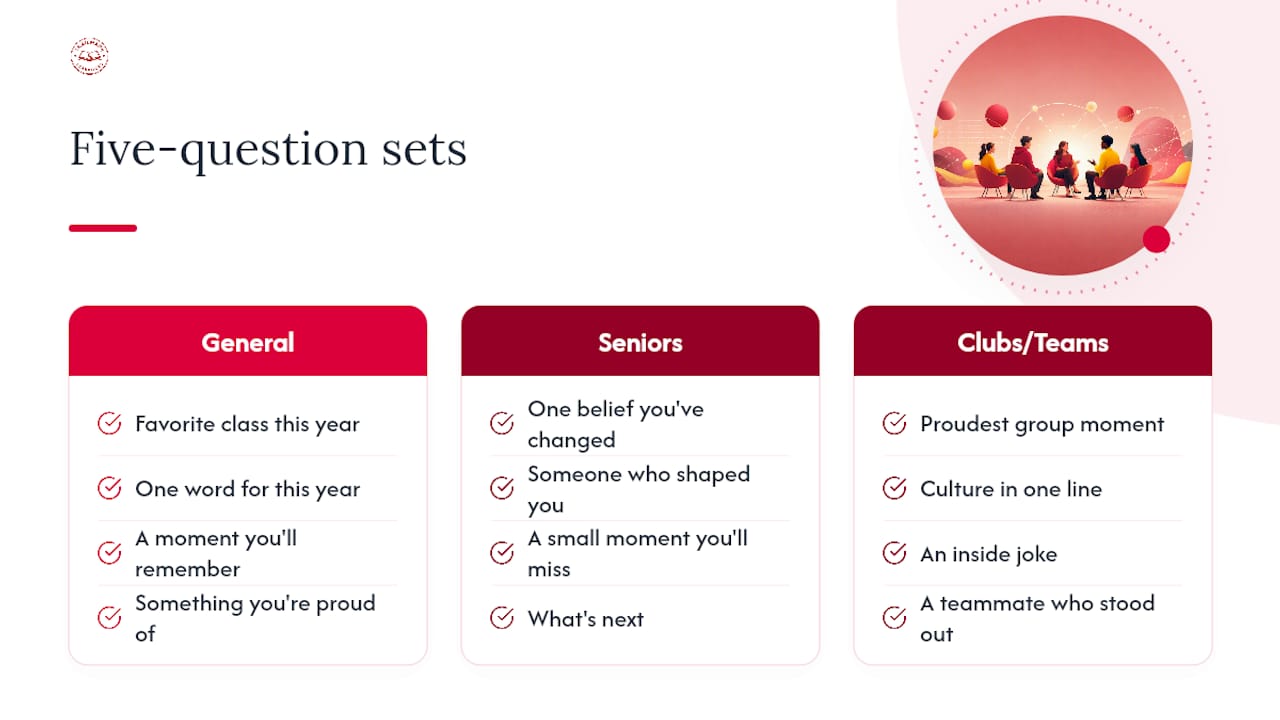
Set B, seniors: One belief you've changed your mind on. Someone who shaped you. A small moment you'll miss. What's next. One sentence that sums up your time here.
Set C, clubs and teams: Proudest group moment. Culture in one line. An inside joke. A teammate who stood out. What you'll miss most.
Organizing prompts by audience and topic like this, rather than dumping them into one long undifferentiated list, is what makes a question bank usable under deadline pressure instead of overwhelming.
Collecting Answers Without Losing Your Deadline
Match the method to the moment. A quick face-to-face interview works when you have five minutes and one student in front of you. A written survey works for a whole club at once. A digital form works when you need to reach an entire grade and can't corner everyone individually.
- Quick interview: start with an easy opener, then ask a follow-up that demands specifics, who, what, when, where. Soft questions first, specifics second, consistently produces longer answers than leading with the hard question.
- Written survey: hand it out at the end of a meeting or practice; five to seven questions max, or people rush the last three.
- Digital form: best for large groups, but only if fields are labeled clearly, sensitive questions are marked optional, and there's a real deadline reminder built into the form rather than an open-ended "whenever" window.
Before collecting anything from students, especially minors, use plain consent language: "Your answer may be edited for length or clarity and printed in the yearbook. Let us know if you'd prefer it stay anonymous or be left out." That single sentence covers most of the ground schools need, and it lines up with the general guidance in the Student Privacy Pledge. For the paperwork side of things, a documented adviser policy on consent and review workflows saves headaches later.
Pro Tip: Batch interviews by category, all the seniors on Tuesday, all the clubs on Thursday, and pair each quote with its photo the same day. Waiting to match them later is where good quotes get lost.
Three Templates You Can Paste Right Now
Five-question interview script: Favorite memory this year? Follow-up: what made it stick? One thing you're proud of? Advice for someone starting where you started? One sentence that sums up this year for you?
- Single-page survey: Name and grade (required). Three short-answer questions (optional, 1-2 sentences each). One long-answer question (optional, 2-3 sentences). Keep the whole thing under ten fields.
- Senior profile form: Bio capsule (activities, plans). Short narrative response, 75 to 100 words. One standalone pull-quote line. Photo upload or photo request note.
Adjust length and vocabulary for grade level, and match the field count to how much space the spread actually has. A crowded club page needs a five-question set. A full-page senior spread can carry the whole profile form.
Why These Questions Work, and Where TrailMark Yearbooks Fits In
Open-ended questions push students past the reflex "fine" or "good" answer into the kind of specific, sensory detail that actually reads well on a printed page. That shift, from a one-word reply to a real sentence, is the difference between a filler quote and a pull quote someone screenshots.
The same principle drives effective classroom questioning strategies for K to 12 educators, which is worth knowing if you're training student editors to conduct interviews themselves.
- Lead with a pull quote or short capsule; readers scan spreads before they read them.
- Pair quotes with photos taken the same week, while context is fresh.
- Use a dedicated quote-capture field in every form so you're not hunting through paragraphs later.
TrailMark Yearbooks backs this up with free design assistance, adviser templates, and guidance on selecting and editing senior quotes once the interviews are done.
Adjusting Questions for Different Cultural and Regional Contexts
A question that feels natural in one community can land oddly in another. "Who's your best friend?" assumes a single close friendship structure that doesn't fit every student's social world, especially in schools with large multigenerational households or tight-knit cultural communities where "family" and "friend group" overlap. Swap it for "Who's someone who matters to you at this school?" and you widen the net without losing the intent.
Family and future-plans questions need similar care. "What do your parents do?" can be awkward for students in nontraditional households, immigrant families, or households led by grandparents or guardians. "Who are the people who support you?" gets at the same idea without narrowing the answer to one acceptable format.
Language matters too. In schools with a large population of English language learners, offering a translated version of the survey, or simply allowing shorter written answers, produces better participation than a form built only for fluent English speakers. Regional norms around humor differ as well. A joking prompt that reads as playful in one school culture might read as disrespectful in another, so run quirky questions past a co-adviser familiar with the community before they go into a shared form.
The goal isn't a universal question set. It's a flexible one, built so a student anywhere can answer honestly without translating their life to fit the prompt.
What One Adviser Learned the Hard Way About Asking the Right Question
A single line changed everything about one senior's page: not "What will you miss?" but "What's a moment you didn't know you'd remember?" She answered with a story about a hallway conversation nobody else would have thought to ask about. It became the spread's pull quote.
If you're short on time, batch five-question interviews during one lunch period instead of chasing students individually for weeks. A short digital form works just as well when face time isn't possible.
— Jace
Get Fast, Affordable Yearbook Production Without the Guesswork
Once your interviews are collected and your quotes are picked, you still need a partner who can turn all of it into a printed book without missing your deadline. TrailMark Yearbooks offers instant all-inclusive pricing, a 2 to 3 week turnaround, and free design assistance, so the questions you just gathered end up on a page instead of stuck in a spreadsheet.
Three ways TrailMark supports the staff doing this work: ready-made templates that match the categories in this article, full-service design help if your team is short-staffed, and flexible tools whether your school prefers Canva, Adobe InDesign, or TrailMark's own online creator. There are no order deadlines locked months in advance and no hidden fees added after you've already committed. If your team wants to see the print quality before committing, you can request a sample yearbook or check current production pricing and options to see what fits your school's timeline this year.
Sources
- Using effective questions to engage students | Cornell Center for Teaching Innovation
- Questions to Ask Seniors: Interview Templates for Yearbook Features and Digital Tribute Displays | Touch Archive
- Student Privacy Pledge | Future of Privacy Forum
- 65 Funny Interview Questions (With Sample Answers) | Indeed
- 31 Yearbook Survey Questions | HeySurvey examples