

Yearbooks are defined as curated, physical records of a school year, and their role in student memory extends far beyond a collection of photos. They function as personal archives, social artifacts, and cultural time capsules all at once. A student who flips through a yearbook ten years after graduation is not just looking at pictures. They are re-entering a specific moment in time, complete with the slang, fashion, and social dynamics that shaped who they were. For students and educators alike, understanding what yearbooks actually preserve, and what they leave out, makes them far more useful tools.
How yearbooks preserve memories as time capsules
Physical yearbooks are permanent, curated narratives that resist the link rot and platform shutdowns that erase digital memories. A photo posted on a social media platform in 2015 may be gone today. A yearbook from that same year still sits on a shelf, intact. That durability is one of the most underappreciated aspects of the yearbook experience for students.
Yearbooks capture more than milestone events. They freeze the everyday cultural details of a school year, including slang terms, clothing trends, candid hallway moments, and the specific "vibe" of a particular class. Those details gain sentimental value over time in ways that a filtered Instagram post simply cannot replicate.
Consider what a yearbook from 1995 reveals compared to a Facebook album from 2008. The 1995 yearbook shows hairstyles, club names, and even the typography of the era. The Facebook album may no longer load. Physical books also function as historical records that document the evolution of youth culture, social norms, and school communities across decades. Researchers and historians have used school yearbooks as primary sources for exactly this reason.
- Photos and candid shots capture the visual culture of a specific year, from clothing to classroom setups.
- Club and sports sections document which activities defined school identity at a given moment.
- Quotes and superlatives preserve the language and humor students actually used.
- Advertisements and sponsor pages reflect the local economy and community surrounding the school.
Pro Tip: Scan and digitally back up your yearbooks, but keep the physical copy. The original preserves texture, handwriting, and color accuracy that digital scans often lose.
What do yearbook memories mean for student identity?
Yearbooks validate a student's place in the school community. That validation matters more than most people realize. School spirit and belonging are reinforced when a student sees their own face, their team, or their club represented in print. The yearbook says, in concrete terms: you were here, and this mattered.

The psychological function of yearbooks connects directly to how students navigate life transitions. Graduation is disorienting. The social world a student spent years building dissolves almost overnight. A yearbook provides a tangible anchor to that world. Many alumni use yearbooks specifically for reconnection at reunions, using them to recall names, faces, and shared experiences that memory alone cannot reliably hold.
The signing ritual deserves its own recognition. When students write messages in each other's yearbooks, they are doing something specific and meaningful. The act of signing yearbooks transforms a mass-produced book into a personalized artifact that documents real relationships, inside jokes, and genuine affection. Those handwritten notes often outlast the friendships themselves as evidence that the connection was real.
Here is how yearbooks serve students across different stages of life:
- During the school year: Students see their participation documented, which reinforces a sense of belonging and contribution.
- At graduation: The yearbook becomes a farewell artifact, a way to process the end of a chapter with something physical to hold.
- In early adulthood: Yearbooks help young people contextualize who they were versus who they are becoming.
- At reunions and beyond: They serve as shared reference points that rebuild social connections across years of distance.
"Yearbooks are more authentic than social media profiles, capturing awkward phases, evolving personalities, and genuine interactions in ways that feel less filtered." — We Wishes
Understanding middle school emotional development also helps explain why yearbooks carry such weight at younger ages. Students in grades 6–8 are actively forming their identities, and seeing themselves represented in a school publication reinforces that their presence counts.
Do yearbooks tell the whole story?
Yearbooks do not tell the whole story. That is not an accident. Analysis of nearly 100 years of Salinas High School yearbooks found that they consistently prioritize a pleasurable collective identity, focusing on sports, rallies, and social triumphs. The pain, conflict, and inequality that also defined those years are largely absent.
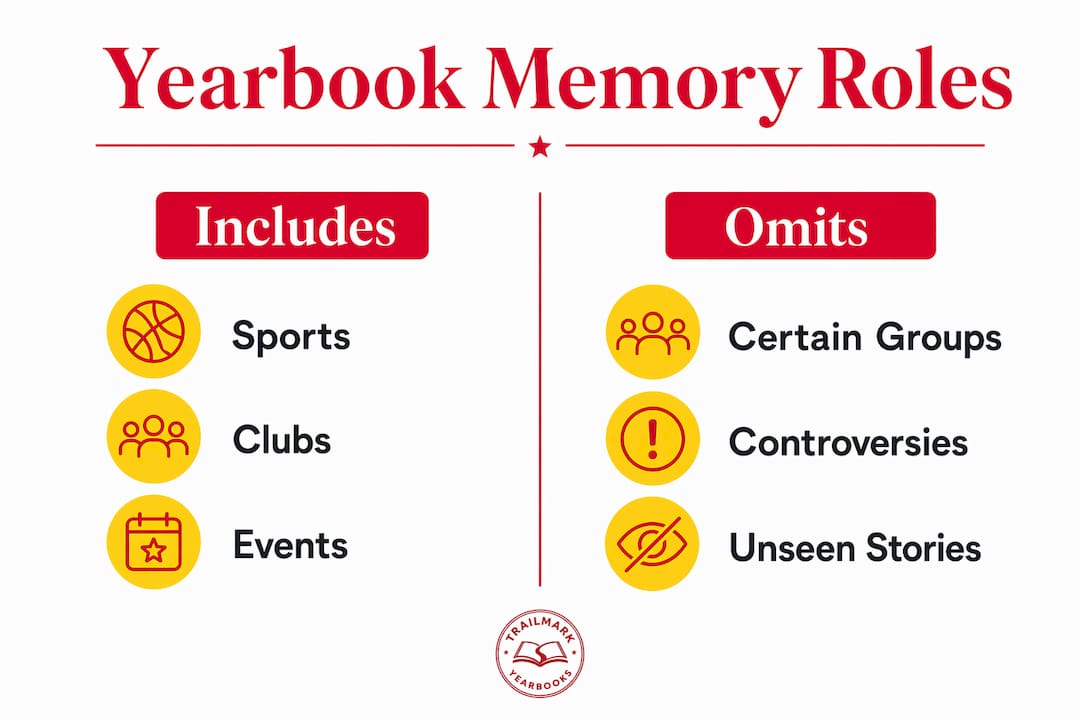
This selective curation is worth naming directly, especially for educators. A yearbook is not a neutral document. It reflects the choices of the students and advisers who created it, including choices about whose faces appear most often, which clubs receive full-page spreads, and which moments get left on the cutting room floor.
The concept of "critical nostalgia" addresses this gap directly. Researchers recommend that students and educators apply critical nostalgia to appreciate the joy a yearbook captures while also recognizing what it omits. This approach does not diminish the value of the yearbook. It deepens it.
| What Yearbooks Typically Include | What Yearbooks Often Omit |
|---|---|
| Sports championships and team photos | Academic struggles or school-wide failures |
| Prom, homecoming, and rallies | Conflicts, protests, or disciplinary events |
| Popular clubs and student government | Marginalized student groups or alternative communities |
| Smiling portraits and candid fun | Mental health challenges or social exclusion |
| Faculty highlights and senior quotes | Staff turnover, budget cuts, or community hardship |
Historically, marginalized groups including students of color, LGBTQ+ students, and students with disabilities have been underrepresented or entirely absent from yearbook pages. Acknowledging this history is not about guilt. It is about using the yearbook as a teaching tool that reflects the full complexity of school life.
Pro Tip: Educators can use old yearbooks as primary sources in social studies or history classes. Ask students to identify who is represented, who is missing, and what that absence reveals about the school's culture at the time.
How students and educators can get more from yearbooks
Getting more from a yearbook starts before it is printed. Students who participate in yearbook production develop real skills in project management, design, and collaboration. These are not soft skills. They are the same competencies that employers list in job postings. Yearbook staff learn to meet deadlines, manage a creative team, and produce a finished product under pressure.
For educators, the yearbook is an underused classroom resource. A 1980s yearbook pulled from the school library can anchor a lesson on cultural change, media representation, or local history. Students respond to primary sources they can physically hold, and a yearbook from their own school carries a personal connection that a textbook photograph never will.
Here are concrete ways to maximize the value of yearbooks for both students and educators:
- Involve more students in production. Expanding the yearbook staff beyond the usual group brings in new perspectives and ensures broader representation across the school community.
- Encourage specific, personal signatures. Generic messages fade in memory. Ask students to write one specific memory or inside joke. Those details become the most treasured parts of the book years later.
- Use yearbooks in advisory or homeroom periods. Distribute them with time for students to reflect, sign, and share. The ritual matters as much as the object.
- Build a school yearbook archive. A collection of yearbooks spanning decades becomes a genuine community resource, useful for alumni events, local history projects, and school anniversaries.
- Connect yearbook themes to current events. Advisers who plan yearbook sections around real student experiences create books that feel authentic rather than promotional.
The importance of yearbooks in building school community is well documented. Schools that treat yearbook production as a serious, inclusive project see higher student engagement with the final product and stronger connections between students who worked on it together.
Educational storytelling formats research confirms that physical, narrative-driven formats create stronger memory retention than digital alternatives. Yearbooks fit that model precisely.
Key takeaways
Yearbooks preserve student memory most effectively when they are created with intention, used as teaching tools, and examined with honest awareness of what they include and exclude.
| Point | Details |
|---|---|
| Yearbooks outlast digital media | Physical books resist platform shutdowns and link rot that erase online memories. |
| Signing rituals build lasting bonds | Personalized notes transform a printed book into a record of real relationships. |
| Critical nostalgia adds depth | Recognizing what yearbooks omit makes them more honest and more useful as teaching tools. |
| Production builds real skills | Students who create yearbooks develop project management, design, and teamwork abilities. |
| Archives serve the whole community | A school's yearbook collection becomes a historical resource for alumni, educators, and local history. |
Why i think we underestimate what yearbooks actually do
I have spent years watching schools treat yearbooks as an end-of-year formality, something to order, distribute, and forget. That approach misses almost everything that makes a yearbook worth having.
The most interesting thing I have noticed is how differently people engage with yearbooks at different life stages. At 17, a student flips through it looking for their own photo. At 35, they are reading the signatures, trying to remember who wrote what and why it mattered. At 55, they are looking at the fashion and the faces and feeling something closer to grief than nostalgia. The same object does completely different emotional work depending on when you open it.
The critical nostalgia framework is one I wish more educators knew about. It is not about tearing down the yearbook or making students feel bad about celebrating their school years. It is about teaching students to read any curated document, including a yearbook, with the question: whose story is this, and whose is missing? That skill transfers directly to how they read news, social media, and history.
My honest advice to educators is this: do not just distribute the yearbook. Use it. Pull out a copy from 20 years ago and put it next to this year's. Ask students what changed and what stayed the same. The conversation that follows will be more memorable than most lessons you plan from scratch.
— Jace
Create a yearbook that students will keep for decades
The research is clear: a well-made yearbook becomes one of the most meaningful objects a student owns. Trailmarkyearbooks makes that possible for schools of every size, without the stress, hidden fees, or long lead times that make yearbook production feel overwhelming.

Trailmarkyearbooks offers all-inclusive pricing, free design assistance, and a 2–3 week turnaround. Schools can use Canva, InDesign, or the Trailmarkyearbooks online creator to build a book that genuinely reflects their students. Advisers can access downloadable planning resources to manage the process from start to finish. If you want to see the quality before you commit, request a free sample and hold the product in your hands before making any decisions.
FAQ
What is the role of yearbooks in student memory?
Yearbooks serve as permanent, curated records of school life that help students revisit milestones, validate their sense of belonging, and maintain social connections long after graduation. They preserve not just events but the cultural details, relationships, and personal notes that memory alone cannot reliably hold.
How do yearbooks preserve memories better than social media?
Physical yearbooks resist platform shutdowns and link rot that erase digital content over time. They also capture unfiltered, authentic moments including candid photos and handwritten notes that feel less staged than social media posts.
What is critical nostalgia in the context of yearbooks?
Critical nostalgia is the practice of appreciating the joy a yearbook captures while also recognizing the voices and experiences it omits. Researchers recommend this approach so students and educators engage with yearbooks as curated documents rather than complete historical records.
Why do yearbook signatures matter so much?
The act of signing a yearbook transforms a mass-produced book into a personalized artifact that documents real relationships and inside jokes. Those handwritten messages often become the most treasured part of the book decades later.
How can educators use yearbooks as teaching tools?
Educators can use old yearbooks as primary sources to explore cultural change, media representation, and local history. Comparing yearbooks from different decades prompts students to analyze whose stories are told and whose are missing, building critical thinking skills that apply well beyond the classroom.