
A yearbook bulk discount is defined as a tiered pricing model where the cost per book drops as the total number of copies ordered increases, typically triggered once a school orders a minimum of 40 to 100 copies. Understanding what does yearbook bulk discount mean is the first step to building a smarter yearbook budget. Schools that order above the minimum threshold unlock lower unit prices, which can translate into hundreds of dollars in savings per year. Trailmarkyearbooks offers transparent, all-inclusive bulk pricing with no hidden fees, making it easier for advisers to plan with confidence. Early-bird discount windows, which typically run from august through october, add another layer of savings on top of volume-based pricing.
What does yearbook bulk discount mean for school pricing?
A yearbook bulk discount is a volume-based pricing structure where the unit cost decreases at defined quantity thresholds. The more copies a school orders, the less each individual book costs. This is the core mechanic behind tiered yearbook pricing and the reason school size matters so much when budgeting.
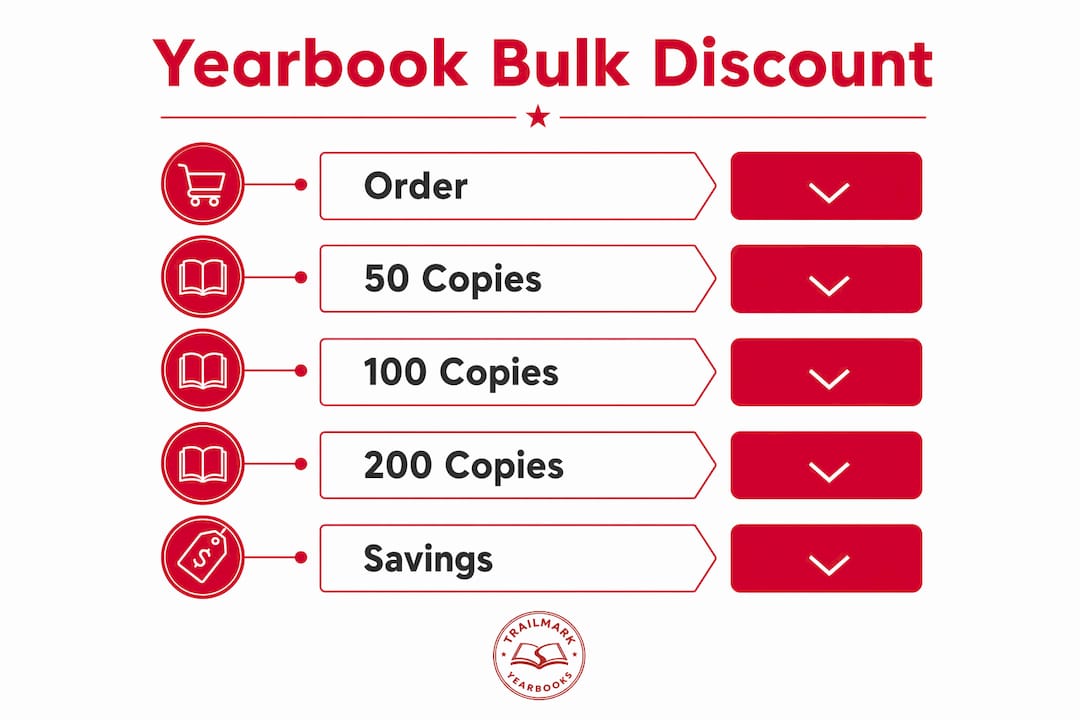
The industry standard for triggering a bulk discount is a minimum order quantity of 40 to 100 copies, depending on the vendor and printing format. Below that threshold, schools pay the standard per-unit rate. Above it, each additional quantity tier unlocks a lower price per book.
Softcover yearbooks typically cost between $7 and $20 per copy at lower volumes. That range narrows and drops significantly as order quantities climb. The difference between ordering 50 copies and 200 copies can be dramatic enough to change whether a school breaks even or generates surplus funds for other programs.
Yearbook bulk pricing is not the same as a wholesale discount. A standard wholesale book discount averages around 55% of retail price and applies to resellers, not to schools placing direct print orders. Bulk discounts apply directly to the print run and are earned by volume, not by reseller status. Advisers who confuse the two terms often misjudge what savings are actually available to them.
How tiered bulk pricing works in practice
Tiered pricing means the discount is not a flat rate applied to every order. Instead, it activates at specific quantity breakpoints. Crossing a new threshold drops the unit price for every book in that tier, not just the extra copies.
Here is an illustrative example of how tiers typically function:
| Order Quantity | Estimated Unit Price | Approximate Savings vs. Base |
|---|---|---|
| 1–39 copies | $18–$20 | No discount |
| 40–99 copies | $14–$17 | 10%–15% off |
| 100–199 copies | $10–$13 | 25%–35% off |
| 200+ copies | $7–$9 | 40%–55% off |
These figures are illustrative. Actual pricing varies by vendor, page count, binding type, and paper stock. The pattern, however, is consistent across the industry: unit cost drops at each threshold.
Printing format choices affect where you land within a tier. Softcover bindings cost less than hardcover. Standard paper stock costs less than premium weight. Choosing a premium finish on a 60-copy order can push your effective cost per book back up to what you would have paid without any discount at all.
Pro Tip: Request an all-inclusive price quote before comparing vendors. A lower unit price with add-on fees for shipping, design, or binding can end up costing more than a slightly higher base price that includes everything.
When should you order to maximize bulk order yearbook savings?
Timing is the second lever advisers control, and it works alongside volume to produce the best possible price. Early-bird discount periods typically run from august through october 31 and can save schools up to 10% on the total order. That 10% stacks on top of whatever volume discount the order quantity unlocks.
The practical implication is clear. A school that orders 150 copies in september pays less per book than a school that orders the same 150 copies in february. Both schools hit the same volume tier, but only the september order captures the timing discount.
Last-minute orders carry the opposite effect. Rush printing fees and expedited shipping charges can erase bulk savings entirely. Planning backwards from distribution day is the most reliable method for avoiding those costs.
Key planning steps to protect your savings:
- Set your distribution date first, then count back the weeks needed for printing and shipping.
- Launch a pre-sale or early-bird campaign in the fall to collect orders and forecast volume before committing to a print quantity.
- Lock in your order before the early-bird window closes, typically october 31.
- Build a buffer of two to three weeks between your print deadline and distribution day.
- Confirm all design files are complete before submitting the order to avoid revision delays that push you past the discount window.
Pro Tip: Run your pre-sale campaign for at least three weeks before the early-bird deadline. Schools that close pre-sales too early often underestimate demand and miss a higher volume tier by a small margin.
Common misconceptions about yearbook discounts explained
The biggest misconception advisers encounter is treating bulk discount as a flat rate. Volume discounts are tiered and threshold-based, meaning a school that orders 99 copies pays a different rate than one that orders 100. Missing a threshold by a handful of copies can cost more than the price of those extra books.
A second misconception is ignoring add-ons when calculating savings. The effective price per book is not just the base unit cost. It includes:
- Binding upgrades (hardcover vs. softcover)
- Paper weight and finish (matte, gloss, premium stock)
- Cover lamination or spot UV treatments
- Shipping and handling fees
- Design service charges
Add-ons like premium finishes and heavier paper stocks can offset bulk savings if not planned carefully. A school that orders 120 copies at a discounted unit price but adds hardcover binding and premium paper may end up paying more per book than a school that ordered 80 copies with standard options.
Total cost of ownership is the right metric. Advisers who focus only on the per-unit price miss the full picture. The question is not "what does each book cost?" but "what does the entire order cost, delivered and complete?"
A third misconception is assuming all vendors offer the same discount structure. Minimum order quantities, tier thresholds, and included services vary widely. Trailmarkyearbooks publishes transparent, all-inclusive pricing with no signup required, which makes direct comparison straightforward for advisers.
Practical steps to secure the best bulk yearbook pricing
Getting the best bulk price requires preparation, not luck. The advisers who consistently save the most money follow a repeatable process rather than reacting to deadlines.
-
Run a pre-sale campaign early. Launch yearbook sales in september or october. Pre-sales give you a reliable volume forecast before you commit to a print quantity. Knowing whether you will sell 80 or 150 copies changes which discount tier you target.
-
Set a volume target above your next threshold. If your pre-sale shows 90 orders and the next tier starts at 100, consider whether a small promotion or staff outreach could close that gap. Crossing the threshold saves money on every book in the order.
-
Choose a vendor with transparent bulk pricing. Advisers should not need a sales call to get a price. Vendors that publish all-inclusive pricing online make it easy to model costs at different quantities before committing.
-
Evaluate print-on-demand options for smaller schools. Zero-cost-to-school models and on-demand printing eliminate the risk of unsold inventory. For schools with fewer than 40 students ordering, avoiding leftover copies can be as financially beneficial as a bulk discount.
-
Get staff and parent buy-in early. Order volume depends on participation. Getting staff buy-in before the pre-sale launches increases the likelihood of hitting your target quantity. Teachers who promote the yearbook to families drive more orders.
-
Review your yearbook budget plan annually. Costs change year to year. Reviewing your prior year's order, actual spend, and leftover inventory tells you exactly where to set your quantity target for the next cycle.
-
Request a physical sample before committing. Evaluating paper quality, binding, and print color in person prevents surprises after a large order ships. Most reputable vendors offer sample books at no cost.
Key Takeaways
Yearbook bulk discounts work through tiered pricing thresholds, and advisers who plan volume and timing together capture the greatest savings.
| Point | Details |
|---|---|
| Bulk discount definition | Unit price drops at quantity thresholds, typically starting at 40–100 copies. |
| Timing adds savings | Early-bird windows through october 31 can add up to 10% off on top of volume discounts. |
| Add-ons affect total cost | Premium finishes and binding upgrades can offset bulk savings if not budgeted carefully. |
| Pre-sales forecast volume | Running a fall pre-sale helps advisers hit the right discount tier before committing to print. |
| Transparent pricing matters | Vendors with all-inclusive, published pricing make it easier to compare true total costs. |
Why bulk discounts only work when you plan for them
Most advisers I talk to understand that ordering more books costs less per book. What surprises them is how much the timing and the add-ons matter. I have seen schools order 120 copies at a solid volume discount, then add hardcover binding and premium paper, and end up paying more per book than a smaller school that kept it simple.
The other pattern I see regularly is schools that miss a discount tier by 10 or 15 copies because they closed their pre-sale too early. They locked in 90 orders when 100 would have dropped the unit price enough to save more than the cost of those extra books. That is a planning failure, not a pricing failure.
My honest opinion is that bulk discounts are only as good as the process behind them. The discount structure is the easy part. The hard part is running a pre-sale that gives you accurate volume data, choosing a vendor whose pricing is genuinely all-inclusive, and building enough lead time to avoid rush fees. Schools that treat yearbook ordering as a logistics project, not just a creative one, consistently come out ahead on cost.
Transparent pricing from a vendor like Trailmarkyearbooks removes one major variable. When you can see the full cost at any quantity without a sales call, you can model your budget honestly and make decisions based on real numbers.
— Jace
Trailmarkyearbooks makes bulk yearbook pricing clear from the start
Trailmarkyearbooks gives school advisers instant, all-inclusive pricing online with no signup, no sales pitch, and no hidden fees. Shipping is included. That means the price you see at any order quantity is the price you pay, which makes it straightforward to compare tiers and plan your budget accurately.
Before committing to a bulk order, request a physical sample to evaluate print quality, paper weight, and binding in person. Trailmarkyearbooks offers a free sample request so advisers can assess quality before placing a large order. When you are ready to compare options and pricing across quantities, the full range of yearbook production services is available online with no barriers to entry.
FAQ
What is the minimum order to get a yearbook bulk discount?
Most vendors require a minimum of 40 to 100 copies to trigger bulk discount pricing. The exact threshold depends on the vendor and the printing format selected.
How is a bulk discount different from a wholesale discount?
A wholesale discount averages around 55% of retail price and applies to resellers. A bulk discount applies directly to schools based on print volume, not reseller status.
When is the best time to place a bulk yearbook order?
Ordering during the early-bird window, typically august through october 31, captures both volume and timing discounts. Orders placed after this window lose the timing savings and risk rush fees.
Do add-ons like hardcover binding reduce bulk savings?
Yes. Premium binding, heavier paper, and specialty finishes increase the effective cost per book and can offset volume discounts if not planned carefully. Always calculate total order cost, not just the base unit price.
Can smaller schools still benefit from yearbook bulk pricing?
Schools that cannot reach the minimum quantity threshold benefit most from print-on-demand options that eliminate unsold inventory risk. Avoiding leftover copies can deliver savings comparable to a volume discount.