

Here are more than 100 funny "most likely to" award phrases you can paste directly into a ballot or certificate today. The one rule that keeps everything running smoothly: every award should make the winner smile, not squirm. Stick to personality quirks, habits, and aspirations, and steer clear of anything touching appearance, relationships, or sensitive personal circumstances. Effective award categories fall into three main buckets: aspirational ("Most Likely to Publish a Novel"), relatably funny ("Most Likely to Bring Snacks to Every Meeting"), and observational inside-jokes ("Most Likely to Know Every Shortcut in the Building"). The strongest lists mix all three.
For quick inspiration before you build your own list, sites like Pinterest's funny most likely to awards collection and TeachersPayTeachers both offer editable templates and ballot designs you can download and customize in minutes.
- Most Likely to Start a Business Before Graduation
- Most Likely to Become a Famous Chef (Based on Lunch Choices Alone)
- Most Likely to Know the Answer Before the Question Is Finished
- Most Likely to Survive a Zombie Apocalypse
- Most Likely to Write a Memoir Nobody Asked For (But Everyone Will Read)
- Most Likely to Adopt a Llama
- Most Likely to Turn Any Situation Into a Dance Party
- Most Likely to Still Be Talking When the Bell Rings
- Most Likely to Have a Podcast by Next Year
- Most Likely to Bring Snacks and Save the Day
Pro Tip: Run your final award list past a second staff member before printing ballots. A fresh set of eyes catches anything that reads as unintentionally pointed before it reaches students or colleagues.
Key Takeaways
The strongest funny "most likely to" awards mix aspirational, funny, and observational categories while keeping every phrase positive, inclusive, and free of anything touching appearance, relationships, or sensitive personal traits.
| Point | Details |
|---|---|
| Mix category styles | Combine aspirational, funny, and observational awards for a list that feels balanced and keeps everyone engaged. |
| Match voting method to group | Use preselect for elementary, paper ballots or Google Forms for high school and college, and digital voting for large office groups. |
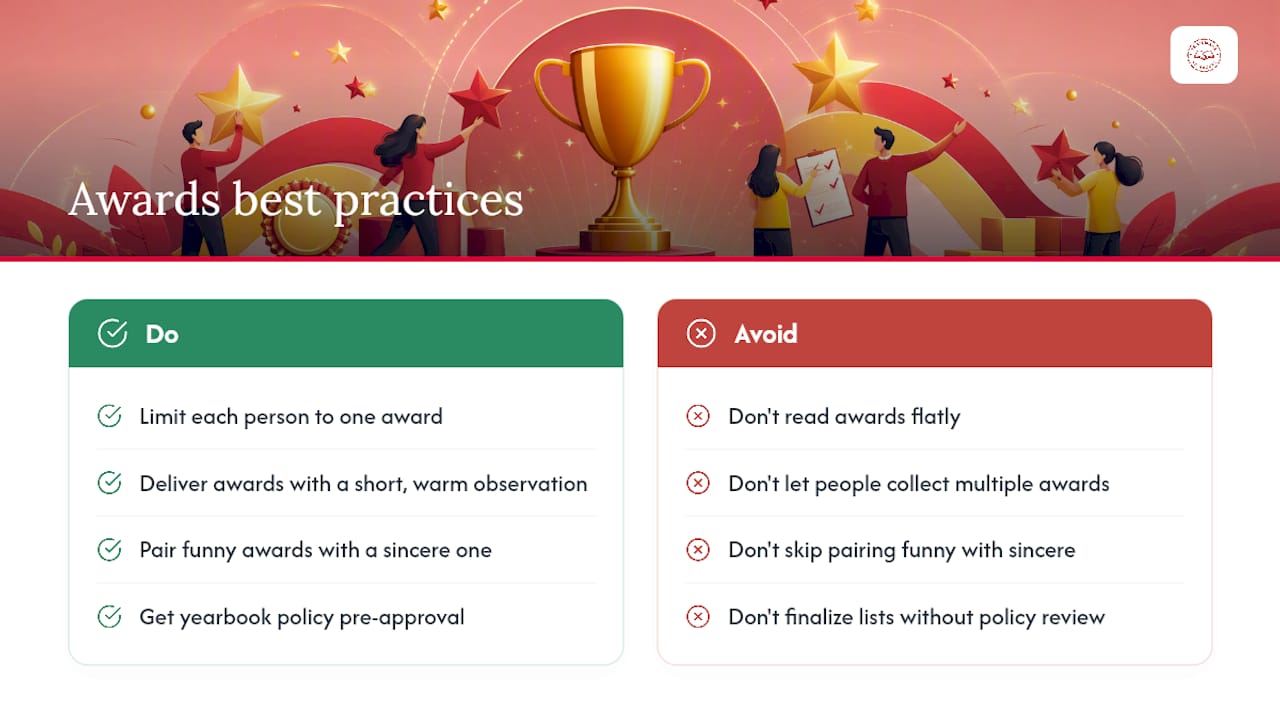
| Spread the recognition | Limit each person to one award so more participants are recognized and the room stays engaged throughout. |
| Present with a warm anecdote | A short, positive observation about each winner turns a flat announcement into a moment the room remembers. |
| Trailmarkyearbooks for yearbook pages | Add a winners spread quickly with free design help, flexible tools, and a 2–3 week turnaround. |
Table of Contents
- The big list of funny "most likely to" award ideas by audience
- How to choose categories, run voting, and present winners without causing offense
- Where to find templates, printables, and inexpensive trophies
- What actually works when you run these awards
- Preserve your winners in the yearbook with Trailmarkyearbooks
- Sources
The big list of funny "most likely to" award ideas by audience
The phrases below are organized by audience so you can grab the ones that fit your group without editing. Each category also carries a short note on what to avoid for that setting.
Funny and quirky (all audiences)
These work across age groups because they target universal habits rather than personal traits.
- Most Likely to Survive on Coffee Alone
- Most Likely to Narrate Their Own Life
- Most Likely to Become a Professional Napper
- Most Likely to Turn a 5-Minute Task Into a 3-Hour Project
- Most Likely to Have a Motivational Quote for Every Situation
- Most Likely to Befriend Every Animal They Meet
- Most Likely to Start a Trend Nobody Else Understands Yet
- Most Likely to Show Up Late but Still Be the Most Prepared
- Most Likely to Forget Their Own Birthday
- Most Likely to Have a Backup Plan for Their Backup Plan
Aspirational (high school and college)
Aspirational awards feel like a compliment with a wink. Classic phrasing like "Most Likely to Write a Memoir" and "Most Likely to Adopt a Llama" shows how a single line can be both flattering and funny at the same time.
- Most Likely to Win a Nobel Prize (and Forget to Mention It)
- Most Likely to Be on the Cover of a Magazine
- Most Likely to Change the World Before Lunch
- Most Likely to Have a TED Talk by 30
- Most Likely to Write a Bestselling Novel
- Most Likely to Become a CEO and Still Remember Everyone's Name
- Most Likely to Invent Something We All Use Daily
- Most Likely to Win an Oscar (for Best Dramatic Reaction)
- Most Likely to Be Quoted in a History Book
- Most Likely to Run for Office and Actually Win
Avoid for high school: anything referencing romantic relationships, physical appearance, or academic performance in a way that could embarrass a student.
Sentimental and soft (elementary school)
Elementary awards need the gentlest touch. Keep every phrase warm, achievable, and free of any comparison to other students.
- Most Likely to Make Everyone Feel Welcome
- Most Likely to Share Their Snack Without Being Asked
- Most Likely to Cheer Up a Friend on a Bad Day
- Most Likely to Become a Teacher (Because They Already Explain Things Better Than Most)
- Most Likely to Remember Every Classmate's Birthday
- Most Likely to Grow the Best Garden
- Most Likely to Write the Funniest Story
- Most Likely to Build Something Amazing
- Most Likely to Make the Whole Class Laugh
- Most Likely to Be Kind to Everyone They Meet
Avoid for elementary: superlatives tied to grades, speed, or anything that implies one child is smarter or faster than another.
Gen Z and Gen Alpha (middle school through college)
Printable superlatives using current slang like "Certified Slay" and "Main Character Energy" land well with modern students when a teacher has reviewed and approved the language first. Teen Vogue's most-likely-to question sets are a solid starting point for culturally current phrasing.
- Most Likely to Have Main Character Energy in Every Room
- Most Likely to Be Living Their Best Life (Documented in Real Time)
- Most Likely to Go Viral for Something Completely Wholesome
- Most Likely to Have a Vibe That's Impossible to Explain
- Most Likely to Know Every Trending Sound Before It Trends
- Most Likely to Manifest Their Dream Life and Actually Pull It Off
- Most Likely to Be the Group Chat's Emotional Support
- Most Likely to Have an Aesthetic for Every Season
- Most Likely to Accidentally Start a Movement
- Most Likely to Be Unbothered in Any Situation
Avoid for this group: slang that could read as sarcastic or dismissive to a student who doesn't identify with it.
Workplace and office (reunions and holiday parties)
Workplace awards work best when they focus on situation-based or role-based categories like "Best Zoom Background" rather than anything tied to personality, appearance, or performance reviews. Spreading winners around so no one person collects multiple awards keeps morale high and prevents anyone from feeling singled out.
- Most Likely to Have the Best Zoom Background in Any Meeting
- Most Likely to Save the Day with Five Minutes to Spare
- Most Likely to Know Where Everything Is (Including the Thing Nobody Can Find)
- Most Likely to Reply to an Email Before You Finish Sending It
- Most Likely to Turn a Monday Into a Friday Feeling
- Most Likely to Have a Solution Before the Problem Is Fully Described
- Most Likely to Bring the Best Snacks to Every Meeting
- Most Likely to Still Be on the Call After Everyone Else Has Left
- Most Likely to Make the Whole Team Laugh During a Stressful Week
- Most Likely to Have a Backup Plan Nobody Knew Was Needed
Avoid for office settings: anything referencing salary, job title, personal relationships, or physical appearance. When in doubt, run the list by HR before printing ballots.
Class reunion
Reunion awards mix nostalgia with humor. The best ones reference shared experiences rather than individual traits.
- Most Likely to Look Exactly the Same as Senior Year
- Most Likely to Have the Best Story About What They've Been Up To
- Most Likely to Have Fulfilled Every Prediction from the Original Yearbook
- Most Likely to Still Know All the Words to the School Fight Song
- Most Likely to Have Traveled to the Most Countries Since Graduation
- Most Likely to Have the Funniest "How We Met" Story
- Most Likely to Be Exactly Who You Expected Them to Become
- Most Likely to Have the Most Interesting Career Nobody Saw Coming
- Most Likely to Still Have Their Senior Yearbook in Perfect Condition
- Most Likely to Organize the Next Reunion Before This One Ends
How to choose categories, run voting, and present winners without causing offense
The most effective approach is to mix mostly funny categories with a few sincere ones, then pick a voting method that matches your group's comfort level. Getting that combination right matters more than the length of your list.
Three voting methods and when to use each
A recommended process is to hand out ballots at check-in, collect them during cocktail hour or dinner, tally during the main course, and announce winners in a 20–30 minute block to keep energy high. That rhythm works for reunions and graduation events alike.
| Method | Best for | Pros | Cons |
|---|---|---|---|
| Preselect winners | Small groups, elementary school | Fast, fully controlled, no surprises | Less participant buy-in |
| Paper ballot | Reunions, mid-size classes | Familiar, anonymous, low-tech | Requires manual tallying |
| Digital vote | Large groups, offices, college | Fast tallying, easy to share | Needs reliable Wi-Fi or device access |
For elementary school, preselecting winners is almost always the right call. A teacher or small staff committee reviews the list, assigns awards thoughtfully, and avoids any awkward vote where one child is repeatedly passed over. For high school and college, anonymous paper ballots or a simple Google Form both work well. Digital voting via Google Forms or a free tool like SignUpGenius is the fastest option for large office groups.
Sample presentation script
Keep each announcement to about 30 seconds. A structure that works:
- Read the award name.
- Give one short, positive observation about the winner ("Anyone who has seen [Name] handle a deadline knows exactly why this one fits").
- Call the winner up and hand over the certificate or trophy.
- Move on.
Avoid roast-style delivery unless you know the group extremely well. Generators that switch between Funny, Heartfelt, Roast, or Professional styles are a useful planning tool, but the Roast setting belongs only in tight-knit groups where everyone is genuinely comfortable with it. In schools, Funny plus Heartfelt is the right combination.
Pro Tip: Set up a photo station with a simple backdrop and a prop or two (a graduation cap, a novelty trophy, a sign with the award name). Winners remember the photo far longer than the announcement itself.

Handling negative reactions
Even a well-curated list occasionally lands wrong. If a winner looks uncomfortable, the presenter should pivot immediately: acknowledge the award lightly, thank the winner, and move on without dwelling. After the event, a brief private check-in goes a long way. The fix for most problems happens before the event: pre-approve every category with a second staff member or HR contact, and build in a simple opt-out so anyone who receives a nomination they dislike can quietly decline before the announcement.
Where to find templates, printables, and inexpensive trophies
You don't need a design background or a large budget to make awards feel polished.
Template sources
- TeachersPayTeachers — offers editable certificate and ballot templates specifically built for classroom superlatives, many for under $5. Search "most likely to certificate" to find designs that match your school's color scheme.
- Pinterest — is the fastest way to browse dozens of visual styles before committing to one. Search "funny most likely to awards" to find curated boards with both printable links and DIY ideas.
Buying inexpensive trophies and props
Amazon is the most convenient source for novelty trophies, mini award ribbons, and plastic medals in bulk. Search "funny award trophies" or "novelty office trophies" to find sets of 12 or 24 for under $30. For a school ceremony, a small trophy paired with a printed certificate feels more substantial than either alone.
Certificate formatting checklist
- Use a font size of at least 18pt for the award name and 14pt for supporting text so it reads clearly from a few feet away.
- Keep the wording simple: "[Name] is hereby recognized as [Award Name], [Year]."
- Add a small photo of the winner if the certificate will be included in a yearbook spread.
- Print on 80lb cardstock minimum for a finish that doesn't curl or look flimsy.
Pro Tip: Export your award winners list as a simple spreadsheet with name, award, and photo file name. That single file makes it easy to drop winners into a yearbook spread without hunting for information later.
Yearbook integration is straightforward when you plan for it early. A two-page spread with winner photos, award names, and a short caption for each is a format that strengthens school community and gives students something to look back on for years.
What actually works when you run these awards
The conventional wisdom says "keep it fun and it'll be fine." That's mostly true, but it skips the part where the presenter's delivery carries about half the weight. A well-written award read flatly lands with a thud. The same award delivered with a short, warm observation about the winner gets a laugh and a round of applause.
The tweak that makes the biggest difference in practice: limit each person to one award. When you spread recognition across as many participants as possible, the room stays engaged because more people are waiting to hear their name. When two or three people collect four awards each, everyone else checks out. Spreading winners around is a structural fix, not just a nice-to-have.
Pairing a funny award with a sincere one for the same winner also changes the tone in a useful way. "Most Likely to Still Be Talking When the Bell Rings" hits differently when it's followed by "and also the person who stayed after class to help every single time." The humor lands, and the winner feels genuinely seen rather than just teased.
For yearbook advisers, the school yearbook policy best practices resource is worth reviewing before you finalize any award list. Pre-approval at the policy level saves a conversation with administration later.
Preserve your winners in the yearbook with Trailmarkyearbooks
Adding a "most likely to" winners spread to your yearbook is one of the easiest ways to make the awards feel permanent rather than forgotten by the following week.

Trailmarkyearbooks makes that addition fast and low-stress. With a 2–3 week turnaround, free design assistance, and flexible design options through Canva, Adobe InDesign, or the Trailmarkyearbooks online creator, your staff can drop winner photos and award names into a spread without needing a professional designer. All-inclusive pricing means no surprise fees when you add pages. If you want to see the print quality before committing, request a physical sample and review it alongside your current yearbook. Ready to move forward? Browse yearbook production options and get instant pricing with no signup required.
Sources
- Free End of Year Funny Classroom Awards & Superlatives — teachandachieve
- Class Reunion Most Likely To Awards — Free Printable Ballot | Reunly
- Funny Office Superlatives for A Holiday Party - PaperDirect Blog
- RandomlyFun Superlative award generator
- 60 Funny Office Awards and Trophies — SignUpGenius