
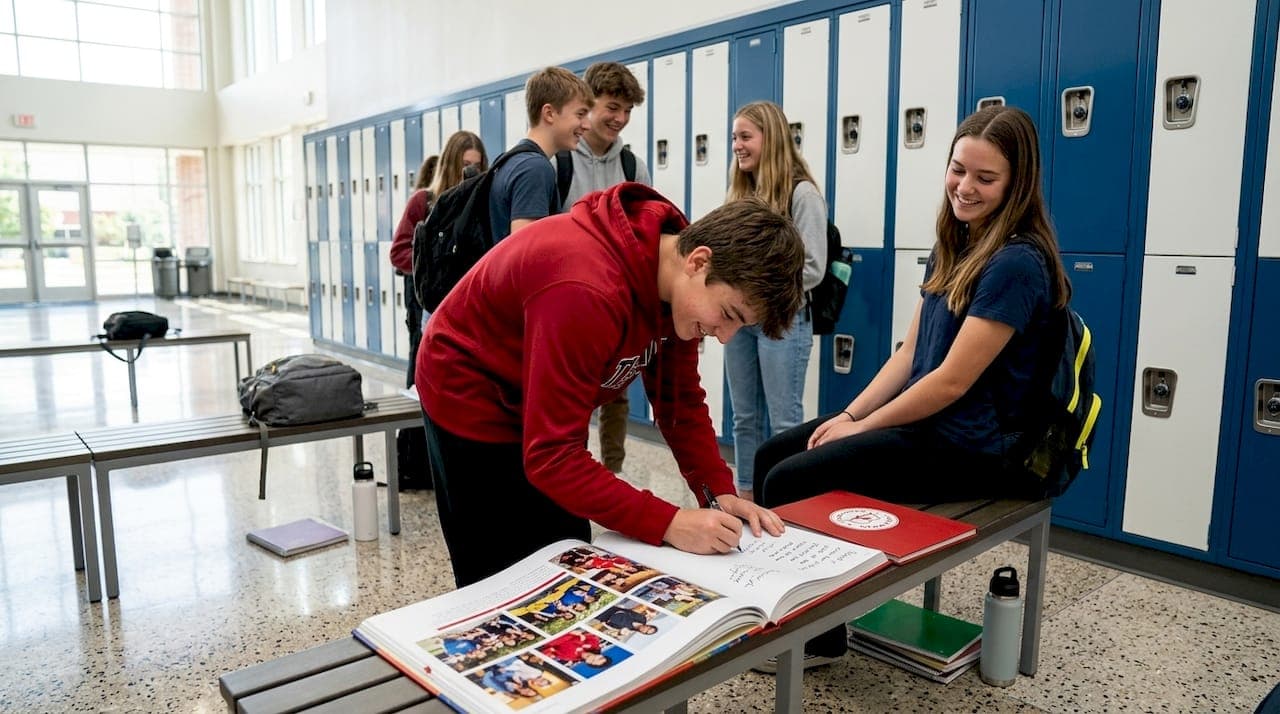
Most people flip past the autograph section without thinking twice. That's a mistake. The yearbook autograph page, officially known as the signing pages or autograph section, is often the most personal corner of any school yearbook. It's where a generic school document becomes your document. Yet students and parents consistently feel unsure about what actually belongs there, beyond a quick signature. This guide breaks down exactly what the autograph page is, how to write messages worth keeping, and how to make the whole experience more meaningful for everyone involved.
Table of Contents
- Key takeaways
- What is a yearbook autograph page?
- How to write meaningful messages
- Creative and inclusive autograph page ideas
- Common mistakes to avoid
- Autograph pages and student belonging
- My take on autograph pages
- Make your autograph pages unforgettable with Trailmarkyearbooks
- FAQ
Key takeaways
| Point | Details |
|---|---|
| Autograph pages are more than signatures | They preserve specific memories, inside jokes, and personal connections that photos alone can't capture. |
| Structure your message intentionally | A greeting, specific memory, brief encouragement, and clear signature creates lasting impact in minimal space. |
| Avoid generic phrases | Specific details and authentic tone outperform vague praise every time. |
| Inclusivity matters | Shared autograph sheets let students without yearbooks participate fully in the signing tradition. |
| Short messages win | Space is limited, so tight and personal beats long and rambling. |
What is a yearbook autograph page?
The yearbook autograph page is a designated section of a school yearbook reserved for students, teachers, and friends to write short messages and sign their names. In its simplest form, it's a blank or lightly formatted page that says, "Write something here." But the format has evolved well beyond that.
Originally, autograph pages were exactly what the name suggests: a place to collect signatures. Think of it like a physical version of signing a cast when someone broke their arm. The goal was proof of connection, not depth of conversation. Over time, schools and students started expecting more. Autograph pages evolved to include drawings, personal notes, inside jokes, small doodles, and even thematic decorations that reflect the year's shared experiences.
Today, a well-designed signing page does several things at once:
- It captures the voice of individual relationships, not just group photos.
- It gives students a reason to interact across social groups they might not normally mix with.
- It creates a record of who mattered to you at a specific point in time.
- It functions as what researchers describe as a time capsule archiving personal narratives for future retrieval.
For families, this section carries particular weight. Parents often revisit yearbooks decades later and find that the autograph notes tell more of the real story than any posed class photo ever could. The signing page is where authenticity lives.
"A yearbook autograph isn't just a signature. It's a timestamp on a relationship that mattered."
How to write meaningful messages
Knowing what to write is where most students freeze. The blank page feels intimidating, and the pressure to say something clever or heartfelt can lead to writing nothing useful at all. The good news is that a solid yearbook message follows a clear pattern.
A strong message has five components, and none of them require you to be a writer:
- Greeting. Use the person's actual name. Starting with "Hey!" or "To whoever reads this" already signals you didn't care enough to personalize it.
- Specific compliment or observation. Not "you're so nice." Something real, like "You always made calculus feel survivable with your terrible math jokes."
- A brief shared memory. One sentence. The time you got lost on the field trip, the group project that almost went sideways, the lunch table ritual. Specific yearbook messages have far more lasting impact than general praise.
- Positive closing. Wish them something genuine. College, summer, a career, a specific goal they mentioned to you once.
- Your full name and a fun detail. Sign your name clearly. Nobody wants to squint at a scrawl 20 years from now trying to remember who wrote that note.
Space is the biggest constraint on any signing page. Tight message structure optimizes both readability and available room, so resist the urge to write a paragraph. Four to six lines is the sweet spot for most autograph page formats.
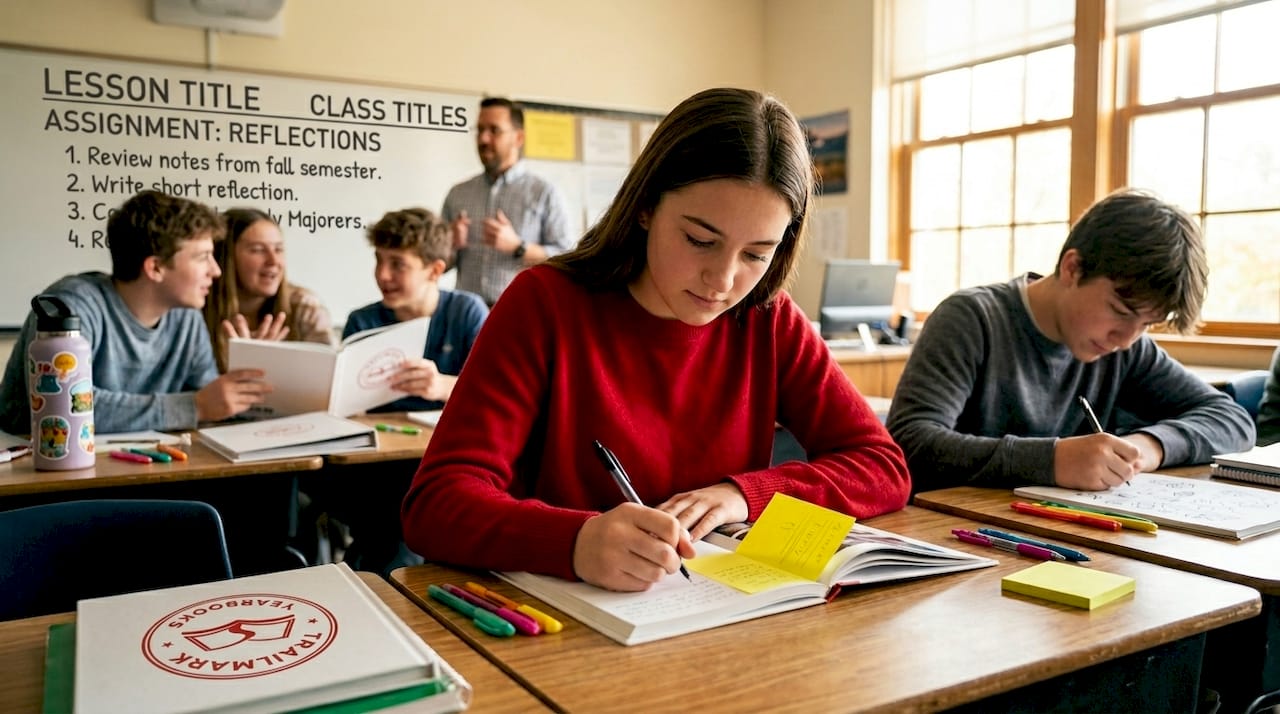
Pro Tip: Write your message in pencil on a sticky note first. Check that it fits the space and says what you actually mean before you commit pen to paper in someone's yearbook.
Yearbook copy writing techniques for advisers can also help students learn how to compose thoughtful, concise notes that hold up over time. The same principles that guide good feature writing apply to great autograph messages.
Creative and inclusive autograph page ideas
The standard autograph page format works fine, but there's significant room to make it more interesting and more inclusive without much extra effort.
On the creative side, consider what can accompany a signature. Small drawings are completely fair game. A tiny sketch of something that represents your friendship, a quick caricature, or even a simple symbol that carries meaning between two people transforms a generic note into something unmistakable. Some students use themed stickers or color coding. Some teachers write their messages in a completely different format, like a short poem or a bulleted list of what they noticed about the student that year.
Prompt questions are another underused tool for the yearbook signing page. Instead of leaving the page entirely blank, some schools print light sentence starters like "My favorite memory with you is..." or "What I hope for you next year..." These prompts lower the barrier for students who struggle with what to write while still producing personal responses. Schools can incorporate prompt-based autograph designs to make the page more functional and fun.
Here's a quick comparison of autograph page formats to help you choose what fits:
| Format | Best for | Drawback |
|---|---|---|
| Blank white space | Maximum flexibility | Some students don't know where to start |
| Prompt-based page | Getting specific memories | Less visual creativity |
| Grid with photos | Visual and sentimental balance | Space per person is tighter |
| Themed design page | School spirit and cohesion | May feel less personal |
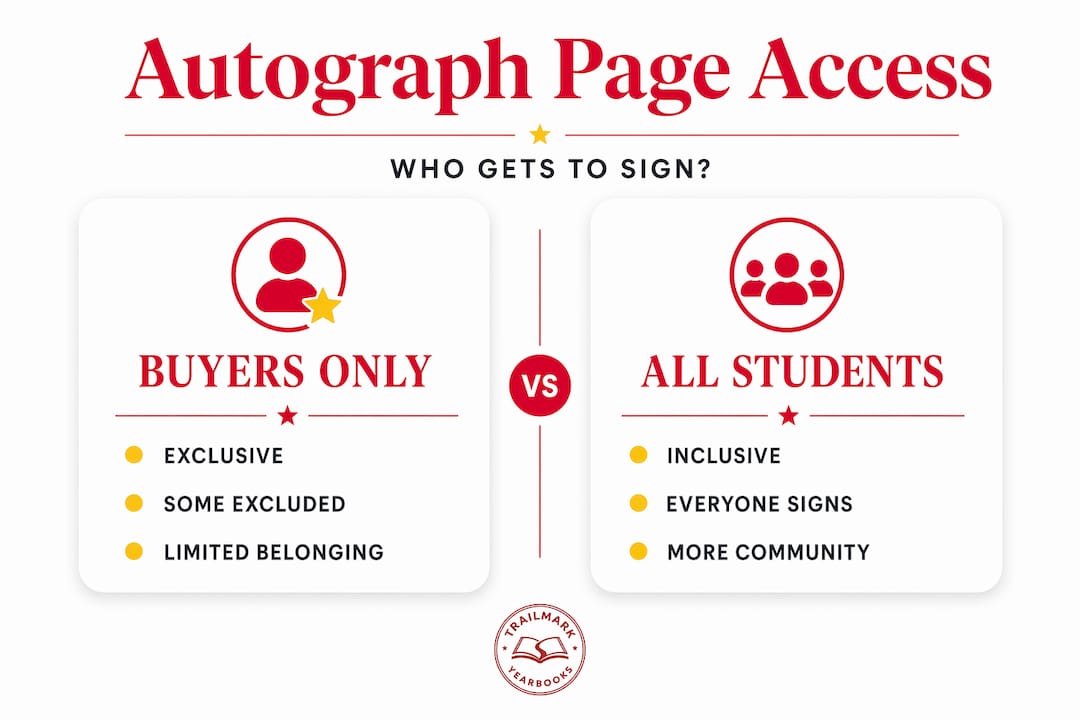
One of the most overlooked aspects of autograph pages is who gets left out. Not every student purchases a yearbook. Printable autograph sheets solve this directly by giving every student a page to collect signatures regardless of whether they bought a yearbook. Schools that use shared signing sheets report stronger participation and fewer students feeling left out of the tradition.
Common mistakes to avoid
Even with the best intentions, autograph messages can miss the mark. Here are the patterns that consistently undercut an otherwise good message.
Writing too much. It feels generous to fill an entire page for someone you're close to. In practice, a note that spills into someone else's assigned space or runs off the edge of the page creates a layout problem and often becomes hard to read. Say what matters and stop there.
Using phrases everyone uses. "Have a great summer," "Stay cool," and "Don't ever change" are the autograph equivalents of a form letter. Generic messages lack the personal connection that makes autograph pages worth revisiting. One specific sentence about this actual person in this actual year beats three sentences of feel-good filler.
Forgetting to sign legibly. Signatures are fun, but an unreadable autograph defeats the whole purpose. Write your name clearly somewhere near your signature, especially if your handwriting tends toward the abstract.
Pro Tip: If you have a lot to say to someone, write the core message in their yearbook and hand them a separate card or note with the longer version. Both formats feel intentional instead of one overwhelming the other.
Other things to watch for:
- Avoid inside references that might feel hurtful if read by the wrong person.
- Skip anything you wouldn't want a parent or teacher to read over your shoulder.
- Don't use autograph space to process a complicated friendship. Save that for a private conversation.
Autograph pages and student belonging
Autograph pages are not just keepsakes. They function as a real measure of community, and the impact of being included or excluded lands harder than most adults realize.
Research consistently shows that inclusion in yearbooks carries serious emotional weight for families. In documented cases where students with special needs were left off school yearbook pages entirely, parents pushed for full reprints, not out of vanity, but because exclusion from a community document signals something far deeper than a printing oversight.
When a student opens a yearbook years later and finds their autograph pages full, the message is clear. People saw them. People took the time to write something specific. That matters whether you are in fifth grade or looking back at forty-five.
"Being included in an autograph page is proof that your presence in that building was noticed and valued."
The role of inclusive autograph participation goes beyond kindness. It actively reinforces student belonging and community identity, which are foundational to how students experience school as a whole. Schools that build autograph page access into the end-of-year routine, rather than leaving it as a privilege only for yearbook buyers, consistently create more unified signing experiences.
| Approach | Community impact |
|---|---|
| Autograph pages for buyers only | Reinforces social divisions; some students feel forgotten |
| Shared printable sheets for all | Every student participates; inclusion becomes the default |
| Teacher-guided signing events | Structured participation; reduces awkward social dynamics |
The yearbook cover customization process offers a useful parallel here: when every student sees themselves represented from the cover through the autograph section, the entire document earns its place as a shared object rather than a product some kids have and others don't.
My take on autograph pages
I've worked with enough schools and yearbook advisers to say this clearly: the autograph section is consistently the most undervalued part of the entire book. Schools spend months perfecting photo layouts, captions, and theme design, then treat the signing pages like an afterthought. In my experience, that's exactly backwards.
What I've seen over and over is that twenty years later, people don't remember the cover design. They remember what someone wrote in pen on page 98. A specific, honest, funny message from a friend outlasts every production choice the yearbook staff ever made.
I've also watched the flip side. Students who filled their signing pages with "KIT" and "HAGS" (keep in touch, have a great summer) look back and feel almost nothing when they reread them. Contrast that with the student who wrote three sentences about a shared experience in geography class, a bad joke they both used to tell, and a genuine wish for the other person's future. That note still gets read out loud at reunions.
The other thing I feel strongly about is inclusivity. Making autograph pages accessible to every student, regardless of whether they bought a book, costs almost nothing. The emotional return is enormous. Every school should have a plan for this before the signing day, not after.
My advice is to write like someone will actually read it someday. Because they will.
— Jace
Make your autograph pages unforgettable with Trailmarkyearbooks
If you are in the middle of planning a yearbook and want autograph pages that students will actually treasure, Trailmarkyearbooks makes it straightforward. The team at Trailmarkyearbooks builds flexible yearbook layouts with designated signing sections that work for schools of every size, from small elementary programs to large high school productions.

You can explore yearbook layout options built specifically for high schools, or request a sample to see autograph page designs before you commit to anything. There are no order deadlines, no hidden fees, and a support team with real experience helping schools create books worth keeping. If you want personalized help planning your autograph section, reach out directly and someone will walk you through your options.
FAQ
What is a yearbook autograph page used for?
A yearbook autograph page is a designated space where classmates, teachers, and friends write short personal messages and sign their names. It transforms the yearbook into a personal keepsake tied to real relationships.
What should you write on a yearbook signing page?
The most effective messages include a personalized greeting, one specific shared memory, a brief word of encouragement, and a clear signature. Authentic, specific notes are far more memorable than generic phrases.
How do you autograph a yearbook if you don't own one?
Many schools provide printable autograph sheets so students without yearbooks can still participate in the signing tradition. These shared sheets give everyone a page to collect messages regardless of whether they purchased a book.
How long should a yearbook message be?
Four to six lines is the ideal length for most autograph page formats. Space constraints make short, focused messages more readable and respectful of the layout design.
What are some good yearbook quote examples for autograph pages?
Skip the generic closings and write something specific to your relationship with that person. Reference a real memory, use their name, and close with a genuine wish. That structure outperforms any pre-written quote every time.