
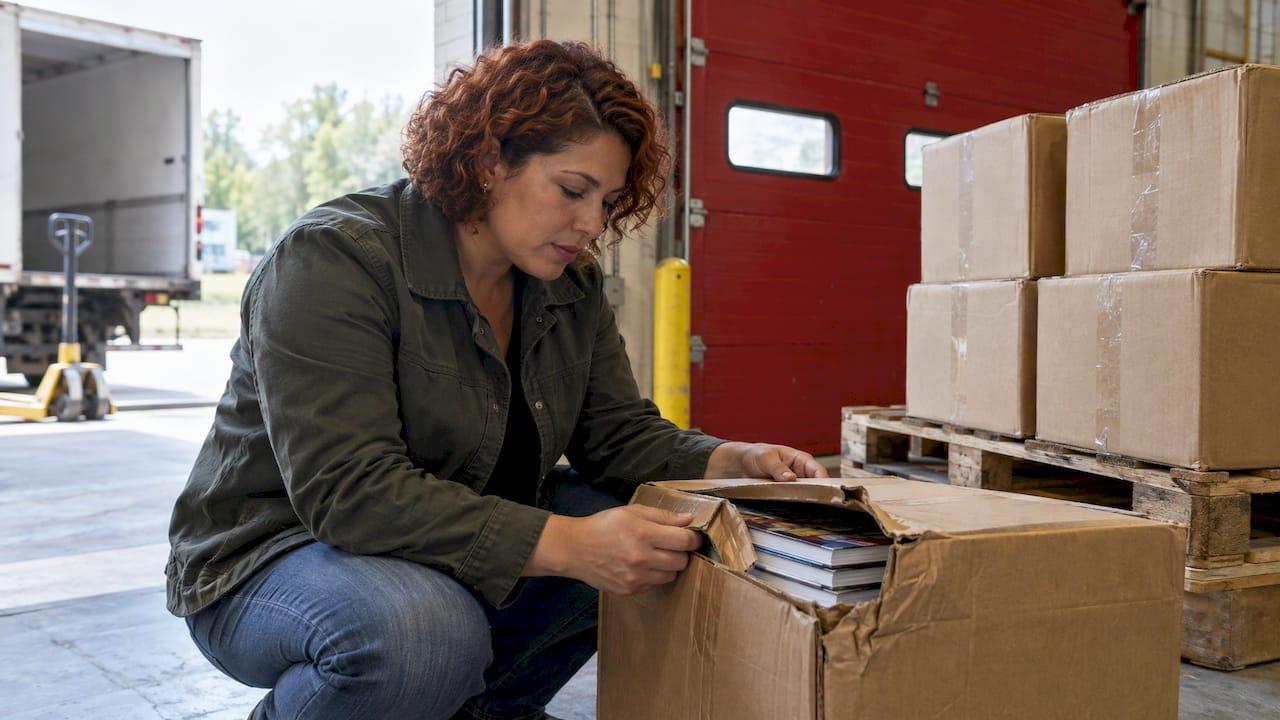
Most yearbook orders arrive without a hitch, but a school that gets a crushed carton in May has no time to fix it. Yearbook shipping insurance is a real option, and it helps to know what it covers, what it costs and how little of it you may need when the printer ships the books to your door under one all-inclusive price. TrailMark gives schools instant pricing online with shipping included, a 2–3 week turnaround and no order deadlines, so the delivery risk is priced and planned from the start instead of bolted on at the end.
This guide is for advisers and administrators who sign off on the order. It explains how carrier coverage works, what separate coverage costs, what a claim requires and what to check before you buy any of it.
TL;DR
- Yearbooks do not typically come with insurance by default. Coverage is an optional add-on, so confirm in writing what your order includes.
- Carrier "insurance" is mostly declared value, a liability cap that pays only if the carrier is at fault. USPS, UPS and FedEx each build in about $100 per package on standard services.
- Claim windows are short. USPS damage claims must be filed within 60 days of mailing, so inspect cartons the day they arrive and keep the packaging.
- The cheapest protection is a clean process: shipping priced into the order, delivery to a staffed door, inspection on arrival and a printer that can reprint on demand.
Table of Contents
- What shipping insurance actually covers
- What carriers include and what extra coverage costs
- Does a school need separate yearbook insurance?
- Questions to settle before you order
- How to inspect and file a claim
- Lower the risk before you buy any coverage
- How TrailMark handles shipping
- Our view on insuring yearbook shipments
- FAQ
- Sources
What shipping insurance actually covers
Shipping insurance pays when a shipment is lost, damaged or stolen on the way. Coverage sold with yearbooks typically covers damage, loss or theft during shipping or after delivery, for example after a vehicle accident or severe weather, subject to deductibles, limits and exclusions. Normal wear and tear, intentional damage and negligence are the usual exclusions.
Two things get confused, and the difference matters to a school.
Carrier liability (declared value). When you ship, the carrier accepts responsibility up to a stated amount. This is a contractual cap, not an insurance policy. It pays only if the carrier is found at fault, and FedEx's own service guide says it does not provide insurance coverage of any kind.
True shipping insurance. A separate policy pays on the declared value without requiring proof that the carrier was at fault. Freight programs, for example, contrast carrier liability of typically $5 to $15 per pound with claims taking up to 120 days against insured claims typically paid within 30 days.

For a school, the practical question is not which is better in the abstract. It is how much of your order value sits in one carton, one pallet or one truck, and who is responsible if something goes wrong between the printer's dock and your front office.
What carriers include and what extra coverage costs
Carrier fees change, so treat the figures below as the published 2026 schedules and confirm them on each carrier's page before you rely on them.
| Carrier | Included coverage | Added coverage (published 2026) |
|---|---|---|
| USPS Priority Mail, Priority Mail Express, Ground Advantage | Up to $100 | From $2.80 for declared value up to $50, rising to $9.05 at $500.01 to $600, then $1.50 per additional $100, up to $5,000 |
| USPS Registered Mail | Declared value | Up to $50,000 maximum |
| UPS | $100 per package | $5.10 for $100.01 to $300, then $1.70 per $100 |
| FedEx Express | $100 per package | $4.95 for $100.01 to $300, then $1.65 per $100 |
Sources: the USPS claims reference guide for included coverage and Registered Mail, and a 2026 carrier comparison for the fee schedules. First-Class Mail and Media Mail include no insurance at all.
FedEx declared value is available up to $50,000 for most services, $2,000 for Ground and $500 for Envelope and Pak shipments, according to the same comparison.
A worked example
Suppose a carton of yearbooks has a replacement value of $300. Under the 2026 schedules above, declaring that value on a FedEx Express shipment costs $4.95, and on UPS $5.10. That is inexpensive per carton, but it multiplies across a large order, and it still pays only if the carrier is found at fault. A 600-book order shipped in 30 cartons would carry 30 of those fees, and each carton would be a separate claim.
One recent change to know
Included coverage is not fixed. UPS cut the included declared value on Ground Saver from $100 to $20 per package, effective April 2, 2025. UPS also accepts Ground Saver claims only for packages it delivered itself: once a scan records the handoff to the Post Office, claims are no longer accepted. If your yearbooks travel on a economy service, ask which service and which coverage applies.
Does a school need separate yearbook insurance?
A dedicated "yearbook insurance" product is uncommon. Schools that want coverage can assemble it from three sources, according to an insurance broker's overview:
- school or nonprofit property insurance
- printers' liability insurance for production errors and omissions
- inland marine insurance for goods in transit or off-site storage
When it is sold as an add-on by a publisher or third-party insurer, the same overview puts the cost at about $1 to $5 per yearbook or a flat rate per order, often lasting 30 to 90 days after delivery. Claims may require photos and sometimes police reports.
District-owned coverage can also apply. Oregon State University's risk-management office, for example, explains that its policy covers university property shipped by scheduled air carriers such as FedEx and UPS and by tracked USPS mail, while untracked USPS shipments carry no coverage and deterioration, wear and tear, and temperature or humidity damage are excluded. A school district's policy will have its own terms, so ask your business office or risk manager whether books in transit are covered and under what conditions.
Check that the coverage is real
If a publisher offers insurance at checkout, verify how it works. In one widely used program's terms, coverage is sold by a licensed agency, underwritten by a named insurer, and applies only if the premium was actually charged and received. A checkbox or a displayed offer alone creates no coverage. Ask for the policy name, the insurer, the per-shipment limit and the claim process in writing.
Questions to settle before you order
Put these in an email to your printer and your business office. The answers go in the file with the purchase order.
- Who owns the books in transit? Does risk pass to the school when the carrier picks up, or when you sign for delivery?
- Is shipping in the price? A quote that lists freight separately makes the final total harder to budget. Our guide to how shipping affects yearbook costs shows where those charges tend to appear.
- Which carrier and service? Included coverage differs by service, as the Ground Saver change shows.
- What is the per-shipment limit and the deductible? Compare the total order value with the limit. A policy capped at $5,000 per shipment, as one common program is, does not stretch to a pallet of books worth more.
- What is excluded? Wear and tear, negligence and damage that existed before shipment are typical.
- What does the printer do if books arrive damaged? A reprint path matters more than a reimbursement check when graduation is two weeks away.
- Who can receive the delivery? A loading dock that is empty on Friday afternoon is a theft and weather risk no policy fixes.
Our risk management checklist for yearbook printing walks through the rest of the production chain, and the delivery options guide covers the receiving end.
How to inspect and file a claim
Claim rules are strict, and the clock starts at mailing, not at the day you open the box.
- Inspect on arrival. Open every carton the day it comes. Note crushed corners, water marks and short counts on the delivery receipt where possible.
- Photograph before you move anything. Take pictures of the outer carton, the labels and the damaged books. Oregon State's risk office advises photographing both the packaging and the damaged goods.
- Keep everything. Retain the container, packing material and contents. The carrier may want to inspect them.
- Watch the deadlines. For USPS, damage or missing-contents claims must be filed within 60 days of mailing. Lost-article claims on Priority Mail, Ground Advantage and insured mail can be filed 15 to 60 days after mailing, and Priority Mail Express lost claims 7 to 60 days after. Other carriers set their own windows, and FedEx's 2026 service guide gives U.S. shippers 90 calendar days from delivery to file in writing.
- Gather proof of value. You will need proof of damage or missing contents, the value of the item and proof of insurance or declared value.
- Tell your printer at the same time. A reprint can start while the claim is processed.
If a large order moves as freight rather than parcels, the rules and timelines differ. A shipper's guide to filing freight claims within nine months lays out the documentation for that route.
For how schools typically get replacements once books are damaged, see our guide to damaged yearbooks and replacements.

Lower the risk before you buy any coverage
Insurance reimburses a loss. It does not return books to the cafeteria in time for distribution day. The steps that matter most happen before and after shipping:
- Pick a printer that inspects before shipment. Public contracts spell this out. Seattle Public Schools' yearbook contract, for instance, requires books to be inspected for blemishes, defects or damage before shipment, with defective books replaced at no cost to the buyer.
- Compare warranty terms in your own request for proposals. One district's bid comparison showed a lifetime warranty with vendor-paid shipping from one vendor and one-year warranties from others, with delivery 6 to 8 weeks after the final deadline, according to that district's RFP file.
- Leave a margin for delays. A 2–3 week turnaround and no order deadlines give you room to receive, inspect and, if needed, reorder before the last week of school.
- Name a receiver. Ship to a staffed office, not an open dock, and tell the front desk what is coming.
- Order close to need. Unneeded copies are their own cost, as we explain in why leftover yearbook copies are costly.
How TrailMark handles shipping
TrailMark gives schools instant, all-inclusive pricing online with no signup, no sales pitch and no hidden fees, with shipping included. That removes the most common surprise in a yearbook budget: freight added after you thought the price was final. If you want to see how fees show up elsewhere, our piece on yearbook hidden fees lists them.
Orders move fast, 2–3 weeks, with no order deadlines. On-demand reprints are part of what we offer, so if a carton arrives wrecked or the count comes up short, a reprint is a request, not a restart of the whole production cycle. Printed proof books are also available: two litho proof copies, shipping included, for $100, so you see the finished product before the full run ships.
Price your order and see the shipping included at trailmarkyearbooks.com.

If you want a printer's detailed price sheet for covers, binding and finishes, the printing page lists every option with its per-book price.
Our view on insuring yearbook shipments
We think about shipping insurance the way a good adviser thinks about a field trip: the best plan is the one where nothing goes wrong, and the second best is the one where everyone knows what happens if it does.
Insurance is one tool. The better one is a transparent order. When the price is all-inclusive and shipping is part of it, the school is not trying to reconstruct who paid for what after a box goes missing. When turnaround is 2 to 3 weeks and there are no order deadlines, a delivery problem is a scheduling problem, not a crisis in the last week of May.
That is why we publish instant pricing with no signup and no sales pitch. Advisers and administrators should be able to see the total, share it with a principal and move on. Our team brings more than 50 years of combined experience to making that process less stressful, and on-demand reprints are part of what we offer when books need replacing.
Whatever you decide about outside coverage, put the answers in writing: who owns the books in transit, what the limits are, and who to call when a carton arrives damaged. Then open every carton the day it lands.
Jace
FAQ
Are yearbooks insured during shipping by default?
Not typically. Yearbooks do not usually come with insurance by default, though some publishers or schools offer it as an add-on. Carriers include a basic amount, such as $100 per package on USPS Priority Mail, but that is a liability cap rather than a separate policy. Ask your printer to state in writing what applies to your order.
How much does yearbook shipping insurance cost?
Add-on coverage from publishers or third-party insurers usually runs $1 to $5 per yearbook or a flat rate per order. Carrier declared value is priced by shipment value: in the 2026 schedules, USPS starts at $2.80 for up to $50 and UPS and FedEx Express charge about $5 for $100.01 to $300. Confirm current fees on each carrier's page.
How long do we have to file a claim for damaged yearbooks?
For USPS, damage and missing-contents claims must be filed within 60 days of mailing. Other carriers use different windows, so check the one that delivered your order. Inspect cartons the day they arrive and keep all packaging.
Can our school's own policy cover books in transit?
Possibly. School or nonprofit property policies and inland marine coverage can apply to goods in transit, and university and district policies often list covered carriers and exclusions. Ask your business office or district risk manager which carriers and shipment types your policy accepts.
Sources
- Yearbook Insurance: Do Schools Protect Memories With Coverage?
- USPS Publication 122, Domestic Claims: Customer Reference Guide
- Shipping High Value Items? Packaging and Insurance Guide
- Filing a claim on UPS Ground Saver
- Shipping | Insurance and Risk Management Services, Oregon State University
- Shipping Insurance Program | PartnerShip
- Terms & Conditions, InsureShip
- Seattle Public Schools yearbook contract
- District yearbook RFP comparison
- File Freight Claims in Nine Months: A U.S. Shipper's Playbook