

Shipping typically adds a few dollars per copy on bulk school deliveries and significantly more per copy for individual ship-to-home orders. That gap is wide enough to swing a $5,000 yearbook budget by several hundred dollars depending on how you structure distribution. A practical rule of thumb: budget 5–10% of your total print cost for bulk shipping, and 15–25% if a significant portion of your order ships directly to families. Carriers like UPS and USPS Media Mail anchor most yearbook shipping programs, and vendors like Trailmarkyearbooks build shipping into their all-inclusive pricing so that line item never surprises you mid-order.
Table of Contents
- How does the role of shipping in school yearbook cost actually get calculated?
- What are your shipping options and when does each one make sense?
- How do Alaska, Hawaii, and U.S. territories change your shipping budget?
- What do typical shipping costs look like at different order sizes?
- How can you reduce and budget for yearbook shipping costs?
- What should you ask a yearbook vendor about shipping before you sign?
- How Trailmarkyearbooks handles shipping and pricing
- Key Takeaways
- The shipping line item advisers underestimate most
- Transparent pricing and fast turnaround from Trailmarkyearbooks
- Useful sources
How does the role of shipping in school yearbook cost actually get calculated?
Vendors don't pull a shipping number from thin air. Every quote reflects a stack of components, and knowing each one helps you read an invoice without guessing.
Weight-based postage. Most carriers price by actual weight. A standard softcover yearbook runs 1–2 lbs; a hardcover with 200+ pages can hit 3–4 lbs. Multiply that by your order quantity and you're talking about a pallet that weighs hundreds of pounds before packaging.
Dimensional weight. UPS and FedEx both apply dimensional (DIM) weight pricing when a box's volume exceeds a threshold. A lightly packed box of yearbooks can trigger DIM pricing that costs more than the actual weight rate. Vendors who pack efficiently save you money here.
Packaging and handling fees. Boxes, packing tape, and labor aren't free. Some vendors itemize these as a flat per-box fee; others roll them into a per-book handling charge. Either way, expect $0.25–$1.00 per book in packaging costs on top of postage.
Per-label fees. Ship-to-home orders require individual address labels, sometimes with barcode scanning for tracking. Vendors may charge $0.50–$2.00 per label. On a 300-book ship-to-home run, that's $150–$600 before a single book leaves the warehouse.
Insurance and declared value. Yearbooks are irreplaceable once the school year ends. Some vendors add insurance on shipments above a certain declared value, which adds a small percentage to the total.
Address correction charges. USPS and UPS both charge for address corrections when a label has an error. These fees can appear on a final invoice weeks after delivery. Always verify addresses before submitting your order.
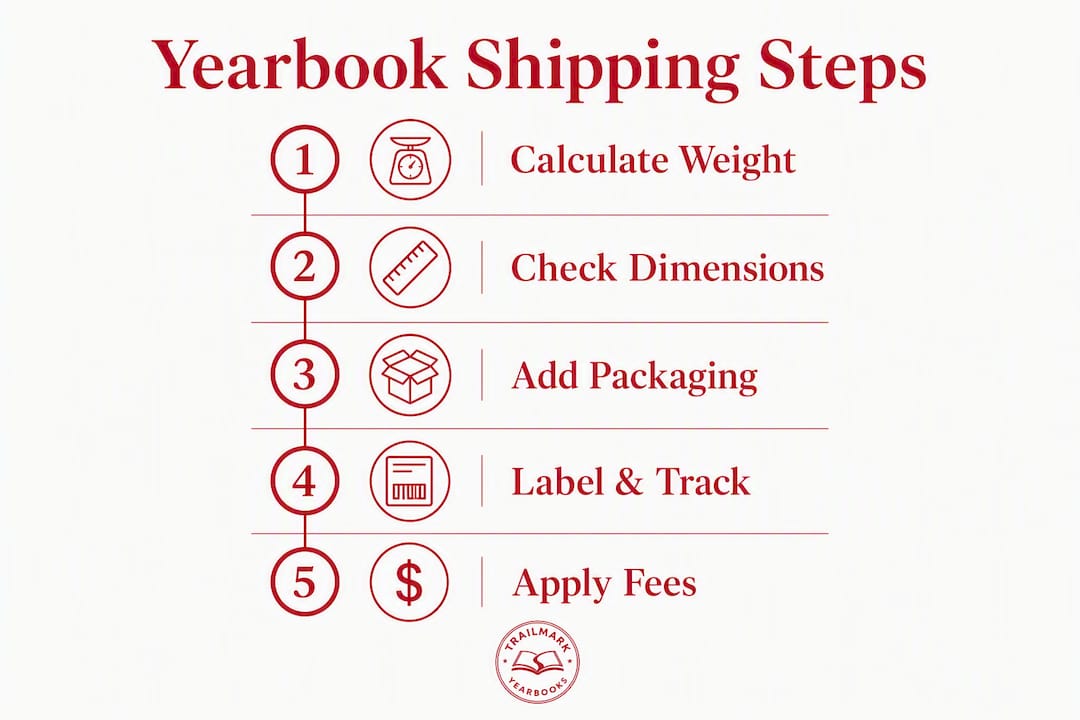
Territory and international surcharges. Shipments to Alaska, Hawaii, Puerto Rico, Guam, and APO/FPO addresses carry additional fees from most carriers. More on those below.
On carrier choice: USPS Media Mail prices by weight rather than distance, making it one of the most cost-effective options for heavy book shipments sent in bulk. UPS Ground uses zone-based pricing, so a school in Ohio shipping to a student in California pays more than one shipping within the same state.
Pro Tip: Ask your vendor how ship-to-home fees are calculated before you enable that option. Most platforms compute it dynamically: package weight × destination zone × carrier rate. A student three zones away can pay double what a local student pays for the same book.
What are your shipping options and when does each one make sense?
Three main models cover nearly every school scenario. The right choice depends on your school's size, how many students live out of the area, and how much administrative work your staff can absorb.
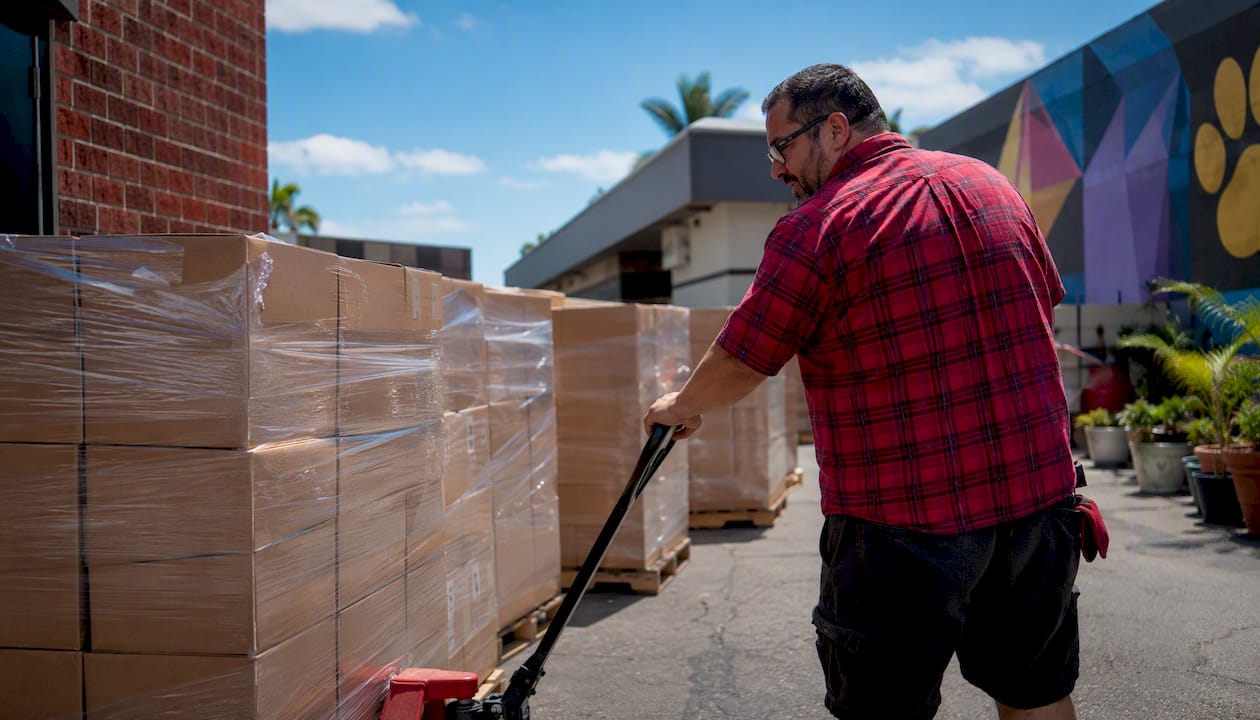
Bulk delivery to school ships the entire order to one address. You receive pallets or boxes, then distribute in-house. It's the lowest per-book shipping cost and the simplest invoice. The trade-off is that your staff handles distribution, and students who miss pickup day need a follow-up plan.
Direct-to-home (ship-to-home) sends each book to the student's address. Families love the convenience, but the per-book cost jumps significantly, and variable fees based on distance can create equity issues if some families pay more than others without warning. Vendor portals typically auto-calculate shipping fees when ship-to-home is enabled; if no shipping fee appears on a portal order, the books are likely defaulted to bulk school delivery.
Hybrid model ships the main run in bulk to school, then handles late orders, reprints, and out-of-area students via individual shipments. This keeps the bulk of your cost low while accommodating edge cases. The yearbook reorder process for reprints almost always uses individual shipping, so budget for it separately.
| Scenario | Best Option | Why |
|---|---|---|
| Small school (under 200 students) | Bulk to school | Low volume, easy in-person distribution |
| Large school | Bulk to school | Economies of scale lower per-book cost |
| Many out-of-state or remote students | Hybrid | Bulk for local students, ship-to-home for outliers |
| Late orders and reprints | Ship-to-home | Reprints rarely justify a second bulk shipment |
| High parent demand for home delivery | Ship-to-home with fee disclosure | Convenience justified if families are informed of variable costs |
How do Alaska, Hawaii, and U.S. territories change your shipping budget?
Special destinations add real cost and real time. If your school has families in any of these locations, flag them before you finalize your shipping method.
- Alaska and Hawaii: Both states are outside the contiguous 48, so UPS and FedEx apply extended delivery area surcharges. Expect to add $5–$20 per shipment depending on carrier and service level. USPS rates to Alaska and Hawaii are generally lower, but transit times run longer.
- Puerto Rico and Guam: USPS Priority Mail is often the most practical option. UPS and FedEx treat these as international-equivalent destinations, which means higher rates and customs-adjacent documentation.
- APO/FPO addresses: Military addresses require USPS exclusively. Transit times vary widely (2–6 weeks is not unusual), and tracking updates can be sparse once a package enters the military mail system.
- U.S. Virgin Islands and other territories: Similar to Puerto Rico. Budget for USPS Priority Mail and add at least 2–3 weeks to your expected delivery window.
The practical move is to collect all student addresses during preorder and flag any non-contiguous or territory addresses before you submit your order. Surprising a military family with a 6-week wait or an unexpected surcharge is avoidable with a single address audit.
What do typical shipping costs look like at different order sizes?
The table below uses representative assumptions: softcover yearbook averaging 1.5 lbs, standard box packing, UPS Ground for ship-to-home, and bulk freight for school delivery. Print costs are illustrative to show the shipping proportion.
| Scenario | Order Size | Est. Print Cost/Book | Est. Shipping Line Item | Per-Book Shipping | Total Per-Book |
|---|---|---|---|---|---|
| Small school, bulk delivery | 150 books | — | — | $1.50 | — |
| Medium school, bulk delivery | — | — | — | $1.00 | — |
| Large school, bulk delivery | — | — | — | $0.70 | — |
| Ship-to-home, mixed destinations | 200 books | — | — | — | — |
School size directly affects per-copy economics: larger print runs spread fixed shipping and handling costs across more books, which is why the per-book shipping drops from $1.50 to $0.70 as order size grows. The ship-to-home scenario shows why that model can nearly double the per-book total.
Common hidden fees that can shift these numbers:
- Per-label charges on ship-to-home orders ($0.50–$2.00 per book)
- Address correction fees when student records have errors
- Reprint handling fees, which are often higher per-book than first-run shipping
- Fuel surcharges that carriers adjust quarterly
One school's reporting noted that printing costs for a full-color book can be under $10 per copy at the production level, while vendor fees and services push the final price much higher. Shipping is one of those contributors, and it's one of the few you can actually control.
How can you reduce and budget for yearbook shipping costs?
- Lock in a preorder cutoff date. Every late order that ships individually costs more than one included in the bulk run. A firm cutoff date keeps the vast majority of books in one shipment.
- Default to bulk school delivery. For most K–12 schools, bulk delivery is the right baseline. It's cheaper, simpler to invoice, and easier to communicate to parents. Reserve ship-to-home for genuine exceptions.
- Use USPS Media Mail for eligible bulk shipments. Media Mail's weight-based pricing can cut postage costs substantially on heavy book orders compared with zone-priced carriers.
- Consolidate reprint orders. Rather than shipping reprints one at a time, batch them and ship weekly or bi-weekly. The per-book cost drops when you're not paying individual parcel rates on every single reorder.
- Negotiate handling fees with your vendor. Per-label and per-box handling fees are sometimes negotiable, especially for larger orders. Ask directly before signing.
- Embed shipping in your per-book price. When you sell yearbooks to students, include an estimated shipping cost in the unit price rather than adding it as a surprise line item at checkout. This is cleaner for families and easier to reconcile in your school budget.
- Request a sample invoice. Before committing to a vendor, ask for a sample invoice that shows every line item, including handling, packaging, and any per-label fees. Including shipping in an all-in price removes that administrative friction entirely.
Pro Tip: When building your school yearbook budget, add a 10% shipping buffer on top of your estimated shipping line item. Carrier fuel surcharges and address corrections are unpredictable, and a small buffer prevents a shortfall from coming out of your activity fund.
The equity trade-off with ship-to-home is real: students farther from school or in different zip codes can pay materially more for the same book when fees are calculated by destination zone. If your school values consistent pricing for all families, bulk delivery with in-school distribution is the more equitable default.
What should you ask a yearbook vendor about shipping before you sign?
Use this checklist in your vendor emails or procurement forms:
- Is shipping included in the quoted price, or invoiced separately? Get this in writing.
- How is ship-to-home shipping calculated? Ask for the formula (weight × zone × rate) and a zone-rate example.
- Are there per-label or per-package handling fees? Ask for the exact dollar amount per label.
- Which carriers do you use, and what service levels? UPS Ground, USPS Priority, USPS Media Mail — each has different cost and transit implications.
- What is the standard turnaround time from order submission to shipment? Confirm whether that includes printing time or only transit time.
- How are reprints shipped, and what is the per-book cost for a reprint order?
- Do you provide tracking numbers and delivery confirmation for every shipment?
- How do you handle shipments to Alaska, Hawaii, Puerto Rico, and APO/FPO addresses? Ask for a sample surcharge amount.
- Can I see a sample invoice with all line items, including shipping, handling, and any convenience fees?
- What happens if a book is lost or damaged in transit? Ask about the replacement and reshipping policy.
The yearbook quantity ordering checklist from Trailmarkyearbooks covers several of these points and is worth reviewing before your next vendor conversation.
How Trailmarkyearbooks handles shipping and pricing
Trailmarkyearbooks builds shipping into its all-inclusive instant pricing, which means advisers see the full cost upfront with no signup required and no sales call needed. There's no separate shipping invoice that arrives after the fact.
Key features advisers rely on:
- Shipping included — in the quoted price, so the number you see is the number you pay
- No hidden fees — on per-label charges, handling, or address corrections buried in a final invoice
"Shipping included" isn't just a convenience feature. When families see one price for a yearbook, they buy it. When they see a base price plus a variable shipping fee that depends on their zip code, some of them don't. Transparent, all-in pricing keeps participation rates up and keeps advisers out of the middle of parent complaints about fee discrepancies.
Advisers who want to verify pricing before committing can request a sample book directly from the site, no account required.
Key Takeaways
Shipping is one of the few yearbook cost variables advisers can actively control, and bulk delivery with all-in pricing is the most reliable way to keep it predictable.
| Point | Details |
|---|---|
| Bulk vs. ship-to-home gap | Bulk delivery runs $0.70 to $1.50 per book as order size grows; ship-to-home can cost several times more. |
| Budget rule of thumb | Add 5–10% of print cost for bulk shipping; 15–25% if significant ship-to-home volume is expected. |
| Hidden fees to verify | Per-label charges, address correction fees, and reprint handling can all appear on a final invoice. |
| Special destinations cost more | Alaska, Hawaii, Puerto Rico, and APO/FPO addresses carry surcharges and longer transit times. |
| Trailmarkyearbooks approach | All-inclusive instant pricing with shipping included removes surprise fees and simplifies school budgets. |
The shipping line item advisers underestimate most
The advisers who get caught off guard by shipping costs aren't the ones who ignored it. They're the ones who got a verbal "shipping is included" from a vendor rep, then received a final invoice with a separate handling fee, a per-label charge, and an address correction surcharge that added up to more than they expected.
The real mistake isn't failing to budget for shipping. It's failing to get the full shipping picture in writing before the order is placed. Vendors sometimes present base shipping as included while burying per-label and handling fees in the terms. A sample invoice request before signing costs you nothing and can save a meaningful amount.
The simplest policy an adviser can adopt: treat shipping as a line item in your budget from day one, not an afterthought. Get the exact formula in writing, confirm it covers every fee, and build a 10% buffer on top. That approach handles most surprises before they happen.
Transparent pricing and fast turnaround from Trailmarkyearbooks
Shipping surprises are one of the most common complaints advisers bring to yearbook conversations. Trailmarkyearbooks was built to eliminate that specific frustration. The all-inclusive instant pricing model means the quote you get online, without signing up or talking to a sales rep, already includes shipping. No separate invoice. No per-label fees. No handling charges that appear after the fact.
With a 2–3 week turnaround and on-demand reprints that come with clear, upfront shipping terms, Trailmarkyearbooks gives advisers the budget certainty they need to plan confidently. The production services page shows the full range of options, and if you want to see the quality before committing, you can request a sample book directly, no account or commitment required.
Useful sources
- Yearbook Shipping Included: Benefits for Schools — covers how all-in shipping pricing simplifies school budgets and reduces adviser workload
- Why School Size Affects Yearbook Pricing: A Budget Guide — explains how order quantity drives per-copy shipping and printing economics
- School Yearbook Quantity Ordering Checklist for Advisers — practical checklist for quantity planning that includes shipping considerations
- USPS Media Mail: The Cheapest Way to Ship Books — explains how Media Mail's weight-based pricing works for bulk book shipments
- The Yearbook Doesn't Need To Be a Hundred Dollars — school-level perspective on how fees and services contribute to final yearbook price
- Types of Yearbook Hidden Fees: What Parents Must Know — breaks down per-label, processing, and other fees that appear on final invoices