

The yearbook principal sign-off is defined as the formal administrative approval process where the principal reviews and authorizes the completed yearbook before it goes to print. This step sits at the end of the production cycle, after final content submission and proofing, and it carries real consequences. Skip it or treat it as a formality, and you risk costly reprints, reputational damage, and a book that does not reflect your school's standards. Every yearbook adviser and administrator needs to understand what this approval involves, how it differs from the principal's message, and how to manage it well.
What is yearbook principal sign-off and what does it involve?
The principal's sign-off is the last mandatory checkpoint before a yearbook enters production. It is an active verification step, not a passive rubber stamp. The principal reviews the entire book to confirm that content is accurate, appropriate, and aligned with school values.
The review covers a wide range of elements:
- Names and captions: Every student name, staff name, and photo caption must be spelled correctly and matched to the right image.
- Senior ads and dedications: These sections are prone to late edits and errors that slip through earlier proofing rounds.
- Layouts and page order: The principal confirms that no pages are missing, duplicated, or out of sequence.
- School-appropriate content: Any photo, quote, or graphic that could be considered offensive or inaccurate gets flagged before printing.
- Index accuracy: Student and staff listings must match the actual content of the book.
The sign-off also carries administrative weight. According to yearbook production guidelines, failing to complete this step can result in reprint fees and reputational damage for the school. That is a significant financial and institutional risk for a single missed approval.
Pro Tip: Build the sign-off review into your production calendar at least two weeks before your print deadline. Principals have full schedules, and a rushed review increases the chance of missed errors.
The adviser's role during sign-off is to prepare, not to decide. You organize the final proof, flag any areas of concern, and give the principal everything needed to review efficiently. The principal's role is to verify and authorize. Keeping those responsibilities separate prevents confusion and speeds up the process.

How is the principal's sign-off different from the principal's yearbook message?
Many advisers conflate the principal's message with the principal's sign-off. They are two entirely different things, and mixing them up creates real problems in the production timeline.
The principal's message is a creative contribution. It is a personalized, written note to students that references school culture, celebrates achievements, and offers inspiration for the future. A strong message includes an opening, acknowledgments of specific accomplishments, and a closing that motivates students. Effective administrator messages become treasured keepsakes. They carry warmth and a professional tone that students return to years later.
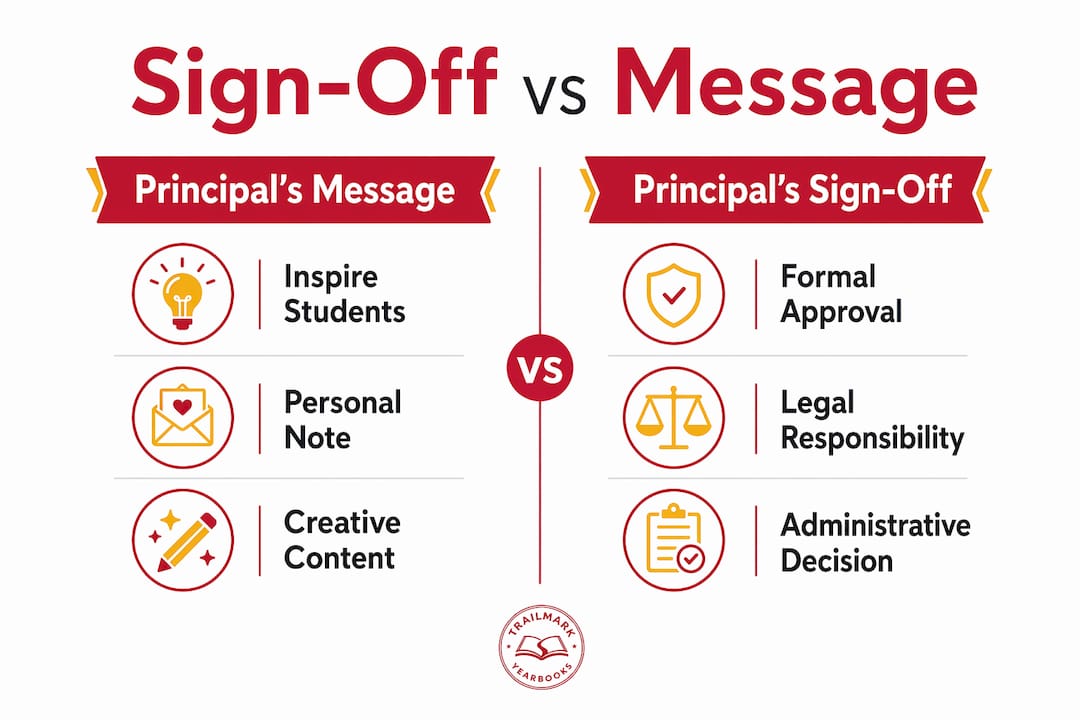
The sign-off is none of that. It is a formal administrative decision with legal and institutional implications.
| Feature | Principal's message | Principal's sign-off |
|---|---|---|
| Purpose | Inspire and celebrate students | Verify and authorize final content |
| Timing | Early to mid production | Final stage before printing |
| Nature | Creative and personal | Administrative and formal |
| Output | Written content for the book | Approval to proceed to print |
| Risk if skipped | Missed opportunity for connection | Reprints, errors, reputation damage |
Treating the message as the sign-off is the most common mistake advisers make. A principal who submits a heartfelt message has not reviewed the index, confirmed photo captions, or approved the layout. Those are separate tasks that require a separate conversation.
Pro Tip: Send the principal's message request and the sign-off request at different times, with different instructions. A single email that asks for both creates confusion about what has actually been approved.
The principal's message should be collected early in the production cycle, ideally in the fall semester. The sign-off happens at the very end. Keeping these two processes on separate tracks protects both the creative quality of the message and the accuracy of the final approval.
Why is the yearbook principal sign-off important for schools?
The sign-off is a protective mechanism that safeguards the school's reputation and upholds institutional standards. It is the last line of defense against errors that would otherwise be permanently bound into hundreds or thousands of copies.
Schools that skip or rush the sign-off process face predictable consequences. A misspelled student name, a mismatched photo, or an inappropriate image discovered after printing cannot be corrected without a costly reprint. Beyond the financial cost, errors in a yearbook damage trust. Students, parents, and staff notice when names are wrong or photos are misidentified. That damage to the school's credibility is harder to repair than any printing bill.
"The principal's sign-off is more than a formality. It is a quality-assurance mechanism that protects the school's reputation and honors the standards the institution stands for. Every name, photo, and page that passes through that review carries the weight of the school's legacy."
The sign-off also serves a legal function. Yearbook sign-off is the last official approval that legally endorses the final product before publishing. That includes verifying that all photos are appropriate, all names are accurate, and all content meets school policy. The principal's signature on that approval is not ceremonial. It is a documented record that the institution reviewed and authorized the publication.
Yearbook dedications add another layer of institutional significance. A dedication to a retiring principal or a long-serving staff member becomes part of the school's permanent record. The sign-off process protects the accuracy and dignity of those tributes. Getting the details right matters for legacy, not just logistics.
Best practices for managing the principal sign-off process
A well-managed sign-off process starts months before the final proof is ready. Advisers who involve the principal early avoid the last-minute scrambles that produce errors and missed deadlines.
-
Schedule a kickoff conversation in the fall. Walk the principal through the yearbook timeline, including when the sign-off will be needed. This sets expectations and prevents the approval from landing as a surprise in the spring.
-
Use a structured proofing checklist. A proofing checklist gives the principal a clear framework for the review. It covers names, photos, captions, layouts, and content appropriateness. Without a checklist, reviews become inconsistent and items get missed.
-
Submit the final proof in a format the principal can actually use. A printed proof or a clearly organized PDF is easier to review than a raw design file. Make the review as simple as possible.
-
Set a firm sign-off deadline with buffer time. Build at least five business days between the sign-off deadline and the print submission deadline. Principals need time to review carefully, and you need time to address any corrections they identify.
-
Document the approval in writing. An email confirmation or a signed approval form creates a record. If questions arise later about what was approved, that documentation protects both the adviser and the principal.
-
Separate creative feedback from approval decisions. If the principal wants to suggest changes during the sign-off review, note them, evaluate them, and respond professionally. Not every suggestion requires a revision. The sign-off is an approval process, not a redesign session.
Adviser and principal collaboration around sign-off works best when both parties treat it as a quality-control step, not a bureaucratic hurdle. Transparency about the process builds trust and makes the review faster.
Pro Tip: Attach a one-page summary to the final proof that lists the total page count, the number of student photos, and any sections that received late edits. This gives the principal context and helps them focus their review where it matters most.
Advisers who follow yearbook policy best practices consistently report smoother approvals and fewer last-minute corrections. The investment in process pays off in a cleaner final product and a less stressful production cycle. For schools planning school events and celebrations alongside yearbook production, coordinating timelines with the principal early keeps everything on track.
Key Takeaways
The yearbook principal sign-off is the formal administrative approval that protects school reputation, prevents costly reprints, and legally endorses the final book before printing.
| Point | Details |
|---|---|
| Sign-off is administrative, not creative | The principal verifies accuracy and appropriateness, separate from writing the yearbook message. |
| Timing matters | Schedule sign-off at least two weeks before the print deadline to allow time for corrections. |
| Checklists reduce errors | A structured proofing checklist ensures names, photos, captions, and layouts are all reviewed. |
| Documentation protects everyone | A written approval record protects both the adviser and the principal if questions arise later. |
| Message and sign-off are separate | Collecting the principal's message early and the sign-off at the end prevents confusion about roles. |
The sign-off is where the yearbook earns its credibility
After working with yearbook teams across many production cycles, the pattern is clear. The schools that treat the principal sign-off as a genuine quality-control step produce better books. The schools that treat it as a box to check produce books with errors that haunt them for years.
The most common mistake I see is advisers handing a principal a final proof with no context and no checklist, then expecting a fast turnaround. That is not a sign-off process. That is a hope. A principal who does not know what to look for will either approve too quickly or get overwhelmed and delay the whole timeline.
The adviser's responsibilities include making the sign-off easy for the principal to complete. That means a clean proof, a clear checklist, and a realistic deadline. When you do that work upfront, the principal can focus on what they do best: verifying that the book reflects the school accurately and with dignity.
The sign-off is also where the yearbook becomes a school legacy document, not just a printed product. Every name the principal confirms, every photo they approve, and every page they authorize becomes part of a permanent record. That is worth doing carefully. The colophon records the technical details of production, but the sign-off versus colophon distinction matters: the sign-off is the active, protective step that makes the colophon's record trustworthy.
Treat the principal as a partner in this process, not an obstacle. Their involvement protects the book, the school, and the students whose memories live in those pages.
— Jace
How Trailmarkyearbooks supports a smooth approval process
Trailmarkyearbooks works with advisers and administrators at every stage of yearbook production, including the final approval phase. When your principal reviews the proof, the quality of that proof matters. A clear, professionally printed sample gives administrators the confidence to approve quickly and accurately.

Trailmarkyearbooks offers yearbook samples on request so your principal can review actual print quality before the final sign-off. With fast 2–3 week turnaround times, transparent pricing, and free design assistance, Trailmarkyearbooks makes the entire production process less stressful for advisers. Explore the full range of yearbook production services and see how schools nationwide get from first draft to final approval without the headaches.
FAQ
What is the yearbook principal sign-off?
The yearbook principal sign-off is the formal administrative approval where the principal reviews and authorizes the completed yearbook before printing. It is the final checkpoint that verifies names, photos, captions, and content meet school standards.
How is the sign-off different from the principal's yearbook message?
The principal's message is a creative, written note to students collected early in production. The sign-off is a separate administrative approval completed at the end of the production cycle, after all content is finalized.
What happens if the principal sign-off is skipped?
Skipping the sign-off risks costly reprints, misspelled names, mismatched photos, and content that does not meet school standards. It also removes the legal endorsement that protects the school before the book is published.
When should the principal sign-off happen in the production timeline?
The sign-off should be scheduled at least two weeks before the print submission deadline. This gives the principal adequate review time and leaves room for corrections before the final file is submitted.
How can advisers make the sign-off process faster?
Advisers can speed up the process by submitting a clean final proof with a structured checklist, setting a firm deadline, and briefing the principal on what to review. Early communication about the timeline prevents last-minute delays.