

Here are senior awards ideas you can copy directly into your yearbook spread or awards-night program right now. The most effective approach combines a short, diverse shortlist with three non-negotiable process rules: every category must be inclusive, students must have a voice in nominations, and every nomination gets a quick vetting pass before it goes to print.
Six copy-ready award lines to get you started:
- Most Likely to Change the World
- The Quiet Achiever Award
- Best Comeback Story
- Most Likely to Have a TED Talk by 30
- Community Builder of the Year
- The "Still Showed Up" Perseverance Award
Two quick presentation tips:
- Yearbook: Pair each award with a candid photo and a two-sentence citation. Keep captions under 30 words.
- Awards night: Limit spoken remarks to 15–30 seconds per recipient. Read the citation, say the name, pause for applause.
Longer category lists, selection checklists, and a copy-ready nomination timeline follow below.
Key Takeaways
A mix of classic, creative, and character-first categories, combined with a structured nomination and vetting process, produces senior recognition that feels earned, inclusive, and worth printing.
| Point | Details |
|---|---|
| Start with a shortlist | Use a suitable number of categories matched to class size; smaller classes require fewer categories. |
| Build in a vetting step | Require a one-sentence nomination justification to reduce frivolous votes and speed up caption writing. |
| Replace appearance-based awards | Swap "Best Hair" and similar categories for personality or character-first alternatives that age better in print. |
| Match citation length to format | Yearbook captions: 20–30 words. Ceremony scripts: 15–30 seconds spoken. |
| Trailmarkyearbooks supports tight timelines | A 2–3 week turnaround and free design assistance let advisers finalize award pages close to graduation. |
Table of Contents
- 25 ready-to-use senior awards and superlatives you can copy right now
- Classic superlatives that work every year
- Funny and lighthearted superlatives that stay school-appropriate
- Academic and departmental awards that teachers can use immediately
- Leadership, service, and character awards
- Arts and creative awards for visual, performing, and writing students
- Athletics and team awards
- Clubs, activities, and niche awards
- Tech, STEM, and innovation superlatives for modern graduates
- Unique and modern superlatives that reflect students' real lives
- Inclusive and character-first awards that replace appearance-based categories
- How to choose the right awards for your school
- Nomination, voting, and timeline template advisers can copy
- Writing award citations and presentation tips
- Adviser-tested tips that save time and reduce pushback
- Choosing the right tone, inclusivity, and focus for your school's awards
- Unique and creative awards paired with senior quote ideas
- Tips for keeping award selections inclusive and bias-free
- How to involve students and staff in nominations to boost engagement
- Customizing awards to reflect your school's specific culture and values
- Recognizing diverse achievements beyond academics and athletics
- What most advisers get wrong about senior recognition
- Trailmarkyearbooks makes award pages easier to produce
- Sources
25 ready-to-use senior awards and superlatives you can copy right now
Modern superlative guides recommend mixing classic, creative, and achievement-focused categories so every student sees themselves somewhere in the list. Here is a shortlist organized for fast selection.
Classic
- Most Likely to Succeed
- Best All-Around
- Class Clown
- Most School Spirit
- Best Dressed
- Most Athletic
- Teacher's Pet (use only if your school culture supports it warmly)
Creative and personality-driven
- Most Likely to Have a TED Talk by 30
- Best Playlist Curator
- Most Likely to Go Viral for Something Good
- Master of Memes
- Most Likely to Write a Bestseller
- The Human GPS (never gets lost)
- Most Likely to Open a Restaurant
Achievement and future-focused
- Most Likely to Change the World
- Best Comeback Story
- Community Builder of the Year
- Most Likely to Patent an Idea
- Future CEO
- Most Dedicated (fill in club or subject)
- The "Still Showed Up" Perseverance Award
- Best Capstone Project
- Most Likely to Win a Grammy
- Unsung Hero
- Most Improved
Classic superlatives that work every year
Large curated superlative lists show that classic categories remain the backbone of any senior recognition spread because they are immediately understood by students, parents, and alumni alike.
- Most Likely to Succeed — Caption template: "[Name] set the bar in [subject/activity] and never looked back." / "[Name]: the one who made the rest of us want to try harder."
- Best All-Around — Caption template: "From [activity] to [activity], [Name] did it all." / "[Name] showed up everywhere and made it look easy."
- Class Clown — Caption template: "[Name] turned every Monday into a Friday." / "If laughter is medicine, [Name] kept us all healthy."
- Most School Spirit — Caption template: "[Name] bled [school color] from day one." / "No one cheered louder or meant it more."
- Best Dressed — Caption template: "[Name] treated every hallway like a runway." / "Style? [Name] had it before it was trending."
- Most Athletic — Caption template: "[Name] left everything on the field, every time." / "Four years, zero excuses."
- Most Artistic — Caption template: "[Name]'s work stopped people in the hallway." / "Every piece [Name] made told a story worth reading."
- Most Likely to Be Famous — Caption template: "Remember [Name]'s name — you'll be saying it again." / "We're already practicing our autograph requests."
- Most Likely to Succeed in Business — Caption template: "[Name] was negotiating better lunch deals by sophomore year." / "The boardroom won't know what hit it."
- Best Smile — Caption template: "[Name]'s smile made the whole room shift." / "Genuinely contagious, every single day."
Pro Tip: Avoid giving the same student two classic superlatives. It concentrates recognition on a small group and leaves others feeling invisible. Build a one-award-per-student rule into your nomination form from the start.
Funny and lighthearted superlatives that stay school-appropriate
Humor works in senior recognition when it punches up (celebrating quirks) rather than punching down (mocking appearance or struggle). Every funny superlative below has a tone note so you can judge fit for your school.
- Most Likely to Survive Senioritis — Tone: Universally relatable; safe for any school.
- Master of Memes — Tone: Works well at schools with an active student social culture; skip if digital humor isn't part of your school's identity.
- Most Likely to Forget Their Homework but Ace the Test — Tone: Warm and self-deprecating; students love it.
- Professional Napper — Tone: Light and harmless; avoid if the student has struggled academically in a visible way.
- Most Likely to Be Late to Their Own Graduation — Tone: Classic; works best when the student is a good sport about it.
- Best at Pretending to Pay Attention — Tone: Fun but use only with a student who will genuinely laugh.
- Most Likely to Turn a Group Project into a Solo Act — Tone: Funny only if the student is known for leadership, not for being difficult.
- Most Likely to Become a Motivational Speaker — Tone: Positive spin on talkativeness; broadly safe.
- Human Alarm Clock — Tone: Works for the student who is always early and enthusiastic.
- Most Likely to Have a Wikipedia Page — Tone: Aspirational and funny; broadly safe.
Avoid entirely: Any category referencing body size, skin, hair, weight, physical ability, or economic status. "Best Hair" and "Best Eyes" seem harmless but can sting students who feel self-conscious about those features.
Pro Tip: Before finalizing any funny superlative, read it aloud to a colleague and ask: "Would this student's parent smile or wince?" If there's any doubt, swap it.
Academic and departmental awards that teachers can use immediately
Formal academic recognition benefits from official-sounding names. Real 2026 award ceremonies used titles like "Award for Excellence in Mathematics" and named honors such as the "Boynton Harwood Willis Award for Pursuit of Mastery" — language that gives yearbook captions an authoritative tone.
Subject award titles (copy-ready):
- Award for Excellence in Mathematics
- Outstanding Achievement in Science
- Excellence in English Language Arts
- Distinguished Performance in World Languages
- Award for Excellence in History and Social Studies
- Outstanding Lab Research Award
- Top Creative Writing Project
- Excellence in Computer Science
- Distinguished Achievement in Music Theory
- Award for Excellence in Visual Arts
Criteria checklist for nomination forms:
| Criterion | Notes for advisers |
|---|---|
| GPA threshold | Set a minimum GPA in the subject or leave open for teacher discretion |
| Teacher nomination required | One nominating teacher per award keeps accountability clear |
| Project or portfolio evidence | Optional but strengthens the selection for arts and STEM awards |
| Demonstrated improvement | Useful for "Most Improved" or "Perseverance" categories |
Yearbook labeling tip: List departmental awards under a subhead like "Departmental Honors — [Department Name]" so each faculty team retains clear ownership in the printed spread.
Leadership, service, and character awards
These categories carry the most weight at ceremonies and the most scrutiny from parents, so the selection method matters as much as the award name.
Award names:
- Student Leadership Award
- Community Impact Award
- Outstanding Service to School
- The Mentor Award (for students who supported peers)
- Future Leader of Tomorrow
- Civic Engagement Award
- Kindness in Action Award
- The Bridge Builder Award
- Most Dedicated Volunteer
- Character and Integrity Award
Selection methods, ranked by fairness:
- Combined faculty-student panel — A panel of two teachers and two elected student representatives scores nominees against a shared rubric. Reduces single-teacher bias and gives students ownership.
- Rubric-scored faculty nomination — Each nominating teacher completes a structured form (impact, consistency, peer feedback). Scores are averaged across nominators.
- Faculty nomination only — Faster but more vulnerable to familiarity bias. Works best for smaller schools where teachers know every student well.
Documenting impact for yearbook captions: Ask nominees to submit a two-sentence impact statement during the nomination process. That language often becomes the caption verbatim, saving layout time and giving the student a voice in how they are remembered.
Arts and creative awards for visual, performing, and writing students
Arts recognition is most meaningful when it showcases the actual work, not just the student's name.
Award titles:
- Distinguished Studio Artist
- Excellence in Theatre
- Best Original Composition
- Outstanding Performance in Dance
- Excellence in Film and Media Production
- Best Original Screenplay
- Distinguished Achievement in Photography
- Excellence in Graphic Design
- Outstanding Literary Achievement
- Best Spoken Word Performance
Showcase tips:
- Yearbook layout: Use a half-page spread for arts awards. Pair the citation with a photo of the student's actual work (a painting, a production still, a manuscript excerpt) rather than a standard headshot.
- Ceremony presentation: For performing arts, play a 15-second clip or show a single image on screen before announcing the recipient. It gives the audience context and makes the moment more memorable.
Pro Tip: Before reproducing any student artwork, photograph, or written excerpt in the yearbook, get written consent from the student (and parent if the student is under 18). A one-sentence release on the nomination form covers this cleanly.
Athletics and team awards
The most common mistake in athletic recognition is over-indexing on varsity stars and leaving JV and intramural contributors invisible.
Standard awards:
- Team MVP
- Most Improved Athlete
- Unsung Hero Award
- Best Team Player
- Most Dedicated (by sport)
- Coaches' Award
Specialty awards for multi-sport contributors:
- The Iron Athlete Award (three or more sports)
- Best Sportsmanship across Seasons
- Most Versatile Competitor
- Student-Athlete Leadership Award
Ceremony tip: Use action photos, not posed headshots, for athletic award slides. List one season highlight beneath each recipient's name (e.g., "Led the team in assists, Fall 2025"). Keep individual speeches to 20 seconds; let the highlight reel do the talking.
Pro Tip: Create at least one award specifically for intramural or club sport participants. It signals that athletic recognition is about effort and character, not just varsity letters.
Clubs, activities, and niche awards
Club awards keep recognition inclusive for students who never played a varsity sport or won a departmental honor. The key is balance.
Examples by club type:
- Best Debate Strategist (Debate Team)
- Most Dedicated Robotics Member (Robotics Club)
- Community Service Champion (Service Club)
- Most Creative Set Designer (Drama/Theatre)
- Best Investigative Reporter (School Newspaper)
- Most Dedicated Band Member (Marching Band)
- Outstanding Model UN Delegate (Model UN)
- Most Committed Environmental Advocate (Eco Club)
Balance guideline:
- Cap each club at one or two awards in the yearbook spread to prevent any single organization from dominating the page.
- Rotate which clubs receive featured spreads year to year so every group gets a moment over the course of four years.
- For clubs that don't make the printed spread, offer digital certificates or a brief mention in the ceremony program.
Quick keepsake ideas: Digital badges (designed in Canva and emailed to recipients), printed certificates on card stock, and a dedicated club-awards slide in the ceremony presentation all complement yearbook entries without requiring extra print pages.
Tech, STEM, and innovation superlatives for modern graduates
STEM recognition has evolved well past "Best Science Student." Project-based achievements and digital contributions deserve their own category language.
Award titles:
- Innovation Award
- Best Capstone Project
- Most Likely to Patent an Idea
- Outstanding Contribution to Open Source
- Best Data Visualization
- Excellence in Engineering Design
- Most Likely to Found a Startup
- Best App or Software Prototype
- Excellence in Environmental Research
- Most Likely to Work at NASA
QR code tip: Embed a QR code on the yearbook award page that links to a student's project portfolio, demo video, or GitHub repository. It turns a static printed page into an interactive showcase and costs nothing extra to produce.
Judging criteria for project-based awards:
- Originality of concept
- Technical challenge relative to grade level
- Real-world applicability or impact
- Quality of documentation and presentation
Pro Tip: Involve a STEM teacher as a co-judge for project awards. Their subject-matter credibility makes the selection harder to dispute and gives the award more weight with students and parents.
Unique and modern superlatives that reflect students' real lives
Contemporary superlatives resonate because they reflect how students actually spend their time. Guides focused on modern categories recommend expanding beyond traditional labels to capture personality and digital culture.
Modern superlative titles:
- Most Likely to Go Viral for Something Good
- Best Playlist Curator
- Social Media Hype Person
- Most Likely to Have a Podcast by 25
- Best Group Chat Moderator
- Most Likely to Be a Travel Influencer
- Best at Turning Hobbies into Side Hustles
- Most Likely to Trend on LinkedIn
Privacy warning: Never base a superlative on a student's actual follower count, likes, or social metrics. It creates a visible hierarchy based on popularity data and can feel humiliating for students with smaller audiences.
Substitute social-metric categories with merit-based equivalents:
- Instead of "Most Followers," use "Most Likely to Build a Community"
- Instead of "Best Instagram," use "Best Eye for a Photo"
- Instead of "Most Viral Post," use "Most Likely to Go Viral for Something Good"
Pro Tip: Run modern superlatives past your school's social media or acceptable-use policy before publishing. Some districts have guidelines about referencing specific platforms by name in official school publications.
Inclusive and character-first awards that replace appearance-based categories
Appearance-based superlatives ("Best Hair," "Best Eyes," "Hottest") carry real risk: they can embarrass students, invite parental complaints, and in some cases conflict with school anti-bullying policies. Yearbook best-practice guides recommend replacing them with character-first alternatives.
Ten inclusive award ideas:
- Most Supportive Friend
- Community Builder Award
- Perseverance Award
- The Empathy Award
- Most Likely to Brighten Your Day
- Best Listener
- Most Likely to Make a Difference Quietly
- The "Always in Your Corner" Award
- Most Genuine
- Growth Mindset Award
Phrasing alternatives for appearance-based categories:
- "Best Dressed" → "Most Original Style" (focuses on creativity, not physical appearance)
- "Best Hair" → remove entirely or replace with "Most Likely to Set a Trend"
- "Best Smile" → "Most Contagious Enthusiasm" (shifts focus to personality)
Consent note: When publishing any personal content — photos, quotes, award citations — get written consent from the student. For students under 18, parental consent is standard practice. A single consent checkbox on the nomination form handles this efficiently.
Pro Tip: Before finalizing your category list, run it through a simple test: could any of these awards be read as a comment on a student's body, economic status, or social standing? If yes, cut it.
How to choose the right awards for your school
A practical senior awards-night planning guide frames the core question well: the best award program reflects your school's actual values, not a generic template copied from another school.
Decision checklist for advisers:
- What is the class size? Fewer than 200 students supports 15–20 categories; 200–400 students can sustain 20–30; above 400, consider departmental sub-lists to avoid repetition.
- How many yearbook pages are allocated to awards? A single two-page spread fits roughly 8–12 awards with photos; a four-page spread can accommodate 20–25.
- Does your school have an existing awards policy or administrative approval process? Check before finalizing categories.
- What is the school's cultural tone — formal, casual, or mixed? Match award language to that tone.
- Are there any categories that have caused complaints in previous years? Remove them before they become a pattern.
- Will awards appear in both the yearbook and the ceremony, or only one? Ceremony-only awards can be more experimental; print awards need to age well.
Layout and category count by class size:
| Class size | Recommended categories | Yearbook pages needed |
|---|---|---|
| Under 200 students | a moderate number of categories | 2 pages |
| 200–400 students | a larger selection of categories | 2–4 pages |
| Over 400 students | a broad set of categories with departmental sub-lists | 4–6 pages |
Nomination, voting, and timeline template advisers can copy
University award programs use faculty nomination panels with structured responsibilities — a model that translates directly to high school ceremonies. Requiring a short nomination justification (one or two sentences) dramatically reduces frivolous votes and makes vetting faster.
Process steps:
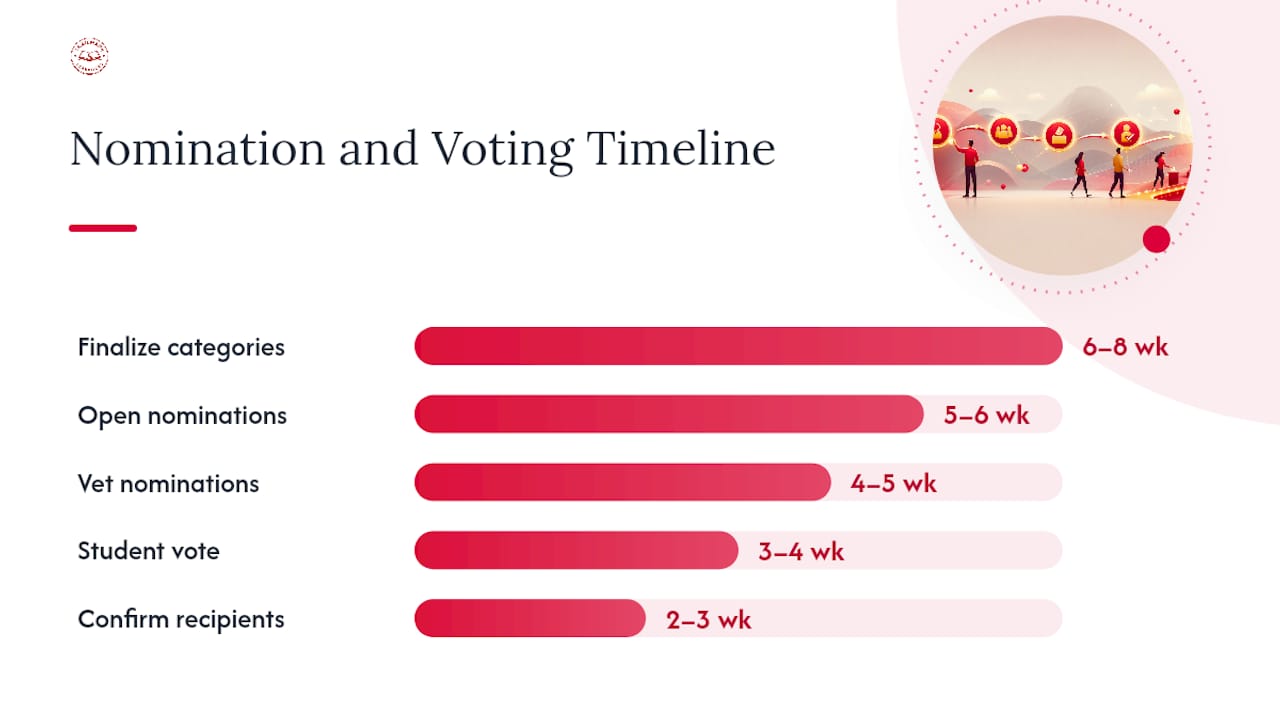
- Set categories (6–8 weeks before graduation): Finalize the award list with administrative approval.
- Open nominations (5–6 weeks out): Distribute nomination forms (paper or Google Form) to students and faculty. Require a one-sentence justification per nomination.
- Vetting pass (4–5 weeks out): Adviser and one faculty co-reviewer screen nominations for mean-spirited content, privacy issues, or policy conflicts.
- Student vote (3–4 weeks out): Run voting through a closed, school-email-authenticated platform (Google Forms works). Limit one vote per student per category.
- Finalize recipients (2–3 weeks out): Confirm winners, collect photos, and draft citations.
- Yearbook layout deadline (2 weeks out): Submit award pages to your production partner.
- Ceremony rehearsal (1 week out): Confirm pronunciation of every recipient's name. Print the ceremony script.
Timeline table:
| Weeks before graduation | Task | Responsible party |
|---|---|---|
| 6–8 weeks | Finalize categories and get approval | Adviser and administration |
| 5–6 weeks | Open nominations | Adviser and yearbook staff |
| 4–5 weeks | Vet nominations | Adviser and faculty co-reviewer |
| 3–4 weeks | Run student vote | Adviser |
| 2–3 weeks | Confirm recipients and collect photos | Yearbook staff |
| 2 weeks | Submit award pages to printer | Adviser |
| 1 week | Rehearse ceremony script | Ceremony coordinator |
Pro Tip: Build a "no self-nomination" rule into your form. It keeps the process peer-driven and reduces awkward situations where a student campaigns for their own award.
Writing award citations and presentation tips
Citation length should match the format. A ceremony script needs a spoken sentence; a yearbook caption needs a printed line that reads well at small type sizes.
Citation templates by length:
- One-line (yearbook caption): "[Name]: the student who [defining quality or achievement]."
- Two-line (ceremony script or yearbook pull quote): "[Name] spent four years [doing X]. We'll remember them for [specific quality or moment]."
- Two-sentence (formal program): "[Name] demonstrated [quality] throughout their time at [School Name]. Their [specific achievement or contribution] set a standard the class of [year] won't forget."
Ceremony timing: Aim for 15–30 seconds per spoken citation. Read the citation, pause, say the name, pause again for applause. Anything longer slows the ceremony and loses the audience.
Yearbook format example:
| Element | Guidance |
|---|---|
| Photo | Candid or action shot preferred over posed headshot |
| Award title | Bold, above the photo or caption |
| Citation line | One or two sentences, 20–30 words maximum |
| Student quote | Optional; one sentence in the student's own words |
Real-world award recipient pages, like 2026 ceremony examples, show how formal naming conventions ("Award for Excellence in Mathematics") pair naturally with brief, dignified citation language.
Adviser-tested tips that save time and reduce pushback
The biggest time sinks in the awards process are vague nominations, last-minute photo chases, and categories that generate parental complaints after the fact. Each one is preventable.
Time-saving checklist:
- Use a single Google Form for all nominations with required justification fields (eliminates vague "just because" votes).
- Build a shared photo folder (Google Drive or Dropbox) where students upload their own award-eligible photos early in the process.
- Create a master citation template in Google Docs that staff can fill in rather than write from scratch.
- Set a hard internal deadline two days before the printer's deadline to absorb last-minute changes.
Common pitfalls and fixes:
- Bias toward visible students: Add a "nominate someone you haven't seen recognized before" prompt to the form.
- Parental complaints about category tone: Share the finalized category list with administration for sign-off before voting opens.
- Space overruns in the yearbook: Decide the page count before finalizing category count, not after.
Involving students without losing editorial control:
- Let students nominate and vote, but keep final vetting authority with the adviser and a faculty co-reviewer.
- Publish the finalized category list to students before voting opens so there are no surprises.
- Invite yearbook staff to write first drafts of citations, then review and approve each one.
Yearbook layout and theme guides note that award pages with consistent visual themes and clear typography read better and generate fewer layout revision requests.
Choosing the right tone, inclusivity, and focus for your school's awards
Tone is the single most consequential decision in the awards process. A category that lands as funny at one school lands as cruel at another, and the difference is almost always school culture.
Start by auditing last year's categories. Flag anything that references appearance, economic status, or social popularity. Then ask: does this award celebrate what a student did or what a student looks like? The former ages well in a yearbook; the latter rarely does.
Inclusivity means more than removing offensive categories. It means actively building a list where students from every social group, academic track, and extracurricular background can see themselves recognized. A list that only rewards varsity athletes and honor-roll students will feel exclusionary to the majority of the class.
Appearance-based awards deserve a specific note. "Best Hair" and "Best Eyes" seem harmless, but they invite comparisons students didn't ask for and can reinforce insecurities. Replace them with personality or style-based alternatives that celebrate choice rather than genetics.
Unique and creative awards paired with senior quote ideas
The most memorable senior recognition combines an award title with a student quote that feels personal rather than generic. A few examples:
- The Quiet Achiever Award paired with: "I didn't need the spotlight. I just needed the work."
- Most Likely to Change the World paired with: "Start small. Stay consistent. The rest follows."
- Community Builder of the Year paired with: "Every person I helped made me better at it."
- Best Comeback Story paired with: "Sophomore year was rough. Senior year was mine."
- Most Original Style paired with: "I dressed for the person I was becoming, not the one people expected."
The quote doesn't need to be profound. It needs to sound like the student. Encourage nominees to submit their own quote during the nomination process rather than assigning one after the fact. Students who write their own quotes are far more likely to feel proud of their yearbook page.
Tips for keeping award selections inclusive and bias-free
Bias in senior recognition tends to be structural rather than intentional. The students who get nominated most often are the ones teachers see most often, which means quieter students, those in smaller programs, and those who contribute in less visible ways get overlooked.
Three practical fixes:
Diversify your nominators. Don't rely solely on homeroom teachers. Ask coaches, club advisers, counselors, and support staff to submit nominations. Each group sees a different slice of the student body.
Use a structured rubric. Open-ended nominations favor articulate advocates. A rubric with specific criteria (consistency, impact, peer feedback) levels the field and makes the selection defensible if a parent questions the outcome.
Track representation. After finalizing recipients, check the list against your school's demographic breakdown. If one group is significantly over- or under-represented, revisit the nomination pool before announcing winners.
How to involve students and staff in nominations to boost engagement
Student buy-in is what separates a forgettable awards ceremony from one people talk about at the reunion. The more students feel ownership over the process, the more they care about the outcome.
Give students a role in category design, not just voting. Run a short survey (five questions, Google Form, two weeks before nominations open) asking seniors what qualities they most want recognized in their class. Use those responses to shape or refine your category list. Students who helped design the categories will promote the voting process to their peers.
For staff, create a simple one-page nomination guide that explains each category and the criteria. Teachers who understand what they're nominating for write better justifications, which makes vetting faster and citations easier to write. A brief five-minute mention at a staff meeting is usually enough.
Recruiting students into the yearbook process follows the same logic: ownership drives effort. Students who contribute to the awards section care more about the final product.
Customizing awards to reflect your school's specific culture and values
Generic award lists are a starting point, not a finish line. The most resonant senior recognition programs borrow from the school's own language, traditions, and identity.
If your school has a motto, work it into an award title. A school with a "Lead with Courage" motto might offer a "Courage in Action Award" that no other school in the district uses. That specificity makes the award feel earned rather than mass-produced.
Pull from your school's history. Named awards honoring former teachers, alumni, or community figures carry weight that generic titles don't. They also connect the graduating class to the school's longer story, which is exactly what a yearbook is supposed to do.
Yearbooks that reflect school culture generate stronger alumni engagement and higher student satisfaction with the final product. The awards section is one of the highest-read pages in any yearbook — it deserves that level of intentionality.
Recognizing diverse achievements beyond academics and athletics
The students most likely to be overlooked in traditional recognition programs are those whose contributions are relational, creative, or community-focused rather than measurable by GPA or box scores.
Personal growth is one of the hardest things to recognize formally, but it's often what students and parents remember most. A "Best Comeback Story" or "Perseverance Award" acknowledges that the path to graduation wasn't straight for everyone, and that showing up anyway is worth celebrating.
Community impact awards fill a gap that academic and athletic categories leave wide open. A student who organized a food drive, mentored younger students, or translated for non-English-speaking families made a real contribution to the school community. That deserves a citation as much as a perfect GPA.
Consider adding one award each year that recognizes a contribution your school has never formally acknowledged before. It signals that the recognition program is alive and responsive, not just a recycled list from 2010.
What most advisers get wrong about senior recognition
The conventional wisdom says more categories means more students feel recognized. The opposite is usually true. When every student gets an award, no award means anything. The goal is a list short enough that each recognition feels earned, diverse enough that it reaches across the whole class, and specific enough that the recipient knows it was chosen for them.
The other underrated move: write citations before the ceremony, not during. Advisers who draft citations in advance — using the nomination justifications students submitted — produce better language, make fewer errors on names and pronouns, and finish the ceremony on time. The students who receive those citations feel the difference between a sentence someone thought about and one someone improvised at the podium.
Trailmarkyearbooks makes award pages easier to produce
Pulling together 20-plus award categories, candid photos, and citation copy under a graduation deadline is a lot to manage. Trailmarkyearbooks is built for exactly that pressure: a 2–3 week turnaround means you can finalize recipients late in the spring and still get a polished yearbook in students' hands before the last day of school.

Free design assistance is included, so if your award spread needs a layout overhaul or you want to add a QR code linking to student project portfolios, the support team handles it without an extra charge. You can design in Canva, Adobe InDesign, or Trailmarkyearbooks's own online creator, whichever fits your workflow. No hidden fees, no order deadlines, and shipping is included in the price.
Request a sample yearbook to see how award pages reproduce in print before you commit to a full order. Or browse high school yearbook production options to get instant all-inclusive pricing with no signup required.
Sources
- Senior Recognition Award Recipients 2026
- Senior Superlatives | 50+ Creative Award Categories to Celebrate Your Graduating Class
- 100 Clever Yearbook Superlatives for 2026 | Shutterfly
- Senior Awards Night Planning Guide | How to Honor Your Graduating ...
- Senior Recognition Awards