
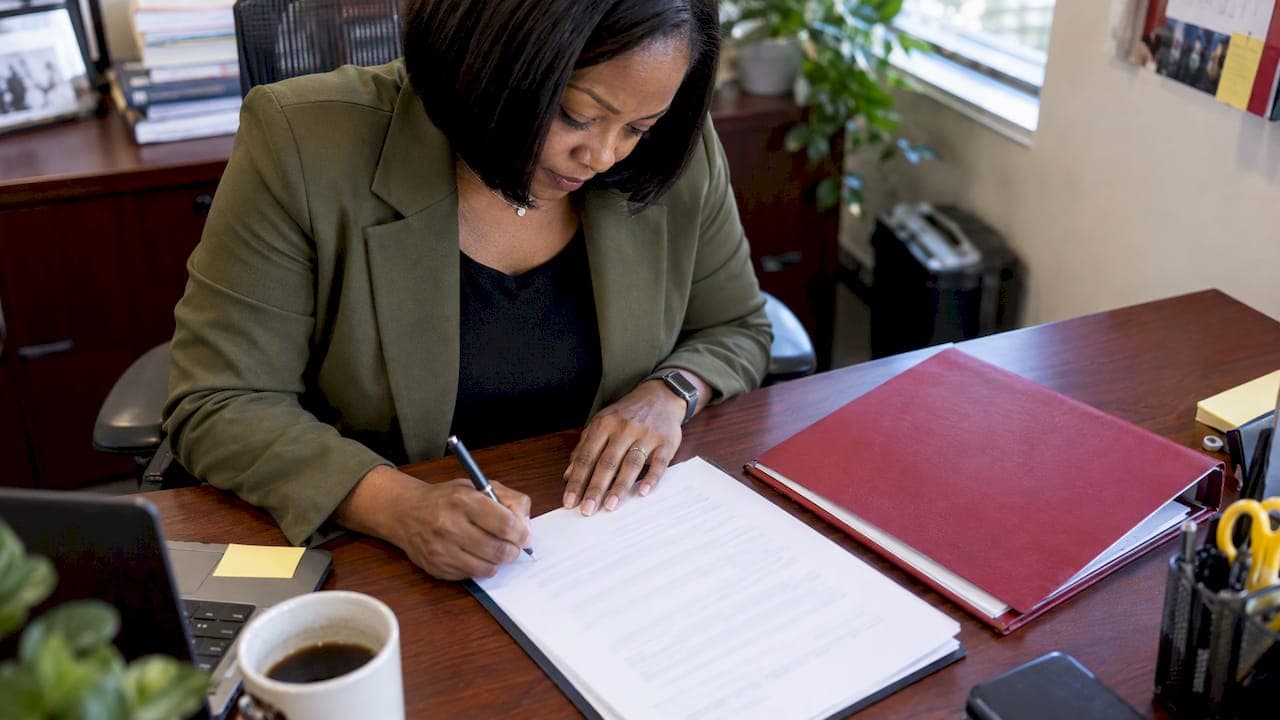
A district yearbook contract is the written agreement between a school district (or a single school acting under district rules) and the company that prints and supports its yearbooks. Done well, it fixes the scope, price, delivery dates, data protections and exit terms in one place. Done badly, it leaves advisers chasing late books and families asking why the price changed. This guide walks through who signs, when you have to bid, how to score proposals, and which clauses are worth the time.
TL;DR
- Contract authority sits with the board or superintendent, not the adviser. Check your own policy for who may sign and at what dollar threshold.
- Bidding triggers vary by state and district. Many policies require quotes at one level of spend and formal bidding above another, so look up yours before you write the RFP.
- Score more than price. One large district weighted qualifications at 80% and pricing at 20%, so a low bid alone does not win.
- Put late-delivery penalties, student data rules, renewal limits and an exit clause in writing before you sign.
- Keep the whole file: the solicitation, every proposal, the scoring sheets, the approval and the signed agreement.
Table of Contents
- Who enters into a district yearbook contract
- What the contract usually covers
- When you have to bid it out
- How to prepare and issue the RFP
- Scoring proposals and approving the award
- Terms to review before you sign
- Records to keep
- Our perspective: what a contract should not make a school do
- Where TrailMark fits
- FAQ
- Sources
Who enters into a district yearbook contract
The contracting party is the district or school board, not the yearbook club and not the adviser personally. In Seattle, the board action report for the yearbook RFP authorized the Superintendent to execute the contract after the solicitation. Salem City Schools in Virginia states in its 2026 RFP that school officials act as fiduciaries for students and parents when contracting for yearbook sales. That framing matters: families pay for these books, so the district owes them a documented, defensible choice.
In practice three roles are involved:
- The adviser knows the production calendar, the software students use and what went wrong last year. They write the specifications.
- The administrator or business office owns purchasing rules, runs the solicitation and signs or recommends.
- The board or superintendent approves the award where policy requires it.
Many districts let each school pick its own vendor from an approved list. Seattle reserved the right to award on an all-or-none basis or to select up to two vendors per category so schools could choose between firms. If your district has elementary, middle and high schools with different needs, a multi-vendor award is worth considering.
What the contract usually covers
Read a few district solicitations side by side and the scope looks familiar. Oldham County Board of Education in Kentucky, in its 2025 yearbook RFP, defined scope to include production services for secondary schools, customized designs for each school level, user-friendly software or online platforms, dedicated customer support and secure digital storage of yearbook assets. Seattle's request sought management and classroom support for preparation and printing, including budget tracking plus technical and sales support.
Turn that into a checklist for your own document:
- Products and specs. Trim size, page counts, paper, binding, cover type, endsheets, and any extras such as foil, spot UV or personalized covers.
- Pricing. The per-book price at stated page counts and quantities, every add-on, and what happens to price if the count changes.
- Shipping. Whether freight is in the price or billed separately.
- Design tools and support. Which software your students can use, what training exists, and who the adviser calls.
- Schedule. Proof dates, ship dates, final deadlines and the delivery window.
- Data and digital assets. Where student files live, who can access them and what happens to them at the end.
- Remedies and exit. Late-delivery penalties, cancellation rights, renewal limits.
If your team wants a ready-made structure for comparing bids on these points, our yearbook RFP template for districts lays out a bid sheet that makes hidden fees visible.
When you have to bid it out
There is no single national rule. Thresholds come from state procurement law and from your own board policy, and they differ widely. As one example, Stanwood-Camano School District in Washington requires three quotes for purchases of $40,000 to $75,000 and formal competitive bidding above $75,000 for furniture, supplies or equipment. Your district's numbers, and the category yearbooks fall into, will differ.
To find your own rule, work through these in order:
- Your board's purchasing policy (usually a 3000-series or similar fiscal section).
- Your state's school procurement statute or administrative code.
- Any rule on multi-year contracts. Some districts allow them only when the longer term serves the district, as in the Little Silver, New Jersey policy on multi-year and competitive contracts.
- Whether the yearbook is treated as a purchase by the district or as a student-funded activity run through an activity account. The answer can change which threshold applies, so ask your business office rather than assuming.
Keep one more point in mind: a yearbook program can look small in one school and large across a district. Add up the whole district's annual spend before you decide a single quote is enough.
How to prepare and issue the RFP
A good request is short on boilerplate and long on specifics. You are asking vendors to price the same thing, so they have to see the same thing.
Start with real numbers. List the number of schools, typical book counts per school, page ranges, cover types and whether you want hardcover, softcover or both. Add last year's final bill if you have it.

Name the dates. State when proposals are due, when questions close and when you expect to award. Use your own calendar here; the dates in this article are examples from other districts and not yours.
Ask for the same pricing format from everyone. Require per-book prices at defined quantities, plus a line for every add-on and for shipping. A bid that quotes a low base and bills the rest later is the most common way schools overpay. Our guide to yearbook pricing for advisers shows how a break-even worksheet exposes that.
Require marketing and sales support in writing. Oldham County requires the winning proposer to give each school principal all marketing materials at least 30 days before sales begin. A lead time like that keeps the sales window from being squeezed.
Ask about the sales pitch. Some vendors rely on a representative visit and a long contract to lock in the school. Decide up front whether that is what you want. We explain the pattern in what a yearbook sales pitch means for schools.
Ask for references from similar schools. Same grade span, similar book count, same design software.
Scoring proposals and approving the award
Decide the scoring before the proposals arrive, and publish it in the RFP. Seattle Public Schools used a split of 80% for qualifications and 20% for pricing, with points for product quality, staff experience and workshops or seminars. Your split can be different, but the principle holds: price is one factor among several.
A simple scorecard could look like this:
| Criterion | What to look for | Suggested weight |
|---|---|---|
| Total cost | All-in per-book price, add-ons, shipping, reprint pricing | 25% |
| Product quality | Samples, paper and binding options | 20% |
| Schedule reliability | Stated turnaround, deadline flexibility, late-delivery remedies | 20% |
| Adviser and student support | Named contact, training, design help | 20% |
| Data privacy and security | Student data handling, file storage, access controls | 15% |
The weights are a starting point of our own, not a standard. Change them to fit your district.
Two cautions at award time. First, Salem City Schools makes clear that the award is made in the best interest of the district and that the board may reject any or all proposals. Build that right into your own document. Second, ask for a printed sample from the finalists. A glossy portfolio and the book your students will hold are not always the same thing; you can request a sample from us at any point.

Terms to review before you sign
Late-delivery penalties
A yearbook that arrives after the last day of school is worth far less. Oldham County's 2025 RFP includes a penalty provision: the successful proposer absorbs an assessment fee for each day a delivery runs past the agreed date. Put a daily remedy in your contract, define what counts as the agreed date, and say who bears the cost when the delay comes from late school submissions rather than from the printer. If delays are a recurring problem at your school, read our fix-it guide to common yearbook timeline delays first, so your deadlines are realistic.
Student data
Salem City Schools' 2026 RFP requires vendors to give clear information on how student personal information is collected, maintained and used, in line with data privacy safeguards. Ask the same. Cover where files are stored, who at the vendor can see them, whether they are used for anything beyond the yearbook, and how they are returned or deleted when the contract ends. Our student data privacy guide for advisers and the piece on centralizing opt-outs for FERPA-compliant photos go deeper. For a broader checklist, see our yearbook program compliance requirements guide.
Term, renewal and amendments
This is where contracts quietly cost schools the most. State rules on multi-year terms vary, so confirm with your business office or district counsel before you pick a length. Within what your policy allows, consider these protections:
- Short initial term with annual renewal options, rather than one long term that is hard to leave.
- Written notice for renewal or cancellation. The Gilbert Public Schools (Arizona) yearbook solicitation, for instance, lets the contractor cancel only by written notice during the 60 days before an annual renewal, and says termination does not affect projects already in progress. That protects a book mid-production.
- Amendments only in writing, signed by the district's authorized representative.
- Price lock for the term, or a stated cap on increases at renewal.
Exit rights
The same Gilbert document is a useful model. It allows the district to cancel for convenience without penalty when it decides cancellation is in its best interests, to cancel for conflict of interest under Arizona law, and to cancel if the contractor files for bankruptcy or is acquired. It also allows cancellation if the state legislature fails to appropriate funds. Whether those clauses fit your state is a question for district counsel, but a contract with no exit at all should make you pause.
Auto-renewal and consumer-style fine print
Check the back of any vendor's standard form. Standard purchase agreements often say they apply to a "customer" and carry the vendor's terms on the reverse side. When a district contract exists, the district's terms should control, and the vendor's form should be attached only if the contract says so.
Records to keep
Stanwood-Camano stresses the importance of clear documentation and standardized purchasing regulations for compliance with state and federal law. For a yearbook contract, that means one file containing:
- the board policy or statute that set your bidding threshold;
- the RFP, any addenda and the list of vendors who received it;
- every proposal received, including the ones you rejected;
- the scoring sheets and evaluator notes;
- board minutes or the superintendent's approval;
- the signed agreement and every amendment;
- delivery records, invoices and any penalty or credit applied.
Keep it for as long as your state's records schedule requires. The business office can tell you the number.
Our perspective: what a contract should not make a school do
We have watched a lot of districts inherit contracts that nobody remembers signing. The pattern is consistent: a representative visits, the price looks fine, a multi-year term is signed, and two years later the adviser discovers add-ons, shipping lines and deadlines nobody planned for.
Our view is that a school should be able to see the full price before it talks to anyone, and should never need a long commitment to get a fair one. That is how we built TrailMark: instant, all-inclusive pricing online with no signup and no sales pitch, no order minimums or submission deadlines, and a 2 to 3 week turnaround. Our team has more than 50 years of combined experience, and we work with the design tools advisers already use, including Canva and InDesign, as well as our online creator.
So when a district asks us what to put in a contract, our answer is simple. Ask for the total price in writing. Ask what happens when you are late. Ask who owns the student files. And keep the right to leave.
— Jace
Where TrailMark fits
If your district is writing an RFP, or a school wants a price to compare against current bids, you can get all-inclusive pricing on our yearbook production services page without signing up. Options such as hard cover, Smyth sewn binding, printed endsheets, foil or spot UV and personalized covers are itemized on our printing page, so you can see what each choice adds per book. A printed proof set of two copies, with shipping included, is listed there at $100. Schools that want us to build the book can ask about optional full-service design, and every school gets a dedicated adviser.
FAQ
Does every district need a formal RFP for yearbooks?
Not necessarily. It depends on your state's procurement law and your board's policy, which set the dollar levels for quotes and for formal bidding. Stanwood-Camano's policy, for example, steps from three quotes to formal bidding at $75,000, but your district will have its own numbers. Ask your business office which threshold applies to total annual yearbook spend.
How long should a district yearbook contract run?
There is no universal answer, and some policies limit multi-year terms to cases where a longer term serves the district. A short initial term with annual renewal options keeps leverage with the school. Whatever the length, include notice requirements and an exit for convenience.
Can different schools in the district use different vendors?
Often yes. Some districts award to up to two vendors per category so each school can choose, as Seattle's RFP allowed. Others award all-or-none for a single price across the district. Decide which suits your mix of elementary, middle and high schools before you issue the request.
What should a yearbook contract say about student data?
It should require the vendor to explain how student information is collected, stored and used, and what happens to files when the agreement ends. Salem City Schools asks for exactly this in its 2026 RFP. Have your district's privacy or technology lead review the language.
What happens if the books arrive late?
The contract should say. A common approach is a daily fee that the vendor absorbs for each day past the agreed delivery date, as Oldham County's RFP does. Also define the dates that count, so delays caused by late school files are handled fairly.
Sources
- Oldham County Board of Education yearbook RFP (2025)
- Salem City Schools Request for Proposals (2026)
- Seattle Public Schools board action report, yearbooks RFP
- Stanwood-Camano School District purchasing policy
- Gilbert Public Schools yearbook publishing and design services solicitation