

Yearbook student data privacy is the legal and ethical practice of protecting students' personally identifiable information (PII) used in school yearbooks, governed primarily by FERPA and COPPA. These two federal frameworks define what counts as a protected education record, who can access student data, and under what conditions. Yearbook advisers and school administrators who ignore these standards risk losing federal funding and exposing their districts to serious liability. This guide breaks down the regulatory requirements, explains how student photos and records are classified, and gives you concrete steps to protect student privacy throughout the yearbook production process.
What legal regulations govern student data privacy in yearbook publishing?
Student data protection in yearbook publishing falls under two primary federal laws: the Family Educational Rights and Privacy Act (FERPA) and the Children's Online Privacy Protection Act (COPPA). Both apply directly to the yearbook production process, and both carry real consequences for non-compliance.
FERPA covers all schools that receive federal funding. It defines education records broadly, and student photos qualify as education records when schools or their agents maintain them to identify students. That means your yearbook vendor, if they store or process student photos on your behalf, is handling education records. FERPA requires parental consent before disclosing those records, with specific exceptions.

COPPA adds a separate layer of protection for children under 13. Online platforms must obtain parental consent before collecting personal information from this age group, unless the school acts as the parent's agent. Yearbook advisers using digital photo submission tools or online design platforms must verify those platforms comply with COPPA, including limiting data collection and prohibiting commercial use of student information.
State laws can impose additional requirements beyond FERPA and COPPA. Many states have enacted Student Data Privacy Acts that require specific contract language with vendors, stricter data deletion timelines, and broader definitions of protected information. Advisers should check their state's education code alongside federal requirements.
Key regulatory requirements at a glance:
- FERPA: Parental consent required before disclosing education records; annual notice of directory information policies required
- COPPA: Parental consent required for online data collection from children under 13; commercial use of student data prohibited
- School official exception: Vendors may access records without direct parental consent if strict criteria are met (see next section)
- State laws: May require Student Data Privacy Agreements, stricter deletion timelines, and broader PII definitions
- Directory information: Schools must notify parents annually and provide an opt-out period before including student data in yearbooks
Pro Tip: Check your state's department of education website for a current list of required contract clauses. Many states publish model Student Data Privacy Agreements you can adapt for your yearbook vendor contracts.
How are student photos and information classified as education records?
Student photos are education records under FERPA when a school or its agent maintains them and uses them to identify students. This classification is not limited to official school files. If your yearbook vendor stores student headshots on their servers, those images carry the same legal protections as a student's transcript.
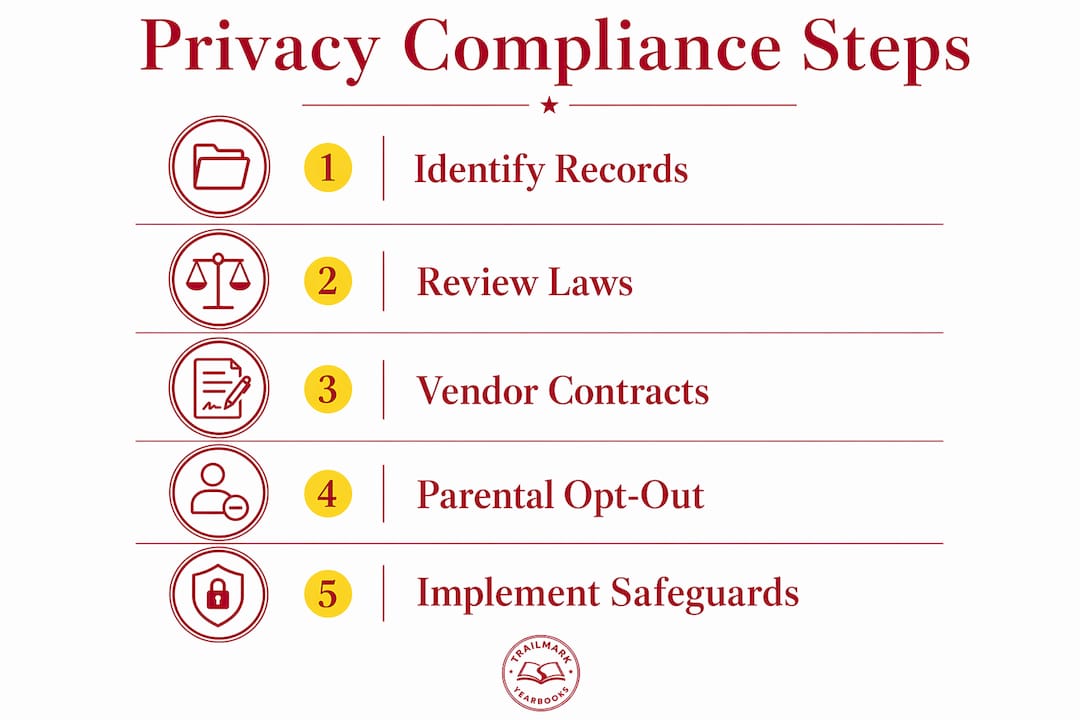
The "directory information" category is where most yearbook advisers get tripped up. FERPA allows schools to designate certain information, such as a student's name, photo, and grade level, as directory information. Once designated, schools can disclose this information without individual parental consent. However, parents must receive annual notice of what is designated as directory information and must be given a reasonable opt-out period before any disclosure occurs.
Here is how to manage student records correctly throughout the yearbook cycle:
- Audit your data inventory. List every type of student information your yearbook program collects: names, photos, grade levels, club memberships, and any other identifiers.
- Confirm directory information designations. Work with your district's privacy officer to verify which data elements are officially designated and published in your annual FERPA notice.
- Document opt-outs before production begins. Collect and honor all parental opt-out requests before submitting any student data or photos to your vendor.
- Review vendor contracts for re-disclosure prohibitions. Vendors must be contractually prohibited from sharing student data with third parties for any purpose beyond the yearbook.
- Require data deletion after production. Vendors must delete student data within a defined period after the yearbook is complete. Build this deadline into your contract.
The school official exception allows vendors to access education records without direct parental consent, but only when five conditions are met: a written agreement exists, the vendor performs a function the school would otherwise handle, the school maintains direct control over the vendor, data use is limited to the agreed purpose, and re-disclosure is prohibited. All five conditions must be satisfied simultaneously. Missing even one condition removes the exception and requires parental consent.
Pro Tip: Never assume a vendor's standard contract satisfies the school official exception. Have your district's legal counsel review the contract language before signing, and request amendments if the five required conditions are not explicitly addressed.
What are best practices for yearbook advisers in protecting student data?
The most effective approach to student information security is building privacy controls into every stage of production, not adding them at the end. Advisers who treat privacy as a checklist item at contract signing consistently miss critical gaps that emerge during production.
- Vet vendors before signing. Request documentation of the vendor's data security practices, including encrypted storage, access restrictions, and audit controls. Strong security measures prevent unauthorized access and fulfill your contractual obligations.
- Limit data to what is necessary. Share only the student information the vendor needs to produce the yearbook. Do not provide full student rosters, contact information, or demographic data unless each element is directly required.
- Maintain direct control. The school official exception requires the school to control how the vendor uses student data. Assign a staff member to monitor vendor compliance throughout production.
- Communicate clearly with parents. Direct communication with parents about data collection, sharing, and privacy protections builds trust and reduces disputes. Send a plain-language notice at the start of each school year explaining what data is collected for the yearbook and how it is protected.
- Handle opt-out requests promptly. When a parent opts out of directory information disclosure, remove that student's photo and name from all yearbook materials before submission to the vendor.
- Audit compliance throughout production. Do not sign off on a final proof without confirming that opted-out students are excluded and that no unauthorized data was shared.
Pro Tip: Create a privacy checklist specific to your yearbook program and review it at three points: before vendor selection, before data submission, and before final approval. This three-checkpoint system catches most compliance gaps before they become problems.
What risks and common mistakes should yearbook advisers avoid?
The most common and costly mistake is assuming a vendor's standard privacy policy covers your school's legal obligations. Schools are responsible for ensuring vendor contracts explicitly align with FERPA and applicable state Student Data Privacy Agreements. A generic privacy policy does not satisfy this requirement.
- Relying on vendor terms without review. Standard vendor agreements are written to protect the vendor, not your school. They rarely include the specific language required by FERPA's school official exception or state privacy laws.
- Allowing data use beyond the yearbook. Vendors must be contractually prohibited from using student photos or information for marketing, product development, or any purpose outside the yearbook. EdTech tools introduce commercialization risks that require active oversight, not passive acceptance of vendor terms.
- Misunderstanding directory information consent. Directory information designation does not mean unlimited disclosure. Parents retain the right to opt out, and that opt-out must be honored in every publication, including the yearbook.
- Ignoring COPPA on digital platforms. If your yearbook program uses an online photo submission tool or digital design platform, COPPA applies to any student under 13. Verify that the platform has a compliant privacy policy and does not collect data beyond what is needed.
- Skipping privacy training. Staff and student yearbook editors who handle photos and personal data need basic training on what they can and cannot share. One well-meaning post of a student's photo on social media can trigger a FERPA violation.
Schools that post yearbook content on public websites or social media face an additional layer of risk. Content shared online is no longer under the school's control. For guidance on how online platforms affect student privacy in educational contexts, advisers should review current best practices for digital content management.
How can schools balance student privacy with the value of yearbooks?
Yearbooks serve a genuine educational and social purpose. The goal is not to eliminate student data from yearbooks but to handle it responsibly. Schools that communicate clearly with families and build privacy into their workflows can produce meaningful yearbooks without legal exposure.
| Situation | Privacy-compliant approach |
|---|---|
| Student opts out of directory information | Exclude photo and name from all yearbook pages |
| Vendor requests full student roster | Provide only names and photos of students who have not opted out |
| School wants to post yearbook pages online | Obtain explicit written permission separate from yearbook consent |
| Student appears in a candid group photo | Apply the same opt-out rules as for individual portraits |
| Vendor proposes using student photos in marketing | Refuse and add a prohibition clause to the contract |
Obtaining explicit permission for uses beyond the printed yearbook, such as social media posts or website features, is a separate step from the annual directory information notice. Many advisers assume the yearbook consent covers all downstream uses. It does not. A yearbook compliance guide can help advisers map out which permissions apply to which uses.
Privacy-by-design means building data minimization and access controls into your production workflow from the start, rather than patching problems after the fact. Advisers who adopt this approach spend less time resolving complaints and more time on the creative work that makes yearbooks worth producing.
Key Takeaways
Yearbook student data privacy requires FERPA and COPPA compliance, explicit vendor contracts, annual parental opt-out notices, and active school oversight of every vendor that handles student records.
| Point | Details |
|---|---|
| FERPA covers student photos | Photos maintained by schools or vendors to identify students are education records with full FERPA protections. |
| School official exception has five conditions | Vendors must meet all five criteria simultaneously or parental consent is required before data access. |
| Annual opt-out notice is mandatory | Schools must notify parents of directory information policies yearly and honor all opt-out requests before yearbook production. |
| Vendor contracts must be explicit | Generic privacy policies do not satisfy FERPA or state Student Data Privacy Agreement requirements. |
| Digital platforms trigger COPPA | Online yearbook tools collecting data from students under 13 require COPPA-compliant privacy policies and parental consent. |
Privacy compliance is harder than it looks, and that's the point
Working with yearbook programs across the country, I have seen the same pattern repeat itself: advisers who are meticulous about design deadlines treat vendor contracts as a formality. They sign whatever the vendor sends, assume the legal language is standard, and move on. That assumption is where most compliance problems begin.
The school official exception sounds straightforward on paper. In practice, verifying that all five conditions are met requires reading contract language carefully, asking vendors direct questions about their data handling, and sometimes pushing back on terms that do not meet the standard. Most vendors are cooperative when asked. The problem is that most advisers never ask.
The shift to digital production tools has made this more urgent, not less. Every online platform your yearbook program uses is a potential FERPA and COPPA exposure point. I have seen schools use photo submission apps that collect more data than the yearbook requires and share it with third-party analytics providers. That is a violation waiting to happen.
My advice is to treat yearbook policy best practices as a living document, not a one-time exercise. Review your vendor contracts and privacy notices every year before production starts. The regulatory environment is changing, and what was compliant in 2024 may not be sufficient in 2026.
— Jace
How Trailmarkyearbooks approaches student data privacy
Trailmarkyearbooks builds FERPA and COPPA compliance into its vendor agreements from the start. Student photos and records shared during yearbook production are used solely for producing your school's yearbook, never for marketing or third-party purposes. Contracts include explicit data deletion timelines, re-disclosure prohibitions, and access controls that satisfy the school official exception. For advisers who want to evaluate these protections firsthand before committing, requesting a sample is the fastest way to see how Trailmarkyearbooks handles student data in practice. With 50+ years of combined experience and a school-first approach, Trailmarkyearbooks gives advisers the transparency they need to feel confident about compliance.
FAQ
What is yearbook student data privacy?
Yearbook student data privacy is the legal and ethical practice of protecting students' personally identifiable information used in school yearbooks, governed by FERPA, COPPA, and applicable state laws.
Are student photos in yearbooks protected by FERPA?
Yes. Student photos are education records under FERPA when maintained by a school or its vendor to identify students, and they must be managed according to strict parental consent and opt-out requirements.
What is the school official exception under FERPA?
The school official exception allows vendors to access student education records without direct parental consent, but only when five conditions are met: a written agreement, direct school control, authorized purpose only, no re-disclosure, and a legitimate educational interest.
Do parents have the right to opt out of yearbook inclusion?
Yes. Schools must provide annual notice of directory information designations and give parents a reasonable period to opt out before any student data, including photos, appears in the yearbook.
Does COPPA apply to yearbook production?
COPPA applies whenever an online platform collects personal information from students under 13. Yearbook advisers using digital photo tools or online design platforms must verify those platforms have COPPA-compliant privacy policies and do not use student data commercially.