

Yearbook program compliance requirements define the standards and procedures schools must follow to protect student privacy, maintain content integrity, and secure administrative approval throughout yearbook production. These requirements draw from federal laws like FERPA (Family Educational Rights and Privacy Act) and COPPA (Children's Online Privacy Protection Act), plus district-level policies that govern everything from photo use to final sign-off authority. Advisers who treat compliance as a checklist rather than a workflow tend to hit problems late in the production cycle, when fixes are expensive and stressful. Getting the structure right from the start protects students, protects the school, and makes the whole process easier.
What federal privacy laws govern yearbook program compliance requirements?
FERPA and COPPA are the two federal laws that directly shape how schools handle student information in yearbooks. FERPA classifies student photos and personally identifiable information (PII) as protected education records. That classification means schools cannot publish student images without proper consent, and vendors must not sell student data or use photos for AI training or facial recognition. That restriction applies to both your printing vendor and any digital platform you use.
COPPA adds a separate layer for students under 13. Any digital yearbook platform that collects data from elementary or middle school students must meet COPPA's parental consent requirements. Schools that skip this step expose themselves to federal enforcement risk, not just district policy violations.

The practical starting point for most advisers is the media release form. Schools must update release forms annually and include explicit notice about yearbook photo use. Families must have a clear, documented path to opt out. Keeping those forms current and on file is the foundation of FERPA compliance for any yearbook program.
Pro Tip: Build your media release form review into the back-to-school calendar every august, before any photography begins. Waiting until production starts creates gaps that are hard to fix retroactively.
Key privacy requirements advisers should track:
- Annual media release forms with explicit yearbook photo use language
- Documented opt-out procedures for families who decline photo publication
- Vendor contracts that prohibit selling student data or using images for AI training
- Restrictions on facial recognition technology in any platform handling student photos
- Directory information designations reviewed and updated each school year
How to establish an effective yearbook program approval process
A formal approval process is the backbone of yearbook program oversight. Without defined sign-off authority, content decisions fall into gray areas, and advisers end up absorbing responsibility that should be shared with administration. Effective approval workflows assign clear roles to faculty advisers, department heads, and principals, with documented deadlines tied to the production schedule.
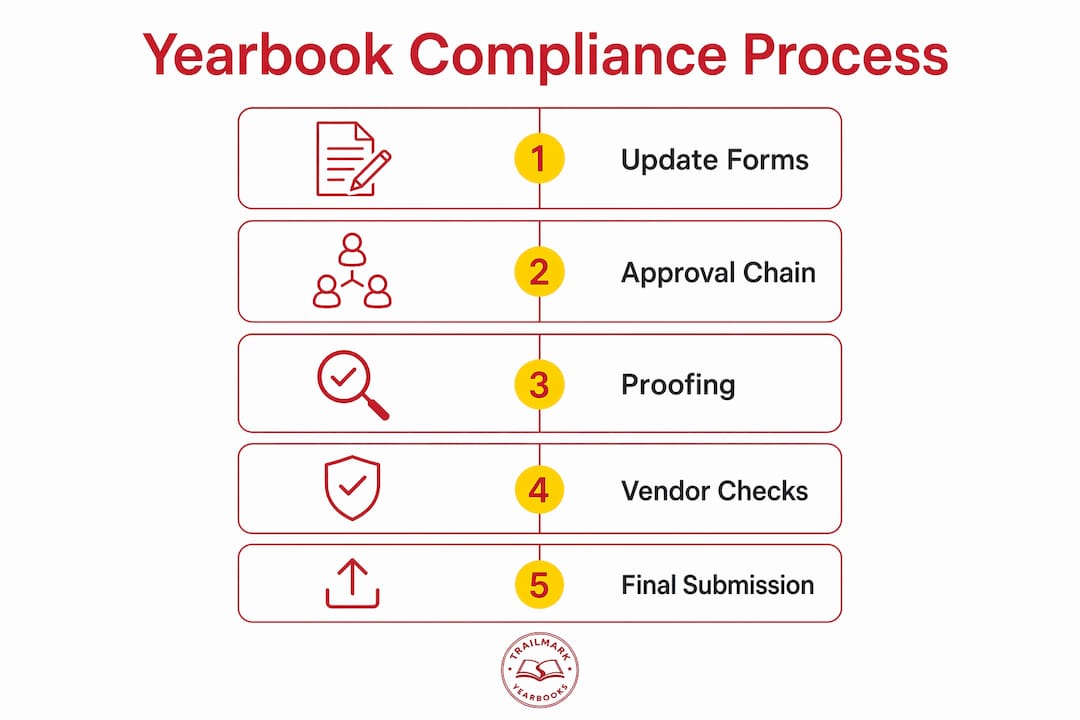
The school yearbook approval process works best when it is written down in a staff manual before the school year begins. That manual should cover policies on senior quotes, political content, superlatives, and any topic that has caused controversy at your school in the past. Advisers who rely on informal agreements with administrators tend to face pushback at the worst possible time, right before the submission deadline.
A practical approval sequence looks like this:
- Adviser review: The yearbook adviser reviews all content for policy compliance and accuracy before anything goes to administration.
- Section editor sign-off: Each section editor confirms names, captions, and photo accuracy for their assigned pages.
- Faculty adviser final check: The adviser does a complete pass of the full book, flagging anything that needs administrative review.
- Administrator review: The principal or designated administrator reviews flagged content and any sections touching sensitive topics.
- Final written approval: The administrator provides written sign-off before files go to the printer. This document protects both the school and the adviser.
Pro Tip: Set your internal approval deadline at least two weeks before your printer's submission deadline. That buffer gives you time to fix issues without paying rush fees or missing your production window.
Scheduling matters as much as the workflow itself. Approval deadlines typically fall by the end of the month before submission, which means advisers need to work backward from the printer's due date to set realistic internal milestones. A clear timeline shared with all stakeholders at the start of the year eliminates most last-minute scrambles.
What are the best practices for proofing and verifying yearbook content?
Proofing is where compliance meets quality control. A yearbook that passes every privacy and approval check but ships with misspelled student names or wrong grade levels still fails the school community. Best proofing practice requires a minimum of three reviewers, including at least one person who had no involvement in designing the pages being reviewed.
The "fresh eyes" principle is not optional. Designers become blind to their own errors after staring at a spread for hours. A reviewer seeing the page for the first time catches layout problems, caption mismatches, and factual errors that the original designer will miss every time.
Printed proofs catch more errors than screen reviews. Physical proofing gives reviewers a fresh perspective and makes layout problems more visible than they appear on a monitor. Schools that skip the printed proof step and rely solely on PDF review consistently report higher error rates in the final book.
| Proofing step | Who does it | What to check |
|---|---|---|
| Roster cross-check | Adviser or editor | Every student name verified against current enrollment records |
| Photo resolution check | Designer or editor | All images meet minimum print resolution standards |
| Caption accuracy review | Section editor | Captions match the correct photo and include accurate details |
| Fresh eyes review | Uninvolved reviewer | Layout, grammar, factual accuracy, and tone |
| Administrator sign-off | Principal or designee | Final approval confirming content meets district policy |
Pro Tip: Print at least one full-size proof of every spread before submitting to your printer. Read it out loud with a partner. You will catch errors that silent reading misses.
For advisers who want a deeper walkthrough of each step, the yearbook proofing process covers roster checks and caption verification in detail.
Managing digital yearbook compliance: unique challenges and solutions
Digital yearbooks introduce compliance challenges that physical books do not face. Digital platforms subject schools to added FERPA and COPPA requirements including secure access controls, vendor data scrutiny, and parental control options. A digital yearbook that is publicly accessible online is not FERPA compliant, full stop.
Access controls are the first line of defense. The platform must restrict viewing to authenticated community members, meaning students, families, and staff who have verified their identity. Anonymous public access to student photos and names violates FERPA regardless of whether the content was approved for the physical book.
Vendor selection is where many schools make their biggest compliance mistake. Before signing any contract with a digital yearbook platform, advisers should confirm the following:
- The vendor does not sell student data to third parties
- The platform does not use student images for AI training or facial recognition
- Parental opt-out options are built into the platform, not just available on request
- The vendor has a documented cybersecurity policy covering data breaches
- Copyright ownership of student-created content is clearly assigned to the school
Schools must verify that platforms do not use student data for AI training or advertising. This requirement is not always obvious in vendor contracts, so advisers should ask directly and get the answer in writing before committing.
Pro Tip: Request a copy of any digital platform's data processing agreement before signing. If the vendor cannot produce one, that is your answer about their compliance posture.
How to handle sensitive content and stakeholder communication
Sensitive content is the area where most yearbook controversies originate. Senior quotes, superlatives, and political references all carry real risk if they are not managed through a clear vetting process. Clear guidelines and administrative involvement reduce controversy and protect the yearbook staff from being caught in the middle of disputes they did not create.
Yearbooks reflect school culture, which makes administrative partnership critical for content standards. Advisers who operate without clear backing from their principal are in a difficult position when a student or parent challenges a content decision.
A practical approach to sensitive content management:
- Write the policy before the school year starts. Define what is and is not acceptable for senior quotes, superlatives, and any recurring content category that has caused problems before.
- Involve student editors in the vetting process. Multiple voices in content decisions improve outcomes and distribute responsibility appropriately.
- Require pre-approval for any content that references real people outside the school community. This includes quotes attributed to public figures and references to current events.
- Document every content decision. If a quote is rejected or modified, record why. That documentation protects the adviser and the school if a decision is later challenged.
For advisers building out their school yearbook policy, having written guidelines in place before content submissions begin is the single most effective risk reduction step available.
Key Takeaways
Yearbook program compliance requires annual privacy form updates, a documented approval chain, multi-person proofing, and vendor contracts that explicitly prohibit student data misuse.
| Point | Details |
|---|---|
| FERPA and COPPA are non-negotiable | Update media release forms annually and verify vendor data policies before signing any contract. |
| Written approval workflows prevent disputes | Assign clear sign-off authority to advisers and administrators before production begins. |
| Three-reviewer proofing reduces errors | Include one reviewer with no involvement in the page's design for every spread. |
| Digital platforms need access controls | Restrict viewing to authenticated users and confirm the vendor has a documented cybersecurity policy. |
| Sensitive content needs written policy | Define acceptable content for senior quotes and superlatives before submissions open, not after. |
What I've learned about compliance after years of watching advisers struggle
Most advisers I talk to treat compliance as something they deal with when a problem surfaces. That approach is understandable. Yearbook production is already a full-time job layered on top of another full-time job. But the advisers who have the smoothest production cycles are the ones who front-load the compliance work in september and october, before a single photo is taken.
The biggest gap I see is the vendor conversation. Advisers spend enormous energy on content and design, then sign a vendor contract without reading the data use clauses. In 2026, with AI image tools everywhere, that oversight carries real risk. A vendor using student photos to train a model is a FERPA violation, and the school bears the consequences, not the vendor.
Administrative partnership is the other piece that gets underestimated. An adviser with a principal who actively backs content decisions is in a completely different position than one operating without that support. If you do not have that relationship yet, building it is worth more than any checklist or workflow tool. Start by sharing your compliance plan with your principal at the beginning of the year. Most administrators are relieved when an adviser brings a structured approach rather than waiting for problems to escalate.
The advisers who get this right are not the ones with the most experience. They are the ones who ask the right questions early and put the answers in writing.
— Jace
How Trailmarkyearbooks supports compliant yearbook production
Trailmarkyearbooks works with elementary, middle, and high schools that need a production partner who understands the compliance pressures advisers face. The process is transparent from the start, with all-inclusive pricing available online and no hidden fees, so advisers can plan budgets without surprises. Design flexibility through Canva, InDesign, or the Trailmarkyearbooks online creator means schools keep control of their content workflow without being forced into a proprietary system.

For advisers who want to evaluate print quality before committing, requesting a sample is the fastest way to see what the finished product looks like. Trailmarkyearbooks also offers free design assistance and a 2–3 week turnaround, which gives advisers the buffer they need to complete internal approval steps without rushing the production timeline. If you have compliance questions specific to your district, the support team is available to help you work through them.
FAQ
What laws apply to yearbook program compliance requirements?
FERPA and COPPA are the primary federal laws governing yearbook programs. FERPA protects student photos and PII as education records, while COPPA applies additional consent requirements for students under 13.
How often should schools update media release forms?
Schools should update media release forms annually, before any photography begins. Each form must include explicit notice about yearbook photo use and a clear opt-out option for families.
Are yearbooks considered legal documents?
Yearbooks are not legal documents. They are student publications and cultural records, but schools must still align content and naming conventions with school board policies and community standards.
How many people should review a yearbook proof?
A minimum of three reviewers should check each spread, including at least one person who was not involved in designing those pages. A final administrator sign-off is required before files go to print.
What should advisers check in a digital yearbook vendor contract?
Advisers should confirm the vendor does not sell student data, does not use images for AI training or facial recognition, and provides documented parental opt-out options. Get all data use restrictions in writing before signing.