

Yearbook company experience is defined as the accumulated production knowledge, vendor accountability practices, and compliance expertise a company brings to every school it serves. Why yearbook company experience matters is straightforward: inexperienced vendors produce delays, design errors, and data security gaps that damage school communities. Experienced vendors like Trailmarkyearbooks bring refined workflows, transparent contracts, and FERPA-grounded data practices that protect students and reduce stress for advisers. In 2026, the stakes are higher than ever, with procurement offices now requiring explicit AI training disclosures and corporate ownership transparency as baseline vendor qualifications.
Why does yearbook company experience matter for quality?
Experience directly determines the quality of the final yearbook. Vendors with years of production history have tested and refined every step, from photo submission to print delivery, so errors get caught before they reach the press.
Experienced companies support advisers with creative tools and guided workflows. Whether a school uses Canva, Adobe InDesign, or an online creator, a seasoned vendor knows how to integrate those tools into a production schedule without confusion. That guidance prevents the most common adviser frustration: discovering a design problem too late to fix it.

Faster delivery and zero school disruption are direct outcomes of vendor experience. That means advisers spend less time chasing status updates and more time working with students on content.
Key quality advantages experienced vendors provide:
- Refined quality control checkpoints that catch resolution errors, missing pages, and color inconsistencies before printing
- Creative support and design feedback so student-led teams produce polished visual storytelling, not just photo dumps
- Deadline management systems that account for school calendars, holidays, and photo day rescheduling
- Consistent print standards built on years of working with professional printing equipment and paper specifications
Pro Tip: Ask any vendor to walk you through their quality control process step by step. An experienced company will describe specific checkpoints. A less experienced one will give you a vague answer about "reviewing files before printing."
Why vendor transparency and ownership matter more than ever
Vendor transparency is now a core marker of experience, not a bonus feature. Schools in 2026 face procurement demands that go well beyond price and delivery speed.
Transparency about AI training restrictions is now among the top four critical criteria for yearbook vendor selection. Procurement offices and IT directors require explicit contract language confirming that student images will not be used to train AI models or biometric recognition systems. This is not a niche concern. It reflects a fundamental shift in how schools think about student data.
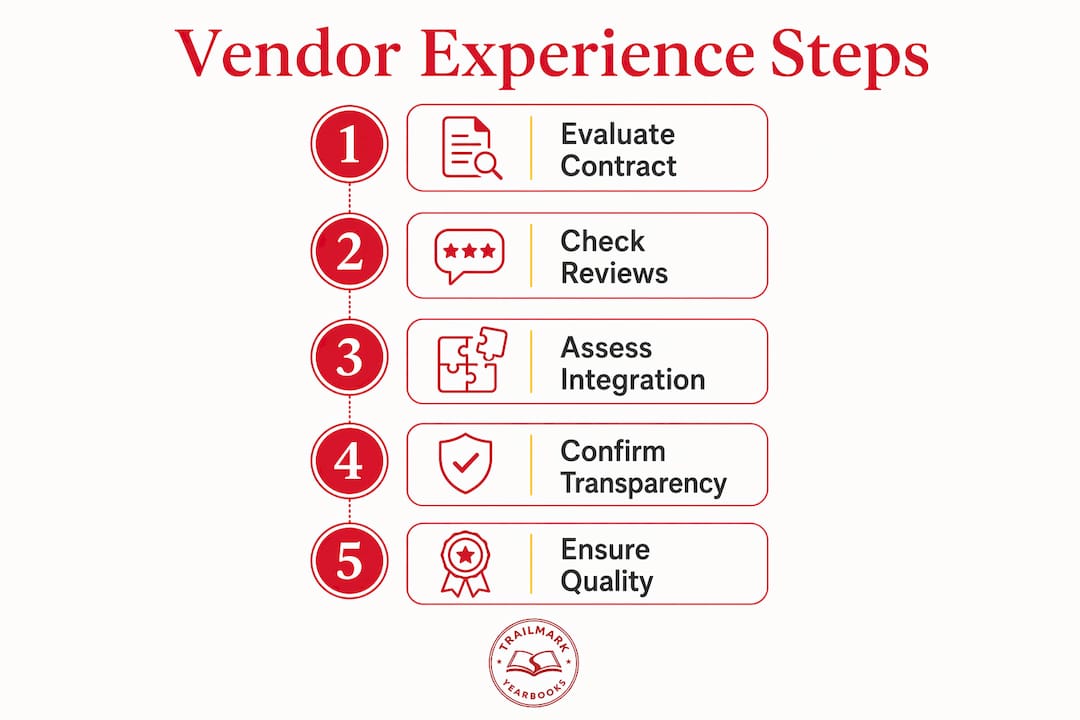
Corporate ownership structure matters for the same reason. A vendor owned by a private equity firm operates under different accountability pressures than a school-focused company with a direct relationship to its clients. Vendor vetting now requires deeper due diligence, including verifying who ultimately controls the company and what their data practices look like.
Experienced vendors address these concerns proactively. They do not wait for a school to ask. Their contracts already include:
- Explicit prohibition on using student images for AI or biometric training
- Clear data retention limits specifying how long images are stored and when they are deleted
- Disclosure of corporate ownership structure and any third-party data sharing arrangements
- FERPA compliance language that goes beyond the legal baseline
"Principals and administrators now consider vendor vetting a critical duty to maintain community trust, beyond routine procurement."
That shift is significant. It means choosing a yearbook vendor is no longer just a budget decision. It is a trust decision with real consequences for the school community.
What operational risks does inexperience pose for school yearbooks?
Inexperienced vendors create predictable, avoidable problems. The most common is delivery failure: a vendor without established print partnerships and production schedules misses deadlines, leaving schools without yearbooks at the end of the year.
Data security lapses are the second major risk. Schools that treat FERPA compliance as a starting point and prioritize contracts explicitly prohibiting AI training use of student images are far better protected than those that rely on a vendor's verbal assurances. An inexperienced vendor may not even know what questions to expect from a school's IT director.
The third risk is community backlash. Lack of full transparency in vendor ownership and AI training disclosures has led schools to switch providers mid-cycle and face community trust challenges. Switching vendors after signing a contract is expensive, disruptive, and damaging to the adviser's credibility.
Specific operational risks to watch for:
- Vague contract language on data use, image rights, and AI training that leaves schools exposed
- No dedicated support contact, forcing advisers to navigate generic customer service queues during critical production windows
- Unclear pricing structures with hidden fees for design revisions, shipping, or reprints
- No references from comparable schools, making it impossible to verify the vendor's actual track record
Ensuring vendor contracts clearly exclude student image use for AI model training is now a growing procurement office mandate. Schools that skip this step during vendor selection face real legal and reputational exposure.
How to evaluate yearbook vendor experience and support
Evaluating vendor experience requires asking specific questions, not accepting marketing language. The right vendor will answer every question directly and in writing.
Check the contract language first
Contracts for yearbook vendors should explicitly address AI training prohibitions, data retention limits, and privacy practices. If a vendor's standard contract does not include this language, that is a red flag regardless of how polished their sample yearbooks look. Review the school yearbook policy best practices for advisers before signing anything.
Assess vendor history and reviews
Ask for references from schools of similar size and type. Read reviews with attention to how the vendor handled problems, not just whether schools were satisfied. A vendor who resolves issues quickly and communicates proactively during production is far more valuable than one with a perfect record on easy jobs. Yearbook vendor reviews matter because they reveal how a company behaves under pressure.
Evaluate technical integration and support
The integration of school information systems (SIS) with yearbook platforms is a key indicator of vendor technical maturity. A vendor that connects directly with your SIS reduces manual data entry errors and speeds up the photo matching process. Ask specifically whether the vendor supports SIS integration and what the setup process looks like.
Pro Tip: Request a live walkthrough of the vendor's support portal before signing. Count how many clicks it takes to reach a real person. Experienced vendors make support fast and direct. Inexperienced ones bury it.
| Evaluation criterion | What to look for |
|---|---|
| Contract language | Explicit AI training prohibition and data retention limits |
| References | Schools of similar size with verifiable outcomes |
| SIS integration | Direct connection to reduce manual data errors |
| Support access | Named contact, not a generic queue |
| Pricing transparency | All-inclusive pricing with no hidden fees |
Benefits of working with experienced yearbook companies
Experienced yearbook companies deliver outcomes that go beyond a printed book. They build school community pride by producing a product students and families want to keep for decades.
Schools that partner with seasoned vendors report smoother production cycles because the vendor anticipates problems before they occur. An experienced team knows that photo day often runs late, that student editors change their minds about cover designs, and that printing timelines need buffer built in. Experienced vendors help advisers avoid common pitfalls around deadlines, design errors, and privacy breaches through tested processes and proactive support.
The community trust benefit is equally concrete. Experienced vendors increase parent and community trust by consistently securing student data and handling image privacy responsibly. That trust translates directly into stronger yearbook sales and fewer complaints during distribution.
Practical benefits schools gain from experienced vendors:
- Faster turnaround times with clear production milestones advisers can share with students and administrators
- Free or included design assistance so schools without a dedicated art program still produce professional results
- Proactive compliance support that keeps the school ahead of FERPA requirements without extra administrative work
- Stronger community engagement because a high-quality yearbook becomes a school tradition, not just an annual purchase
The yearbook's role in building school community depends heavily on the quality of the vendor behind it. A poorly produced book with missing photos or late delivery erodes the tradition. A well-executed one reinforces it.
Key Takeaways
Experienced yearbook vendors deliver better quality, stronger data protection, and more reliable production because they combine proven processes with transparent contracts and proactive adviser support.
| Point | Details |
|---|---|
| Experience drives quality | Refined workflows and quality checkpoints reduce errors before printing. |
| Transparency is now mandatory | Top vendors explicitly prohibit student image use for AI training in contracts. |
| Inexperience creates real risk | Delivery failures, data lapses, and vague contracts expose schools to backlash. |
| Evaluation requires specifics | Ask for contract language, SIS integration details, and verifiable school references. |
| Community trust depends on it | Responsible data handling and consistent quality build lasting school pride. |
What I've learned after watching schools get burned by the wrong vendor
The most expensive mistake I see advisers make is treating yearbook vendor selection like ordering office supplies. They compare price per book, pick the lowest number, and sign without reading the contract. That works fine until it doesn't, and when it doesn't, it is always at the worst possible time: late spring, with students expecting their books at graduation.
The 2026 procurement environment has made this mistake even more costly. AI training disclosures and corporate ownership transparency are not bureaucratic checkboxes. They reflect real risks that schools face when a vendor's parent company decides student photos are a useful training dataset. I have seen schools scramble to explain to parents why their children's images were handled in ways the school never intended or approved.
The counterintuitive truth is that experienced vendors are often more affordable over time, not less. They do not charge for reprints caused by their own errors. They do not bill separately for design support. Their pricing is clear upfront. The cheap vendor with the vague contract frequently costs more by the time production is finished.
My advice is simple: treat vendor selection like hiring a staff member. Check references. Read the contract line by line. Ask the hard questions about data use and ownership. The right vendor will welcome those questions. The wrong one will get defensive.
— Jace
Trailmarkyearbooks: experience schools can count on
Trailmarkyearbooks brings over 50 years of combined experience to every school it serves, with a school-first approach built on transparent pricing, clear contracts, and genuine adviser support.
Every Trailmarkyearbooks contract addresses AI training prohibitions and data privacy directly, meeting the 2026 procurement standards that schools now require. Pricing is all-inclusive with no hidden fees and shipping included, so advisers know exactly what they are getting before they sign. Design support is free, turnaround runs 2–3 weeks, and a real support contact is always within reach. Schools looking to see the quality firsthand can request a sample yearbook with no obligation, no signup, and no sales pitch.
FAQ
Why does yearbook company experience matter for advisers?
Experienced vendors provide tested production workflows, proactive support, and clear contracts that prevent the delays, design errors, and data security gaps that inexperienced vendors routinely cause.
What should a yearbook vendor contract include in 2026?
Contracts should explicitly prohibit student image use for AI or biometric training, define data retention limits, and include FERPA compliance language that goes beyond the legal baseline.
How do vendor reviews help schools choose the right company?
Reviews reveal how a vendor handles problems under pressure, which is more useful than knowing their success rate on straightforward jobs. Look for patterns in how issues were communicated and resolved.
What is an AI training disclosure in a yearbook contract?
An AI training disclosure is contract language confirming the vendor will not use student photos to train artificial intelligence or biometric recognition systems. Procurement offices now treat this as a standard requirement.
How does SIS integration indicate vendor experience?
A vendor that connects directly with a school's student information system reduces manual data entry, speeds up photo matching, and signals the technical maturity that comes from working with schools at scale.