

A yearbook staff advisor stipend is a one-time or periodic supplemental payment that a school district adds to a teacher's regular paycheck to compensate for the significant work done outside normal instructional hours. It is not a salary increase, not a part-time job, and not a permanent benefit change. It is extra pay for extra duty.
Here is what the numbers typically look like across U.S. districts:
- Entry-level or small-school rates: $1,414–$1,508 per year
- Mid-range district rates: $2,000–$2,754 per year
- Larger or comprehensive high school rates: $2,954–$3,305 per year
Atlanta Public Schools, for example, lists a High School Yearbook Sponsor at $2,000 and a Middle School Yearbook Sponsor at $1,500 in its 2025–2026 Supplemental Duty Stipends Schedule. A separate district's extra duty table puts a Comprehensive High School Yearbook Advisor at $3,305 and a Middle School Yearbook Advisor at $2,754. The exact amount for your school is set by your district's pay schedule, collective bargaining agreement (CBA), or board-approved supplemental duty table.
Key Takeaways
A yearbook staff advisor stipend is supplemental pay set by district schedules or CBAs, typically ranging from $1,414 to $3,305 depending on school level, and advisors should locate the official line-item entry before requesting or negotiating any amount.
| Point | Details |
|---|---|
| Stipend range by level | High school rates typically run $2,000–$3,305; middle school rates commonly fall between $1,500–$2,754. |
| Authoritative source | Check your CBA appendix or district supplemental duty schedule, not salary aggregation sites. |
| Tax treatment | Stipends appear as supplemental wages on your W-2 and are subject to standard payroll withholding. |
| How to request one | Document after-school hours, pull comparable district PDFs, and time your ask to the spring budget cycle. |
| Trailmarkyearbooks | Vendor design support and fast turnaround reduce unpaid advisor hours, strengthening any stipend or workload negotiation. |
Table of Contents
- What a yearbook advisor stipend is and why districts pay it
- Typical stipend amounts and concrete district examples
- Who sets stipend amounts and where you can find them
- What duties typically justify a yearbook advisor stipend
- How stipends are paid and what to expect at tax time
- How to request or confirm a yearbook advisor stipend
- How to read a district stipend schedule
- When a stipend may not apply and what to request instead
- A practical note on vendor support and unpaid advisor hours
- Trailmarkyearbooks reduces the hours behind your stipend request
- Sources
What a yearbook advisor stipend is and why districts pay it
A stipend, in this context, is a supplemental duty payment. It sits on top of a teacher's base salary and appears as a separate line on the paycheck. Districts pay it because the yearbook advisor role carries real responsibilities that fall outside the standard school day, and district HR guidance is clear that stipends are meant to compensate significant work outside regular instructional hours, including after-school planning and production supervision.
This is different from a few things advisers sometimes confuse it with:
- A salary: Stipends do not change your base pay, your step on the salary schedule, or your benefits tier.
- A part-time job: You remain a full-time employee. The stipend is a flat supplement, not a separate employment contract.
- A combined position: Some districts post a "Yearbook Teacher" role that folds the advising duty into a class period. When that happens, the stipend may not exist separately because the duty is already embedded in the teaching assignment.
- Postsecondary academic advising pay: University advising roles carry annual salaries and full benefits. K–12 yearbook stipends are not comparable to those structures.
The rationale is straightforward: producing a yearbook takes months of coordinated effort that does not fit inside a 45-minute class period. Districts acknowledge that with supplemental pay.
Typical stipend amounts and concrete district examples
The range across U.S. districts is wide, and school level is the single biggest variable. High school advisors almost always receive more than middle school advisors at the same district, and comprehensive high schools tend to pay more than smaller campuses.
A co-curricular stipend posting from one district shows line-item entries for Yearbook Advisor at amounts including $1,414 and $2,954 depending on role and level. That same type of document also shows how districts organize supplemental pay: roles are listed alphabetically or by activity type, with a flat dollar amount assigned to each.
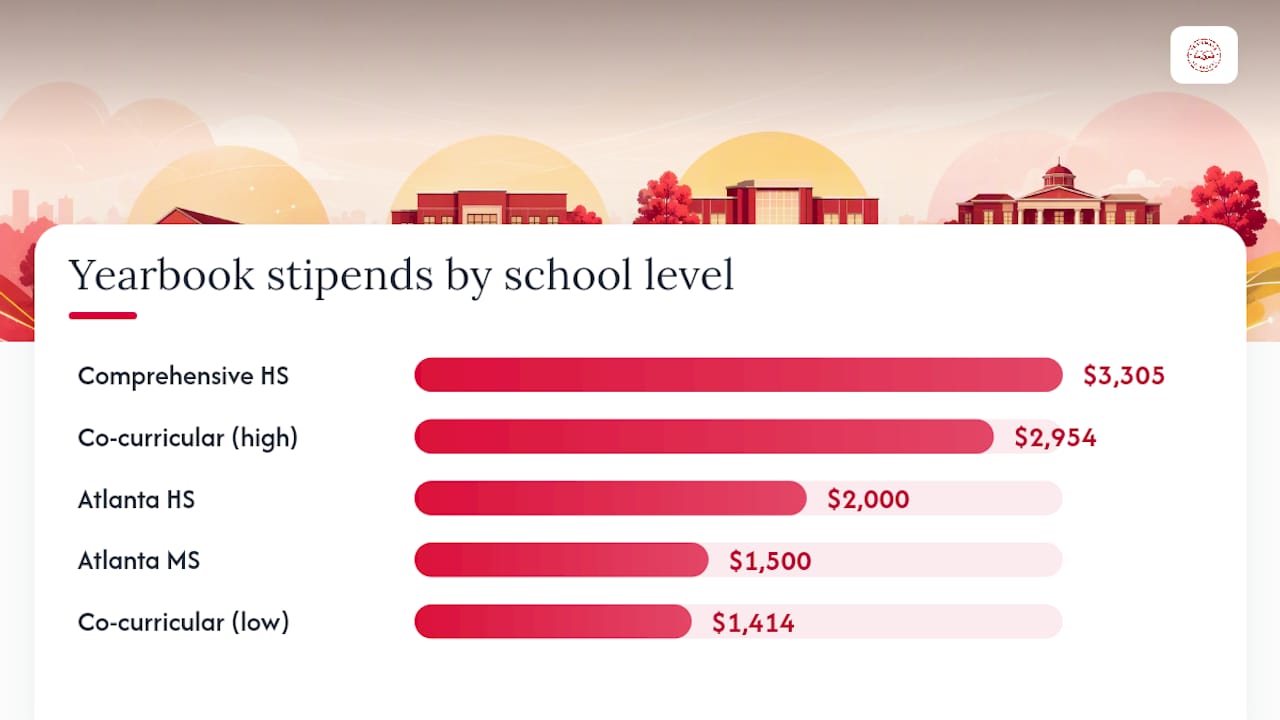
| District / Source | School Level | Stipend Amount |
|---|---|---|
| Atlanta Public Schools (2025–2026) | High School | $2,000 |
| Atlanta Public Schools (2025–2026) | Middle School | $1,500 |
| Sample Extra Duty Schedule | Comprehensive High School | $3,305 |
| Sample Extra Duty Schedule | Middle School | $2,754 |
| Sample Co-Curricular Posting | Yearbook Advisor (varies by level) | $1,414–$2,954 |
| Sample Contract Appendix B | Yearbook Advisor | $1,508 |
A few things to know when reading these schedules:
- Flat fee, not experience-based. Most districts assign a single stipend amount per role and school level without regard to individual experience.
- Annual adjustments are common. The extra duty schedule cited above notes that amounts may be adjusted annually, so last year's figure may not match this year's.
- Avoid salary aggregation sites. Generic job-title searches online often conflate K–12 stipend roles with postsecondary or administrative advising positions, producing inflated or irrelevant numbers. District schedules are the only reliable source.
Who sets stipend amounts and where you can find them
Stipend amounts are set through one of three channels: a collective bargaining agreement, a board-approved supplemental duty schedule, or a combination of both. The co-curricular posting format used by many districts is itself a board-approved document, typically updated each school year.
Here is where to look, in order of authority:
- Collective bargaining agreement (CBA) appendix. Look for "Appendix B," "Supplemental Pay," or "Extra Duty" in your union contract. A sample contract appendix shows exactly this format, with a "Yearbook Advisor $1,508" line item listed alongside other supplemental roles.
- Supplemental Duty Stipends Schedule (district PDF). Many districts post this as a standalone PDF on their HR or payroll page. Search the district website for "supplemental duty," "extra duty," or "co-curricular stipend."
- Board meeting minutes. If the schedule was recently updated, the board approval will appear in meeting minutes, often posted on the district's board page.
- HR or payroll office. If you cannot locate the document online, email HR directly and ask for the current "supplemental duty stipend schedule" or "co-curricular pay appendix."
- Your principal or department head. They often have the current schedule on file and can confirm whether the yearbook advisor role is listed.
Pro Tip: On a district PDF, use Ctrl+F (or Cmd+F on Mac) and search "yearbook" first, then "supplemental," then "advisor." Most schedules are alphabetical by activity, so the yearbook row is usually near the bottom.
What duties typically justify a yearbook advisor stipend
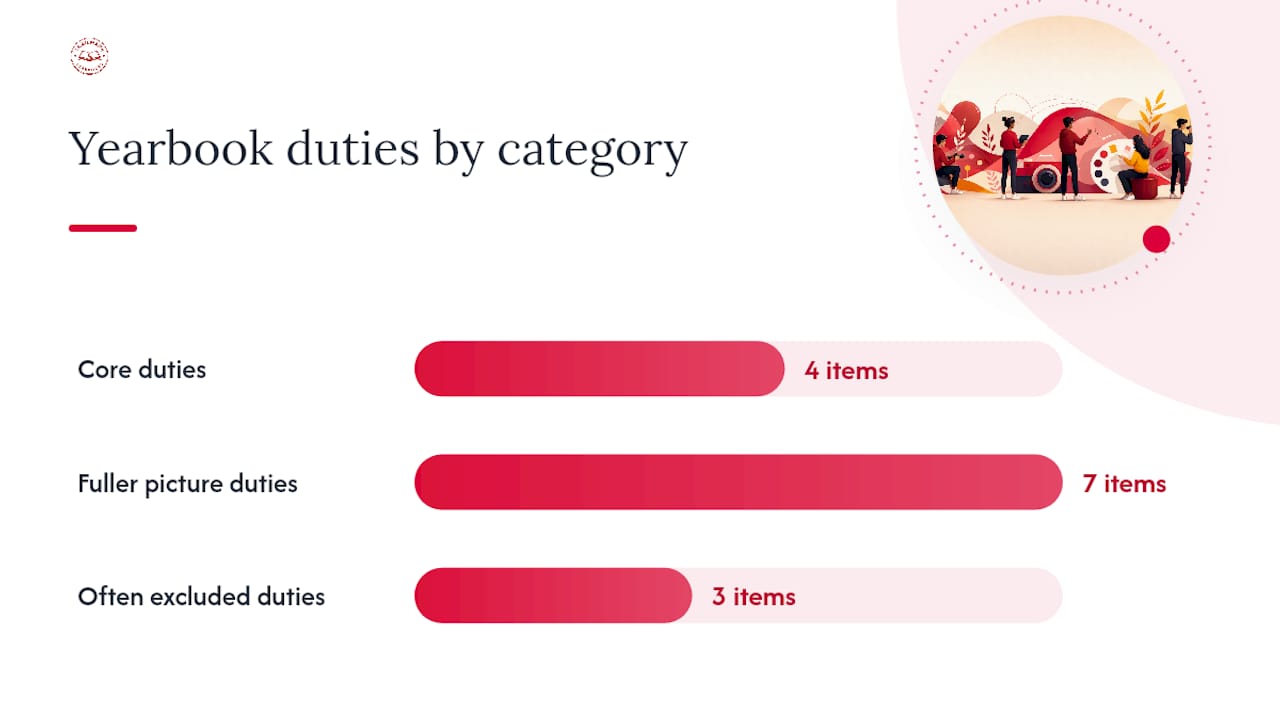
The Mesa School District yearbook advisor job description lists coordinating annual production, managing the publication's budget, overseeing design and layout, and meeting production deadlines as core duties. Those four items alone represent dozens of hours of work that fall outside the regular school day.
A fuller picture of what districts typically expect includes:
- Coordinating the full production timeline from theme selection through final delivery
- Supervising students during after-school work sessions and photo shoots
- Overseeing layout, caption editing, and page proofing
- Managing the yearbook budget and tracking sales revenue
- Liaising with the printer or yearbook vendor on specifications, deadlines, and corrections
- Handling distribution logistics and resolving order issues
- Recruiting and training student staff each year
A few items that districts may handle separately or exclude from the stipend scope:
- Professional photography services (often contracted independently)
- Paid student positions funded through activity accounts
- Graphic design work contracted to outside vendors
When you are documenting your duties for an administrator, a simple weekly log showing after-school hours spent on yearbook tasks is more persuasive than a general description. Tracking this with a yearbook deadline management checklist makes the documentation easier to compile and harder to dismiss.
How stipends are paid and what to expect at tax time
Most districts issue stipend payments in one of three ways: a single supplemental check at the end of the year, two or three installments tied to production milestones, or a prorated amount if the advisor does not complete the full year. District schedules frequently include proration language, and the extra duty schedule cited earlier notes that stipends may be adjusted based on service completion.
Key points on taxes and benefits:
- Stipends are taxable income. They appear on your W-2 as supplemental wages and are subject to federal and state income tax withholding, plus Social Security and Medicare.
- Withholding rate may differ. The IRS allows employers to withhold supplemental wages at a flat rate rather than the graduated rate applied to your regular paycheck. Your net check may look smaller than expected relative to the gross amount.
- Base salary is unaffected. Receiving a stipend does not move you up the salary schedule, change your step, or alter your retirement contribution base unless your CBA explicitly says otherwise.
- Retirement implications vary. Some state teacher retirement systems include supplemental pay in pensionable earnings; others do not. Check with your HR office or union rep before assuming either way.
Pro Tip: Ask HR whether your district uses the optional flat supplemental withholding rate or aggregates the stipend with your regular pay for withholding purposes. The answer affects how much you take home on that check.
How to request or confirm a yearbook advisor stipend
If you are new to the role, unsure whether your position is listed, or advising at a school where the stipend has never been formally requested, here is a practical sequence:
- Locate the official schedule. Pull the current CBA appendix or supplemental duty schedule from the district website or HR office before any conversation with your principal.
- Find the yearbook line item. Confirm the exact dollar amount and any conditions (school level, proration rules, service requirements).
- Document your duties and hours. Log after-school sessions, production meetings, printer calls, and distribution work for at least two to four weeks before making your request.
- Gather comparable district examples. If your district's amount seems low or the role is not listed, pull two or three published schedules from neighboring districts showing higher rates.
- Identify the right contact. Your principal approves the assignment; HR or payroll processes the payment. Your union representative can advise on whether the stipend is negotiable under the current CBA.
- Time your request to the budget cycle. Stipend schedules are typically set during spring budget planning for the following school year. A request made in February or March has a better chance of landing in the next schedule than one made in September.
Sample email you can adapt:
A few negotiation notes worth keeping in mind:
- If budget is the stated barrier, ask for release time, a supply budget, or vendor design support as an alternative.
- Bring your duty log and a yearbook adviser responsibilities overview to any meeting with administration.
- Your union association rep is a useful ally, especially if the stipend is covered under the CBA and has simply not been applied.
How to read a district stipend schedule
District stipend documents follow a fairly consistent format once you know what to look for. The most common types are Appendix B of a CBA, a standalone Supplemental Duty Stipends Schedule PDF, and a co-curricular or extra duty posting.
Steps to extract the relevant entry:
- Open the PDF and use the search function to find "yearbook."
- Note the column headers: most schedules list role name, school level (elementary, middle, high), and dollar amount. Some add a "points" or "units" column used in formula-based pay systems.
- Check for footnotes. Proration rules, annual adjustment language, and eligibility conditions are often in a footnote rather than the main table.
- Save or screenshot the specific row. That image is your documentation when communicating with HR.
Pro Tip: If the PDF is scanned and not searchable, look for an alphabetical index or table of contents. "Yearbook" typically falls near the end of an alphabetical list, after "Wrestling" or "Writing Club."
Common document names to search for on a district website:
- "Supplemental Duty Stipends Schedule"
- "Appendix B — Stipends"
- "Co-Curricular Posting"
- "Extra Duty Advisor Schedule"
- "Activity Pay Schedule"
When a stipend may not apply and what to request instead
Not every yearbook advisor receives a stipend, and there are legitimate structural reasons for that.
- The duty is embedded in a class period. If yearbook is a credited course on your schedule, the advising work is considered part of your teaching load, and a separate stipend may not exist.
- The role is volunteer-based. Small schools with tight budgets sometimes rely on volunteer advisors, particularly at the elementary level.
- The duty falls under a club stipend. Some districts pay a single flat "club advisor" stipend that covers all extracurricular roles, including yearbook.
- The position is split between two staff members. When duties are divided, neither person may meet the threshold for a full stipend.
When a cash stipend is not available, consider requesting one of these alternatives:
- Release time. One or two periods per week freed from other duties to work on yearbook during the school day.
- A supply or materials budget. A dedicated line in the activity account for software, printing proofs, or design tools.
- Grant-funded stipends. Some state arts or journalism education grants include advisor compensation.
- Vendor design support. A yearbook vendor that provides free design assistance and fast turnaround reduces the hours you need to commit, which can make an unpaid or low-stipend role more manageable. Flexible design tools that work with Canva or InDesign are worth factoring into any budget conversation.
- Paid student positions. Some districts allow activity account funds to pay student editors or photographers, reducing the advisor's direct workload.
A practical note on vendor support and unpaid advisor hours
The stipend conversation and the workload conversation are connected in a way that most advisors do not fully leverage. If you can show that your vendor handles design support, catches layout errors, and delivers books in two to three weeks rather than two to three months, the number of after-school hours you are logging drops. A lower documented hour count does not necessarily mean a lower stipend ask. It means you can make a cleaner, more credible case: here is what the role requires, here is what the vendor absorbs, and here is the remaining work that justifies the pay.
Vendor-provided tools also affect what alternatives are worth requesting. If your vendor already provides free design assistance and a resource hub for advisors, the "supply budget" ask becomes less urgent, and you can redirect that negotiating energy toward release time or a higher flat stipend. The adviser success playbook covers this kind of workload mapping in practical terms.
One caution: salary aggregation sites sometimes display figures for roles labeled "yearbook advisor" that reflect combined teaching positions or postsecondary roles. Those numbers are not comparable to a K–12 supplemental stipend. District schedules are the only authoritative source.
Trailmarkyearbooks reduces the hours behind your stipend request
Busy advisors spend the most unpaid time on production logistics: chasing layouts, correcting proofs, and managing printer timelines. Trailmarkyearbooks cuts that workload directly. With a 2–3 week turnaround, free design assistance, and flexible design options through Canva, InDesign, or an online creator, advisors spend fewer after-school hours on production and more time on the parts of the role they actually signed up for.

That matters for your stipend conversation, too. A cleaner, vendor-supported workflow gives you a more honest picture of what the role actually demands, which makes your documentation sharper and your ask more credible. Schools nationwide get instant all-inclusive pricing with no hidden fees and no sales pitch. Request a sample to see what a Trailmarkyearbooks production package looks like, or browse yearbook production services to get a real number for your school's size and needs.
Sources
When you are ready to verify your district's official stipend amount, these are the specific documents and search terms that will get you there fastest:
- Yearbook advisor job description (Mesa School District)
- Atlanta Public Schools — Supplemental Duty Stipends Schedule (2025-2026)
- APPENDIX B — Stipends (sample contract appendix)
Once you find the document, screenshot or save the specific row showing the yearbook advisor entry. That image is your reference point for every conversation with HR, your principal, or your union representative. The sample district figures cited throughout this article, including the $1,508 entry in a contract appendix and the $2,000 and $1,500 figures in Atlanta Public Schools' published schedule, show exactly the format you are looking for.
This article provides general information about yearbook advisor stipend structures in the United States. Stipend amounts, tax treatment, and eligibility rules vary by district and state. Confirm current figures and payroll practices with your district's HR office or your bargaining unit representative.
This article is general information, not a substitute for advice from a qualified financial advisor. Consult a qualified financial professional about your own circumstances before acting on anything here.