
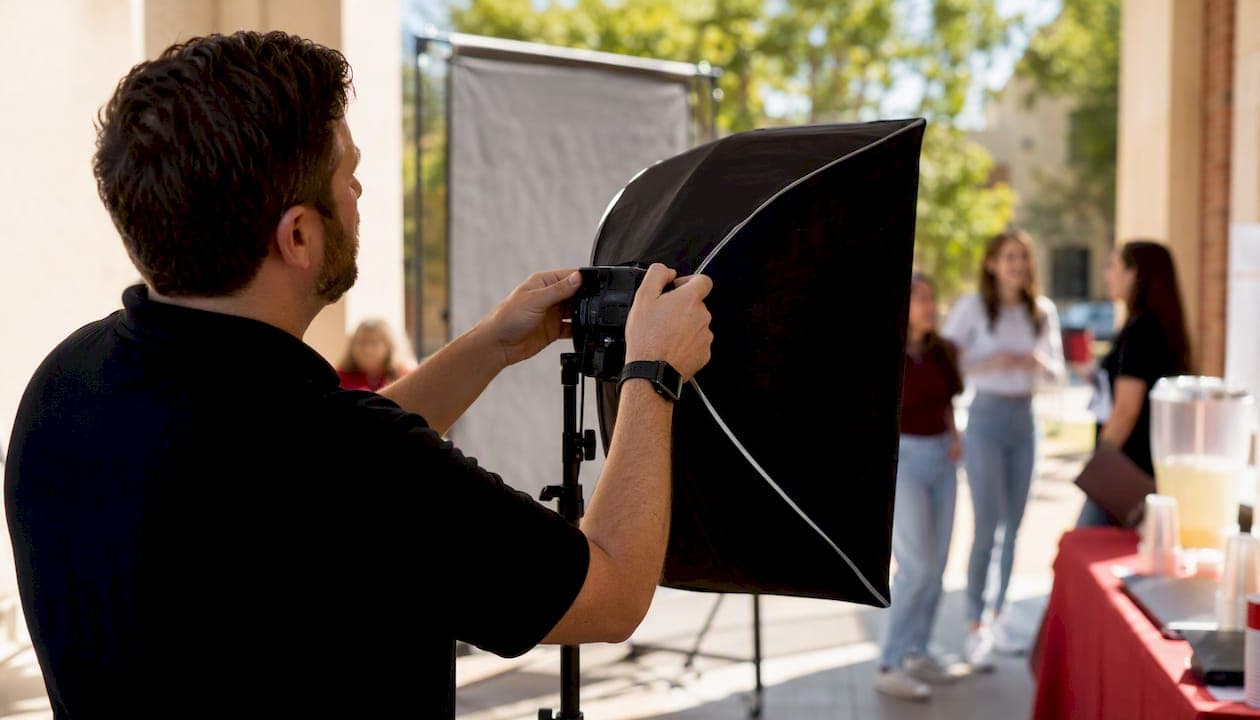
A third-party portrait vendor is an outside business hired to shoot and deliver portraits directly to your students, staff, or families under a written contract with the school. It's not a school employee, and it's not a raw-materials supplier. It's a company defined by a direct contractual relationship to provide a service on your organization's behalf, whether that's picture day at an elementary school or senior portraits for a graduating class.
Here's the bottom line if you're staffing a yearbook or running a portrait day: confirm license scope and model releases before you schedule a single shoot. Waiting until after the photos are taken to ask "wait, can we actually use these in the yearbook, on the website, and in the fall enrollment flyer?" is how schools end up scrambling for signatures in October.
Two things to request right now, before you sign anything:
- A sample license agreement the vendor has used with another school, so you can see the actual usage terms in writing.
- A blank model-release template showing exactly how they handle consent for minors, so you know who signs and what it covers.
Key Takeaways
A third-party portrait vendor operates under a written contract to shoot and deliver images directly to a school's families, and clear license scope determines whether those photos can legally be reused beyond the yearbook page they were taken for.
| Point | Details |
|---|---|
| Confirm the license scope first | Request a sample license before scheduling any shoot to see actual usage terms in writing. |
| Separate vendor and school duties | Vendors handle shooting and ordering; schools own data governance and campus access decisions. |
| Distinguish commercial from editorial use | Yearbook-only use differs legally from marketing or fundraising use of the same photo. |
| Run a formal RFP | Score vendors on quality, logistics, price transparency, and data security before signing. |
| Watch for contract silence | Missing model releases or vague data clauses are bigger risks than any single price difference. |
| Pair vendor photos with production support | Trailmarkyearbooks handles yearbook design and printing with instant pricing and free design help, separate from the portrait shoot itself. |
Table of Contents
- What Does a Third-Party Portrait Vendor Actually Do?
- Why Does Licensing Category Matter for Yearbooks?
- What Contract Clauses Should Schools Require From a Portrait Vendor?
- How Should Schools Run an RFP for a Portrait Vendor?
- What Are the Red Flags in a Portrait Vendor Contract?
- How Do You Keep a Portrait Vendor's Deliverables Yearbook-Ready?
- An Insider's View on Vendor Contracts
- A Simpler Path Than Managing Vendor Contracts Alone
- Sources
What Does a Third-Party Portrait Vendor Actually Do?
On a typical school portrait project, the vendor runs the parts that require photography equipment and a sales system with secured on-campus setup. The school runs the parts that require access, authority, and student data governance. Mixing those up, or assuming the vendor "handles everything," is where most contract disputes start.
Vendors generally own scheduling logistics, the physical shoot (backdrops, lighting, posing), the online ordering platform parents use to buy packages, and the production and shipping of prints or digital files. That's the customer-facing work. Suppliers, by contrast, hand over raw materials or components rather than managing an end-to-end service relationship, which is why a photo vendor and a paper supplier get very different contract clauses even though people sometimes lump both under "vendor."
Photographers themselves often use "vendor" more loosely, covering everyone from print labs to freelance assistants, according to discussions among working photographers. In a school contract, though, precision matters. Here's how responsibilities typically split:
| Responsibility | Vendor | School |
|---|---|---|
| Scheduling shoot dates and time slots | Yes | Provides campus access and calendar |
| On-campus setup and shooting | Yes | Provides space and supervision |
| Online ordering and payment platform | Yes | Communicates ordering window to families |
| Print/digital file delivery | Yes | Confirms file specs for yearbook use |
| Retake and refund policy | Sets policy in contract | Enforces communication to families |
| Student data protection | Shares responsibility | Owns final accountability |
That last row is the one schools underestimate. The moment a vendor collects names, grade levels, or contact information tied to a photo order, the school has taken on a data-handling obligation, even though a third party is doing the collecting. If your district has a data privacy officer or a policy for outside vendors, loop them in before the vendor's ordering platform goes live to families, not after.
Why Does Licensing Category Matter for Yearbooks?
Because "we hired a photographer" doesn't automatically mean "we can use these photos however we want." Licensing determines what you're allowed to do with the images the vendor captures, and yearbooks sit right at the edge of several usage categories most vendor contracts don't spell out clearly.
Commercial use covers anything that promotes, sells, or endorses the school, like a fundraising flyer, a homepage banner, or a paid enrollment ad. Editorial use covers documentary or newsworthy context, which is closer to what a yearbook traditionally does. Attorneys who work on this exact question note that commercial use of third-party photos requires a clear licensing agreement that spells out the difference, because blurring the two is a common source of liability when images later show up in marketing materials nobody cleared in advance.
Statistic to know: there's no universal industry standard percentage for how many school vendor contracts include commercial usage rights by default. What's consistent across attorney guidance is the principle: if the contract is silent on commercial use, assume you don't have it, and get it in writing before you reuse a portrait anywhere beyond the yearbook page it was shot for.
Before you sign anything, run through this model-release checklist:
- Confirm whether the school or the parent signs the release for a minor. Some vendors default to parent-only consent collected through their ordering site.
- Ask what happens to image data after the school year ends. Is it deleted, archived, or reused for the vendor's own marketing?
- Get written confirmation of sublicensing limits. Can the vendor use your students' portraits in their own promotional materials or portfolio?
- Check whether the release covers only the yearbook, or also the school website, social media, and printed enrollment materials.
A tight license scope should specify duration (one school year vs. perpetual), territory (this campus vs. the whole district), permitted uses (yearbook only vs. yearbook plus marketing), sublicensing or printing rights, and whether the vendor can retouch or alter images before delivery. Skip any one of those and you've got a document that reads like a contract but doesn't actually answer "can we use this photo in the spring newsletter?" The practical consequence of a vague license is simple: no clear grant of rights means limited legal ability to reuse student images anywhere outside the exact use the contract names.
What Contract Clauses Should Schools Require From a Portrait Vendor?
A portrait vendor contract is not a one-page invoice. It should read like any other service agreement your district signs, with specific, negotiated language rather than boilerplate the vendor copy-pastes for every client.
Nine clauses belong in every school portrait contract:
- License scope — exactly what the school can do with the images and for how long.
- Exclusivity — whether the vendor is the only photographer allowed on campus for the contract period.
- Indemnity — who's liable if a photo is misused or a release is missing.
- Data and privacy handling — how student names, grades, and contact data collected through ordering platforms are stored and protected.
- Delivery timelines — hard dates for proofs, retakes, and final files.
- Archival and retention — how long the vendor keeps files, and whether the school can request them later.
- Subcontracting and printing — whether a third-party lab handles the actual printing.
- Cancellation and retake policy — what happens if a shoot day is rained out or a student is absent.
- Fees and payment terms — who pays what, and when.
A workable indemnity clause might read something like: "Vendor shall indemnify and hold the School harmless from claims arising from Vendor's failure to obtain valid model releases prior to commercial use of any student image." A data clause could say: "Vendor shall not retain student contact information beyond 90 days following final delivery, except as required for warranty or reprint requests." Neither of those needs to be complicated. It needs to exist in writing, with specific numbers and named responsibilities instead of vague assurances.
The single most common gap in vendor contracts isn't malice, it's silence. A vendor rarely writes in "we can use your students' photos however we want." They just never write in that they can't.
Pro Tip: Push back on any indemnity clause that's one-directional. If the vendor wants the school to indemnify them for image misuse, ask for mutual indemnity language instead, so liability tracks who actually caused the problem, not who has the smaller legal budget.
How Should Schools Run an RFP for a Portrait Vendor?
Treat vendor selection the same way you'd treat any other institutional purchase over a few thousand dollars: with a formal comparison, not a handshake with whoever shot last year's photos. Schools that run this well typically source vendors through a Request for Proposal process, scoring candidates on capability, quality, and price rather than defaulting to whoever's available.
Your RFP should ask vendors to answer, in writing:
- Can you shoot on our campus on the specific dates we need, including makeup days?
- Can we see unedited sample work from a comparable school, not just a curated portfolio?
- What's your pricing structure, and who is billed, the school or individual families?
- What is your retake and refund policy if a student is unhappy with their portrait?
- What are your guaranteed delivery timelines for proofs and final files?
- How do you store and protect student data collected through your ordering platform?
- Do you subcontract printing or file processing to another company?
Score responses against a simple rubric so the decision isn't just gut feel:
| Criteria | What to Look For | Scoring Approach |
|---|---|---|
| Portrait quality | Consistency across unedited samples | 1 to 5 scale from actual sample sets |
| Logistics fit | Availability for your exact calendar | Pass/fail against required dates |
| Price transparency | Clear per-package pricing, no hidden fees | Compare total cost per family |
| Student experience | Wait times, retake process, comfort | Feedback from prior client schools |
| Data security | Written data-handling commitments | Pass/fail against a minimum standard |
Reference checks matter here more than most schools realize. One district's decision to replace a long-standing grad photography vendor came out of exactly this kind of formal evaluation, weighing price, campus availability, and retake policy side by side rather than renewing on habit.
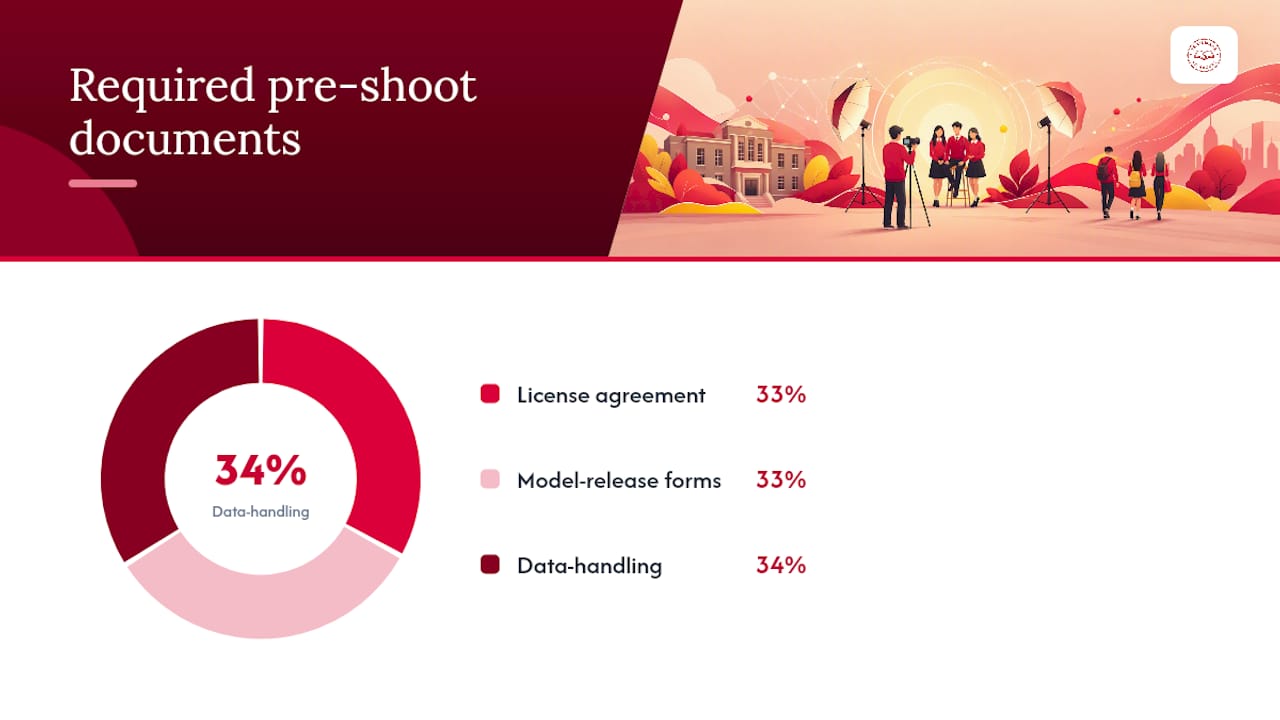
Before the first shoot day, collect three documents from your chosen vendor: the signed license agreement, completed model-release forms (or the process for collecting them), and a written data-handling agreement covering the ordering platform. If a vendor can't produce any of these on request, that's information too.
What Are the Red Flags in a Portrait Vendor Contract?
Most vendor disputes trace back to a handful of repeat offenders. Watch for these during contract review, not after the shoot.
- Ambiguous license language that never says "commercial use" or "editorial use" explicitly, leaving reuse rights open to argument later.
- Missing model releases for minors, or a release process that only captures parent email addresses without actual signed consent.
- Refusal to name subcontractors, especially printing labs, which matters if a data breach happens somewhere in that chain.
- No written data-security commitment for the ordering platform that collects student names and grade levels.
- Surprise exclusivity clauses that block the school from hiring any other photographer, even for events the vendor doesn't cover.
- Vague retake or refund policies that leave "unsatisfactory portrait" undefined.
Student images carry extra weight because minors can't consent for themselves, and federal frameworks like FERPA govern how schools handle education records, while COPPA governs data collection from children under 13 through online platforms. Neither law was written with yearbook vendors specifically in mind, which is exactly why vague contract language is risky: you're relying on the vendor's own data practices to stay compliant with rules the vendor didn't design your contract around. If a vendor's data agreement raises questions your business office can't answer confidently, that's the moment to loop in legal counsel, not after the ordering platform has already collected a semester's worth of family data.
If a vendor can't tell you in plain language who else touches your students' images, whether that's a subcontracted printer, a cloud storage provider, or a marketing team, you don't actually know where that data lives.
How Do You Keep a Portrait Vendor's Deliverables Yearbook-Ready?
The photos might be perfect and still be useless for the yearbook if the files don't match your layout software's specs. This is the operational detail that catches new advisers every fall.
Before shoot day, confirm these with the vendor:
- Shot list and background choices that match your yearbook's visual theme, agreed on before the vendor shows up.
- File format requirements (typically high-resolution JPEG or TIFF), specified in the contract, not assumed.
- Crop-safe margins so faces aren't cut off when portraits get dropped into a grid layout.
- Consistent naming conventions tying each file to a student ID or roster name, not a generic sequential number.
- Metadata standards so files can be sorted and matched to the roster without manual cross-referencing.
Build these specs directly into the contract's delivery clause, not a verbal understanding with the photographer on shoot day. A checklist for shoot-day coordination helps standardize this across grade levels, and understanding resolution requirements ahead of time saves you from finding out in February that half your portraits are too low-res to print at full page size.
Pro Tip: If you're switching vendors, run a small sample shoot with a single grade before committing to the full school. It's the cheapest way to catch file-format or workflow problems before they show up across 400 student portraits.
An Insider's View on Vendor Contracts
Every yearbook adviser I've talked to about vendor headaches describes the same pattern: the contract looked fine at signing, and the gaps only showed up months later when someone asked "can we use this photo for the spring open house flyer?" and nobody could answer with certainty. Clear licensing isn't paperwork for paperwork's sake. It's the difference between reusing a great photo confidently and quietly hoping nobody asks questions.
If you're switching vendors, the single best move is running a compact transition timeline: notify the outgoing vendor early, get the new vendor's sample shoot scheduled well before the real shoot day, and communicate the change to families in writing so nobody's confused about who to contact for retakes. Objective evaluation of logistical fit during that transition period matters more than almost anything else, because a vendor switch that goes smoothly operationally usually goes smoothly contractually too.
A Simpler Path Than Managing Vendor Contracts Alone
Everything above, RFPs, license scopes, model releases, file specs, exists because portrait vendors and yearbook production are often handled as two separate relationships with two separate contracts to track. Trailmarkyearbooks removes one whole layer of that complexity by pairing yearbook production with straightforward, all-inclusive pricing you can see instantly online, no sales calls, no hidden fees, and shipping included.

That matters most in the file-delivery stage, where a portrait vendor's specs and your yearbook layout software need to match up cleanly. Trailmarkyearbooks doesn't replace your portrait photographer, it's the production partner that turns whatever images you've gathered into a finished book, with free design help and flexible tools whether your staff works in Canva, Adobe InDesign, or the built-in online creator. Turnaround runs 2 to 3 weeks with no order deadlines hanging over your team.
If you want to see the print quality before committing your school's yearbook to any provider, request a free sample or check instant pricing on the product page to compare against what you're currently paying for design and printing separately.
Sources
- What is a third-party vendor? (UpGuard blog)
- School photography RFP template (Capturely)
- Supplier vs vendor: what's the difference? (Enable)
- What You Need to Know About Business Use of Third-Party Photos – Part 1 (Bricker & Eckler LLP)
This article is general information, not a substitute for advice from a qualified lawyer. Consult a qualified legal professional about your own circumstances before acting on anything here.